Final Expense Pay Per Call: How to Sell and Route Calls
Final expense pay per call guide for 2026: how inbound calls and live transfers are qualified, routed to licensed agents, and billed without refund fights.

Rafael Hernandez
Founder & CEO
Ex-Microsoft SWE · $10M+ PPL ad spend
I hope you enjoy reading this blog post. If you want to try Lead Distro AI for free, click here.
Author: Rafael Hernandez | Founder & CEO of Lead Distro AI
Final expense pay per call is the model where an operator generates a live phone call from a senior shopping for a small burial or funeral life insurance policy, then sells that call to a licensed agent or agency that pays only when the call clears an agreed quality bar. The caller is already on the line, so the buyer skips the callback race that shared form leads create. That makes final expense pay per call one of the most reliable products in insurance.
The market behind it is real. According to the Life Insurers Council and LIMRA, U.S. final expense new annualized premium rose 16% year over year to $1.05 billion in 2024, across 1.06 million policies reported by 28 companies. That is a sample of carriers, not the whole market, but it shows steady demand from buyers who need calls.
This guide is the call-model companion to our final expense lead generation guide. It covers how final expense inbound calls and final expense live transfers differ, what makes a call billable, how to route calls to agents by state, and how to keep compliance and billing clean. You can start a free trial of Lead Distro AI to set up the routing as you read.
Key Takeaways
- Final expense pay per call bills the buyer for a qualified call, not a form fill. The call has to connect, last long enough, and match the buyer's rules before it counts.
- Inbound calls and live transfers are two products. In an inbound call the consumer dials your number. In a live transfer a call center qualifies the consumer first and then connects them to the agent.
- State licensing decides who can take the call. An agent can only sell to residents of states where they are licensed, so state and ZIP routing protects both the buyer and your reputation.
- Quality rules protect margin. A minimum call duration, duplicate caller detection, and rule-based call scoring cut the junk calls that cause returns.
- Compliance sits on top of the model. TCPA consent, agent licensing, and recording laws apply, so confirm your scripts and flows with counsel.
- Call tracking is usage-based. You pay a per-number monthly fee plus a per-minute inbound rate on top of the $297 per month Starter plan.
What Final Expense Pay Per Call Means
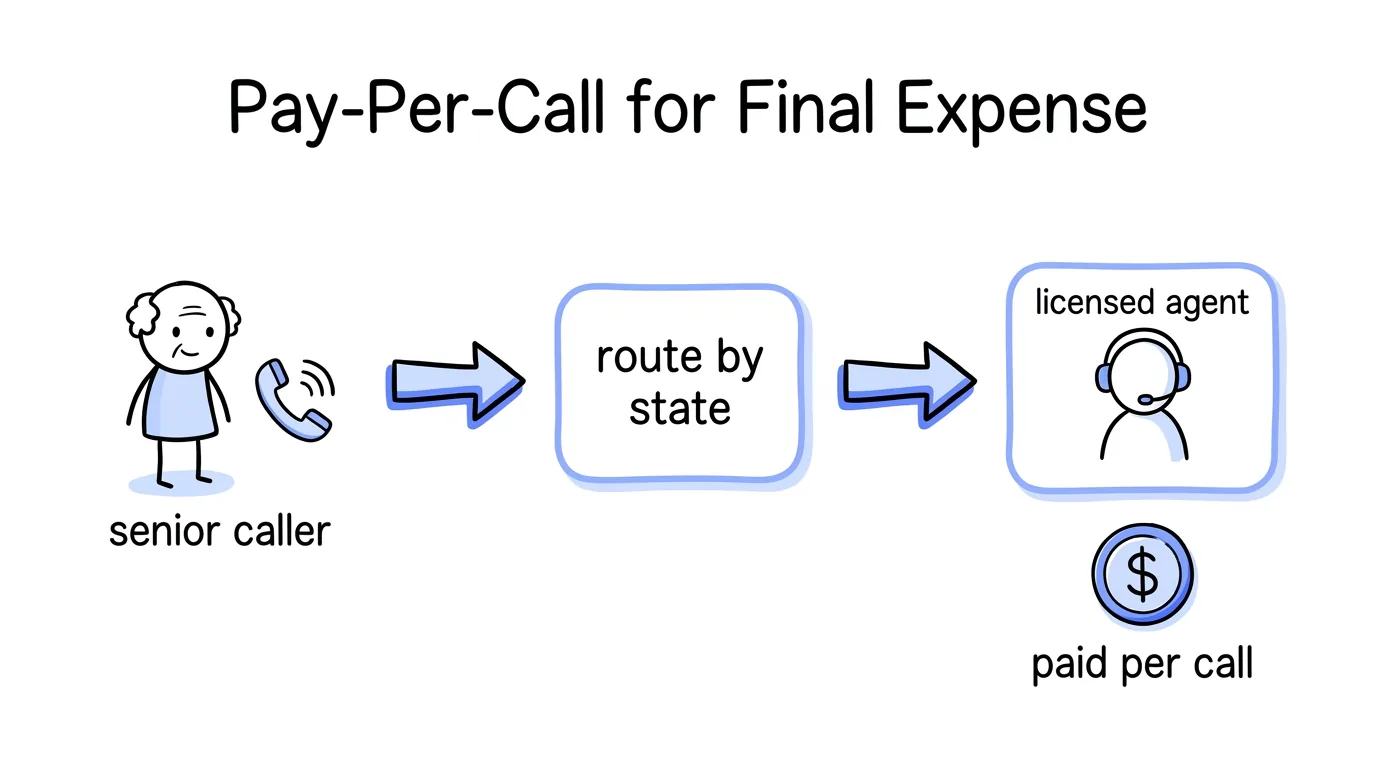
Final expense pay per call sits between a traffic source and an insurance agent. The operator runs ads, TV, search, direct mail, or a call center, and a call tracking platform assigns a unique tracking number to each source. When a senior dials, the platform records the call, measures its length and outcome, and routes it to a buyer who has agreed to pay for calls that meet set rules.
There are two common ways the call reaches the buyer:
- Final expense inbound calls. The consumer sees an ad and dials the tracking number themselves. The call goes straight to the buyer, often after a short keypad menu.
- Final expense live transfers. A call center or publisher speaks with the consumer first, confirms age, state, and interest, and then warm-transfers the call to the agent.
Inbound calls depend on your ad quality. Live transfers cost more to produce but arrive pre-qualified. Both bill the same way: as a call that passes a duration and rules check. For the form-lead side, read the final expense leads guide.
Why Final Expense Callers Convert
Final expense calls convert because the caller is deciding about a real, near-term need. These buyers are usually seniors who want a small policy so their family is not left with the bill, and the numbers behind the product are small. In the same Life Insurers Council and LIMRA survey, 85% of reported sales were simplified-issue policies with an average face amount of $14,535, and the other 15% were guaranteed-issue policies with an average face amount of $9,786.
The cost they are planning for is also concrete. The National Funeral Directors Association reported a median of $8,300 for a funeral with viewing and burial in 2023, as cited by Progressive. A caller who knows that number is not browsing.
Small face amounts also explain why buyers are strict. A thin policy leaves little room for wasted calls, so agents judge every source on cost per sale. Per the same survey, 86% of reported policies came through independent distribution, so most final expense call buyers are independent agents and agencies who compare sources constantly and move volume to whoever sends clean calls.
Final Expense Pay Per Call Pricing: What a Call Is Worth
Price per call varies too much by source, state mix, call length, hours, and exclusivity for one number to be honest. We will not quote a flat price, and you should be wary of anyone who does without a source. Set price from your buyer's math instead.
Here is a hypothetical example with round numbers, not market data. Say a buyer pays $50 for each billable call and sells a policy on 1 call in 5. Their cost per sale from calls is $250. If an average first-year commission does not clear that with room to spare, they will cut your bid or leave. If the same buyer pays $50 but your source delivers 1 sale in 8 calls, cost per sale jumps to $400.
Quality filters matter more than headline price. Run your own numbers in the lead pricing calculator before you agree to a rate, and ask each buyer for their real close rate.
| Factor | What it does to call value |
|---|---|
| Live transfer vs inbound | Pre-qualified transfers usually earn a higher payout per call |
| Exclusivity | A call sold to one buyer is worth more than a shared one |
| Call length | Longer connected calls show real conversation |
| State and hours | Calls routed to a licensed, available agent are more likely to close |
How Buyers Qualify Final Expense Calls
A call earns its price by passing filters before and during the conversation. Lead Distro AI supports several of them, and you can stack them.
IVR qualification. An interactive voice response (IVR) is a keypad menu that asks the caller a few questions before the call connects. For example, you can ask the caller to press 1 if they are shopping for coverage for themselves. Callers who fail the menu never reach the buyer, so no one pays for them.
Minimum call duration. Set the number of seconds a call must last before it is billable. A ten-second hang-up should not cost the buyer anything, and a minimum duration makes that automatic.
Duplicate caller detection. If the same number calls repeatedly, the platform can flag it so a buyer is not billed twice for one person.
Rule-based call scoring. You write rules describing what a good caller is, such as right state, real interest in coverage, and the right person on the line. The platform scores each call against those rules, so you can see which sources send good callers and which do not.
Call recording. Recordings give you proof when a buyer disputes a call. Recording laws differ by state, so check the rules for the states you serve.
Routing Final Expense Pay Per Call Volume to Licensed Agents
Routing decides which buyer gets which call, and in insurance it starts with geography. An agent can only sell policies to residents of states where they hold a license, so a call from the wrong state is worthless to them. Geographic routing by state or ZIP sends each call only to buyers who can take it.
Buyers also set hours and caps. A buyer who works nine to five Central should not receive calls at midnight, and an agent who can handle only a set number of calls a day should stop receiving them after that. Lead Distro AI enforces buyer hours and caps, then falls through to the next eligible buyer.
You pick how the remaining buyers share calls:
- Round Robin rotates calls evenly across eligible buyers.
- Weighted sends a larger share to the buyers you choose.
- Priority/Waterfall offers each call to your first-choice buyer, then the next if they decline or hit a cap.
- Ring tree rings several targets in a set order until one answers.
- Real-time bidding (RTB) for calls lets buyers bid on a call as it arrives so the highest bid wins.
RTB suits operators with many final expense call buyers competing for the same volume. Waterfall suits a smaller book with one favorite buyer. You can watch these methods work in the product tour, and the broader pay-per-call for insurance guide shows how they apply across other insurance lines.
Compliance for Final Expense Pay Per Call
Final expense is regulated, so treat compliance as part of the product. This section is general information, not legal advice. Confirm your setup with counsel.
TCPA consent. The Telephone Consumer Protection Act (TCPA) governs telemarketing calls and texts to consumers. A call the consumer places to you is different from a call someone places to them, but live transfers and follow-up dials often involve outbound contact. Prior express written consent is defined in federal rules as a written agreement bearing the signature of the person called (47 CFR 64.1200, via Cornell Law School). The same rule bars telephone solicitations to residential subscribers before 8 a.m. or after 9 p.m. local time.
The one-to-one consent rule. On January 24, 2025, the Eleventh Circuit held in Insurance Marketing Coalition v. FCC that the FCC's one-to-one consent rule exceeded the agency's authority and vacated it (Reed Smith). Many buyers and some states still ask for seller-specific consent, so check each buyer's terms.
Agent licensing. The agent on the phone must be licensed to sell insurance in the caller's state. Build state routing around that fact, and confirm each buyer's licensed states before you send them calls.
Recording. Some states require every party on a call to agree to recording. Use a clear recording notice.
Our Medicare pay-per-call guide shows a vertical with extra rules on top of the TCPA.
Billing, Returns, and Profit
Most disputes in pay per call come from calls the buyer says were not good. The fix is to agree on the billable rules up front and let the platform apply them. A call is billable only if it passes the minimum duration and your quality rules, and anything that fails is simply not billed.
Lead Distro AI handles buyer billing and returns in the same place as routing, so a returned call is credited against the buyer's balance with the call recording and score attached as proof. Real-time P&L reporting then shows revenue, cost, and margin by source, by buyer, and by campaign.
That visibility lets you cut a losing source fast. If a source sends calls that score poorly and get returned often, you see it in days, not at month-end. If you are still building the business, the guide to starting a pay-per-call agency walks through the operating model, and the insurance vertical page shows how the platform fits insurance workflows.
FAQ
What is final expense pay per call?
Final expense pay per call is a buying model where an operator sends a live phone call from a senior shopping for burial or funeral insurance to a licensed agent, and the agent pays only if the call meets agreed rules such as minimum duration and correct state. The call can be an inbound call the consumer dials or a live transfer from a call center. Billing is per qualified call, not per form submission.
What is the difference between final expense inbound calls and live transfers?
Final expense inbound calls come from consumers who dial a tracking number after seeing an ad, so they go directly to the buyer. Final expense live transfers are calls where a call center or publisher first speaks with the consumer, confirms details like age and state, and then connects them to the agent. Transfers usually cost more to produce but arrive pre-qualified, while inbound calls depend on ad quality and filters.
How do final expense call buyers decide what to pay?
Final expense call buyers work backward from cost per sale. They estimate how many calls it takes to sell one policy, multiply by the price per call, and compare the result to their commission. Source quality, state mix, exclusivity, and call length all shift that math. Ask each buyer for their target cost per sale, then use that number to set your price and filters rather than copying a market rate.
What compliance rules apply to final expense calls?
Telemarketing calls and texts fall under the TCPA, which requires prior express written consent for certain automated or prerecorded contact and bars solicitations before 8 a.m. or after 9 p.m. local time. The agent must also be licensed in the caller's state, and recording laws vary by state. The FCC's one-to-one consent rule was vacated in January 2025. This is general information, not legal advice, so confirm your setup with counsel.
How does Lead Distro AI route and bill final expense calls?
Lead Distro AI routes each call by state or ZIP, buyer hours, and caps, then applies Round Robin, Weighted, Priority/Waterfall, ring tree, or real-time bidding. It enforces a minimum call duration, detects duplicate callers, scores calls against your rules, and records them. Billing and returns run per buyer, with real-time P&L. The Starter plan is $297 per month with a 7-day free trial, and call tracking is usage-based on top.
Conclusion
Final expense pay per call works when three things line up: calls from real seniors, routing to agents licensed in the caller's state, and billing rules both sides accept before the first call. Final expense pay per call rewards operators who do not chase the highest price per call. They filter hard, route by state and hours, and watch cost per sale for their buyers. Start with one source and one buyer, then add more once the numbers hold.
When you are ready to build it, start your free 7-day trial of Lead Distro AI and set up your first tracking number, IVR menu, and routing rules.
Ready to route your first final expense call? Start your 7-day free trial and set up call tracking, state routing, and buyer billing in one place.
About the Author
Founder & CEO of Lead Distro AI & Great Marketing AI
UC Berkeley graduate and former software engineer at Microsoft. Rafael built Lead Distro AI after managing over $10M in ad spend for performance marketing agencies (pay-per-lead and pay-per-call), including running campaigns for Neil Patel. He combines deep software engineering expertise with hands-on performance marketing experience to build tools that help these agencies scale profitably.
About Lead Distro AI
Capture, Route, and Sell Every Lead, Call, and Appointment
Capture, route, and sell leads, calls, and appointments from one platform, with funnels, call tracking, ping-post, and billing built in. Set it all up in minutes by chatting with AI.
Funnels
Quiz, form, appointment, VSL, and webinar templates
Call Tracking
Tracking numbers, call recordings, and per-call billing
4 Distribution Methods
Priority/Waterfall, Round Robin, Weighted, Ping-Post
Ping-Post and Live Bidding
Sell each lead and call to the highest bid
Real-Time P&L
Revenue, cost, and profit per campaign
Partner Portal
Your Destinations see their own leads and results