Pay-Per-Call for Water Damage: Selling Restoration Calls
Water damage pay per call guide for 2026: how emergency restoration calls work, why insurance claims shape their value, plus routing, filtering and billing.

Rafael Hernandez
Founder & CEO
Ex-Microsoft SWE · $10M+ PPL ad spend
I hope you enjoy reading this blog post. If you want to try Lead Distro AI for free, click here.
Author: Rafael Hernandez | Founder & CEO of Lead Distro AI
Water damage pay per call is a buying model where a restoration company pays for a live inbound call from a property owner with a flood, leak, or burst pipe, and only when that call is qualified and connected. It fits restoration better than almost any other home service. The caller has standing water in the house, the clock is running, and the hiring decision happens in minutes, not days.
According to the Insurance Information Institute (Triple-I), water damage and freezing made up 22.6% of homeowners insurance losses incurred in 2023. This guide is for operators who generate water damage calls and for the restoration companies that buy them. It covers what makes these calls valuable, how to route them around the clock, and how to filter and bill them. If you want to see routing and billing in a live account first, start a free 7-day trial of Lead Distro AI.
Key Takeaways
- Urgency is the defining trait. A caller with active water in the building wants a crew now, so a live call is worth more than a form that waits in a queue.
- Insurance shapes the value. Water damage and freezing are a major homeowners claim category, so many restoration jobs are paid through a claim, and a caller who says they plan to file is a different lead from a tire-kicker.
- Surges follow weather. Hard freezes and storms bunch
water damage restoration leadsinto a few days, so static call caps either strand demand or send calls to crews that are already full. - Routing must run 24/7. A midnight call that rings out is a lost job, so buyer hours, priority order, and fallback buyers matter more here than in a nine-to-five trade.
- Call tracking is usage-based. A per-number monthly fee plus a per-minute inbound rate sits on top of the $297 per month Starter subscription, so model your numbers and minutes before you scale.
What Water Damage Pay Per Call Means for Restoration
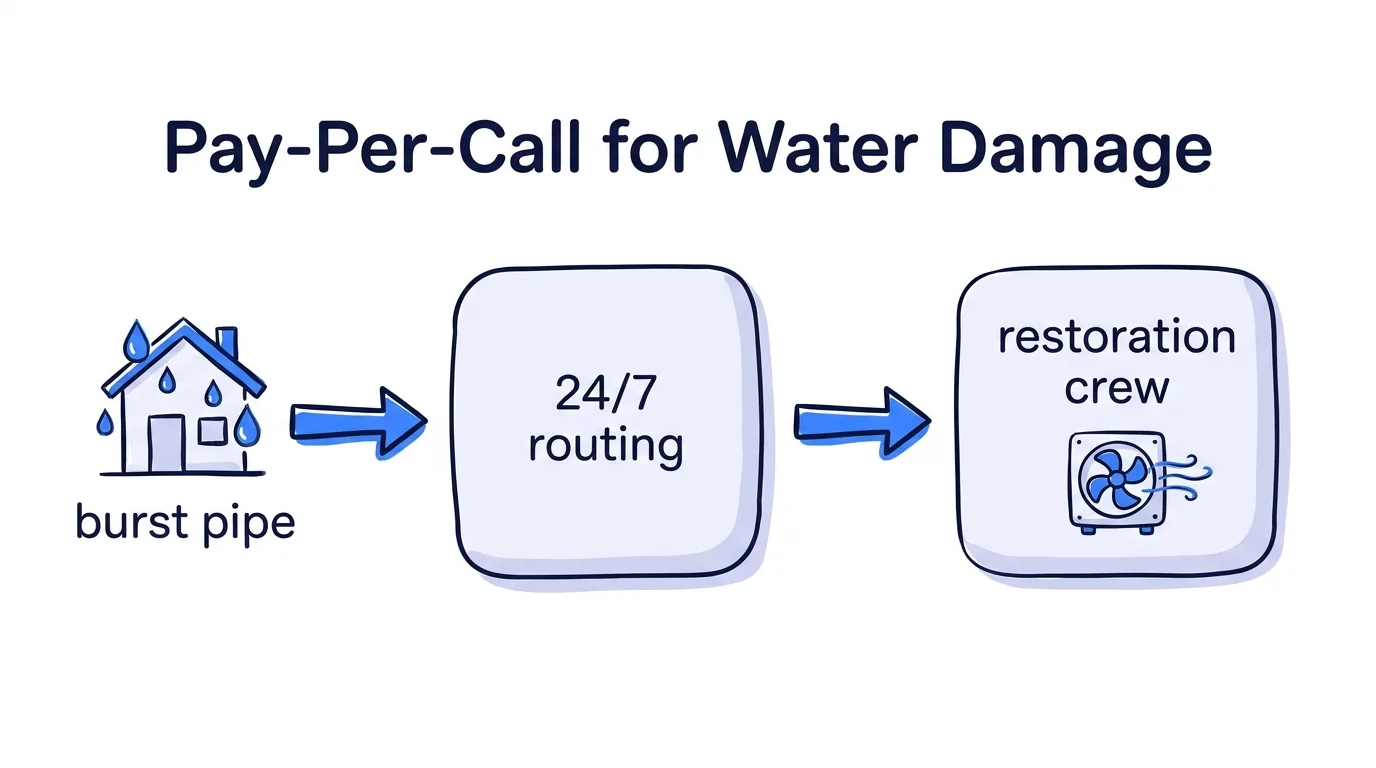
A publisher generates calls through search ads, Local Services Ads, SEO, or call placements, assigns a unique tracking number to each source, and sells the connected call to a restoration company. The platform records the call, measures its length, and bills the buyer only when the call clears the rules you set. A ten-second hang-up costs the buyer nothing.
Restoration work is different from repair work. A plumber stops the leak. A restoration crew handles what follows: water extraction, structural drying, mold prevention, and often the insurance paperwork. That makes restoration call buyers a distinct group with their own capacity limits, service areas, and truck schedules. A platform like Lead Distro AI's pay-per-call distribution sits between the traffic and those buyers. It scores each call, applies the buyer's hours and caps, and sends it to the next crew that can actually roll a truck.
What a Water Damage Call Is Worth
The value of a restoration call comes from the job behind it, and the job is often paid by an insurer. Triple-I reports an average severity of $15,400 per homeowners claim for water damage and freezing, a weighted average for 2019 to 2023. That figure covers the whole claim, not only the restoration invoice, but it shows the scale of money these claims move. Triple-I also reports that about one in 60 insured homes had a property damage claim caused by water damage or freezing each year from 2018 to 2020.
Those facts explain why buyers pay more for a qualified call than for a form. We do not quote a single price range here, because per-call payouts for water damage restoration leads vary by market, exclusivity, and job type, and no public price source is reliable enough to cite. Negotiate each rate with your buyers, then use the lead pricing calculator to compare the cost of a call against the value of a booked job.
24/7 Emergency Intent: Why Water Damage Pay Per Call Wins
The EPA says it is important to dry water-damaged areas and items within 24 to 48 hours to prevent mold growth, and that wet materials dried in that window usually do not grow mold (see the EPA guide to mold, moisture and your home). A caller who has read that advice does not wait for an email reply.
This is why water damage pay per call beats shared leads. A form sold to four companies starts a callback race that the buyer often loses, because the homeowner has already hired whoever answered first. A live call reaches one buyer with the owner still on the line. Your job as the operator is to make sure that buyer is awake, in the right area, and under cap. An IVR (keypad menu) can qualify the caller first by asking whether water is still entering the property.
Storm and Freeze Surges Break Static Call Caps
Water damage demand is not smooth. A cold snap bursts pipes across a region in one night, and a storm floods basements in an afternoon. Calls arrive in a spike, then drop.
That pattern breaks a flat daily cap. Set it low and you turn away water damage calls when they are worth the most. Set it high and you send a flood of calls to a crew that is already booked for days. The fix is to treat caps as live settings. Lead Distro AI lets you set caps and buyer hours per buyer, so you can raise a cap for the crew that added trucks and lower it for the one that is full. Pair that with a second buyer behind the first in a priority order, so overflow lands somewhere useful.
After-Hours and Service-Area Routing
Restoration buyers rarely staff the same hours. One company runs a 24-hour dispatcher, another answers until 6 p.m. and uses an answering service after that. Buyer hours let you describe each schedule, and Priority/Waterfall routing sends the call down a ranked list until a buyer accepts. A ring tree can try several phones at one company before the call moves on.
Geography matters just as much. A crew only profits on calls it can reach quickly, so geographic routing by state and ZIP code must gate every call before it connects. Then choose a distribution method to fit your buyer mix:
- Round Robin spreads calls evenly across crews with similar capacity.
- Weighted favors the buyer with the best close rate.
- Priority/Waterfall keeps your best buyer first and falls back in order.
- Real-time bidding (RTB) lets buyers compete for each call, so the highest bidder in that ZIP wins it.
The Plumbing-to-Restoration Overlap
Water damage sits next to plumbing. The same burst pipe that produces a call for a plumber also produces a call for a restoration company, and a customer often needs both. If you already sell plumbing calls, you know the pattern. Our guide to pay-per-call for plumbing walks through it.
The difference is the buyer and the job. A plumber is paid to fix the pipe. A restoration company is paid to dry the structure and, in many cases, deal with an insurer. So the keyword, the ad copy, and the screening questions change. A caller who says "my basement flooded and I need it dried out" belongs with a restoration buyer. Keep the two as separate campaigns, with separate tracking numbers, so each buyer pays only for calls that match what they sell.
For a wider view of how the other trades compare, read the pay-per-call by vertical guide and the home services vertical page.
Filtering, Scoring, and Billing Restoration Calls
Filtering is what keeps a restoration program profitable. Four controls do most of the work:
- Minimum call duration. A call becomes billable only after it stays connected for the time you set, which screens out wrong numbers and hang-ups.
- Duplicate caller detection. A homeowner who calls three numbers from the same ad cannot bill three buyers for one job.
- IVR qualification. A short keypad menu confirms the caller has a water problem now and is in your service area.
- Rule-based call scoring. You write rules about what a good caller looks like, such as an active loss, a property the caller owns, or a request for same-day service, and the platform scores each call against them.
Call recording settles disputes with evidence. Buyer billing and returns handle credit-backs, and real-time P&L reporting shows margin by source. Call tracking is usage-based, with a per-tracking-number monthly fee and a per-minute inbound rate on top of the Starter subscription, so model both before a ramp. Our guide to starting a pay-per-call agency covers the business model.
Comparison Table: Restoration Lead Types
| Lead type | Intent | Speed to contact | Exclusivity | Best for |
|---|---|---|---|---|
| Live pay-per-call | Highest, caller is on the line | Instant | Exclusive to one buyer | Crews with 24/7 dispatch |
| Exclusive form lead | High | Depends on callback | Exclusive | Buyers with a fast call team |
| Shared form lead | Mixed | Callback race | Sold to several buyers | High-volume buyers who tolerate losing races |
FAQ
What is water damage pay per call?
Water damage pay per call is a model where a restoration company pays for a live inbound call from a property owner with a leak, flood, or burst pipe. The buyer pays only when the call connects and clears a minimum duration and any quality rules you set. It differs from a shared web form because the owner is already on the phone with one buyer, which matters when water is spreading and every hour raises the damage.
How much do water damage calls cost?
Prices for water damage calls vary by market, exclusivity, and job type, and we have not found a reliable public price source, so treat any range you see as a planning figure. For context, Triple-I reports an average severity of $15,400 per homeowners claim for water damage and freezing over 2019 to 2023. Agree a rate with each buyer, then compare it with booked-job value in a pricing calculator before you commit.
How do you route water damage restoration leads after hours?
Set each buyer's hours, then use Priority/Waterfall routing so a call that arrives at midnight moves down a ranked list until a buyer answers. A ring tree can try several phones at one company first. Add a fallback buyer who staffs overnight, and apply ZIP-based geographic routing so the call only goes to crews that can reach the property. The goal is that no emergency call rings out to voicemail.
Do restoration call buyers pay for every call?
No. A well-run program bills only calls that meet your rules. You set a minimum call duration before a call is billable, use duplicate caller detection to stop repeat billing, and can score each call against rules you write about what a good caller is. Calls that fail can be returned through buyer billing and returns. This keeps restoration call buyers confident they pay for real prospects, not hang-ups.
Does Lead Distro AI charge per call?
Call tracking on Lead Distro AI is usage-based: a per-tracking-number monthly fee plus a per-minute rate for inbound calls, layered on top of the Starter subscription at $297 per month. You can estimate the total from your number count and expected call minutes before you scale a campaign. A 7-day free trial is available, so you can test routing, caps, and billing on real calls before you commit to a plan.
Conclusion
Water damage pay per call works because the caller cannot wait. Water spreads, the EPA drying window is 24 to 48 hours, and an insurance claim often sits behind the job. That mix rewards operators who route fast and buyers who answer fast. Qualify the caller with an IVR, score the call against your rules, gate it by ZIP code and buyer hours, and bill only what clears your duration bar. Then keep caps flexible so a storm or freeze helps you instead of overloading your best crew.
To see these controls on real traffic, start your free 7-day trial or take the product tour. Read the plumbing guide next if you also sell burst-pipe calls.
Ready to route every water damage call before the next freeze or storm hits? Start your free 7-day trial and route your first live call in minutes.
About the Author
Founder & CEO of Lead Distro AI & Great Marketing AI
UC Berkeley graduate and former software engineer at Microsoft. Rafael built Lead Distro AI after managing over $10M in ad spend for performance marketing agencies (pay-per-lead and pay-per-call), including running campaigns for Neil Patel. He combines deep software engineering expertise with hands-on performance marketing experience to build tools that help these agencies scale profitably.
About Lead Distro AI
Capture, Route, and Sell Every Lead, Call, and Appointment
Capture, route, and sell leads, calls, and appointments from one platform, with funnels, call tracking, ping-post, and billing built in. Set it all up in minutes by chatting with AI.
Funnels
Quiz, form, appointment, VSL, and webinar templates
Call Tracking
Tracking numbers, call recordings, and per-call billing
4 Distribution Methods
Priority/Waterfall, Round Robin, Weighted, Ping-Post
Ping-Post and Live Bidding
Sell each lead and call to the highest bid
Real-Time P&L
Revenue, cost, and profit per campaign
Partner Portal
Your Destinations see their own leads and results