Final Expense Leads: How to Buy, Distribute, and Convert Them in 2026
Complete guide to final expense leads for agencies: types, pricing, TCPA compliance, ping-post workflows, and how lead distribution software maximizes contact rates.

Rafael Hernandez
Founder & CEO
Ex-Microsoft SWE · $10M+ PPL ad spend
I hope you enjoy reading this blog post. If you want to try Lead Distro AI for free, click here.
Author: Rafael Hernandez | Founder & CEO of Lead Distro AI
Final expense leads are one of the most consistent revenue sources in the pay-per-lead and pay-per-call insurance market. The final expense life insurance industry covers adults aged 50 to 85 who want a small whole life policy, typically $5,000 to $25,000, to cover burial and end-of-life costs. According to LIMRA, over 100 million Americans are underinsured or uninsured for final expense coverage, creating a buyer pool that does not shrink. Law of large numbers: the target demographic is growing, premiums are small enough to convert in a single call, and agents pay $15 to $65 per exclusive real-time final expense lead. For pay-per-lead agencies and lead brokers, the vertical offers high daily volume, nationwide reach, and buyers ready to act.
The challenge is not finding demand. It is sourcing high-quality final expense leads, routing them to the right agent before the lead goes cold, and staying TCPA-compliant on every transfer. This guide covers every layer: the four lead types, how ping-post distribution prevents cherry-picking, the compliance checklist, and how lead distribution software for insurance agencies automates all of it.
Key Takeaways
- Final expense leads target adults aged 50-85 shopping for small whole life policies ($5,000-$25,000) to cover burial costs, a market LIMRA estimates at 100+ million underinsured Americans.
- Four lead types determine your margin: real-time exclusive leads convert best but cost $35-$65; aged leads cost $2-$8 but need a larger dialer operation to work.
- Ping-post distribution is the standard workflow for final expense agencies reselling to multiple agents: the platform pings buyers with partial data, collects bids, and posts the full record to the winner in milliseconds.
- TCPA compliance is non-negotiable: final expense telesales relies on outbound calls to mobile numbers, which requires written prior express consent, documented at lead capture, before every dial.
- Contact speed decides conversion: research from Velocify shows leads contacted within 5 minutes convert at 9x the rate of leads called after 30 minutes. Distribution automation eliminates the delay.
- Lead Distro AI automates the full workflow: real-time routing, acceptance rules, TCPA consent validation, and per-agent performance tracking in a single platform, with a 7-day free trial (credit card required).
The Four Types of Final Expense Leads
Understanding the four lead types is the foundation of any final expense lead generation strategy. Each type trades price against quality and contact rate.
Real-time exclusive leads are delivered to a single agent the moment a consumer submits a form or requests a quote. No competing agents, no stale data. Contact rates run 35-55% because the consumer is actively engaged. Prices range from $35 to $65 per lead depending on geography, exclusivity window, and whether a live transfer is included. These are the highest-margin leads for agents who can work volume fast.
Real-time shared leads (semi-exclusive) go to two to five agents simultaneously. Contact rates drop to 20-35% because the first agent to call wins. Price drops to $10-$20 per lead, making them viable for agencies with strong dialer operations and enough agent capacity to call immediately.
Aged final expense leads are 15 to 90 days old and have been worked by at least one previous agent. Price drops to $2-$8 per lead. Contact rates are low, but aged leads work well for experienced agents with a strong follow-up cadence and the patience to call 8-12 times over 30 days. They pair well with a ping-post lead distribution setup that auto-routes aged inventory to agents specifically configured for that lead type.
Live transfers (pay-per-call) are inbound calls where a call center has already qualified the consumer and transfers them live to the agent. Contact rate is effectively 100% because the consumer is on the line. Prices range from $25 to $90 per call. Pay-per-call final expense is one of the fastest-growing acquisition channels in the vertical because live transfers let agents close at 2-3x the rate of cold outbound.
| Lead Type | Price Range | Contact Rate | Best For |
|---|---|---|---|
| Real-Time Exclusive | $35-$65 | 35-55% | Agents who dial immediately |
| Real-Time Shared | $10-$20 | 20-35% | High-volume dialer operations |
| Aged (15-90 days) | $2-$8 | 8-18% | Follow-up-heavy agents |
| Live Transfer (Call) | $25-$90 | ~100% | Closers who want pre-qualified consumers |
How Ping-Post Distribution Works for Final Expense
Ping-post is the industry-standard delivery method for real-time exclusive and shared final expense leads, and it is the mechanism that prevents cherry-picking by agents.
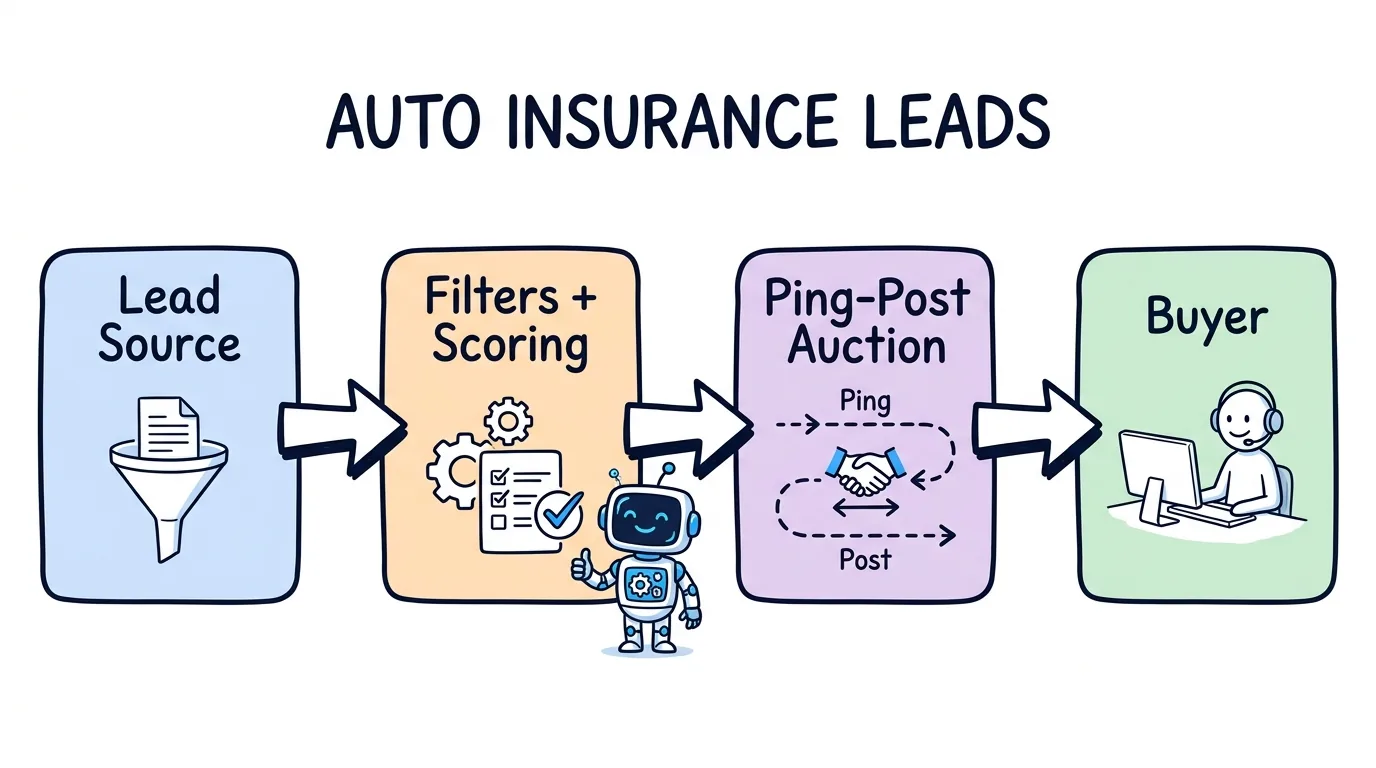
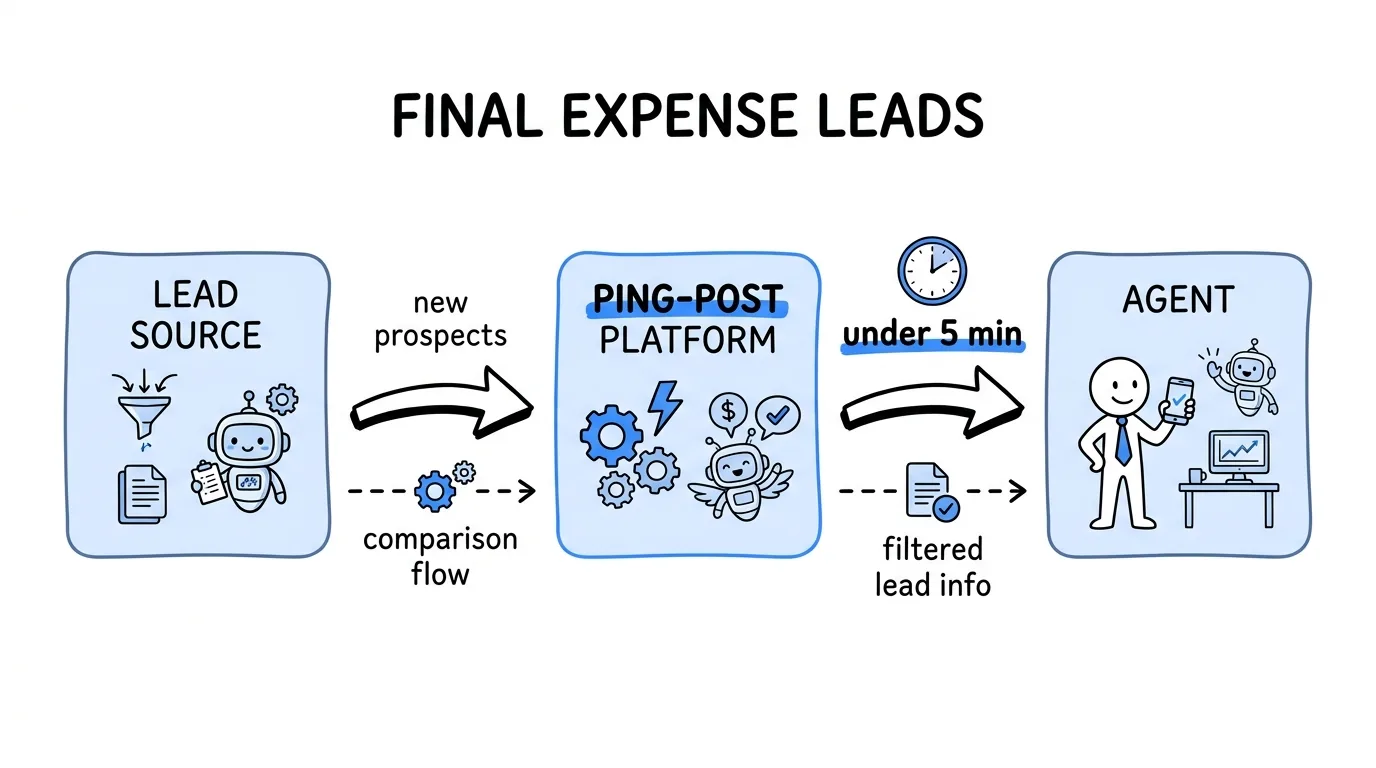
Here is how the workflow runs in a final expense distribution platform: a consumer fills out a final expense insurance quote form on a landing page. The form submission triggers a ping to the distribution platform, which sends a partial data record (state, age range, health status tier, and IP timestamp) to all eligible buyers simultaneously. Each buyer has 2-10 seconds to respond with a bid or pass. The platform selects the winning bid and sends a post with the complete record, including name, phone, email, and full health disclosure, only to the winning agent.
This structure matters for final expense specifically because: agents have daily caps on lead volume (most individual agents cannot work more than 20-30 leads per day effectively), health status dramatically affects an agent's willingness to pay (a preferred health lead is worth more than a standard health lead to a carrier that offers better preferred rates), and geographic routing by state matters because agents are licensed state-by-state.
In Lead Distro AI, buyers configure acceptance rules before each campaign: state allowlist, age range (50-75 vs. 50-85), health tier (preferred vs. standard), daily cap, and bid price. The platform enforces these rules on every ping. An agent in Texas who only holds a Texas license never receives leads from Louisiana, even if they submit a manual request. The lead distribution platform automates what would otherwise require a human dispatcher checking rules on every lead.
For agencies running both form leads and pay-per-call simultaneously, Lead Distro AI supports all four distribution methods (Round Robin, Weighted, Priority/Waterfall, and Ping-Post) in a single account, so final expense calls and final expense form leads route through the same buyer pool with different rules applied to each channel.
TCPA Compliance for Final Expense Telesales
Final expense telesales depends almost entirely on outbound calls to mobile phones, which places every call under the Telephone Consumer Protection Act (TCPA). A single TCPA violation costs $500 to $1,500 per call, and class action exposure is real in the final expense category because the target demographic (adults 50-85) is a protected class under some state laws.
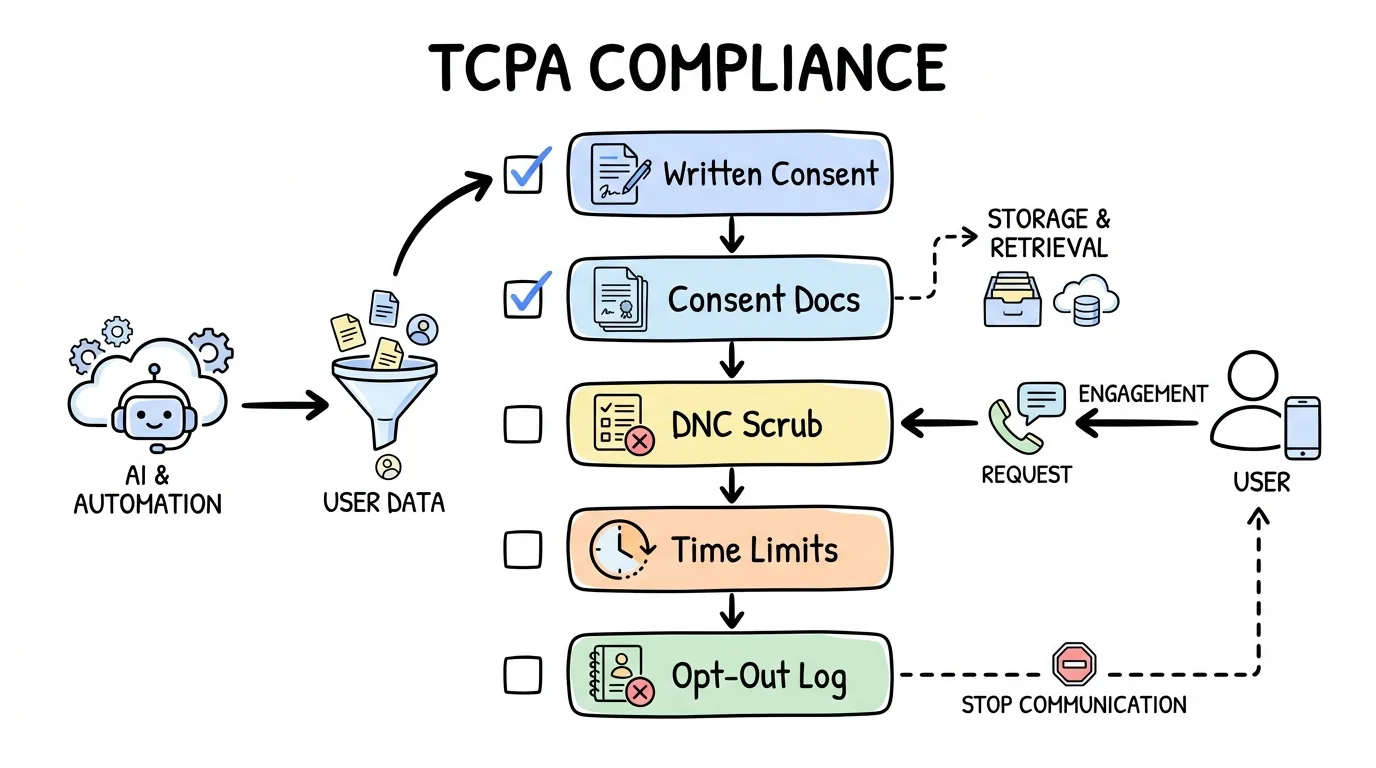
The compliance checklist for final expense lead generation agencies:
1. Written prior express consent at the point of capture. Every final expense lead form must include a clear disclosure that the consumer consents to be contacted by phone, including via automated dialing systems. The disclosure must name the entity making the calls or describe the category (insurance agents). Blanket consent buried in terms of service is not sufficient under TCPA's prior express written consent standard.
2. Consent documentation. The FCC's 2024 one-to-one consent rule, which would have required separate consent for each specific seller, was vacated by the 11th Circuit Court of Appeals (Insurance Marketing Coalition v. FCC) in January 2025 before it took effect, so it is not currently federal law. One-to-one consent still matters in practice: many lead buyers require it, and several state mini-TCPA laws impose similar single-seller consent rules. Marketplaces that route to multiple agents should still ensure each buyer's name appears in the consent language or obtain separate consent per buyer. Lead Distro AI supports TrustedForm certificate validation at lead ingest, so the consent record travels with the lead to every buyer.
3. DNC scrubbing before every dial. Final expense leads must be scrubbed against the National Do Not Call Registry before each outbound campaign. Scrubbing must occur within 31 days of the dial attempt. Most compliant final expense dialer software integrates DNC lookups automatically.
4. Time-of-day restrictions. The TCPA prohibits calls before 8 a.m. or after 9 p.m. in the consumer's local time zone. Distribution platforms with time-zone-aware routing (Lead Distro AI resolves time zone from the lead's state automatically) enforce this without manual calendaring.
5. Opt-out processing. Any consumer who requests removal must be added to the internal DNC list within 10 business days and removed from all future campaigns for that buyer.
The TCPA compliance checklist for agencies running final expense telesales is covered in detail in our TCPA compliance lead generation guide.
Setting Acceptance Rules and Lead Caps in Your Distribution Platform
The operational difference between a profitable final expense lead operation and a loss-making one is acceptance rule discipline. Agents who accept every lead regardless of health status, geography, or daily capacity end up with low contact rates and high return rates. A distribution platform that enforces rules before the post solves this structurally.
In Lead Distro AI, each buyer in the final expense channel sets acceptance rules at the campaign level:
Geography: State allowlist only. An agent licensed in FL, GA, and TX receives leads only from those states. The platform does not require the agent to reject leads manually; it never offers them in the first place.
Age range: Most final expense carriers have preferred age windows. An agent focused on whole life for ages 60-75 (the highest conversion window) sets the filter and receives only leads in that range.
Health tier: Lead forms capture health status via a single self-reported question (Excellent, Good, Fair, Poor). Carriers offer better rates for preferred health, so agents who work preferred-only leads can close faster. Agents with broader carrier panels may accept all tiers and handle underwriting objections in conversation.
Daily and weekly caps: An agent who can realistically work 25 final expense leads per day sets a daily cap of 25. Once that cap is hit, they stop receiving pings for the remainder of the day. Cap enforcement prevents waste on both sides: the agent does not receive leads they cannot call, and the agency does not waste exclusive lead inventory on agents who cannot contact the consumer promptly.
Bid price by lead quality: In a ping-post setup, agents can set dynamic bids: a higher price for real-time exclusive preferred health leads and a lower price for standard health or aged leads. This lets the distribution platform allocate its best inventory to the highest-paying buyer automatically, which is what pay-per-lead agencies need to maximize margin per lead.
ROI Calculation for Final Expense Lead Campaigns
Understanding the math before buying leads is what separates operators who scale from those who churn through budget. Here is the standard ROI model for a final expense lead campaign:
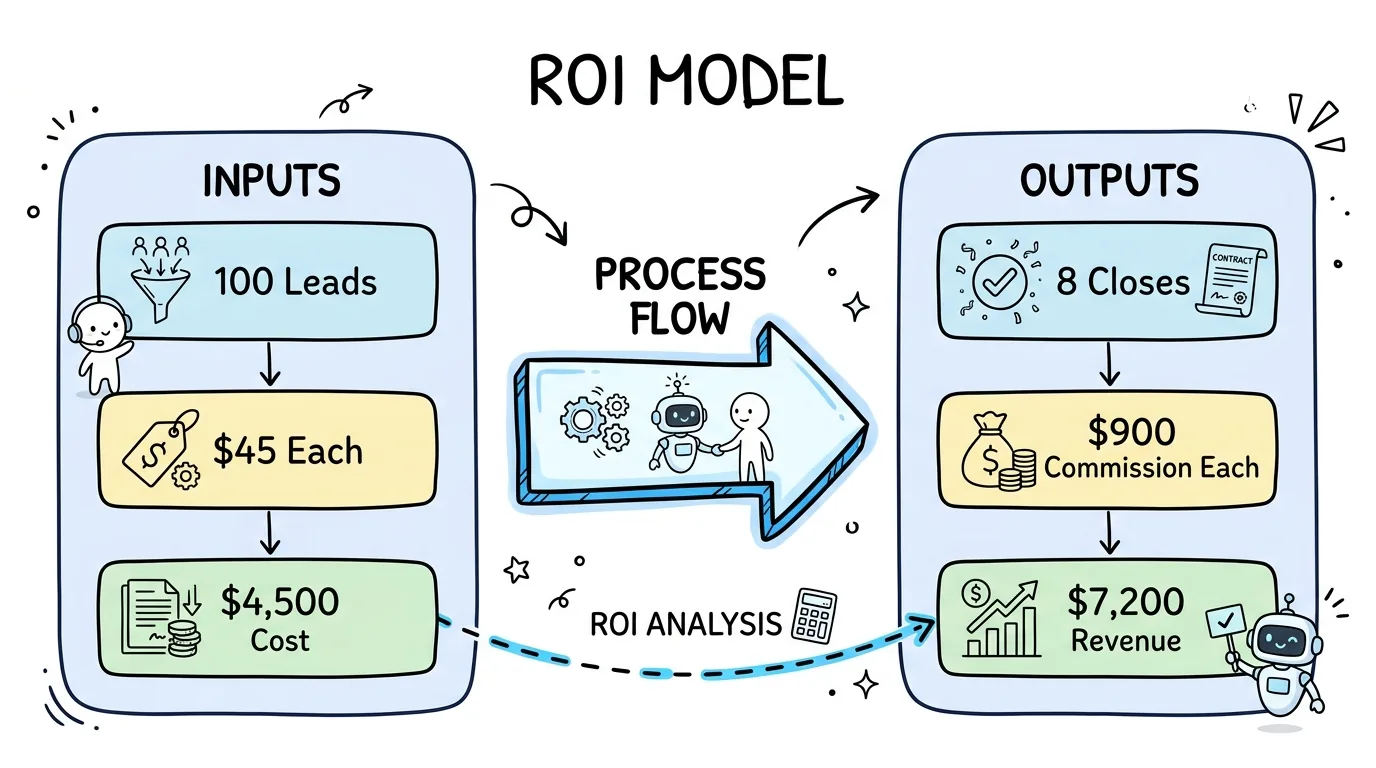
Assume you are buying real-time exclusive leads at $45 each. Your agent contacts 40% of leads (a conservative contact rate for fresh exclusive leads) and closes 20% of contacts. That translates to a close rate of 8% per lead purchased.
A typical final expense whole life policy pays a first-year commission of 100-130% of the annual premium. If the average annual premium on a $15,000 policy for a 65-year-old is $900/year, the agent earns $900-$1,170 on the first year's commission. Assuming a 10-year average persistency (most final expense policies lapse or the insured passes within 10 years), the agent earns renewal commissions of 5-10% annually in years 2-10.
Unit economics per 100 leads purchased at $45:
- Cost: $4,500
- Contacts: 40 consumers
- Closes: 8 policies
- First-year commission: $7,200-$9,360
- Gross profit: $2,700-$4,860 on 100 leads
- ROI: 60-108% before overhead
These numbers assume a dialer operation that contacts leads within 5 minutes of receipt. A 30-minute delay drops the contact rate from 40% to roughly 20%, cutting closes in half and turning a 100% ROI into a break-even operation. That is why the lead distribution platform for insurance agencies matters: the automated routing that delivers each lead to the right agent in under 60 seconds is the single biggest lever on your ROI model.
Use our lead pricing calculator to model your specific commission rates, close assumptions, and lead costs before committing to volume.
Frequently Asked Questions
What are final expense leads?
Final expense leads are consumer inquiries from adults aged 50 to 85 who are shopping for small whole life insurance policies, typically $5,000 to $25,000, to cover burial, funeral, and end-of-life costs. The consumer has either submitted a quote request form, called an inbound response line, or responded to a direct mail piece. Insurance agents and agencies buy these leads from lead generators and brokers, then contact consumers to sell a final expense policy. Lead prices range from $2 for aged leads to $90 for live pay-per-call transfers, depending on exclusivity, recency, and health tier.
How much do final expense leads cost?
Final expense leads cost $2 to $90 per lead depending on type. Real-time exclusive leads cost $35 to $65. Real-time shared leads (two to five agents) cost $10 to $20. Aged leads (15-90 days old) cost $2 to $8. Live transfers, where a call center qualifier hands off a consumer already on the line, cost $25 to $90. Geography and health tier also affect pricing: preferred health leads in high-population states like Florida, Texas, and California command a 15-25% premium over standard health leads in low-density rural markets.
What is the best source for final expense leads?
The highest-converting final expense leads come from owned digital channels: Facebook and YouTube ad campaigns targeting adults 50-75 with a direct response landing page and a compliant consent form. Direct mail remains effective for the 65-and-up demographic because response rates average 1-3%, and respondents demonstrate high intent by mailing back a reply card. Shared lead marketplaces (aggregators that resell leads to three to five agents) are a lower-cost entry point but require a strong dialer operation to compete. The best approach for agencies is to own at least one traffic source, supplement with purchased leads during ramp-up, and route all volume through a ping-post distribution platform to prevent cherry-picking.
Is final expense lead generation TCPA-compliant?
Final expense lead generation is TCPA-compliant when the lead form includes a written prior express consent disclosure that specifically authorizes the buyer to contact the consumer via phone, including autodialed calls to mobile numbers. The FCC's 2024 one-to-one consent rule, which would have required consent to be obtained separately for each seller, was vacated by the 11th Circuit in January 2025 before it took effect, so single-seller consent is not federally mandated today, though many buyers and some state laws still require it. Agencies must also scrub leads against the National DNC Registry within 31 days of each dial, honor time-of-day restrictions (8 a.m. to 9 p.m. local time), and maintain an internal DNC list for opt-outs. TCPA violations carry $500 to $1,500 per call in statutory damages, plus potential class action exposure.
How do I distribute final expense leads to multiple agents?
Final expense leads are distributed to multiple agents using a ping-post lead distribution system. When a lead arrives, the platform sends a partial data record (state, age, health tier) to all eligible buyers simultaneously. Each buyer has 2-10 seconds to bid. The highest bid wins the post with the complete lead data. This prevents cherry-picking because agents cannot see the full record before committing, and it maximizes revenue because lead price is set by market competition rather than a fixed rate. Lead Distro AI supports ping-post for final expense alongside Round Robin, Weighted, and Priority/Waterfall distribution methods, with per-buyer acceptance rules, daily caps, and real-time P&L reporting.
Can pay-per-call agencies sell final expense leads?
Yes. Final expense is one of the strongest verticals for pay-per-call agencies. A live transfer from a qualified final expense consumer converts at 2-3x the rate of a form lead because the consumer is engaged and expecting the call. Pay-per-call agencies use inbound IVR qualification (the consumer presses 1 to speak with an agent), live transfer from a call center, or response to a click-to-call ad. Calls are routed through a distribution platform that applies state licensing filters, agent capacity caps, and bid-based priority routing. Both pay-per-lead and pay-per-call final expense volume can be managed in a single Lead Distro AI account, making it the platform of choice for agencies running both channels simultaneously.
Conclusion
Final expense leads offer pay-per-lead and pay-per-call agencies a reliable vertical: a large and growing target demographic, high daily lead volume, buyers (insurance agents and carriers) already accustomed to purchasing leads, and a range of lead types that fit every budget and operation size.
The operators who win in final expense are not the ones who buy the cheapest leads. They are the ones who contact leads within 5 minutes, enforce acceptance rules so agents only receive leads they can work, and maintain TCPA-documented consent on every record. A lead distribution platform built for insurance automates all three.
For a broader view of which verticals produce the best margins alongside final expense, read our guide to the best lead generation niches for agencies.
Ready to distribute final expense leads in real time? Lead Distro AI gives you ping-post routing, acceptance rule enforcement, TCPA consent tracking, and per-agent performance reporting. Start your 7-day free trial today (credit card required).
About the Author
Founder & CEO of Lead Distro AI & Great Marketing AI
UC Berkeley graduate and former software engineer at Microsoft. Rafael built Lead Distro AI after managing over $10M in ad spend for performance marketing agencies (pay-per-lead and pay-per-call), including running campaigns for Neil Patel. He combines deep software engineering expertise with hands-on performance marketing experience to build tools that help these agencies scale profitably.
About Lead Distro AI
Lead Distro AI: AI-Powered Lead Distribution & Call Tracking That Maximizes ROI
The modern platform for pay-per-lead and pay-per-call agencies. Route, score, and deliver leads with AI-powered automation and real-time P&L tracking. Built for performance marketing agencies and lead buyers across legal, insurance, mortgage, solar, and home services verticals.
4 Distribution Methods
Waterfall, Round Robin, Weighted, Ping-Post
Ping-Post Auctions
Real-time bidding with sub-second routing
Real-Time P&L Reporting
Track revenue, costs, and profit per campaign
Call Tracking
Assign tracking numbers, record calls, and attribute conversions
AI Lead Scoring
Score every lead before routing to maximize conversion
Partner Portal
Self-serve dashboard for buyers to track leads