Debt Relief Pay Per Call: How to Sell Calls to Firms
Debt relief pay per call explained for 2026: how to qualify debt settlement live transfers and tax debt relief calls, FTC rules, TCPA, and routing setup.

Rafael Hernandez
Founder & CEO
Ex-Microsoft SWE · $10M+ PPL ad spend
I hope you enjoy reading this blog post. If you want to try Lead Distro AI for free, click here.
Author: Rafael Hernandez | Founder & CEO of Lead Distro AI
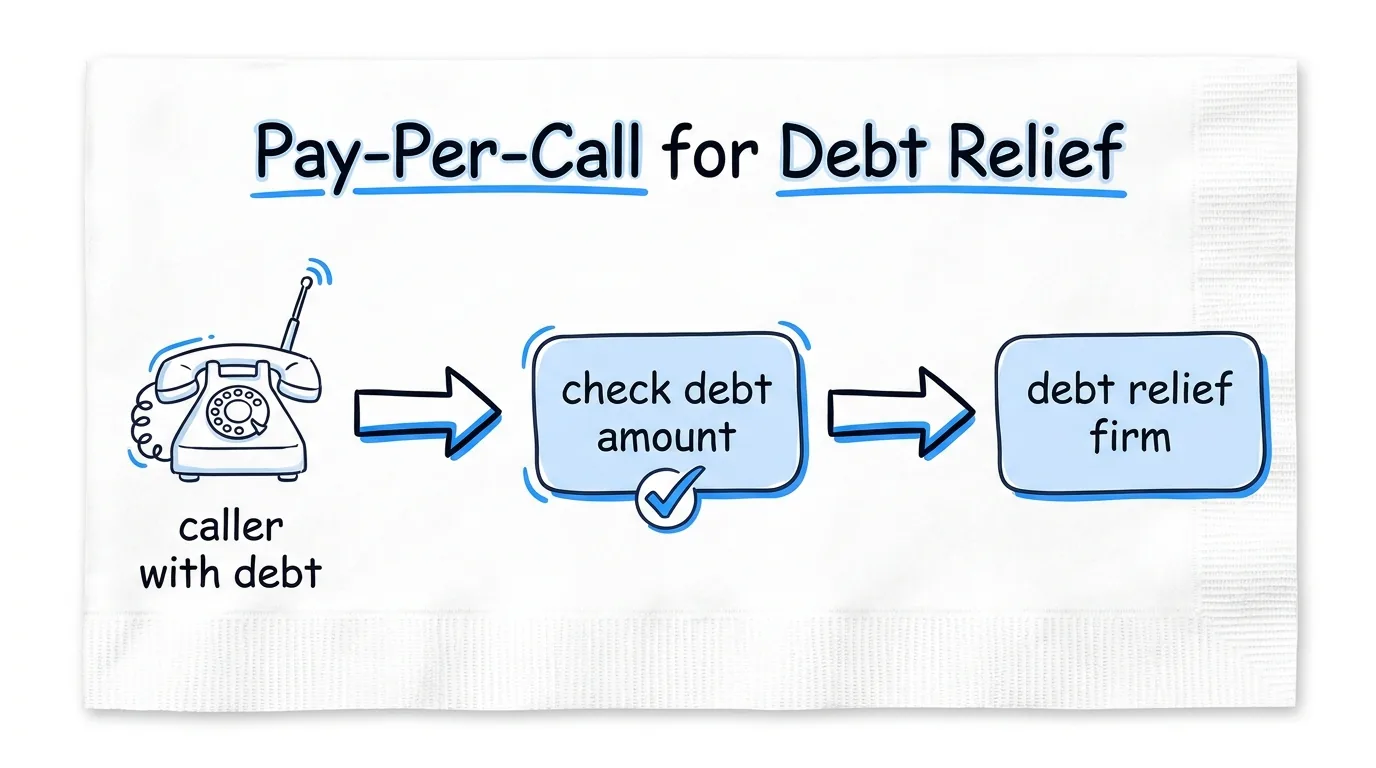
Debt relief pay per call is a model where you generate inbound phone calls from consumers who are struggling with debt, then sell each qualified call to a debt settlement or tax resolution firm. You run the ads and the tracking numbers. The buyer pays for each call that clears its rules, such as a minimum talk time and a debt amount the caller states out loud. Because the caller is already on the line, debt settlement live transfers reach a sales agent in seconds, while a form lead waits for a callback.
The demand side is easy to see. The New York Fed reports that U.S. credit card balances reached $1.263 trillion in the second quarter of 2026, and that 6.97% of those balances moved into serious delinquency (90 or more days past due) on an annualized basis, according to its Q2 2026 Household Debt and Credit report.
This guide is for operators who sell calls, not for firms that settle debt. It covers how debt relief inbound calls work, how to qualify them, what changes for tax debt relief calls, the FTC and TCPA rules that touch your business, and how to route and bill calls with Lead Distro AI.
Key Takeaways
- Debt relief pay per call is a qualification game. Buyers pay for callers they can enroll, so debt amount, debt type, and state decide whether a call bills.
- Each buyer sets its own minimum unsecured debt. Get the floor in writing and enforce it with an IVR (keypad menu) question before the transfer.
- Tax debt relief calls qualify on different facts. Amount owed, IRS versus state debt, and whether the caller has filed all required returns matter most.
- The FTC Telemarketing Sales Rule covers many inbound debt relief calls. Its advance-fee ban and its "substantial assistance" language make buyer vetting part of your job.
- Routing, recording, and returns decide your margin. Lead Distro AI Starter is $297 per month, with usage-based call tracking on top.
How Debt Relief Pay Per Call Works
A publisher runs a campaign, a tracking number appears on the ad or landing page, and a consumer calls. The platform ties the call to its source, asks a few qualifying questions, and routes the live caller to a buyer. The buyer pays once the call passes its rules.
Debt relief inbound calls fall into two sub-verticals with different buyers:
- Consumer debt relief covers credit cards, personal loans, medical bills, and other unsecured debt. Buyers are debt settlement firms, which negotiate with creditors for a reduced payoff.
- Tax debt relief covers back taxes owed to the IRS or a state. Buyers are tax resolution firms, which work on payment plans, offers in compromise, and penalty relief.
The CFPB describes the consumer side plainly: debt settlement companies say they can renegotiate, settle, or change the terms of a debt, and many ask clients to stop paying creditors while funds build up (CFPB). That is why buyers screen hard.
If you are new to the model, how to start a pay-per-call agency covers the business basics. For a side-by-side view of billing models, read pay per call vs pay per lead.
Qualifying Debt Relief Inbound Calls
In debt relief pay per call, the buyer pays for a caller it can enroll. Enrollment depends on facts the caller states in the first minute, so your filters should collect those facts before the transfer. Three filters do most of the work.
1. Unsecured debt amount. Buyers set a minimum, and each buyer's number is different. A call below the floor should not transfer. Ask the buyer for its minimum in writing and build it into your IVR menu or scoring rules.
2. Debt type. The FTC says the definition of a debt relief service "covers all types of unsecured debts," and that services promising relief from mortgage debt are not covered by the TSR (FTC business guide). Credit cards, personal loans, and medical bills are the usual targets. A caller whose only debt is a mortgage or an auto loan is usually a poor match for a settlement buyer.
3. State. Buyers serve the states where they are set up to operate. Route by state or ZIP code so a caller from an unserved state never reaches a buyer who will reject the call.
| Filter | Consumer debt relief | Tax debt relief |
|---|---|---|
| Amount | Total unsecured debt | Total amount owed |
| Debt type | Credit cards, loans, medical | IRS, state, or both |
| Extra checks | Number of creditors, hardship | Returns filed, open bankruptcy |
| Routing | Settlement firms by state | Resolution firms by state |
Payouts vary by buyer, state, and debt size, and I am not quoting a price range here. Use the lead pricing calculator to model margins with your own numbers.
Tax Debt Relief Calls: What Changes
Tax debt relief calls need different questions. The buyer wants to know how much the caller owes, whether the debt is federal, state, or both, and whether the caller is current on filing.
The IRS offer in compromise (OIC) program shows why. To be eligible, a taxpayer must file all required tax returns, make required estimated tax payments, and not be in an open bankruptcy (IRS). A caller with unfiled returns is not ready for most resolution work, so a good IVR asks about it up front.
The IRS also says offers must be "based on their true ability to pay," and that applying "does not guarantee that the IRS will accept the taxpayer's offer" (IRS Tax Tip 2022-103). The same page warns about "OIC mills" that make "huge claims about reducing unpaid taxes for pennies on the dollar" and sometimes charge large fees without delivering.
For you, that is an ad-copy rule. Never promise that a caller will settle for pennies on the dollar. Write ads that describe the call, not the result.
Compliance Rules for Debt Relief Pay Per Call Sellers
Debt relief is one of the most regulated call verticals. This section is general information, not legal advice. Confirm the details with qualified counsel before you launch.
The FTC Telemarketing Sales Rule
The FTC says its debt relief rules cover calls that customers make to a firm "in response to advertising," including TV, radio, online, and billboard ads (FTC business guide). Its general media exemption also does not apply to debt relief services (FTC TSR compliance guide).
The advance-fee ban says a firm cannot collect any fee until it has settled or otherwise resolved at least one of the customer's debts. The ban took effect on October 27, 2010 (FTC). That rule binds your buyer, not you. Still, the same guide lists "obtaining and selling leads" as an example of substantial assistance, says it is illegal to give substantial assistance to a company you know is breaking the Rule, and adds that "willful ignorance isn't a defense."
In practice, that means you should:
- Ask each buyer how and when it charges consumers.
- Keep call recordings and scripts so you can show what callers were told.
- Remove ad claims about guaranteed savings or debt elimination.
Whether a specific tax resolution offer falls under the TSR is a legal question for your counsel.
TCPA Consent
The Telephone Consumer Protection Act (TCPA) rules in 47 CFR 64.1200 require prior express written consent for telemarketing calls that use an autodialer or an artificial or prerecorded voice to restricted lines. They also bar telephone solicitations to numbers on the National Do-Not-Call Registry (47 CFR 64.1200). A consumer who dials your tracking number is a different case from a callback or text you send later, so keep consent records for any follow-up.
Routing Debt Relief Pay Per Call Campaigns With Lead Distro AI
Once the qualifying rules are clear, the platform enforces them. Lead Distro AI supports the setup debt relief calls need:
- Routing methods: Round Robin, Weighted, Priority/Waterfall, ring tree, and real-time bidding (RTB) for calls, so buyers can bid on a caller's profile.
- Geographic routing by state or ZIP, with buyer hours and caps.
- IVR qualification: a keypad menu that asks for debt range or tax situation before transfer.
- Rule-based call scoring against rules you write, such as "the caller states a debt amount" or "the caller owes taxes, not only a mortgage."
- Minimum call duration before a call is billable, and duplicate caller detection, since debt prospects often call several ads.
- Call recording, plus buyer billing and returns, so you can answer a disputed call with evidence.
- Real-time P&L reporting by source and buyer.
The Starter plan is $297 per month, and call tracking is usage-based, with a per-tracking-number monthly fee and a per-minute inbound rate on top of the subscription. A 7-day free trial is available. If your book also includes loans, see how pay per call for mortgage handles licensing and filters, or browse the financial services vertical.
FAQ
What is debt relief pay per call?
Debt relief pay per call is a model where an operator generates inbound calls from consumers with debt and sells each qualified call to a debt settlement or tax resolution firm. A tracking number attributes the call to its source, and the buyer pays once the call meets its rules, such as a minimum talk time and a stated debt amount. It covers both consumer debt relief, such as credit card and medical debt, and tax debt relief for back taxes owed to the IRS or a state. Compliance matters in this vertical, so confirm your obligations with counsel.
What are debt settlement live transfers?
Debt settlement live transfers are calls where a pre-screened caller is connected directly to a debt settlement firm's sales agent while still on the line. The operator asks qualifying questions first, such as the total unsecured debt, then transfers only callers who meet the buyer's rules. Live transfers reach an agent in seconds, which is the main advantage over form leads that wait for a callback. Lead Distro AI can run the IVR questions, route by state, and record the call for each transfer.
How do you qualify debt relief inbound calls?
Qualify debt relief inbound calls on unsecured debt amount, debt type, and state. Each buyer sets its own minimum debt, so get that floor in writing and enforce it with an IVR (keypad menu) question or a scoring rule before the transfer. Mortgage-only callers are usually a poor match, and callers from states a buyer does not serve should never be routed to it. Duplicate caller detection also helps, since the same person may call several ads in one day.
How are tax debt relief calls different?
Tax debt relief calls qualify on the amount owed, whether the debt is federal, state, or both, and whether the caller has filed all required returns. The IRS requires filed returns, required estimated tax payments, and no open bankruptcy for an offer in compromise. Ads must not promise settlement results, because the IRS warns about firms that claim they can cut tax debt to pennies on the dollar. Tax debt relief calls also tend to route to different buyers than consumer debt calls.
Does the FTC Telemarketing Sales Rule apply to debt relief pay per call?
It can. The FTC says its debt relief rules cover many calls consumers make in response to ads, and the advance-fee ban stops a firm from charging until it resolves a debt. The FTC also lists selling leads as a form of substantial assistance if you know the buyer is breaking the Rule. Vet your buyers, keep call recordings and ad copy on file, and confirm your exact obligations with counsel, since this is general information and not legal advice.
Conclusion
Debt relief pay per call rewards operators who qualify tightly. Collect the debt amount, debt type, and state before the transfer, ask tax callers about filed returns, and keep your ads free of promises about results. Vet every buyer, because the FTC treats selling leads to a rule-breaking firm as potential substantial assistance.
If you want routing, IVR qualification, call scoring, and real-time P&L in one place, start a free 7-day trial of Lead Distro AI or take the product tour first.
Building a debt relief pay per call book? Start your 7-day free trial and set up IVR qualification, state routing, and call recording for your first debt settlement buyer.
About the Author
Founder & CEO of Lead Distro AI & Great Marketing AI
UC Berkeley graduate and former software engineer at Microsoft. Rafael built Lead Distro AI after managing over $10M in ad spend for performance marketing agencies (pay-per-lead and pay-per-call), including running campaigns for Neil Patel. He combines deep software engineering expertise with hands-on performance marketing experience to build tools that help these agencies scale profitably.
About Lead Distro AI
Capture, Route, and Sell Every Lead, Call, and Appointment
Capture, route, and sell leads, calls, and appointments from one platform, with funnels, call tracking, ping-post, and billing built in. Set it all up in minutes by chatting with AI.
Funnels
Quiz, form, appointment, VSL, and webinar templates
Call Tracking
Tracking numbers, call recordings, and per-call billing
4 Distribution Methods
Priority/Waterfall, Round Robin, Weighted, Ping-Post
Ping-Post and Live Bidding
Sell each lead and call to the highest bid
Real-Time P&L
Revenue, cost, and profit per campaign
Partner Portal
Your Destinations see their own leads and results