ACA Pay Per Call: Calls, Routing & Compliance (2026)
ACA pay per call explained for 2026: how ACA live transfers and health insurance inbound calls work, Open Enrollment timing, state routing, and CMS rules.

Rafael Hernandez
Founder & CEO
Ex-Microsoft SWE · $10M+ PPL ad spend
I hope you enjoy reading this blog post. If you want to try Lead Distro AI for free, click here.
Author: Rafael Hernandez | Founder & CEO of Lead Distro AI
ACA pay per call is the model where a publisher generates a live phone call from a consumer shopping for an Affordable Care Act (ACA) marketplace plan, a tracking number sends that caller to a licensed agent or agency, and the buyer pays once the call clears a duration and qualification threshold. The market is large but shrinking. CMS reported that 23.1 million consumers selected or were automatically re-enrolled in 2026 marketplace coverage, and KFF found that paid (effectuated) enrollment in February 2026 was 19.2 million, down 12% from 21.8 million a year earlier. Fewer shoppers means ACA call buyers are pickier about every call they pay for.
This guide covers how ACA live transfers and inbound calls work, how enrollment calendars drive volume, why state licensing shapes routing, and what CMS and the TCPA expect. It also shows how to route, bill and track health insurance inbound calls with Lead Distro AI. If you also sell form fills, start with our health insurance lead generation guide.
Key Takeaways
- ACA pay per call bills per qualified call, not per form fill. The buyer pays only when a live caller passes your duration and qualification rules, so call quality decides your margin.
- Volume follows the calendar. Open Enrollment for 2027 coverage opened November 1, 2026, and Special Enrollment Periods create a steadier trickle of calls the rest of the year.
- State is the first routing rule. CMS requires agents and brokers to be licensed in each state where they assist consumers, so a call sent to the wrong state is wasted spend and a compliance risk.
- CMS enforcement is active. In September 2026 CMS said it is canceling about 315,000 unauthorized enrollments, which makes consent records and honest ads a business requirement.
- Never promise free coverage. CMS guidance for agents lists guaranteeing free or low-cost plans to all consumers as a marketing "don't," and your ads reach the same consumers.
- A distribution platform handles the mechanics: routing, state and ZIP rules, buyer hours and caps, call scoring, billing and P&L.
How ACA Pay Per Call Works
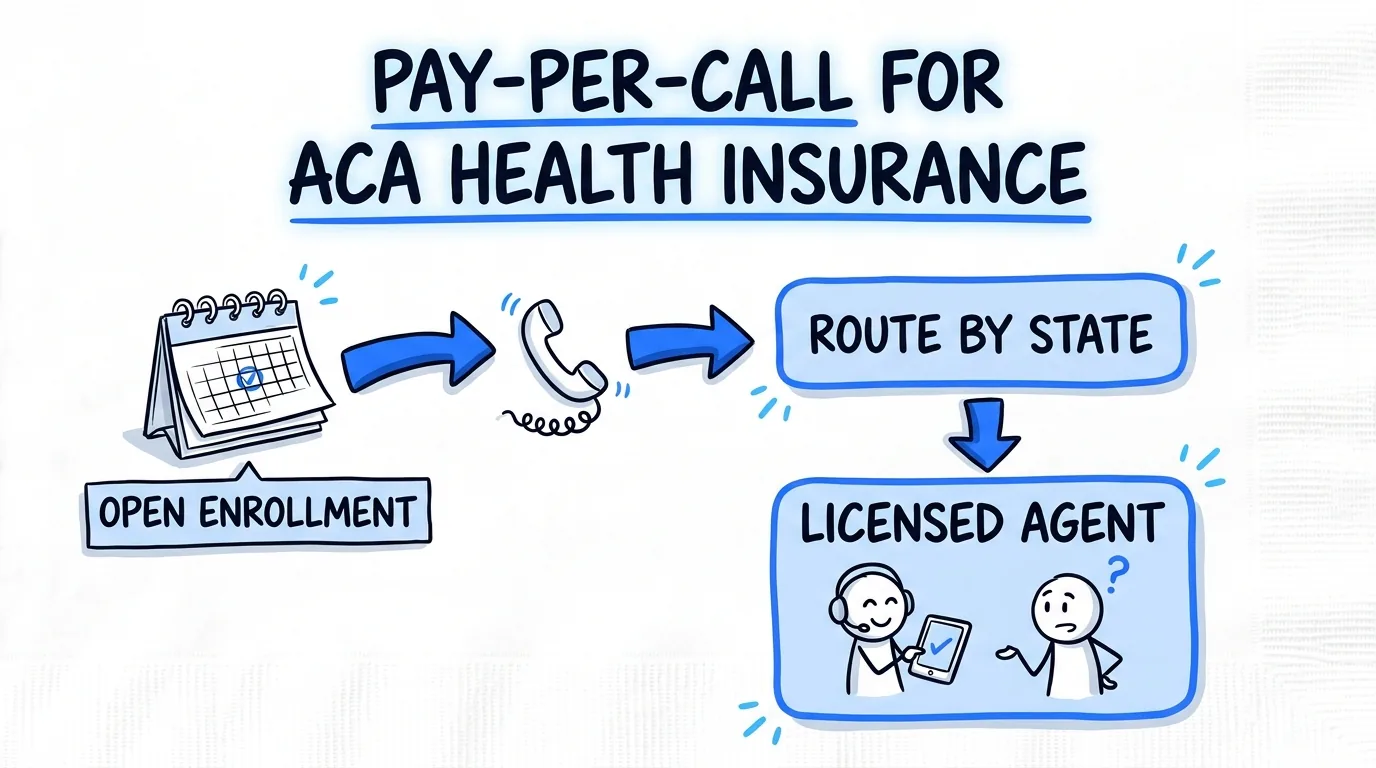
ACA pay per call puts a tracked phone number between a publisher and a buyer. The publisher runs search ads, SEO pages or a plan-comparison site that displays a tracking number. When a consumer calls, the platform records the source, applies the buyer's rules, and routes the live caller to a licensed agent or agency. The buyer pays only for billable calls.
Two formats share the same economics. With health insurance inbound calls, the consumer dials the tracking number and the platform routes the call. With ACA live transfers, someone on your side, such as an IVR (interactive voice response, a keypad menu) or a small call center, qualifies the consumer first and then warm transfers the live caller to the buyer. Live transfers add operating cost but arrive pre-qualified. Inbound calls scale faster.
Our pay-per-call for insurance guide compares health with auto, Medicare and final expense, and the live transfer leads guide covers transfers in depth.
The ACA Pay Per Call Calendar: Open Enrollment and Special Enrollment
ACA pay per call volume follows the Open Enrollment calendar. For 2027 coverage on HealthCare.gov, CMS states that Open Enrollment began on November 1, 2026 and ends on January 15, 2027. HealthCare.gov lists December 15 as the last day to enroll or change plans for coverage that starts January 1. Federal rules on the window's length were in court this year, and states with their own exchanges publish their own dates, so confirm before you set caps.
Outside Open Enrollment, a Special Enrollment Period lets people sign up after a qualifying life event such as losing coverage, moving, getting married or having a baby. HealthCare.gov says you usually have 60 days before or after the event to enroll. That produces a thinner, steadier stream of calls after the window closes.
Before volume arrives, confirm which buyers extend hours, raise daily caps and cover weekends. Medicare runs on its own calendar, covered in our pay-per-call for Medicare guide.
State Licensing and Routing for ACA Call Buyers
State is the first routing rule. CMS guidance says agents and brokers must be licensed in each state where they are assisting consumers and must complete identity proofing, training and agreements before they help anyone. A caller in Ohio is worth nothing to an agent licensed only in Texas, and sending that call anyway creates risk.
Geographic routing by state and ZIP solves this. Ask the caller for a ZIP code through an IVR step and route on the answer. Do not rely on the area code alone, because mobile numbers travel with people.
For competitive volume, real-time bidding (RTB) for calls lets eligible buyers bid on each call and sends it to the highest bidder, while buyer hours and caps keep calls from landing on a closed or full agency. Use Priority/Waterfall when you want a fixed order of buyers per state.
How to Qualify Health Insurance Inbound Calls
Qualification is where ACA pay per call margin is won or lost. Paid enrollment fell 12% while plan selections fell 5%, so buyers have good reason to ask whether a caller can actually finish and keep an enrollment. These are the controls that matter most:
- Minimum call duration. Set the connected time a call needs before it bills, and agree on it with each buyer in writing.
- IVR qualification. One or two keypad questions, such as ZIP and whether the caller needs a marketplace plan, filter out wrong numbers before the buyer pays.
- Duplicate caller detection. Block the same caller from billing twice inside your agreed window.
- Rule-based call scoring. Write rules describing a good ACA caller, and let the platform score each call against them so weak calls are flagged before you invoice.
- Call recording. A recording settles disputes about what was said and whether the call was billable.
- Returns. Agree on a return window and reasons up front, then log returns against the invoice.
ACA Pay Per Call Compliance: CMS, Consent and the TCPA
ACA marketing is regulated, and CMS has been acting. In September 2026 CMS announced it is canceling approximately 315,000 unauthorized enrollments covering more than 760,000 people, expected to return roughly $2.2 billion in subsidies. The same release says CMS has issued termination notices to more than 200 agents and brokers since January 2026, and that it plans to require electronic consumer authorization before an agent or broker can act on an application. In 2024, CMS suspended 850 agents and brokers over suspected fraudulent or abusive conduct tied to unauthorized enrollments or plan switches.
What this means for a call seller:
- Consent sits with the agent. CMS tells agents to document consumer consent before enrollment help, even when a third party connected them to the consumer, and to keep that record for at least 10 years. Buyers will ask how you produce callers who knowingly want help.
- Keep ads honest. The same guidance lists guaranteeing free or low-cost plans to all consumers as a "don't." Never promise free or $0 coverage in ads or on the phone.
- Sell each call once. CMS encourages agents to avoid leads sold to several agents, because it confuses consumers.
The TCPA (Telephone Consumer Protection Act) also applies when your operation or your buyers call or text consumers. It requires prior express written consent for autodialed or prerecorded telemarketing. The FCC's one-to-one consent rule was vacated by the Eleventh Circuit on January 24, 2025, and the earlier written-consent requirements remain. This is general information, not legal advice. Confirm your setup with counsel.
Routing, Billing and Tracking ACA Calls with Lead Distro AI
Once calls flow, the platform decides who gets each one, how it bills and what it earned. Lead Distro AI supports the routing methods below for ACA calls.
| Method | How it routes an ACA call | Use it when |
|---|---|---|
| Round Robin | Spreads calls evenly across buyers | Several licensed agencies in a state share volume |
| Weighted | Sends a larger share to chosen buyers | One buyer closes better or pays more |
| Priority/Waterfall | Offers the call to buyer one, then buyer two | You want a fixed order and a fallback |
| Ring tree | Rings a set of numbers in order | A buyer has several agents to try |
| RTB | Buyers bid per call, highest wins | You have competing buyers for the same state |
Billing runs per buyer, with returns tracked against each invoice, and real-time P&L (profit and loss) reporting shows margin by source and buyer. The Starter plan costs $297 per month. Call tracking is usage-based and billed on top: a monthly fee per tracking number plus a per-minute inbound rate. Model your margin with the lead pricing calculator, then see how the insurance vertical is set up.
FAQ
What is ACA pay per call?
ACA pay per call is a model where a publisher generates a live phone call from a consumer shopping for an Affordable Care Act marketplace plan, a tracking number routes the caller to a licensed agent or agency, and the buyer pays once the call passes a minimum duration and any qualification rules. The buyer pays for a live conversation instead of a form fill. Quality rules such as state matching and duplicate checks decide whether a call bills.
When is the peak season for ACA pay per call?
Peak volume follows Open Enrollment. For 2027 coverage on HealthCare.gov, CMS states Open Enrollment began November 1, 2026 and ends January 15, 2027, with December 15 as the deadline for coverage starting January 1. States that run their own exchanges publish their own dates. Special Enrollment Periods, which usually allow 60 days around a qualifying life event, keep a smaller flow of calls going the rest of the year.
What are ACA live transfers and how do they differ from inbound calls?
With ACA live transfers, your side qualifies the consumer first, often by IVR or a small call center, and then warm transfers the live caller to a buyer. With inbound calls, the consumer dials a tracking number and the platform routes the call directly. Live transfers cost more to operate but arrive pre-qualified. Inbound calls scale faster and suit search and SEO traffic. Buyers decide which format they accept.
How do ACA call buyers decide whether to pay for a call?
Buyers usually pay when a call meets agreed rules: a minimum connected duration, the right state, no duplicate from the same caller, and any qualification answers from the IVR. Many also review recordings and request returns when a call fails them. Write the duration threshold, the return window and the dispute process into your buyer agreement so billing disagreements have a clear, documented answer.
How do I route health insurance inbound calls by state?
Collect the caller's ZIP code with an IVR step, then use geographic routing by state and ZIP to send the call only to buyers licensed there. Add buyer hours and daily caps so calls do not reach a closed or full agency, and use a Priority/Waterfall order or real-time bidding when several buyers compete. CMS guidance says agents and brokers must be licensed in each state where they assist consumers.
Conclusion
ACA pay per call rewards operators who treat each call as a regulated, state-specific transaction. The calendar sets your volume, state licensing sets your routing, and CMS enforcement and TCPA consent rules set your risk. With fewer paid enrollments than a year ago, ACA call buyers will keep paying for callers who can actually enroll. Build your qualification rules, buyer hours and billing before the next surge.
Start your 7-day free trial to set up routing and tracking, or read how Medicare differs in our pay-per-call for Medicare guide.
Building an ACA call book for Open Enrollment? Start your 7-day free trial and route your first call by state, with buyer hours, caps and real-time P&L in one place.
About the Author
Founder & CEO of Lead Distro AI & Great Marketing AI
UC Berkeley graduate and former software engineer at Microsoft. Rafael built Lead Distro AI after managing over $10M in ad spend for performance marketing agencies (pay-per-lead and pay-per-call), including running campaigns for Neil Patel. He combines deep software engineering expertise with hands-on performance marketing experience to build tools that help these agencies scale profitably.
About Lead Distro AI
Capture, Route, and Sell Every Lead, Call, and Appointment
Capture, route, and sell leads, calls, and appointments from one platform, with funnels, call tracking, ping-post, and billing built in. Set it all up in minutes by chatting with AI.
Funnels
Quiz, form, appointment, VSL, and webinar templates
Call Tracking
Tracking numbers, call recordings, and per-call billing
4 Distribution Methods
Priority/Waterfall, Round Robin, Weighted, Ping-Post
Ping-Post and Live Bidding
Sell each lead and call to the highest bid
Real-Time P&L
Revenue, cost, and profit per campaign
Partner Portal
Your Destinations see their own leads and results