Funnel Optimization for Lead Gen: 8 Data-Backed Practices
Funnel optimization for lead gen, backed by research: fewer fields, smart question order, mobile speed, consent proof, and A/B tests that count sold leads.

Rafael Hernandez
Founder & CEO
Ex-Microsoft SWE · $10M+ PPL ad spend
I hope you enjoy reading this blog post. If you want to try Lead Distro AI for free, click here.
Author: Rafael Hernandez | Founder & CEO of Lead Distro AI
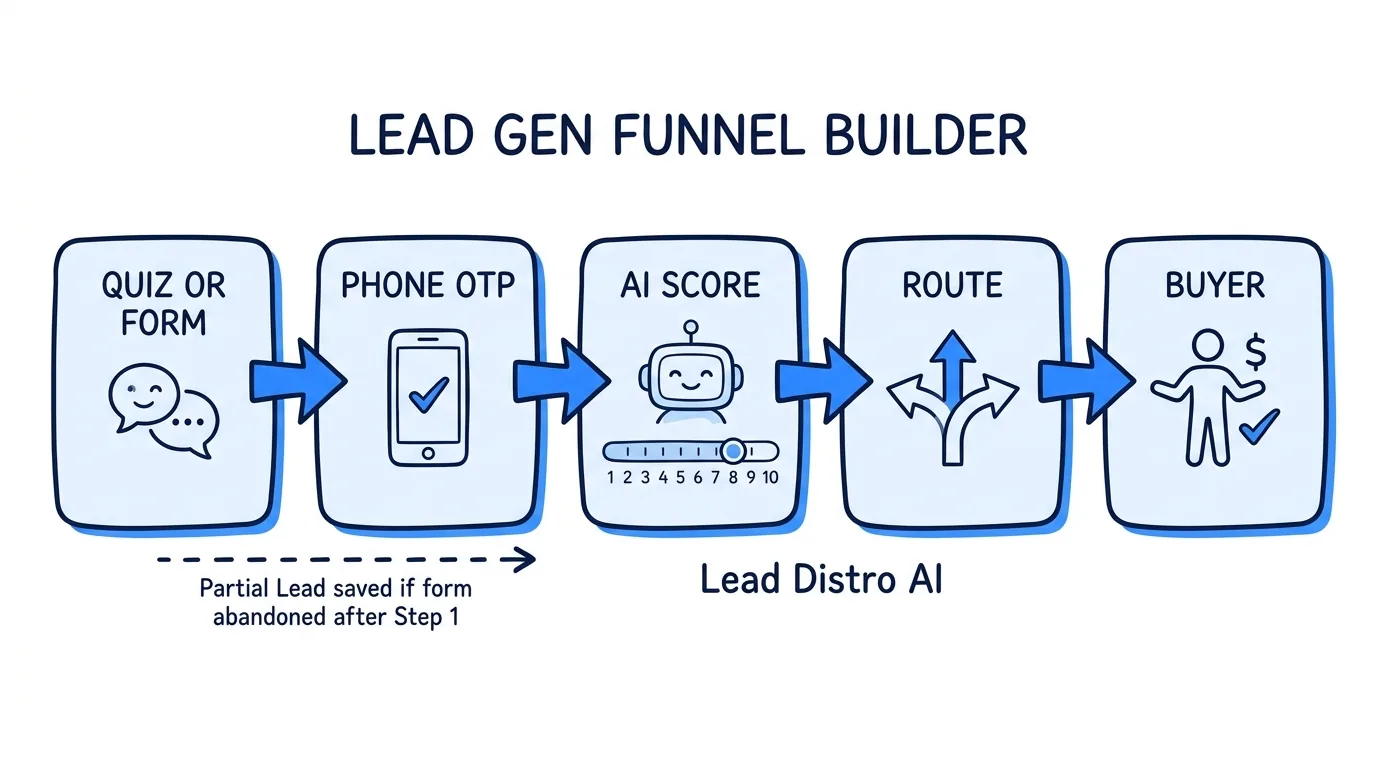
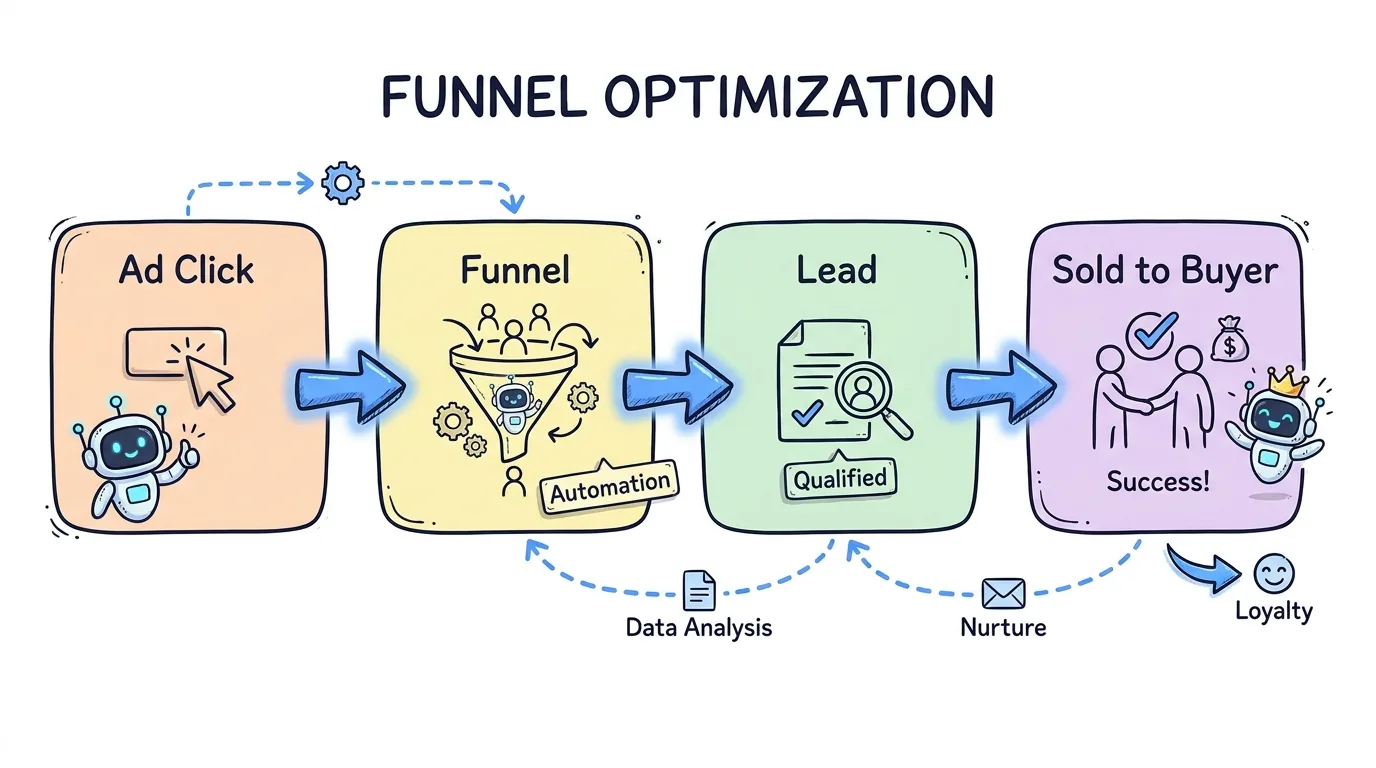
Funnel optimization for a lead gen funnel means removing the friction a visitor feels and adding the proof a buyer needs: fewer form fields, easy questions first, a page that loads fast on a phone, an ad that matches the page, verified consent, and A/B tests judged by sold leads rather than raw submissions.
Every practice in this guide is tied to published research, not opinion. That matters because the baseline is lower than most agencies assume: across more than 41,000 landing pages, the Unbounce Conversion Benchmark Report puts the median landing page conversion rate at 6.6%. For pay-per-lead and pay-per-call agencies, the job does not end at the submit button either. A lead your buyer returns is worth nothing, so this guide measures each practice against buyer acceptance too. If you want to apply these steps in a live builder as you read, you can start a 7-day free trial and follow along.
In short: ask for less, ask the easy things first, load fast on mobile, prove consent, and test one change at a time against the number your buyers pay for.
Key Takeaways
- Cut fields before you add steps. Baymard Institute found that the number of form fields affects usability far more than the number of steps.
- Progress bars are not a free win. A meta-analysis of 32 experiments found constant progress indicators did not significantly reduce drop-off.
- Speed and mobile are conversion levers. In a Deloitte study for Google, a 0.1 second faster mobile site improved bounce rates on lead generation information pages by 8.3%.
- Plain language converts. Unbounce found pages written at a 5th to 7th grade reading level converted at 11.1%, versus 5.3% for professional-level writing.
- Judge every test by sold leads. A higher completion rate that lowers buyer acceptance can make you less money, not more.
What Funnel Optimization Means When You Sell Leads
For a business capturing leads for itself, funnel optimization usually means one number: submissions divided by visitors. When the lead is the product, three numbers matter, and they can move in opposite directions.
- Funnel conversion rate: the share of visitors who finish the funnel.
- Buyer acceptance rate: the share of delivered leads your buyer keeps instead of returning.
- Revenue per click: what you earn for every paid visitor, which is what your ad budget actually buys.
Most advice online optimizes only the first number. A shorter form, a vaguer question, or a removed qualifier can lift the funnel conversion rate and still cut revenue per click, because the extra leads are the ones buyers reject. The practices below are ordered so that each one raises completions without hiding information the buyer needs. Where a practice trades one number for another, we say so.
Cut Form Fields Before You Add Steps
The strongest evidence in form research is about field count, not step count. The Baymard Institute's checkout research found the average checkout has 11.3 form fields, while most sites need only 8, and concluded that "the number of form fields in a checkout impacts overall usability far more than the number of steps."
Nielsen Norman Group reached the same conclusion for lead forms. "Every time you cut a field or question from a form, you increase its conversion rate," wrote Kathryn Whitenton in NN/g's website forms usability guidelines, which describe cutting one of their own forms from 6 fields to 2.
For a lead seller, the test for every field is simple: does it qualify the lead or set its price? If not, cut it or derive it. City and state can come from a zip code, so ask for the zip only. Our guide to multi-step form lead generation covers how to split the fields that survive into short screens.
Order Questions From Easy to Personal
Question order shapes how fast a funnel feels. Put one-tap questions first (zip code, situation, timeframe) and personal details last, so early progress comes quickly and the phone number arrives after the visitor has already invested.
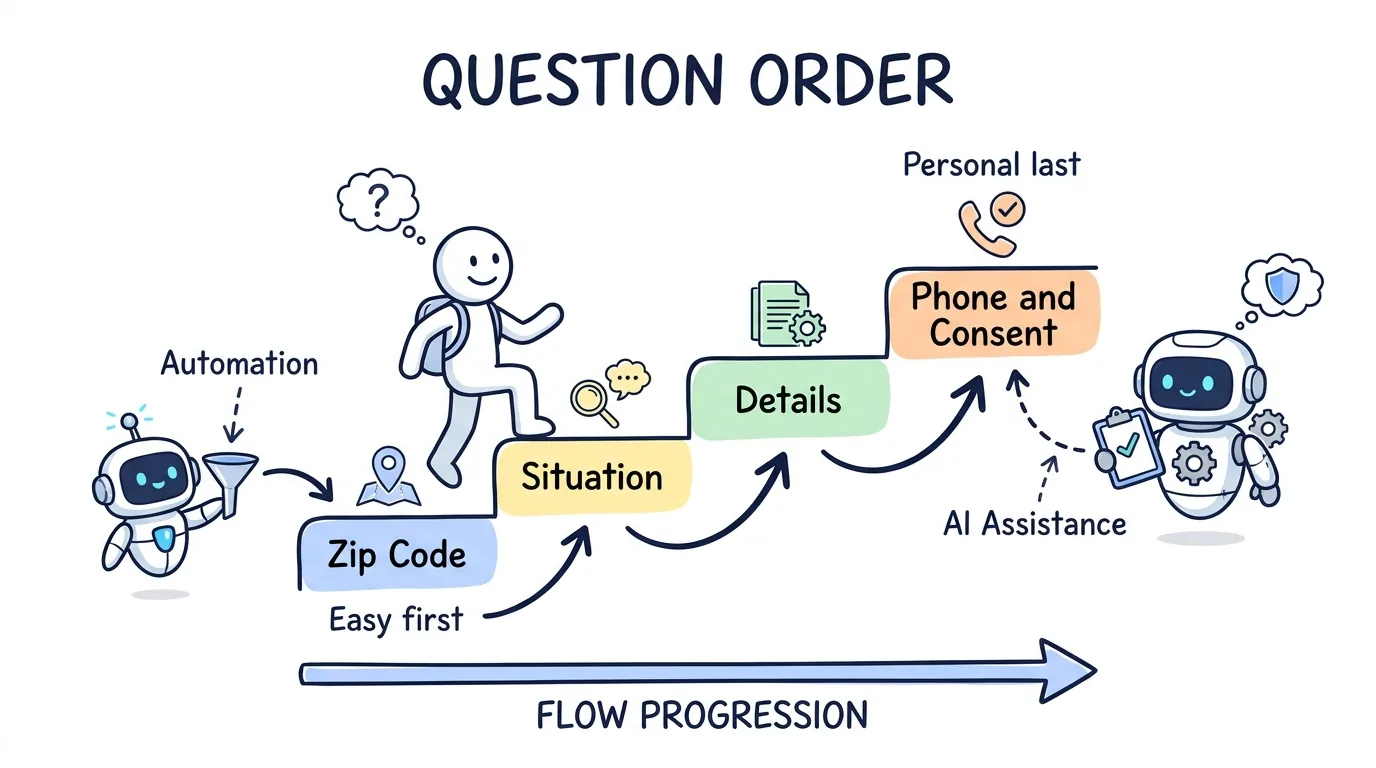
Progress bars deserve more caution than they usually get. A meta-analysis of 32 randomized experiments by Ana Villar, Mario Callegaro, and Yongwei Yang, published in Social Science Computer Review, found that a constant progress indicator did not significantly reduce drop-off. Speed was the deciding factor: "Fast-to-slow indicators reduced drop-offs, whereas slow-to-fast indicators increased drop-offs."
That research studied web surveys, not lead forms, so treat it as a hypothesis to test rather than a rule. The practical takeaway still holds: if you show a progress bar, front-load the easy questions so it moves fast early. Our quiz funnel guide covers how many questions to ask and how to branch away visitors who do not qualify.
Make the Page Fast on a Phone
Most paid lead traffic is mobile, and mobile is where funnels leak. In the Unbounce benchmark data, 83% of the visits analyzed happened on mobile devices, while desktop converted 8% better on average. The gap is where funnel optimization pays off first.
Speed is the most measurable mobile lever. In Milliseconds Make Millions, a study prepared by Deloitte and commissioned by Google, a 0.1 second improvement in mobile site speed improved bounce rates on lead generation information pages by 8.3% and lifted retail conversions by 8.4%. Google's web.dev case studies add a sales example: Vodafone improved Largest Contentful Paint by 31% and saw 8% more sales.
Practical fixes for a lead funnel:
- Compress images and avoid autoplay video above the first question.
- Remove third-party scripts that do not report a conversion you use.
- Test on a real phone over a cellular connection, not office Wi-Fi.
Match the Ad and Write Plainly
Message match means the first screen repeats the promise of the ad that sent the click. If the ad says "See if you qualify for a free case review," the first screen should say that too, not open with your company name.
Plain wording matters as much as matching wording. Unbounce found that pages written at a 5th to 7th grade reading level converted at 11.1%, more than double the 5.3% of professional-level writing, and that word count correlated negatively with conversion. Those are correlations, so test them, but they point the same way as the field research above: less to read, less to do.
Channel also changes what a good landing page conversion rate looks like. On Unbounce's legal benchmark page, legal landing pages convert at a 6.3% median, with paid search at 8.3% and paid social at 4.8%. A Facebook funnel and a Google Ads funnel for the same offer should not be held to the same landing page conversion rate.
Treat Consent as Part of the Conversion
A lead without provable consent is a lead many buyers will not pay for. Under the FCC rule at 47 CFR 64.1200, prior express written consent for telemarketing calls made with an autodialer or prerecorded voice requires a written agreement bearing the consumer's signature, a clear and conspicuous disclosure, and a statement that agreeing is not a condition of purchase.
For funnel optimization, that means consent language belongs next to the submit button in readable type, not hidden in a footer. It also means capturing proof at the moment of submission. A TrustedForm certificate from ActiveProspect or a Jornaya LeadiD token records what the visitor saw and agreed to, and our guide on what TrustedForm is explains how buyers verify it. Phone verification by text adds a second check that the number is real before the lead is sold. This is general information, not legal advice; have your counsel review your disclosure wording.
Give Callers a Path as Well as a Form
Some visitors would rather talk than type, especially in legal, insurance, and home services. A funnel that offers only a form loses them, and a funnel that shows one static phone number cannot tell you which ad or which step produced the call.
The fix is to treat the call as a second conversion inside the same funnel. Show a tracking number on the page, give each visitor their own number from a pool, and attribute the call to the funnel, the traffic source, and the ad just like a form submission. For pay-per-call agencies this is the main event, not a side channel, because the call is what the buyer pays for.
Once calls and forms are measured side by side, you can compare them honestly. A funnel step that loses form completions but gains qualified calls may be working exactly as it should.
A/B Test One Change, With Enough Traffic
Controlled experiments are how you separate a real lift from noise. Ron Kohavi, then general manager of Microsoft's Analysis and Experimentation team, and Stefan Thomke of Harvard Business School describe in Harvard Business Review how a small Bing headline change raised revenue by 12%. "It was the best revenue-generating idea in Bing's history, but until the test its value was underappreciated," they wrote.
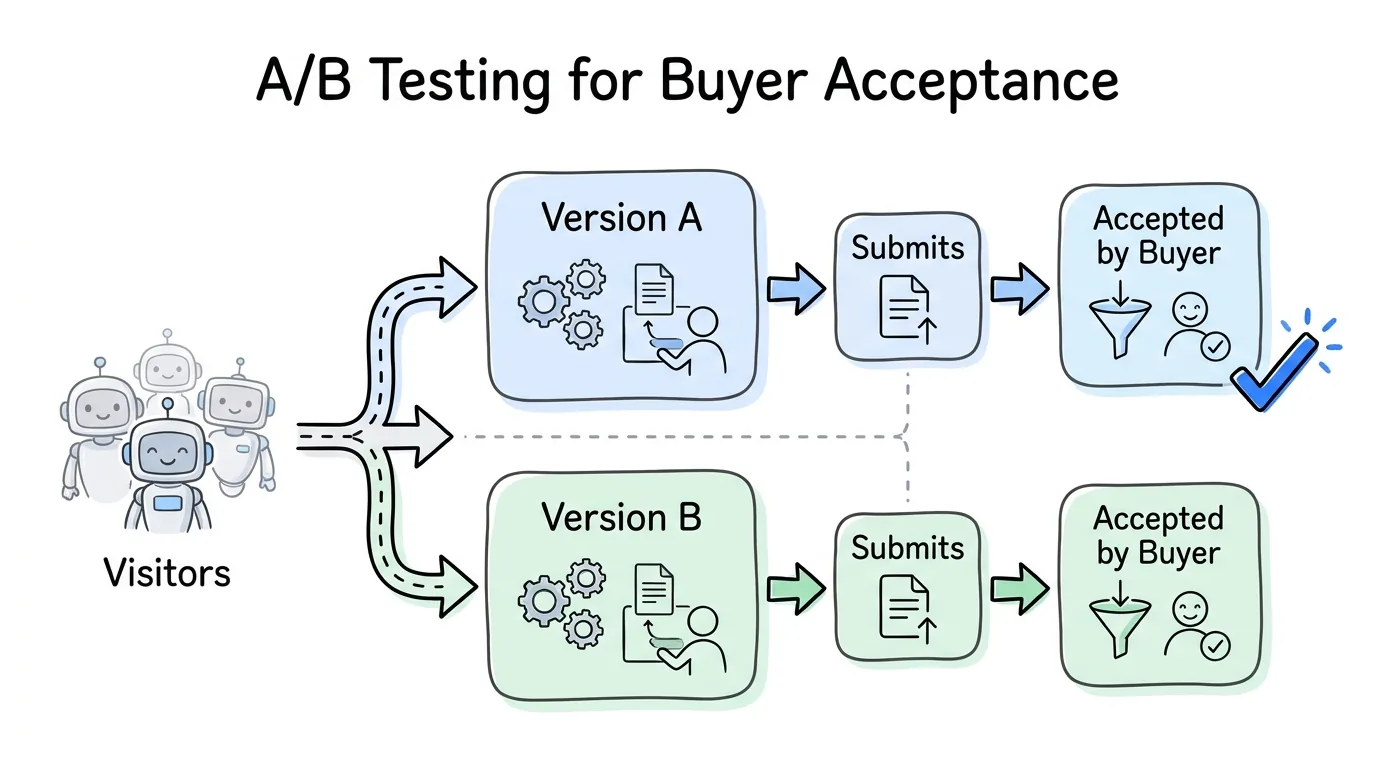
Three rules keep a funnel test honest:
- Change one thing. Test the headline or the question order, never both at once.
- Size the test first. With the standard two-proportion formula at 95% confidence and 80% power, detecting a lift from a 10% to a 12% conversion rate needs about 3,800 visitors per version.
- Do not stop early. Peeking and stopping at the first good day is how false winners ship.
Measure Funnel Optimization by Sold Leads, Not Submits
Here is a worked example of why the metric matters. Version A converts 10% of 1,000 clicks into 100 leads, and buyers accept 70% of them: 70 sold leads. Version B converts 13% into 130 leads, but its looser questions drop buyer acceptance to 50%: 65 sold leads. Version B wins on funnel conversion rate and loses on revenue.
| Practice | What the research found | Source | First test to run |
|---|---|---|---|
| Fewer fields | Field count affects usability more than step count | Baymard Institute | Remove one field the buyer does not filter on |
| Question order | Fast-to-slow progress reduced drop-off | Villar, Callegaro, Yang | Move the easiest question to screen one |
| Mobile speed | 0.1s faster improved lead gen bounce rates by 8.3% | Deloitte for Google | Cut the heaviest script or image |
| Plain language | 5th to 7th grade pages converted at 11.1% | Unbounce | Rewrite the first screen in shorter words |
| Message match | Paid search and paid social convert differently | Unbounce legal data | Repeat the ad headline on screen one |
| Consent proof | Written consent has specific legal elements | 47 CFR 64.1200 | Move the disclosure next to the button |
| Testing discipline | Small changes can drive large revenue shifts | Kohavi and Thomke, HBR | Size the next test before launching it |
How Lead Distro AI Supports Funnel Optimization
Lead Distro AI builds the funnel and routes the lead on the same platform, so the test results include what happens after the submit. You can see the full workflow in the product tour, and the funnel builder page lists every feature.
- Step drop-off analytics: the share of visitors who quit at each step, biggest drop first, with time on step beside it.
- A/B tests: split traffic from 10% to 90%, keep each visitor on one version, see when there is enough traffic to trust the result, and compare accepted leads and revenue per version, not just submits.
- Funnel grading: your AI assistant can score a funnel against quiz best practices out of 20 and name the three fixes most likely to win more leads.
- Consent and verification: TrustedForm and Jornaya, plus phone verification by text that is enforced on our servers at submit.
- Tracking: browser and server-side Meta events with a shared event id, plus Google Ads, GA4, and TikTok.
Plans start at $147 per month for Call Tracking Only. The full platform starts at $297 per month on Starter (5 live funnels), and Growth at $497 per month runs 20 live funnels and adds ping-post, your own ring tree, and white-label. Scale is by quote. See pricing for details.
FAQ
What is funnel optimization?
Funnel optimization is the practice of improving each step between an ad click and a finished conversion so more visitors complete it. For lead sellers it covers form length, question order, page speed, consent proof, and testing. The goal is not only a higher completion rate but more leads that buyers accept and pay for, because a returned lead earns nothing. Good funnel optimization changes one thing at a time and keeps only the changes that raise revenue per click.
What is a good funnel conversion rate for lead generation?
There is no single good number, because it depends on the channel, the offer, the vertical, and how strictly the funnel qualifies visitors. As a reference point, Unbounce reports a 6.6% median across all industries and 6.3% for legal pages. Benchmark against your own funnels by channel and vertical, and always pair the rate with your buyer acceptance rate, since a strict funnel can convert less and still earn more per click.
How do I improve my landing page conversion rate?
Start with the changes the research supports most: remove fields the buyer does not need, put easy questions first, make the page load fast on a phone, repeat the ad's promise on the first screen, and write in short, plain sentences. Then run one A/B test at a time with enough traffic to trust the result, and keep the winner only if buyer acceptance holds. Compare channels separately, because paid search and paid social visitors arrive with different intent.
How many form fields should a lead gen form have?
Use the fewest fields that still qualify and price the lead. Baymard Institute found most checkouts need about 8 fields while the average uses 11.3, and NN/g reports that cutting any field tends to raise conversion. For lead forms, keep every field a buyer filters on, derive anything you can (such as city and state from a zip code), and drop the rest. Fewer, better fields usually raise completions without hurting quality.
Do progress bars increase form completions?
Not reliably. A meta-analysis of 32 experiments found that constant progress indicators did not significantly reduce drop-off, while bars that moved fast early and slower later did reduce it, and slow-to-fast bars increased drop-off. If you use one, put quick, easy questions first so it advances fast, and A/B test the bar against no bar on your own traffic. The research studied web surveys, so your own data is the final word.
How long should a funnel A/B test run?
Run it until each version reaches the sample size you calculated before launch, not until one version looks ahead. Detecting a lift from 10% to 12% needs roughly 3,800 visitors per version at standard confidence levels. Also run full weeks so weekday and weekend traffic are both included, and judge the result by accepted leads, not submissions alone. Change only one element per test so you know what caused the difference.
Conclusion
Funnel optimization for lead generation comes down to a short list backed by real data: fewer fields, easy questions first, a fast mobile page, plain words that match the ad, provable consent, and disciplined A/B tests. The difference for lead sellers is the scoreboard. Measure each change by the leads your buyers accept and the revenue per click they produce, not by submissions alone. When the funnel and the routing live on one platform, that scoreboard is built in. The 7-day free trial requires a credit card, and you can cancel anytime during the trial without being charged.
Want to see step drop-off and A/B results that count accepted leads? Start your 7-day free trial and build your first funnel today.
About the Author
Founder & CEO of Lead Distro AI & Great Marketing AI
UC Berkeley graduate and former software engineer at Microsoft. Rafael built Lead Distro AI after managing over $10M in ad spend for performance marketing agencies (pay-per-lead and pay-per-call), including running campaigns for Neil Patel. He combines deep software engineering expertise with hands-on performance marketing experience to build tools that help these agencies scale profitably.
About Lead Distro AI
Capture, Route, and Sell Every Lead, Call, and Appointment
Capture, route, and sell leads, calls, and appointments from one platform, with funnels, call tracking, ping-post, and billing built in. Set it all up in minutes by chatting with AI.
Funnels
Quiz, form, appointment, VSL, and webinar templates
Call Tracking
Tracking numbers, call recordings, and per-call billing
4 Distribution Methods
Priority/Waterfall, Round Robin, Weighted, Ping-Post
Ping-Post and Live Bidding
Sell each lead and call to the highest bid
Real-Time P&L
Revenue, cost, and profit per campaign
Partner Portal
Your Destinations see their own leads and results