Call Recording Laws by State for Pay-Per-Call Operators
Call recording laws by state for pay-per-call operators: one-party vs all-party consent, the statutes, and what to log when callers cross state lines.

Rafael Hernandez
Founder & CEO
Ex-Microsoft SWE · $10M+ PPL ad spend
I hope you enjoy reading this blog post. If you want to try Lead Distro AI for free, click here.
Author: Rafael Hernandez | Founder & CEO of Lead Distro AI
Call recording laws by state fall into two groups: one-party consent, where one person on the call may agree to the recording, and all-party consent, where everyone on the call must agree. Federal law is one-party. On a pay-per-call tracking number, treat any caller of unknown location as an all-party caller.
A pay-per-call campaign sends a caller through a tracking number to a buyer, and each leg of that call can sit in a different state. This guide to call recording laws by state lists the statutes for the states we could verify against official sources on 2026-11-08, then explains what that means for calls that cross state lines. It is general information, not legal advice. Ask counsel before you set a recording policy.
Key Takeaways
- Federal law is one-party consent. 18 U.S.C. 2511(2)(d) allows recording when you are a party to the call or one party agreed, unless the purpose is criminal or tortious.
- Nine of the states verified below require all-party consent: California, Florida, Illinois, Maryland, Massachusetts, Montana, New Hampshire, Pennsylvania and Washington.
- The caller's state is usually unknown. A tracking number call can touch three states, so the safest policy is to meet the strictest rule in play.
- Put the notice before the ring tree. A campaign greeting plays before the buyers ring, which is the natural place for a recording notice.
- Compliance stays with the operator. Lead Distro AI records both legs when you turn recording on. It does not make a recording legal.
Is It Legal to Record Phone Calls? The Federal Rule
The federal Wiretap Act sets the floor. Under 18 U.S.C. 2511(2)(d), it is not unlawful for a person not acting under color of law to intercept a call "where such person is a party to the communication or where one of the parties to the communication has given prior consent." The exception does not apply when the recording is made to commit a criminal or tortious act.
A violation of the Act carries a fine, up to five years in prison, or both under subsection (4)(a). Federal law is one-party, but states may be stricter, and many are. So the question "is it legal to record phone calls" has no single answer. It depends on where the people on the call are.
One point stays open for pay-per-call: who counts as a party when a tracking number bridges two separate calls. That is a question for your lawyer, not for a blog post.
Call Recording Laws by State: One-Party vs All-Party Consent
The table lists only states where we read the rule in the official code, or in the Reporters Committee for Freedom of the Press (RCFP) Reporter's Recording Guide, on 2026-11-08. A state missing from the table is unverified, not one-party. Look up each missing state before you rely on it.
| State | Consent rule | Statute | Source read |
|---|---|---|---|
| Federal | One-party | 18 U.S.C. 2511(2)(d) | Cornell LII |
| California | All-party | Penal Code 632(a), confidential communications | RCFP guide |
| Florida | All-party | Fla. Stat. 934.03(2)(d) | Florida Legislature |
| Illinois | All-party | 720 ILCS 5/14-2(a)(2), surreptitious recording of a private conversation | Illinois General Assembly |
| Maryland | All-party | Cts. & Jud. Proc. 10-402(c)(3) | RCFP guide |
| Massachusetts | All-party | G.L. c. 272, 99 | Massachusetts Legislature |
| Montana | All-party for hidden recording | MCA 45-8-213(1)(c) | Montana Legislature |
| New Hampshire | All-party | RSA 570-A:2 | NH General Court |
| Pennsylvania | All-party | 18 Pa.C.S. 5704(4) | PA General Assembly |
| Washington | All-party | RCW 9.73.030 | Washington Legislature |
| Georgia | One-party | O.C.G.A. 16-11-62, 16-11-66(a) | RCFP guide |
| New York | One-party | Penal Law 250.00, 250.05 | RCFP guide |
| Ohio | One-party | R.C. 2933.52(B)(4) | Ohio Laws |
| Texas | One-party | Penal Code 16.02 | RCFP guide |
These are the two party consent states we could confirm. Read the wording, not just the label. Illinois reaches recording done "in a surreptitious manner." Montana's subsection covers a "hidden electronic or mechanical device." Massachusetts makes it an offense to "secretly record" without "prior authority" from all parties, with up to five years in state prison. Pennsylvania lets a person intercept a call where all parties have given prior consent.
Washington adds a rule that matters to operators. Consent counts as obtained when one party "has announced to all other parties engaged in the communication or conversation, in any reasonably effective manner, that such communication or conversation is about to be recorded," and that announcement must itself be recorded.
Why a Pay-Per-Call Caller's Location Decides It, Not Yours
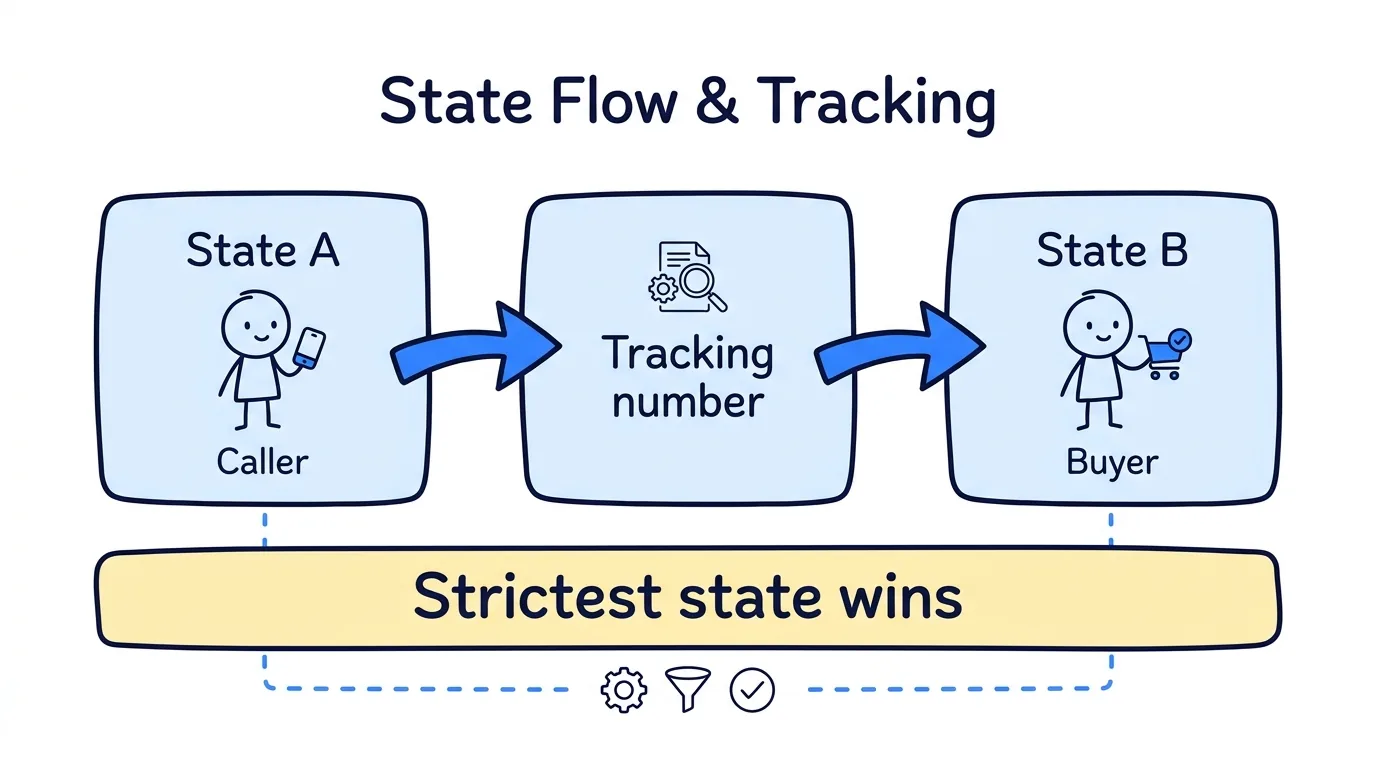
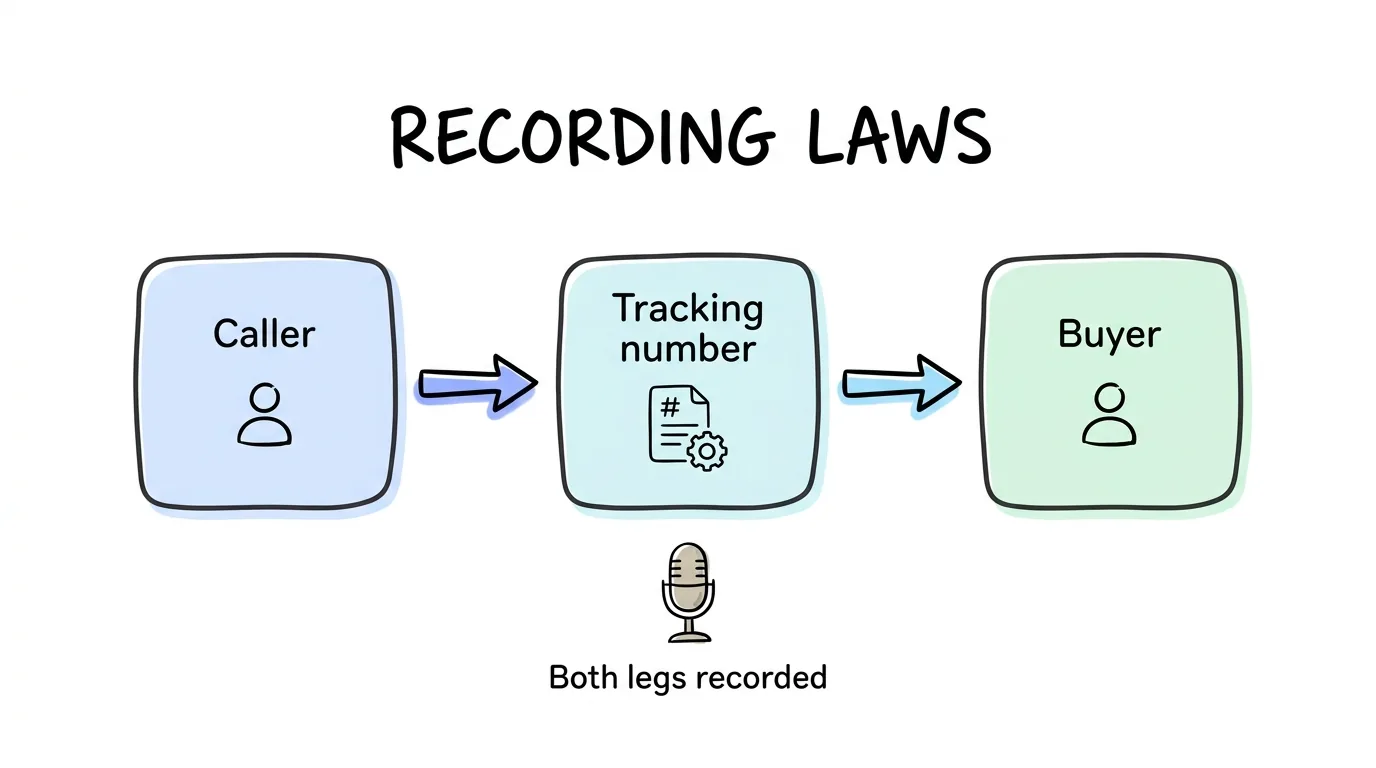
A caller in Florida dials a tracking number you rent in Texas. The platform rings a buyer in California. That is three states on one call, and the tracking number tells you nothing about where the caller stands. An area code shows where a number was issued, not where the person is when they dial.
Which state's law a court would apply to a call like this is a question for counsel, and this article does not answer it. The safe operating rule is simpler: meet the strictest rule among the states that could be involved. For most operators that means one policy for every call, with a recording notice for all callers, rather than a state-by-state switch you cannot run without knowing the caller's location.
The same logic applies to the buyer leg. If your buyers sit in all-party states, the rule follows the call to them. Read what is call tracking if you want the mechanics of how a number routes calls before you write the policy.
What a Tracking-Number Call Records and Where a Notice Can Play
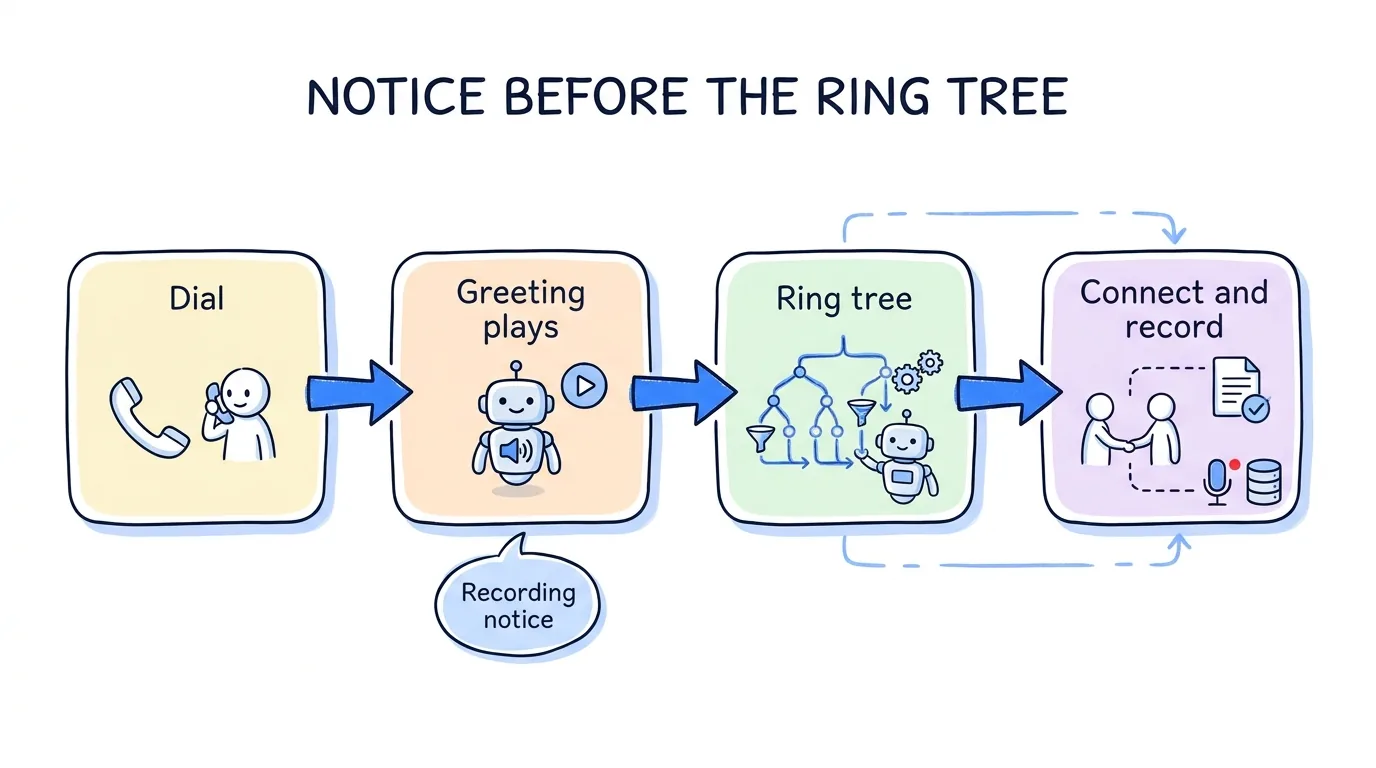
Recording on Lead Distro AI is opt-in per campaign. When it is on, both legs of the call are recorded: the caller and the buyer. A campaign greeting, typed as text or uploaded as audio, plays before the ring tree. That makes the greeting the natural slot for a recording notice, because the caller hears it before any buyer is connected.
The platform does not add a consent notice by itself and does not enforce state rules. You write the greeting. You decide what it says. Compliance stays with you.
Recording is usage-based. Per the call tracking setup guide, tracking numbers rent for $2 a month (local) or $3 a month (toll-free), call time is $0.04 per inbound minute, and recording adds $0.01 per recorded minute. See call tracking for pay-per-call for the full feature set.
Washington asks that the announcement itself be recorded. Place a test call to your tracking number and listen to the saved recording to see whether your greeting is captured. Then ask counsel what your setup needs.
What to Log and How Long to Keep Recordings
A recording alone does not protect you in a dispute. The context around it does. For each call, keep the campaign, tracking number, caller ID, date and time, the buyer who answered, the duration and the recording itself. Lead Distro AI's call log holds those fields, plus billing status.
Add one thing the call log cannot know: the exact text of the greeting in use on that date. Save a dated copy each time you change it. If a caller later says no notice played, a dated greeting is your best evidence.
Recordings and transcripts hold the same conversation, so give them the same retention period. The statutes in the table cover how a recording is made. They do not set how long you keep it, and we are not giving a number. Retention comes from your buyer contracts, privacy rules and your counsel. Delete on schedule, and keep the schedule in writing.
Buyers Who Record on Their Side
Your recording policy does not cover your buyers. A buyer's call center usually records on its own phone system, under its own rules, in its own state. When a buyer answers a transferred call, two recordings of the same conversation may exist, and each side is responsible for its own.
Put the split in the buyer agreement. Say who plays the notice, who records, who stores the files and who answers a subpoena or complaint. Ask each buyer for the text of their own recording notice so you know what the caller hears at the connect.
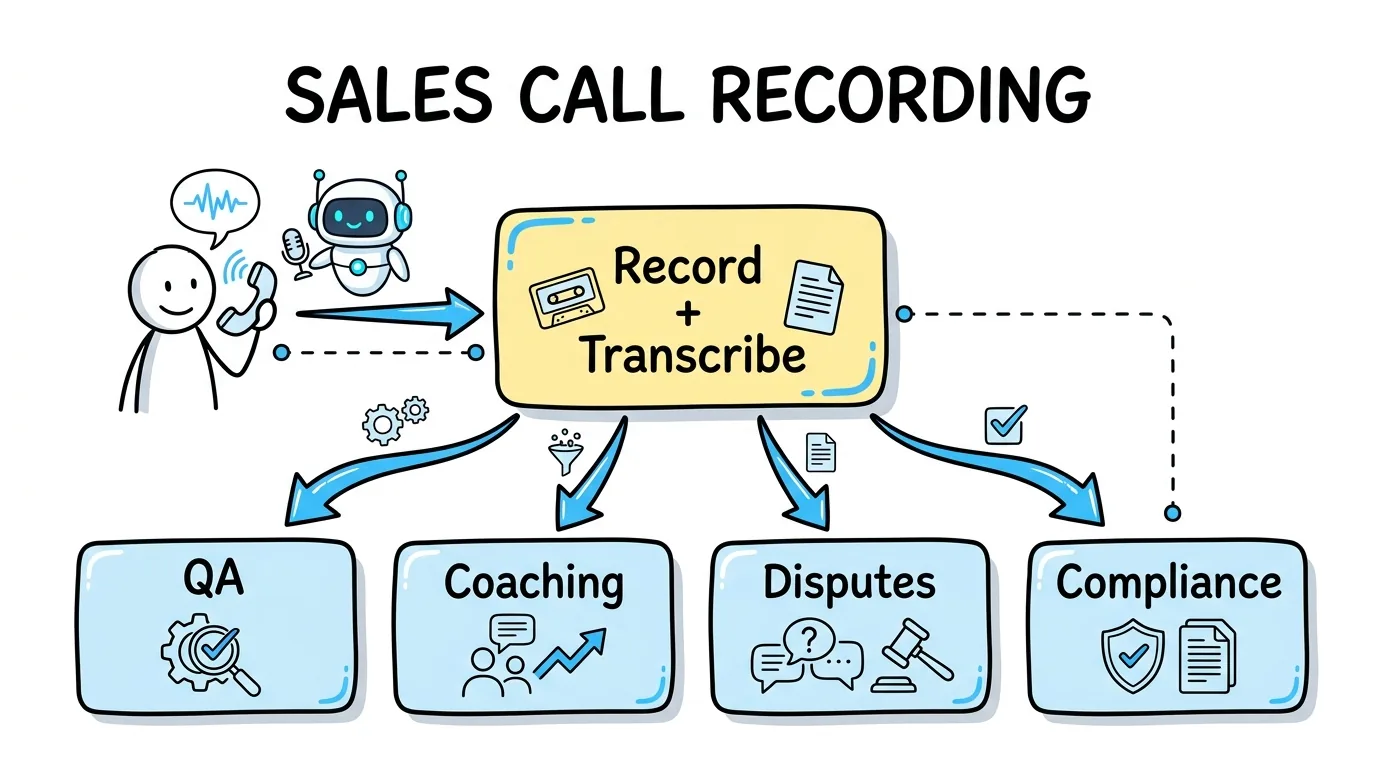
This matters for disputes too. When a buyer says a call was too short or unqualified, a recording from your side settles the question faster than an argument. Read call monitoring software for how monitoring and recorded QA protect buyer billing, and sales call recording software for the wider tool landscape.
What Recording Law Does Not Cover
Call recording laws by state answer one question: who must agree to the recording. Consent to be contacted is a different question. The TCPA compliance for lead generation guide covers the Telephone Consumer Protection Act, which governs who you may call or text and what consent you need first. A compliant recording notice does not satisfy TCPA, and a TCPA consent form does not satisfy a state wiretap law.
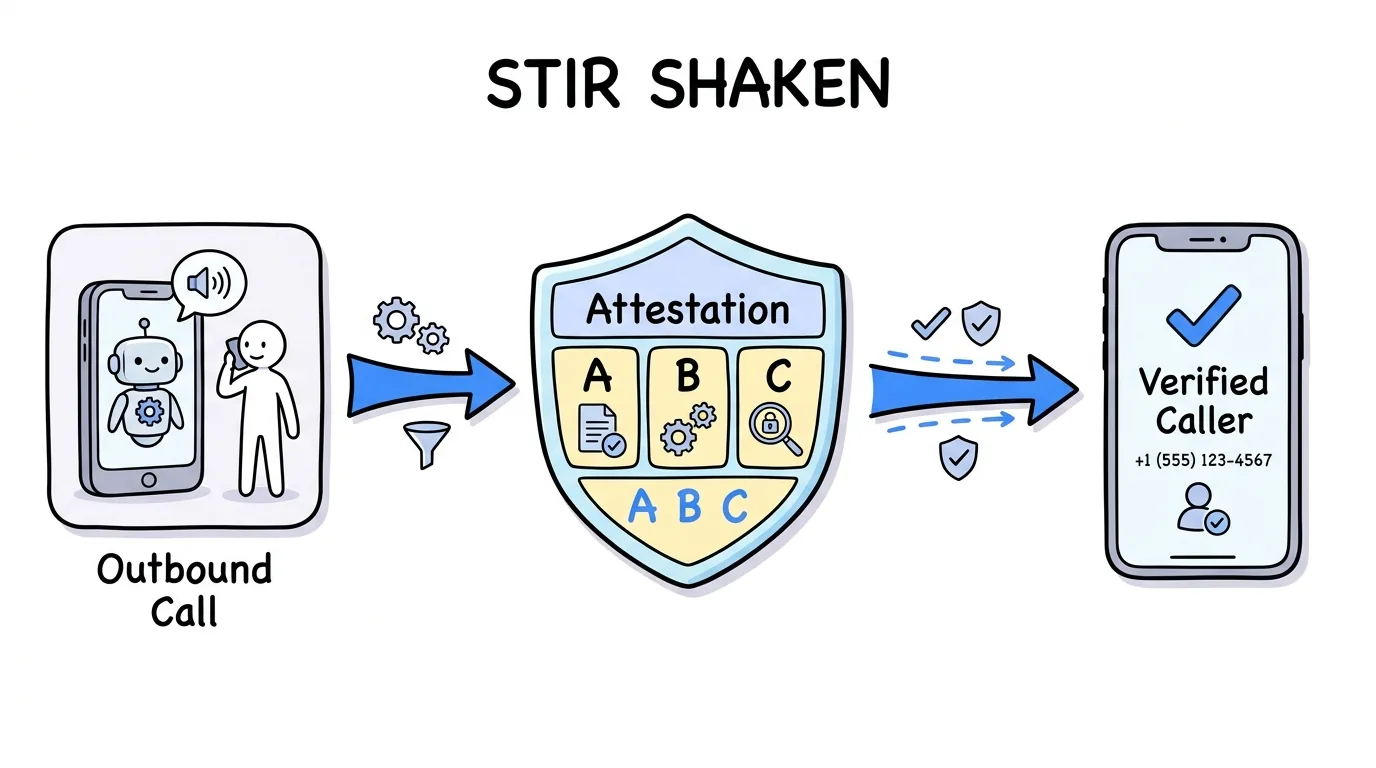
The same separation holds for other call rules. Caller ID authentication has its own rules, which the STIR/SHAKEN guide for pay-per-call covers. Each rule has its own statute, its own penalty and its own evidence you need to keep.
Treat call recording laws by state as one row in a larger compliance checklist. Build that checklist with counsel who knows the states your callers and buyers sit in.
FAQ
Is it legal to record phone calls without telling the other person?
It depends on the state. Federal law and states such as Texas, New York, Georgia and Ohio allow recording when you are a party to the call or one party agreed. States such as California, Florida, Illinois, Maryland, Massachusetts, Montana, New Hampshire, Pennsylvania and Washington require every party to agree. Recording for a criminal or tortious purpose is unlawful under federal law either way. Ask counsel before you rely on any state rule.
What is the difference between one-party and all-party consent?
One-party consent means a single participant, often the person recording, can agree to the recording. All-party consent, sometimes called two-party consent, means every person on the call must agree. A recording notice that the caller hears before the call connects is the usual way to get that agreement. Consent rules differ by state, so confirm the wording of each statute with counsel before you write a policy for your campaigns.
Which call recording laws by state apply to a call that crosses state lines?
We do not give a rule for this, and the answer is a question for counsel. The practical approach for operators is to meet the strictest rule among the states that could be involved. A caller's location is usually unknown when a tracking number rings, so one policy with a notice for every caller is simpler than switching by state. Counsel can confirm whether that policy fits every state you serve and every buyer you route to.
Does Lead Distro AI make call recording legal?
No. Recording is opt-in per campaign, and when it is on, both legs of the call are recorded. A campaign greeting can play before the ring tree, typed or uploaded as audio. The platform does not add a consent notice by itself or enforce state rules. Following your jurisdiction's one-party or all-party rules stays with the operator, so write the greeting with counsel and test it before you turn on traffic.
Where should a recording notice play on a pay-per-call?
Before the call reaches any buyer. The campaign greeting plays before the ring tree, so a notice in the greeting reaches the caller before a buyer answers. Test it by calling your own tracking number and listening to the saved recording. Washington requires the announcement itself to be recorded, so check that your greeting appears in the file. Fix the wording first, then send traffic, and keep a dated copy of the final greeting text on file.
Do my buyers have to tell callers they record?
Your buyer agreement decides who plays a notice, and each buyer's state law decides what they owe the caller. Your recording and your buyer's recording are separate. Ask each buyer for their notice text and write down who is responsible for what. Do not assume your greeting covers the buyer's own recording, and keep their notice text on file next to your own dated greeting. Update both files whenever either side changes its notice.
Conclusion
Call recording laws by state split into one-party and all-party rules, and a pay-per-call tracking number crosses state lines on most calls. The simplest policy is one notice for every caller, played in the greeting before the ring tree, with a dated log behind it. This table lists only states verified against official sources on 2026-11-08, so check any other state yourself and ask counsel before you rely on it.
If you run pay-per-call campaigns, start a 7-day trial to set up recording and a campaign greeting on a tracking number of your own.
This article is general information, not legal advice. Statutes change and courts interpret them. Ask counsel in each state you operate in before you set a recording policy.
About the Author
Founder & CEO of Lead Distro AI & Great Marketing AI
UC Berkeley graduate and former software engineer at Microsoft. Rafael built Lead Distro AI after managing over $10M in ad spend for performance marketing agencies (pay-per-lead and pay-per-call), including running campaigns for Neil Patel. He combines deep software engineering expertise with hands-on performance marketing experience to build tools that help these agencies scale profitably.
About Lead Distro AI
Capture, Route, and Sell Every Lead, Call, and Appointment
Capture, route, and sell leads, calls, and appointments from one platform, with funnels, call tracking, ping-post, and billing built in. Set it all up in minutes by chatting with AI.
Funnels
Quiz, form, appointment, VSL, and webinar templates
Call Tracking
Tracking numbers, call recordings, and per-call billing
4 Distribution Methods
Priority/Waterfall, Round Robin, Weighted, Ping-Post
Ping-Post and Live Bidding
Sell each lead and call to the highest bid
Real-Time P&L
Revenue, cost, and profit per campaign
Partner Portal
Your Destinations see their own leads and results