Sales Call Recording Software: Best Tools for QA and Coaching
Sales call recording software captures, transcribes, and scores every call for QA, coaching, and compliance. Compare the best tools and how to choose one.

Rafael Hernandez
Founder & CEO
Ex-Microsoft SWE · $10M+ PPL ad spend
I hope you enjoy reading this blog post. If you want to try Lead Distro AI for free, click here.
Author: Rafael Hernandez | Founder & CEO of Lead Distro AI
Last Updated: June 21, 2026
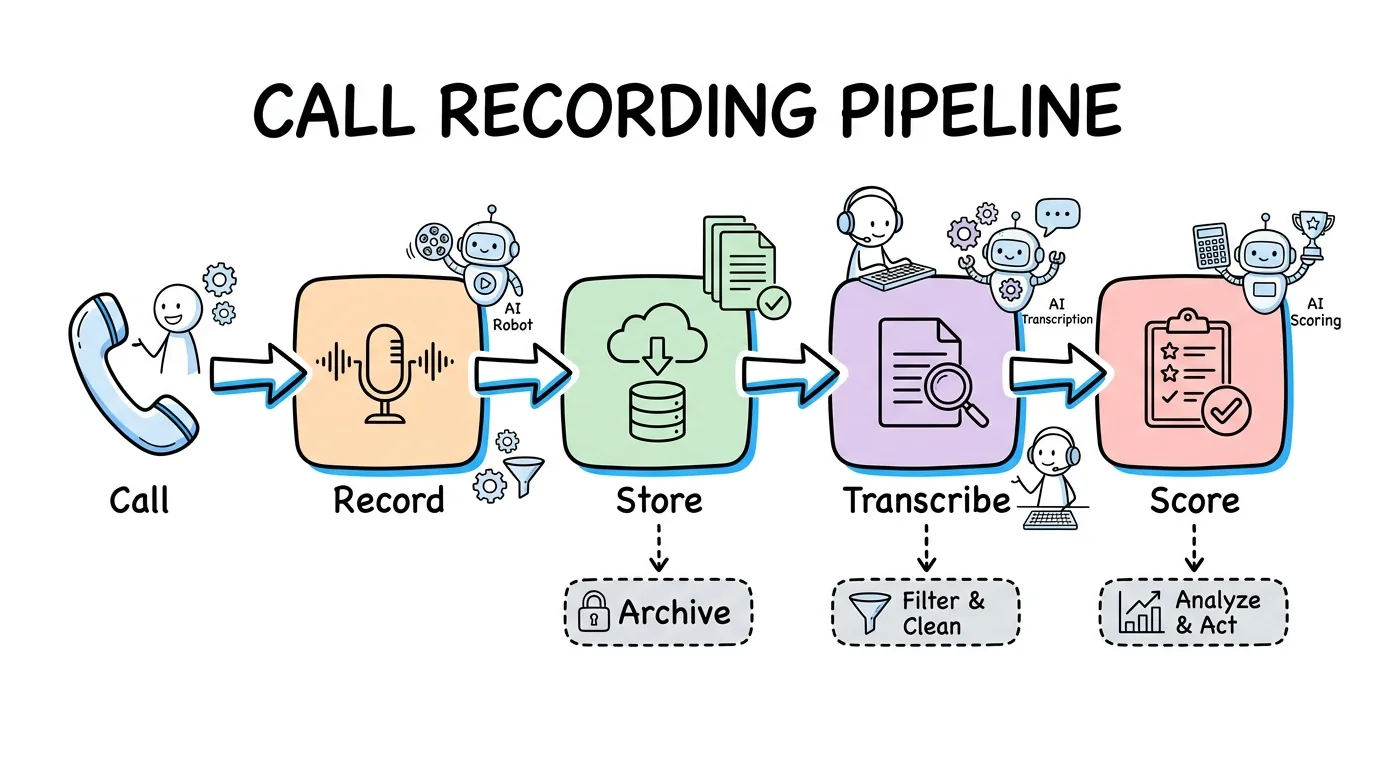
Sales call recording software captures, stores, and transcribes every sales call so teams can review what was said for quality assurance, coaching, dispute resolution, and compliance. Instead of relying on a rep's memory or hand-typed notes, the software records the audio, turns it into a searchable transcript, timestamps key moments, and (in the better tools) scores the conversation against a rubric. For a sales manager, that recording is the source of truth: it shows exactly how a deal was pitched, which objection lost the call, and whether the rep captured proper consent. For a pay-per-call agency, the recording is also the receipt that proves a billable call actually happened and met the buyer's qualification criteria.
This matters because most of what happens on a call is invisible without it. According to Salesforce's State of Sales research, reps spend only about 28% of their week actually selling, so every coachable minute counts. The right sales call recording software turns raw audio into structured data you can coach against, audit, and bill from. This guide explains what the software does, the core features to look for, the best tools to evaluate, and how recording fits agencies that need to verify and QA the calls they route and bill. For the broader category, see our pillar on call center call recording software, and start your 7-day free trial to capture and route calls in one place.
Key Takeaways
- Sales call recording software records, transcribes, and scores calls so managers can run QA, coach reps from real conversations, resolve disputes, and prove compliance.
- The core features to compare are recording, transcription, playback with timestamps, conversation scoring, and consent capture, plus search and CRM sync.
- Recording sales calls legally depends on consent law: federal law and many states allow one-party consent, but two-party (all-party) states require every participant to agree.
- For pay-per-call agencies, the recording is the billing receipt that verifies a routed call met the buyer's duration and qualification criteria before it gets invoiced.
- Lead Distro AI captures and records the calls it tracks and routes, so the same platform that bills a buyer also holds the recording that proves the call.
- Call recording pricing is usage-based: a per-number monthly fee plus a per-minute inbound rate, layered on top of the platform subscription.
What Sales Call Recording Software Does
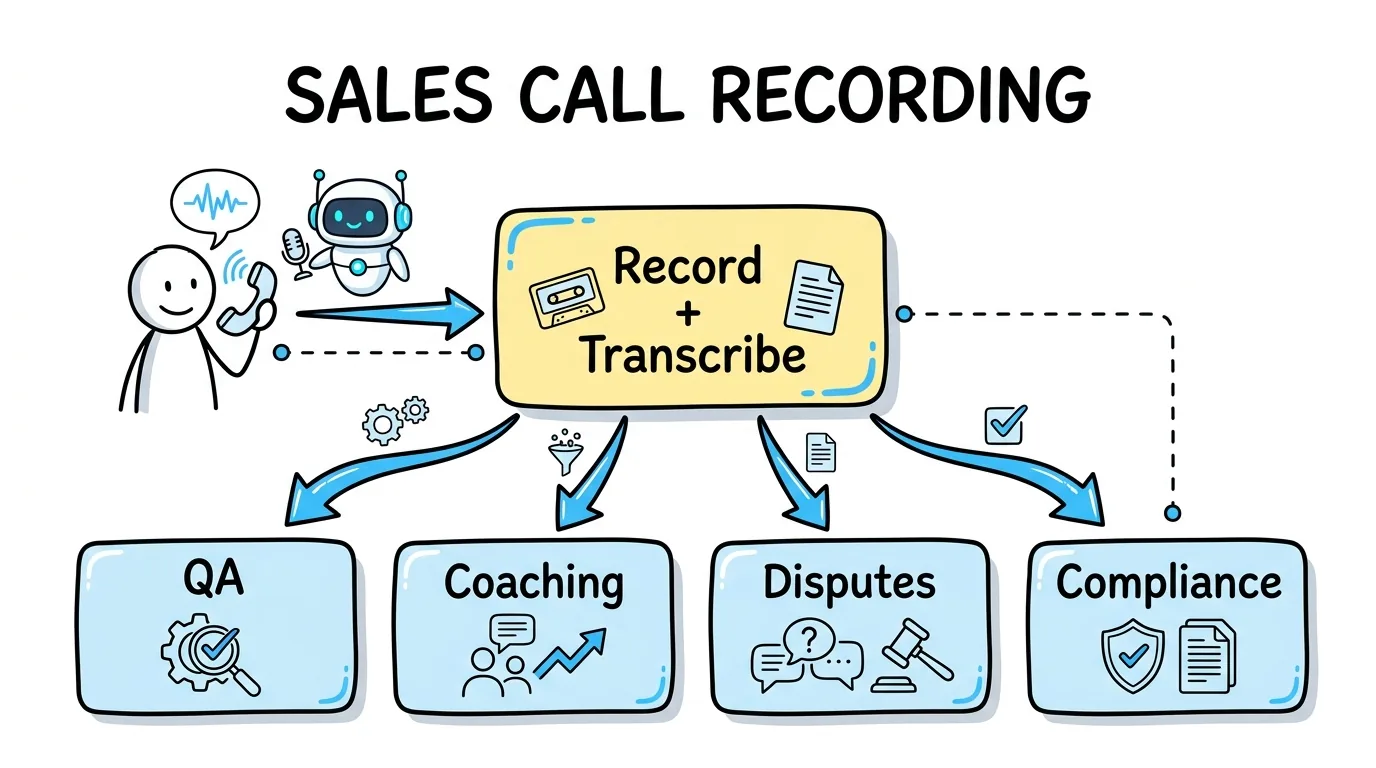
Sales call recording software does four jobs that a notepad never could. First, it records the live audio of inbound and outbound sales calls automatically, with no rep action required. Second, it transcribes that audio into a searchable, timestamped text record using speech-to-text. Third, it offers playback so a manager can jump to the exact moment a discount was promised or an objection surfaced. Fourth, the stronger tools score each call against a rubric, flagging whether the rep followed the script, captured consent, and hit the qualifying questions.
The point is to convert ephemeral conversations into durable, auditable data. When you record sales calls, you can settle a "he said, she said" dispute with a buyer, onboard new reps faster with real examples, and spot the language that closes deals. Gong's research found that top performers talk for only about 46% of a discovery call, letting the prospect speak the rest; you cannot coach toward a number like that without the recording to measure it. Call recording for sales is the foundation that everything else (coaching, QA, compliance, billing) is built on.
Key Features to Compare
The features that separate a real sales call recording software platform from a basic voice recorder fall into a short checklist. Evaluate any tool against these:
- Recording: automatic capture of inbound and outbound calls, with secure storage and retention controls.
- Transcription: accurate speech-to-text with speaker separation, so you can read and search a call instead of scrubbing audio.
- Playback and timestamps: jump-to-moment navigation and keyword search inside a call, not just a play button.
- Conversation scoring: a rubric or AI model that grades each call on script adherence, talk ratio, objection handling, and qualification.
- Consent capture: an automated disclosure ("this call may be recorded") and a logged record that consent was given, which is the backbone of compliance.
- CRM and routing sync: the recording attaches to the right contact, deal, or buyer so it lives where the team already works.
A platform that records sales calls but cannot transcribe or score them leaves most of the value on the table. The whole reason to record is to act on what you find, so prioritize tools where the transcript and the score are first-class, not add-ons.
The Best Sales Call Recording Software Tools
There is no single "best" tool; the right pick depends on whether you are an in-house sales team coaching reps or an agency verifying billable calls. The table below compares the most common options agencies and sales teams evaluate, with their primary focus and pricing model.
| Platform | Best For | Key Feature | Pricing Model | Free Trial |
|---|---|---|---|---|
| Lead Distro AI | Pay-per-lead and pay-per-call agencies | Records, scores, and routes/bills calls in one platform | $297/mo flat + usage-based call fees | 7 days (card required) |
| Gong | Enterprise revenue teams | Deep conversation intelligence and deal analytics | Custom annual | No |
| CallRail | In-house marketers | Marketing call tracking plus recording and transcription | Per-number + per-minute usage | Yes |
| Salesforce Sales Cloud | CRM-first sales orgs | Recording tied to the CRM record of truth | Per-seat license | Yes |
| Ringba | Pay-per-call call buyers | Real-time call routing with recording for the marketplace | Usage-based | Yes |
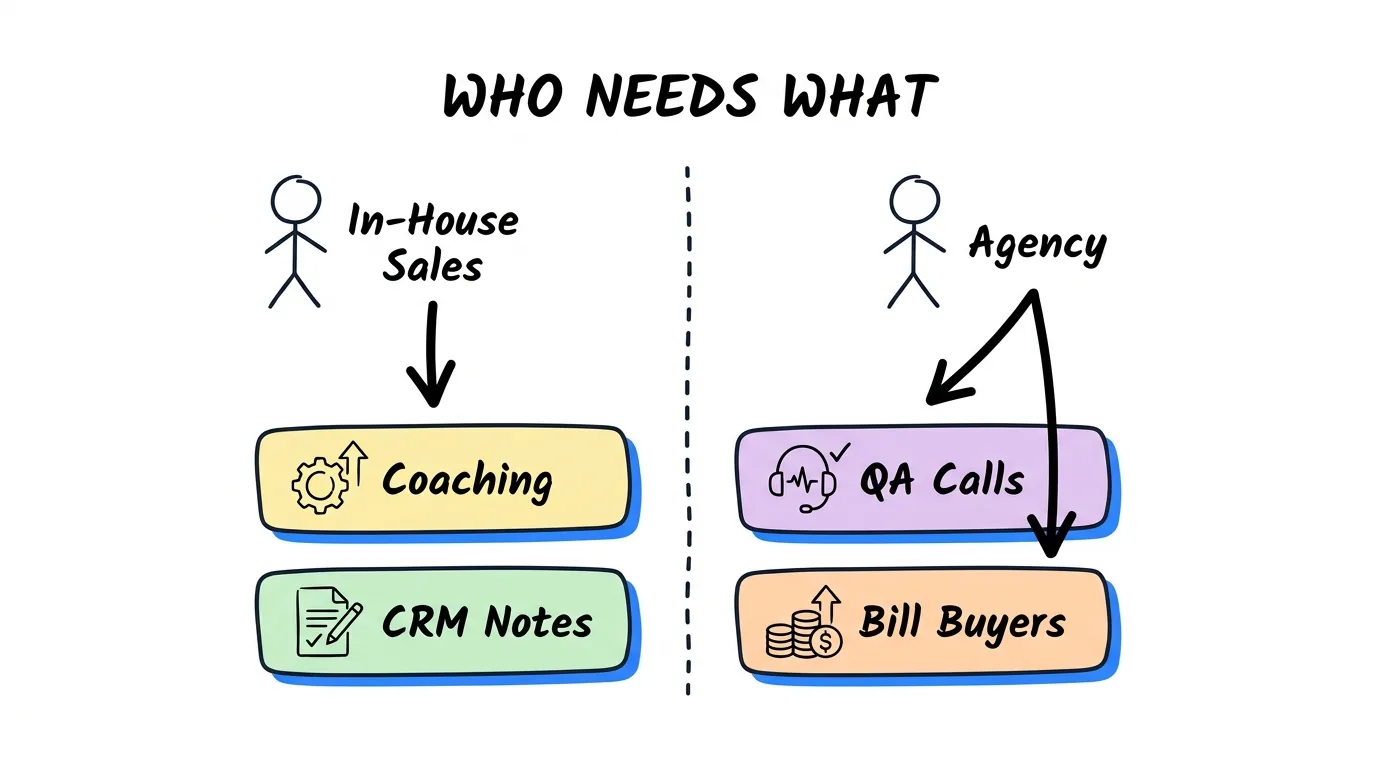
Gong and Salesforce excel at coaching and CRM-native recording for in-house teams. CallRail and Ringba lead on the marketing and pay-per-call side. Lead Distro AI is built for agencies that need both pay-per-lead and pay-per-call in one place, so the recording, the score, and the buyer billing all live together. You can explore the full platform in the product tour to see how recording connects to routing.
How Recording Powers QA and Coaching
Recording sales calls turns coaching from opinion into evidence. A manager who listens to ten real calls a week can spot the exact phrasing that loses deals, the questions reps skip, and the objection that keeps surfacing. Without recordings, a "QA process" is just a manager guessing at what happened. With them, you can build a scorecard, grade calls against it, and show a rep the precise moment a call went sideways.
The data backs this up. According to Harvard Business Review, sales teams that adopt data-driven coaching see meaningful gains in win rates over those that coach on instinct. Lead scoring compresses the work further: instead of a manager listening to every call, the software surfaces the handful that need a human ear. As I tell our own team at Lead Distro AI, "You cannot improve a number you never measure, and a call you never recorded is a number you will never have." That is why call recording for sales is the first system any serious sales operation puts in place, ahead of fancier tooling.
Recording, Compliance, and Consent Law
Recording calls is legal, but how you do it is governed by consent law, and getting it wrong creates real liability. Under U.S. federal law, recording is permitted with one-party consent, meaning one participant (your rep) can consent. But roughly a dozen states require two-party (all-party) consent, where every participant must agree before recording. California, Florida, and Pennsylvania are well-known two-party states.
The safe practice is to record consent for everyone: play an automated disclosure at the start of the call and log that it played. According to the Digital Media Law Project's guide to recording phone calls, when callers are in different states, the strictest applicable law generally controls, so building all-party consent into your sales call recording software is the defensible default. Pay-per-call agencies have an added layer: TCPA rules govern how leads are contacted, so the same consent record that protects your recording also supports your compliance posture. This is judgment-heavy territory; treat the disclosure as non-negotiable and consult counsel for your specific states.
Call Recording for Pay-Per-Call Agencies
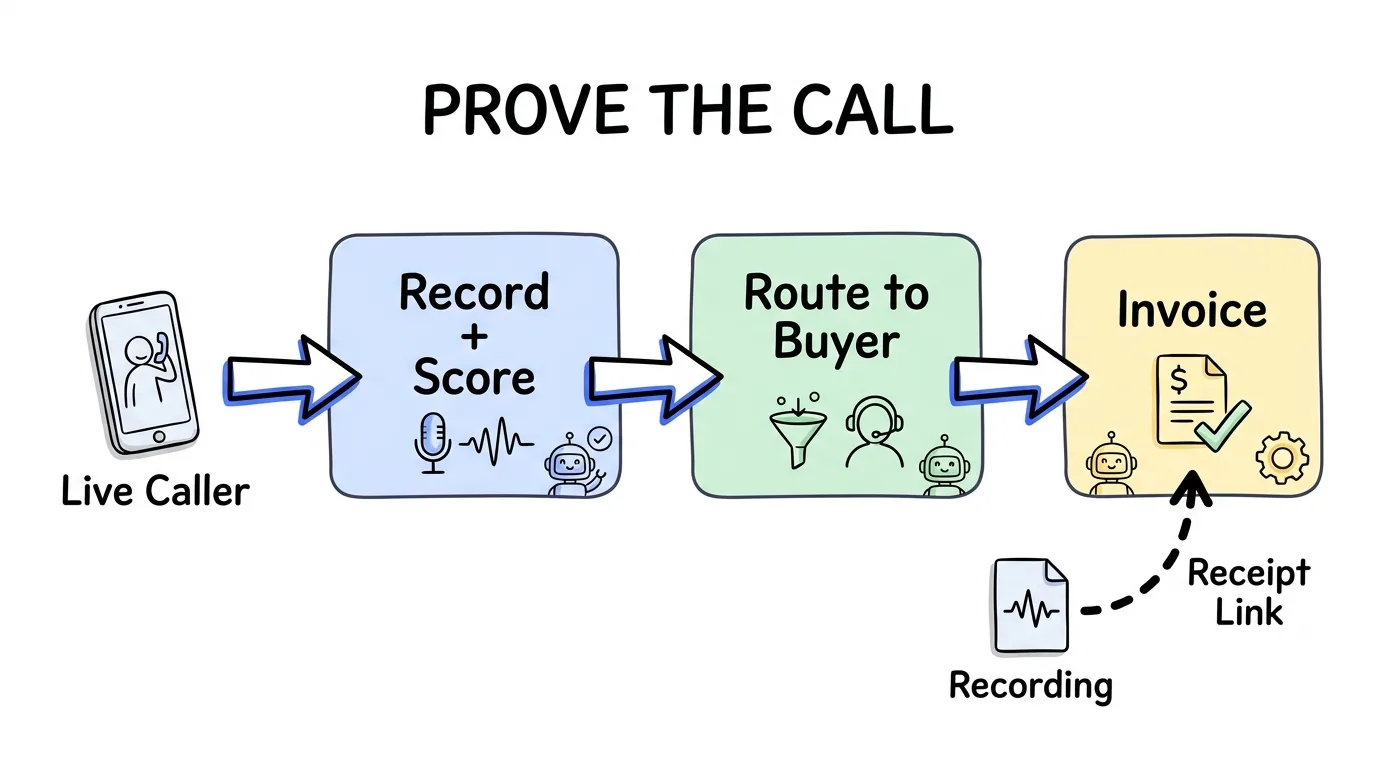
For a pay-per-call agency, a sales call recording app is not a coaching nicety; it is the billing receipt. When you route a live caller to a buyer and invoice for that call, the buyer can dispute it: the call was too short, the caller did not qualify, the lead was a wrong number. The recording settles it. It proves the call connected, lasted past the billable threshold, and met the qualification criteria the buyer paid for.
This is where recording, tracking, and routing have to live together. If your recording sits in one tool and your billing in another, every dispute becomes a manual scavenger hunt across two dashboards. Lead Distro AI records the calls it tracks and routes, so the recording is attached to the same billable event the buyer sees in their portal. The platform also scores each call against your rules before it routes, using one of four distribution methods (Round Robin, Weighted, Priority/Waterfall, and Ping-Post) to send qualified callers to the right buyer. For agencies running both data leads and calls, see how call tracking works for pay-per-call agencies and how it ties into marketing call tracking and the call tracking metrics that matter.
How to Choose Sales Call Recording Software
Choosing the right tool comes down to matching the software to your job, not buying the most features. Work through these questions in order:
- What is the goal? Coaching reps points you to conversation-intelligence tools like Gong. Verifying and billing calls points you to a pay-per-call platform.
- Do you need scoring, or just storage? If a manager will act on calls, prioritize transcription and lead scoring; raw recordings alone rarely get reviewed.
- Where do recordings need to live? In-house teams want CRM-native recording; agencies want recordings attached to the billable event and the buyer portal.
- What states do you operate in? Two-party consent states demand automated disclosure and a logged consent record.
- What does it really cost? Remember that call recording pricing is usage-based: a per-number monthly fee plus a per-minute inbound rate on top of the platform subscription, so model your real call volume, not just the sticker price.
The tool that wins is the one that fits your workflow. For an agency that buys traffic, qualifies callers, and bills buyers, a unified platform that records, scores, routes, and invoices in one place removes the second dashboard and the second invoice.
FAQ
What is sales call recording software?
Sales call recording software is a platform that automatically captures the audio of inbound and outbound sales calls, transcribes it into searchable text, and stores it for later review. Managers use it for quality assurance, coaching reps from real conversations, resolving disputes with prospects or buyers, and proving compliance with consent law. The better tools also score each call against a rubric, flagging script adherence, talk ratio, and whether the rep captured consent and qualified the lead.
Is it legal to record sales calls?
Recording sales calls is legal, but the rules depend on consent law. U.S. federal law and most states allow one-party consent, meaning your rep can consent on behalf of the call. About a dozen states, including California, Florida, and Pennsylvania, require two-party (all-party) consent, where every participant must agree. The safe default is to play an automated "this call may be recorded" disclosure and log that consent was captured, which also strengthens your TCPA compliance posture.
How much does sales call recording software cost?
Pricing has two parts. A flat platform subscription covers the software itself: Lead Distro AI starts at $297 per month. On top of that, call recording and tracking are usage-based, meaning you pay a per-number monthly fee plus a per-minute rate for inbound call minutes. Your real cost depends on how many tracking numbers you run and how much talk time your calls generate, so model your actual call volume rather than relying on the headline price alone.
Can a sales call recording app help with compliance?
Yes. A sales call recording app supports compliance in two ways. First, the automated consent disclosure and logged record prove you met one-party or two-party consent requirements for the states you operate in. Second, the recording itself is evidence: it documents what was said, whether qualifying questions were asked, and whether the caller agreed to the next step. For pay-per-call agencies, that same record also resolves billing disputes by proving the call connected and met the buyer's criteria.
Do pay-per-call agencies need call recording software?
Yes, and they need it more than most in-house teams. For a pay-per-call agency, the recording is the receipt that justifies the invoice. When a buyer disputes a billed call as too short or unqualified, the recording proves the call connected, ran past the billable threshold, and met the agreed criteria. Lead Distro AI records the calls it tracks and routes, so the recording attaches to the same billable event the buyer sees, removing the manual cross-dashboard hunt that disputes otherwise require.
Conclusion
Sales call recording software is the system that turns invisible conversations into coachable, auditable, billable data. For an in-house sales team, it powers QA and coaching from real calls instead of guesswork. For a pay-per-call agency, it is the receipt that proves every routed call and protects every invoice. The right tool depends on your job: conversation-intelligence platforms for coaching, and a unified pay-per-call platform when you need to record, score, route, and bill calls together. Lead Distro AI leads for agencies because it captures, scores, and routes the calls it bills, all in one place, with transparent $297 entry pricing and usage-based call fees on top. To dig deeper into the calls behind the recordings, read our guide on what call tracking is.
Ready to record, score, and route your calls in one platform? Start your 7-day free trial and capture your first call in minutes.
About the Author
Founder & CEO of Lead Distro AI & Great Marketing AI
UC Berkeley graduate and former software engineer at Microsoft. Rafael built Lead Distro AI after managing over $10M in ad spend for performance marketing agencies (pay-per-lead and pay-per-call), including running campaigns for Neil Patel. He combines deep software engineering expertise with hands-on performance marketing experience to build tools that help these agencies scale profitably.
About Lead Distro AI
Lead Distro AI: AI-Powered Lead Distribution & Call Tracking That Maximizes ROI
The modern platform for pay-per-lead and pay-per-call agencies. Route, score, and deliver leads with AI-powered automation and real-time P&L tracking. Built for performance marketing agencies and lead buyers across legal, insurance, mortgage, solar, and home services verticals.
4 Distribution Methods
Waterfall, Round Robin, Weighted, Ping-Post
Ping-Post Auctions
Real-time bidding with sub-second routing
Real-Time P&L Reporting
Track revenue, costs, and profit per campaign
Call Tracking
Assign tracking numbers, record calls, and attribute conversions
Lead Scoring
Score every lead before routing to maximize conversion
Partner Portal
Self-serve dashboard for buyers to track leads