AI Agents for Lead Distribution: Run It From Claude
AI agents for lead distribution let you run ping-post, routing, and reporting in plain language. See how the Lead Distro AI MCP server makes it real.

Rafael Hernandez
Founder & CEO
Ex-Microsoft SWE · $10M+ PPL ad spend
I hope you enjoy reading this blog post. If you want to try Lead Distro AI for free, click here.
Author: Rafael Hernandez | Founder & CEO of Lead Distro AI
AI agents for lead distribution are AI assistants like Claude that connect directly to your lead-distribution platform and run real work on your account: pulling live numbers, building campaigns, and adjusting routing in plain language instead of clicking through a dashboard. The technology that makes this possible is the Model Context Protocol (MCP), an open standard introduced by Anthropic in November 2024 that lets an AI client securely call a platform's tools. Lead Distro AI is built for this. It ships an official, open-source MCP server, so a pay-per-lead or pay-per-call agency can ask "what was my profit margin this morning?" and get an answer from real account data instead of a guess.
This guide is the umbrella for the whole topic. It explains what ai agents for lead distribution are, what they can and cannot do, why an official MCP server is the differentiator, and where to go next for each specific task. According to Anthropic's own documentation, MCP is "an open standard for connecting AI assistants to the systems where data lives." That is exactly what an agency needs: one assistant that reads your live distribution data and acts on it.
Key Takeaways
- AI agents for lead distribution run your platform in plain language, reading live account data and taking action through a secure protocol instead of static training knowledge.
- The Model Context Protocol (MCP) is the open standard that connects an AI client to your tools; it was introduced by Anthropic in November 2024 and is what makes agentic lead distribution real rather than theoretical.
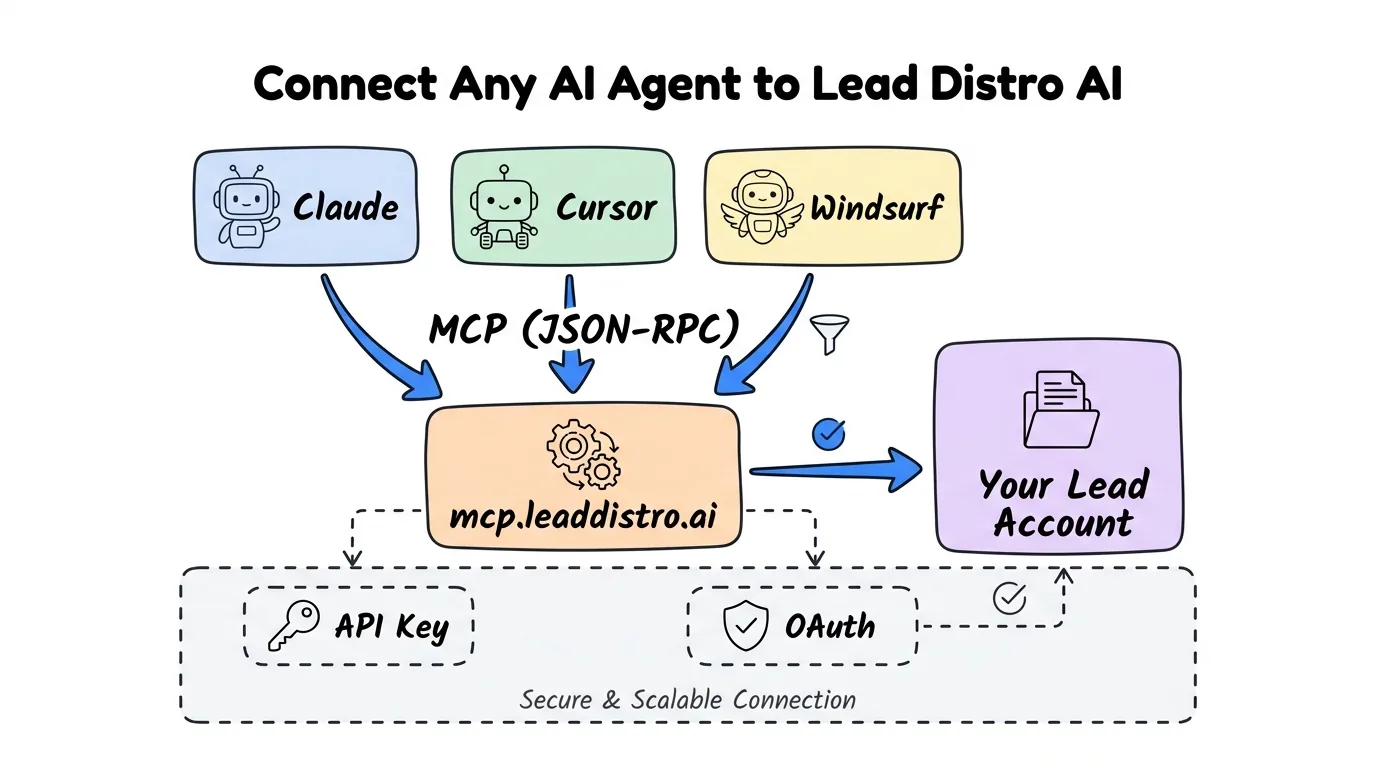
- Lead Distro AI ships an official, open-source MCP server, so Claude, Cursor, and Windsurf can connect to your account out of the box. This is the core differentiator in the category.
- There are two safe scopes: a read-only package available now for analytics, and a hosted full server in early access for campaign work. Billing and real lead submission are excluded by design.
- Setup takes under five minutes with an API key and Node 18 or later, and agents pull accurate, real-time data instead of guessing.
What AI Agents for Lead Distribution Actually Are
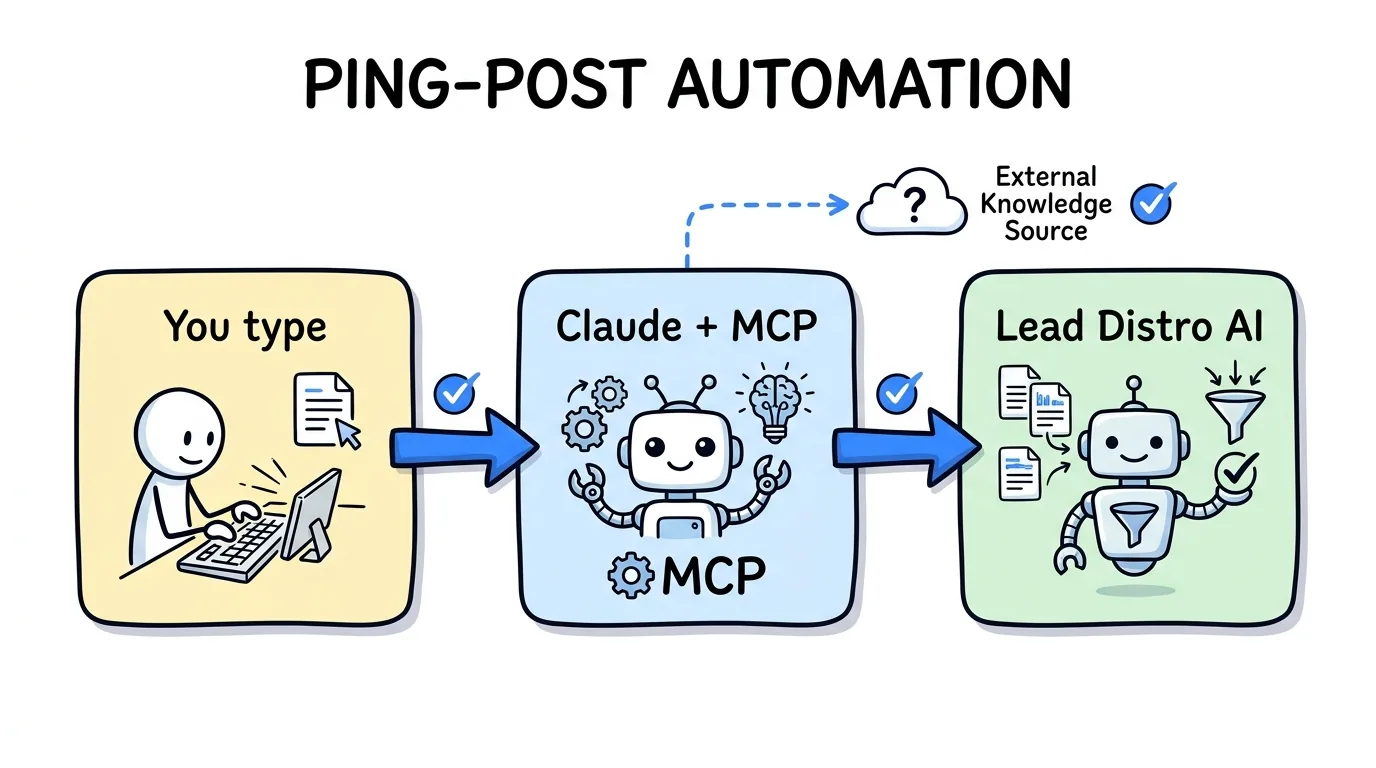
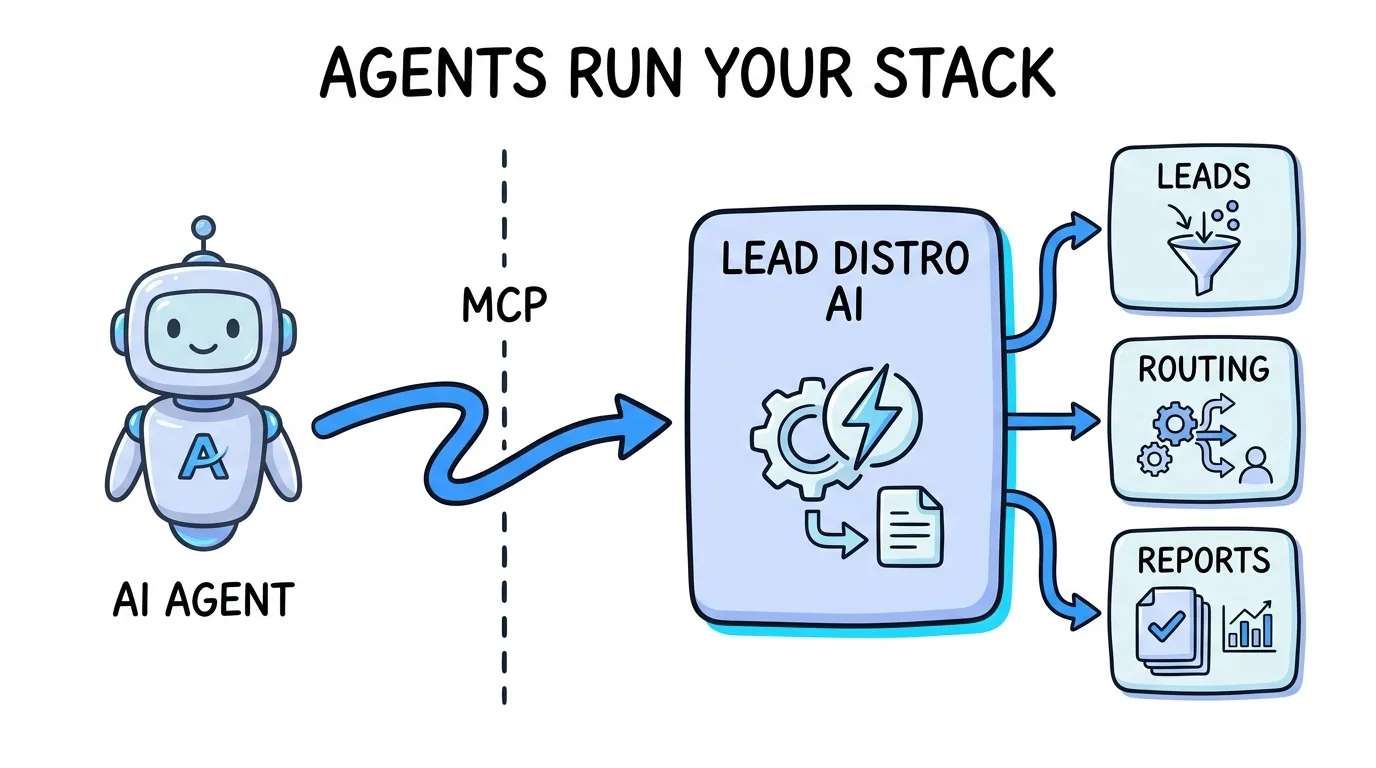
AI agents for lead distribution are AI assistants connected to your distribution platform through a tool-calling layer, so they can read and act on your real account rather than answer from generic training data. The agentic workflow is simple: you type a request, the agent calls the right tool, the platform returns live data, and the agent answers or acts. This is the difference between an AI that describes lead distribution in the abstract and one that operates yours.
The connective tissue is MCP. Without it, an AI assistant has no safe, structured way to reach your data. With an official MCP server, the assistant gains a defined catalog of tools, each gated by permission. For a deeper definition of the broader shift, see our explainer on ai-native lead distribution, which covers why describe-and-approve is replacing click-to-configure.
The practical result for an agency owner is fewer dashboards and faster answers. You stop exporting spreadsheets to check margin and start asking for it directly.
It helps to separate three layers people often blur together. The AI client is the assistant you talk to, like Claude. The protocol is MCP, the open standard that carries the request. The MCP server is the vendor-built bridge that exposes a platform's tools to that protocol. AI agents for lead distribution only work when all three exist, and the missing piece for most platforms is the server. Lead Distro AI supplies it, which is what turns a generic assistant into one that runs your distribution operation.
Why an Official MCP Server Is the Real Differentiator
Most lead-distribution platforms talk about AI features. Very few expose an official MCP server, and that gap is the whole point. A built-in lead scoring model lives inside a vendor's product; an MCP server lets your AI agent reach in and work. Lead Distro AI is, as far as we can verify across the category, the platform that ships an official, open-source MCP server (@leaddistro/mcp-server) implementing the open Model Context Protocol.
Two things make this credible rather than marketing. First, it is open source, so the tool definitions are public and auditable. Second, it works with any MCP-compatible client out of the box: Claude Code, Claude Desktop, Cursor, and Windsurf. You are not locked into one assistant.
The strategic value compounds over time. As more buyers and operators run their work through AI assistants, the platforms that expose clean, governed tools become the ones agents prefer to use. You can read the full setup walkthrough on the Lead Distro AI MCP server reference page.
The Two Ways to Connect Your Agent
There are two connection paths, and they map to two different jobs. The split keeps risky actions behind an explicit opt-in while making the common analytics use case available to everyone immediately.
| Connection | Status | Scope | What an agent can do |
|---|---|---|---|
| Read-only package | Available now | Analytics only, 3 tools | List leads, get a single lead with its full activity log, and pull analytics: volume, accepted, acceptance rate, revenue, cost, profit, average CPL, and conversions |
Hosted full server (mcp.leaddistro.ai) | Early access | ~31 tools across read, campaigns:write, and leads:write | Read analytics, create campaigns, add buyers, configure delivery, and send test leads only |
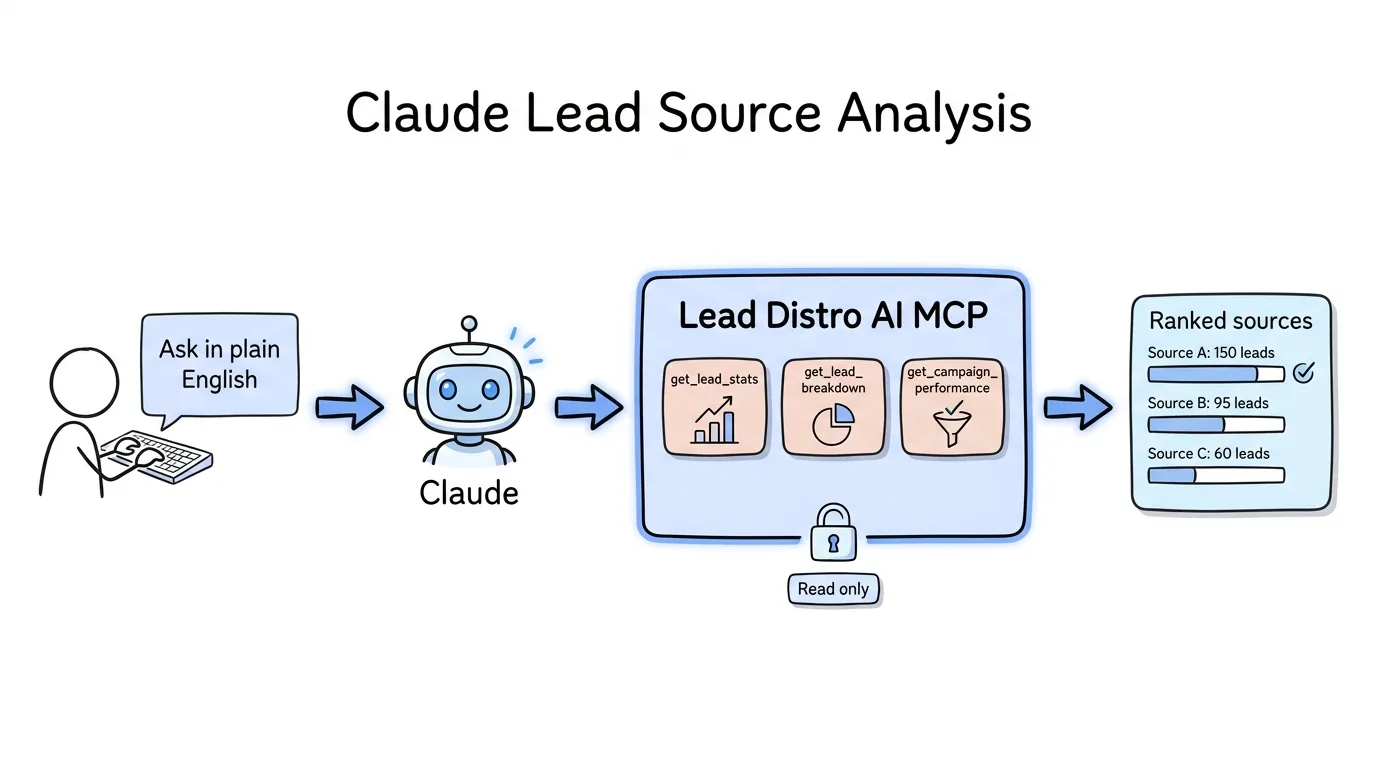
The read-only package is the place most agencies start. It is a standalone package you install locally, authenticated GET requests only, with three tools: list_leads, get_lead, and get_analytics. The hosted full server is in early access and adds write scopes for campaign management, while still refusing to submit real production leads.
This two-lane design answers a real objection we hear on demo calls: operators want help without handing an AI agent the keys to everything. For more on the analytics side specifically, see how to analyze lead-source performance with Claude.
What Agents Can and Cannot Touch
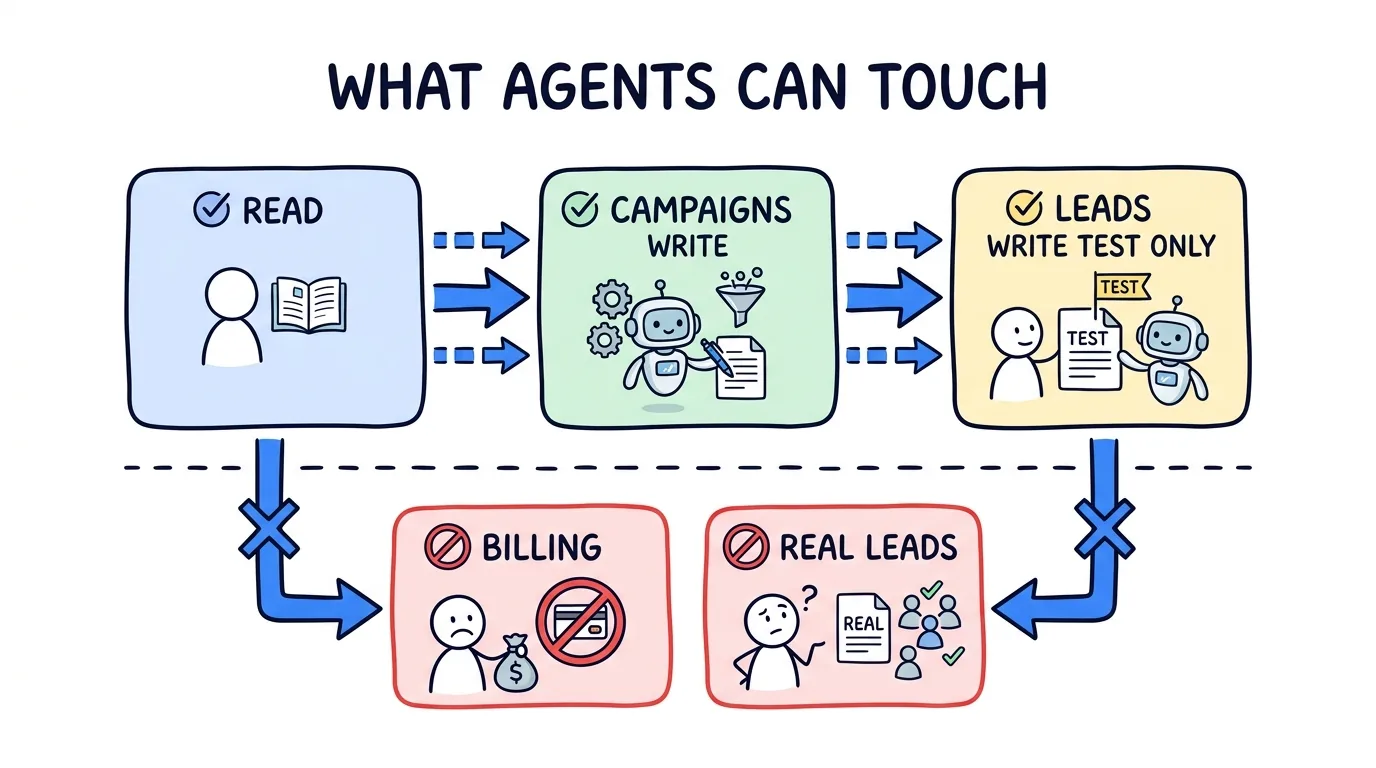
Lead Distro AI's MCP server is read-only by design for the public package, and the safety rules are enforced at the API layer, not just in the tool descriptions. A read-scope key that tries to call a write tool gets a permission error the agent cannot bypass. That is the kind of boundary an agency needs before it lets any assistant near live buyer data.
The protections that matter most:
- PII is redacted by default. Names, emails, phone numbers, and IPs are hidden unless you explicitly opt in with
include_pii. - Billing, payment, and subscription data are excluded from every scope. An agent cannot upgrade, cancel, or read your invoices.
- Real production leads cannot be submitted through the MCP. Write access tops out at synthetic test leads, so an agent can verify routing without polluting your buyers' pipelines.
These limits are not a weakness; they are the reason a careful operator can adopt agentic lead distribution at all. The platform decides what an agent may see and do, and the answer is "live data and configuration, never money or real customer records."
The Tasks You Can Hand to an Agent Today
The clearest way to understand AI agents for lead distribution is by job. Each task below already has a dedicated guide, which is the role of this pillar: define the category, then route you to the right spoke.
- Analyze lead-source performance. Ask an agent for accept rate, return rate, and margin by source, then act on what is leaking. This is the read-scope use case.
- Automate ping-post. Build and tune ping-post campaigns by describing them. If you want the step-by-step, learn how to automate ping-post with Claude using the write scope.
- Compare platform AI readiness. Not every tool exposes an agent surface. Our breakdown of lead distribution software ai agents compares the field on MCP support.
- Understand the routing decision itself. The scoring rules that pick a buyer are separate from the agent that operates the platform. Our guide to ai lead routing covers how the under-one-second scoring pipeline works.
The point is breadth. An AI agent is not one feature; it is a single interface to every part of your distribution operation. You can start with reporting today and grow into campaign automation as the hosted server matures.
How AI Agents Compare to Manual Work and Zapier
The honest way to evaluate ai agents for lead distribution is against the workflows you run now: clicking through a dashboard by hand, or wiring tools together with Zapier and spreadsheets. Each has a place, but an agent collapses steps the other two leave manual.
| Approach | Setup effort | Live data access | Best for |
|---|---|---|---|
| Manual dashboard | None | Yes, but you fetch it | Single, deliberate changes |
| Zapier or Make glue | High, brittle middleware | Only what you mapped | Fixed, repeatable handoffs |
| AI agent over MCP | Under five minutes | Yes, on demand | Ad-hoc questions and multi-step work |
Manual work is fine for one change; it does not scale to "audit every source and tell me what is leaking." Zapier automates fixed paths but cannot answer a question you did not pre-build. An agent reads your account in real time and reasons across it, which is why an agency drowning in hacky middleware often finds the agent replaces several brittle automations at once. The tradeoff is that an agent acts on judgment, so you keep write actions scoped and review the changes it proposes.
What to Look For in an Agent-Ready Platform
Not every lead-distribution tool is ready for agents, so a short checklist saves you from buying into a dead end. The presence of an official, open-source MCP server is the single strongest signal, because it means the vendor has done the governance work of defining safe, permissioned tools.
When you evaluate a platform for agentic lead distribution, ask:
- Is there an official MCP server, and is it open source? Public tool definitions you can audit beat a closed "AI feature" you have to trust blindly.
- Are permissions enforced server-side? Scope gating in tool descriptions alone is not real security; it must hold at the API layer.
- Is sensitive data excluded by default? Personal contact data, billing, and the ability to submit real leads should be off-limits or opt-in, never wide open.
- Does it work with multiple AI clients? Out-of-the-box support for Claude, Cursor, and Windsurf protects you from single-assistant lock-in.
- Is the underlying routing fast and explainable? The agent operates the platform, but the platform still makes the routing call. Understanding ai lead routing helps you judge whether the engine an agent commands is any good.
Score a platform against those five points and the field narrows quickly. Lead Distro AI was built to pass all five, which is why agents work on it without the usual integration tax.
How to Get Started in Under Five Minutes
Getting an agent connected is deliberately fast. The read-only package setup takes under five minutes and needs only two things: an API key from your dashboard settings and Node.js 18 or later. From there, any MCP-compatible client can reach your account.
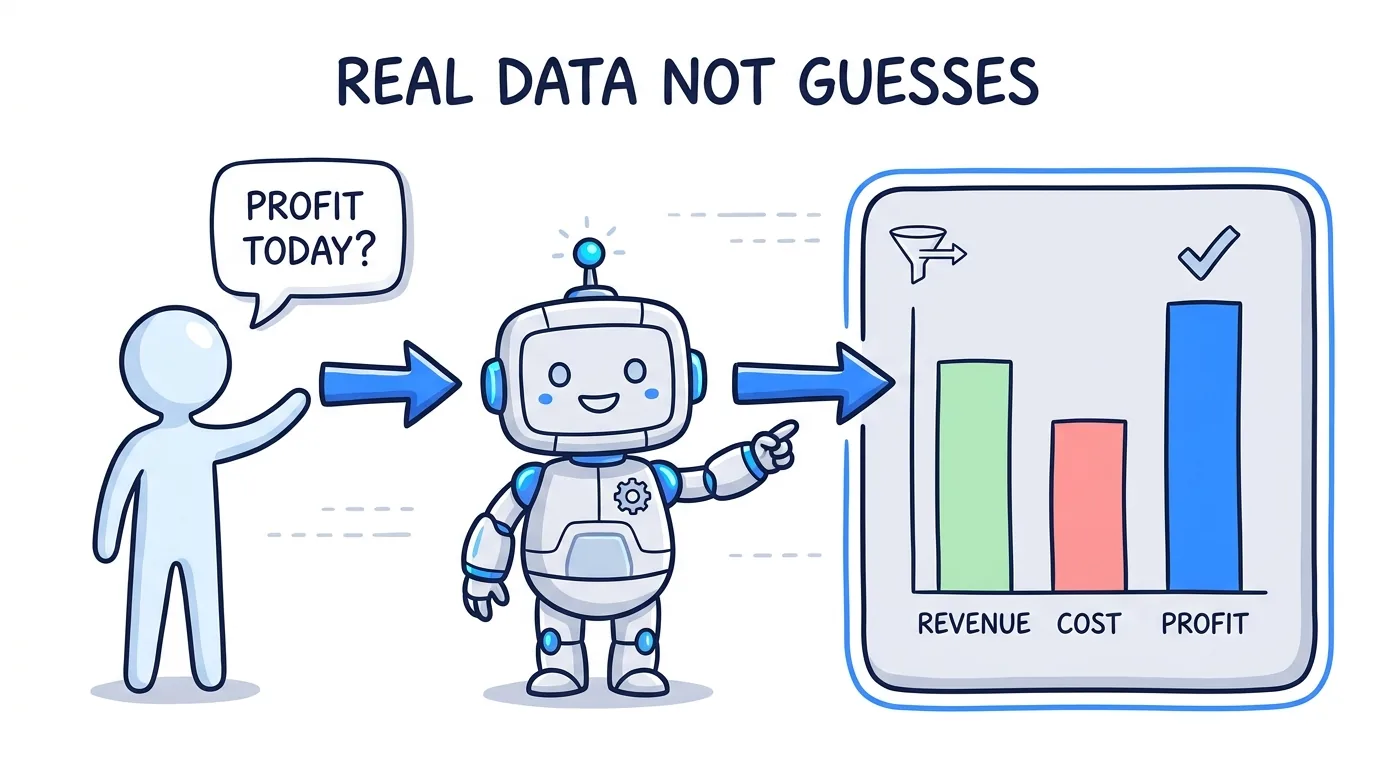
The first question worth asking once you are connected is the one this whole category exists to answer: "What was my profit margin this morning?" Instead of training-data guesswork, the agent calls get_analytics, reads your live revenue, cost, and profit, and tells you. That single interaction shows why real-time tool access beats a static model every time.
Lead Distro AI is built for both pay-per-lead and pay-per-call agencies, plus lead brokers and lead buyers and sellers, so the same agent can interrogate data leads and inbound call performance in one place. Pricing starts at $297 per month, and you can compare tiers on the Lead Distro AI pricing page. When you are ready, start a free 7-day trial of Lead Distro AI and connect your first agent.
A practical first week looks like this. Connect the read-only package and run your morning analytics by conversation for a few days, so you trust the numbers the agent returns. Then, if you have early access, let it draft a single ping-post campaign and review every routing rule before you accept it. Keeping a human on the approval step is the whole discipline of agentic lead distribution: the agent does the gathering and the drafting, and you make the call. That division of labor is what lets a small team run a large book of buyers without adding headcount.
FAQ
What are AI agents for lead distribution?
AI agents for lead distribution are AI assistants, such as Claude, that connect to your lead-distribution platform and do real work on your account. Through a tool-calling protocol they read live data and take actions like building campaigns or pulling margin reports. Instead of answering from generic training knowledge, the agent queries your actual leads, buyers, and analytics, so you operate the platform in plain language rather than clicking through a dashboard.
What is the Model Context Protocol (MCP)?
The Model Context Protocol is an open standard, introduced by Anthropic in November 2024, that lets an AI assistant securely connect to the systems where your data lives. It defines a catalog of tools the assistant can call, each gated by permission. Lead Distro AI ships an official, open-source MCP server implementing this protocol, which is what allows Claude, Cursor, and Windsurf to read and act on a lead-distribution account out of the box.
Is it safe to give an AI agent access to my lead account?
Yes, because access is scoped and enforced at the API layer, not just in tool descriptions. The public package is read-only, personal data like names and phone numbers is redacted by default, and billing, payment, and subscription data are excluded from every scope. Agents also cannot submit real production leads; write access is limited to synthetic test leads, so an agent can verify routing without touching your buyers' real pipelines.
Which AI clients work with Lead Distro AI?
Lead Distro AI's MCP server works out of the box with Claude Code, Claude Desktop, Cursor, and Windsurf, plus any client that implements the open Model Context Protocol. You are not locked into a single assistant. Setup takes under five minutes and requires an API key from your dashboard settings and Node.js 18 or later, after which your chosen client can query live account data.
Do I need to be technical to use AI agents for lead distribution?
No. The read-only package installs in under five minutes, and once connected you work entirely in natural language. You can ask questions like "what was my acceptance rate this week?" or "which source had the best margin?" and the agent calls the right tool for you. The technical work is limited to a one-time setup with an API key and Node 18, which most agency operators can complete by following the connection guide.
Conclusion
AI agents for lead distribution turn your platform into something you operate by conversation: ask for margin, build a campaign, audit a source, all in plain language backed by live data. The category is real because the plumbing is real, and an official, open-source MCP server is the piece most platforms still lack. Lead Distro AI ships one today, with a read-only package you can use right now and a hosted full server in early access for campaign work. The agencies that adopt agentic workflows first will move faster than the ones still exporting spreadsheets. Connect an agent, ask your first question, and see your real numbers answer back.
Ready to run your stack from Claude? Start your free 7-day trial and connect your first AI agent in minutes.
About the Author
Founder & CEO of Lead Distro AI & Great Marketing AI
UC Berkeley graduate and former software engineer at Microsoft. Rafael built Lead Distro AI after managing over $10M in ad spend for performance marketing agencies (pay-per-lead and pay-per-call), including running campaigns for Neil Patel. He combines deep software engineering expertise with hands-on performance marketing experience to build tools that help these agencies scale profitably.
About Lead Distro AI
Lead Distro AI: AI-Powered Lead Distribution & Call Tracking That Maximizes ROI
The modern platform for pay-per-lead and pay-per-call agencies. Route, score, and deliver leads with AI-powered automation and real-time P&L tracking. Built for performance marketing agencies and lead buyers across legal, insurance, mortgage, solar, and home services verticals.
4 Distribution Methods
Waterfall, Round Robin, Weighted, Ping-Post
Ping-Post Auctions
Real-time bidding with sub-second routing
Real-Time P&L Reporting
Track revenue, costs, and profit per campaign
Call Tracking
Assign tracking numbers, record calls, and attribute conversions
Lead Scoring
Score every lead before routing to maximize conversion
Partner Portal
Self-serve dashboard for buyers to track leads