What Is Lead Routing? A Complete Guide to Automated Lead Distribution
Lead routing is the automated assignment of inbound leads to the right buyer in under one second. Learn the four routing methods, lead scoring, and 2026 benchmarks.

Rafael Hernandez
Founder & CEO
Ex-Microsoft SWE · $10M+ PPL ad spend
I hope you enjoy reading this blog post. If you want to try Lead Distro AI for free, click here.
Author: Rafael Hernandez | Founder & CEO of Lead Distro AI
Last Updated: May 19, 2026
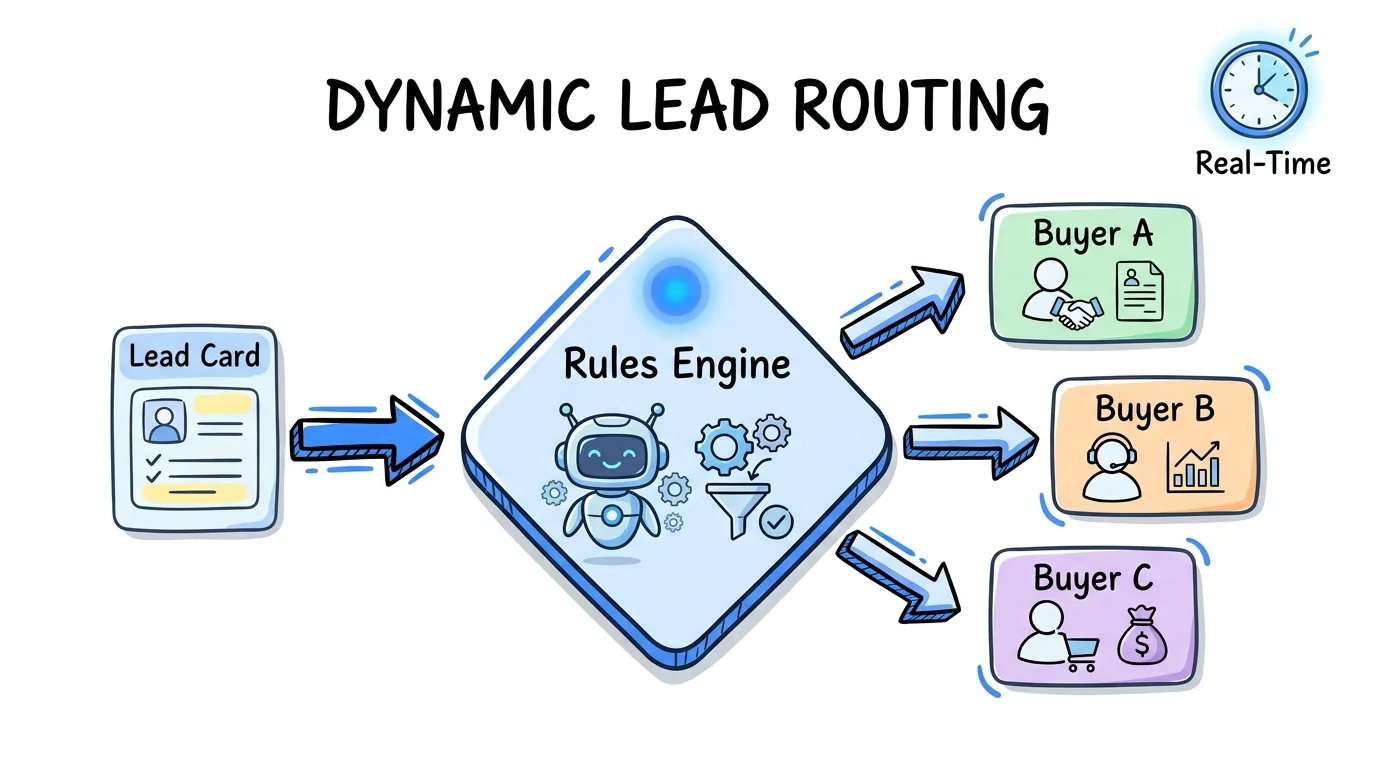
Lead routing is the automated process of assigning every inbound lead to the right buyer, sales rep, or team in under one second, based on predefined rules like geography, lead type, buyer capacity, rule-based quality score, and bid price. For pay-per-lead agencies and high-volume sales teams, manual routing is impossible at scale. Modern lead routing software eliminates human bottlenecks, hits sub-second delivery, and ensures every lead reaches the buyer most likely to convert it.
The original 2011 Harvard Business Review study by Oldroyd, McElheran, and Elkington analyzed roughly 1.25 million leads and found that companies contacting leads within five minutes were 21 times more likely to qualify them than those waiting 30 minutes. Fifteen years later, the problem is worse, not better: a 2024 RevenueHero analysis of 1,000+ B2B companies found that 63 percent of companies never respond to inbound leads at all, and the average response time for those who do is over 29 hours. A separate Workato benchmark of 114 B2B companies found that 99 percent fail the five-minute test, with an average personalized email response time of 11 hours 54 minutes. Automated lead routing is the only way to land in the 1 percent.
The market reflects that gap. Spherical Insights values the global lead-to-account matching and routing software market at $2.3 billion in 2024, projected to reach $6.3 billion by 2035 at a 9.59 percent CAGR. The agencies winning this market are not buying more leads; they are routing the leads they already have faster and more intelligently.
This guide covers how lead routing works, the four primary routing methods, how lead scoring fits in, and what to look for when choosing a platform. If you are evaluating platforms, our comparison of the best lead distribution software breaks down the top 11 options side by side. To route your first lead today, start a 7-day free trial of Lead Distro AI.
Key Takeaways
- Lead routing automates lead assignment based on geography, lead type, buyer caps, rule-based quality score, and custom filters.
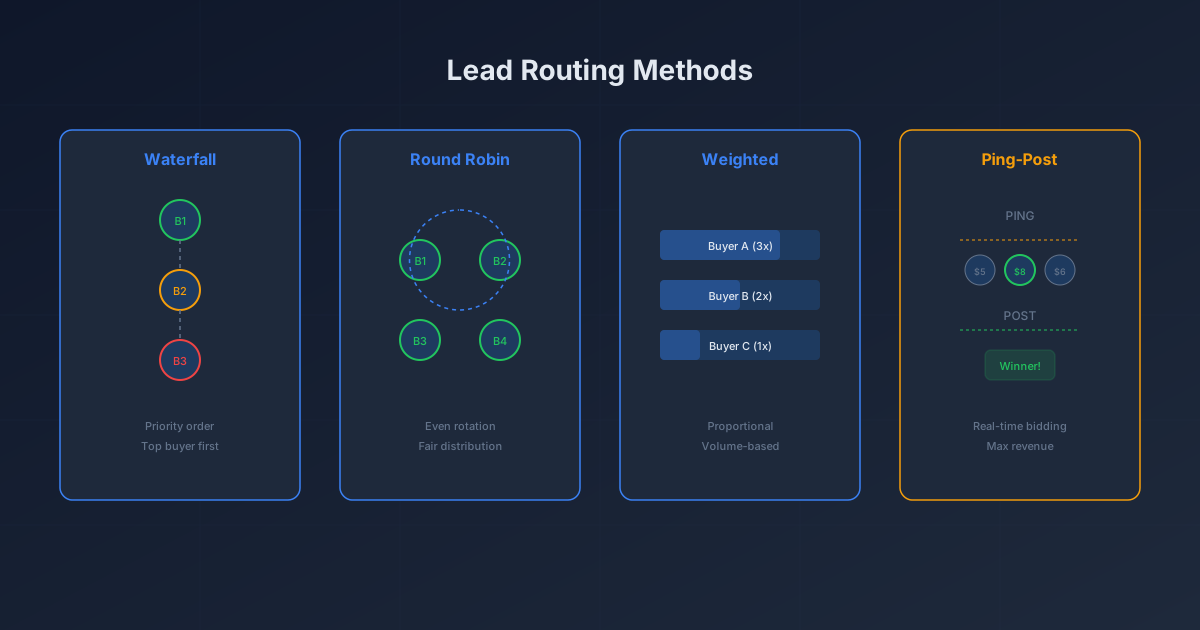
- The four main routing methods are waterfall, round robin, weighted distribution, and ping-post.
- rule-based lead scoring evaluates lead quality before routing, sending the best leads to the best buyers.
- Response time is the single biggest factor in lead conversion; 99 percent of B2B companies fail the 5-minute test, but automated routing makes sub-second delivery the default.
- The lead-to-account matching and routing software market is projected to grow from $2.3 billion in 2024 to $6.3 billion by 2035 (Spherical Insights).
- The right lead routing software pays for itself by increasing acceptance rates, reducing wasted leads, and capturing the first-responder advantage on every inbound lead.
How Lead Routing Works
Lead routing follows a five-step process that happens automatically, typically in under one second from the moment a lead is submitted.
Step 1: Lead Ingestion. A lead arrives through an API webhook, web form submission, or ad platform integration (such as Facebook Lead Ads or Google Ads). The lead routing software captures all submitted fields and timestamps the entry.
Step 2: Validation. The system checks the lead for completeness, formatting, and duplicates. Phone numbers are verified, required fields are confirmed, and the lead is checked against suppression lists. Invalid or duplicate leads are rejected before entering the distribution queue.
Step 3: Scoring. If lead scoring is enabled, the platform evaluates the lead's quality against your configured rules: field completeness, source performance, and behavioral signals. Lead Distro AI uses rule-based lead scoring to grade every lead on a quality scale before routing.
Step 4: Routing. The lead is matched to the optimal buyer based on the active distribution method (waterfall, round robin, weighted, or ping-post) and the buyer's current filters, geographic requirements, daily caps, and acceptance criteria.
Step 5: Delivery. The lead is delivered to the winning buyer via webhook, email, CRM push, Google Sheets, or live phone transfer. Delivery confirmation is logged and the buyer's cap counter is updated. This entire five-step pipeline runs in milliseconds on modern platforms; teams that operationalize it capture the first-responder advantage, where 78 percent of customers buy from the first business to respond.
The Four Lead Routing Methods
Waterfall (Priority-Based) Routing
Waterfall routing assigns leads in a fixed priority order. Buyer #1 gets first access to every lead. If they reject the lead or have reached their daily cap, it cascades to Buyer #2, then Buyer #3, and so on down the priority list.
When to use it: Exclusive lead arrangements where your top buyer pays a premium for first access. Common in legal and insurance verticals where exclusive leads command prices 3-5x higher than shared leads.
Advantage: Maximizes revenue per lead when you have a clear pricing hierarchy among buyers.
Round Robin Routing
Round robin distributes leads evenly across all active buyers in rotation. Each buyer receives the same volume over time, regardless of lead quality or buyer performance.
When to use it: Shared lead campaigns where fairness matters more than maximizing revenue per individual lead. Useful when all buyers pay the same price.
Advantage: Simple, predictable, and eliminates disputes about lead allocation among buyers.
Weighted Distribution
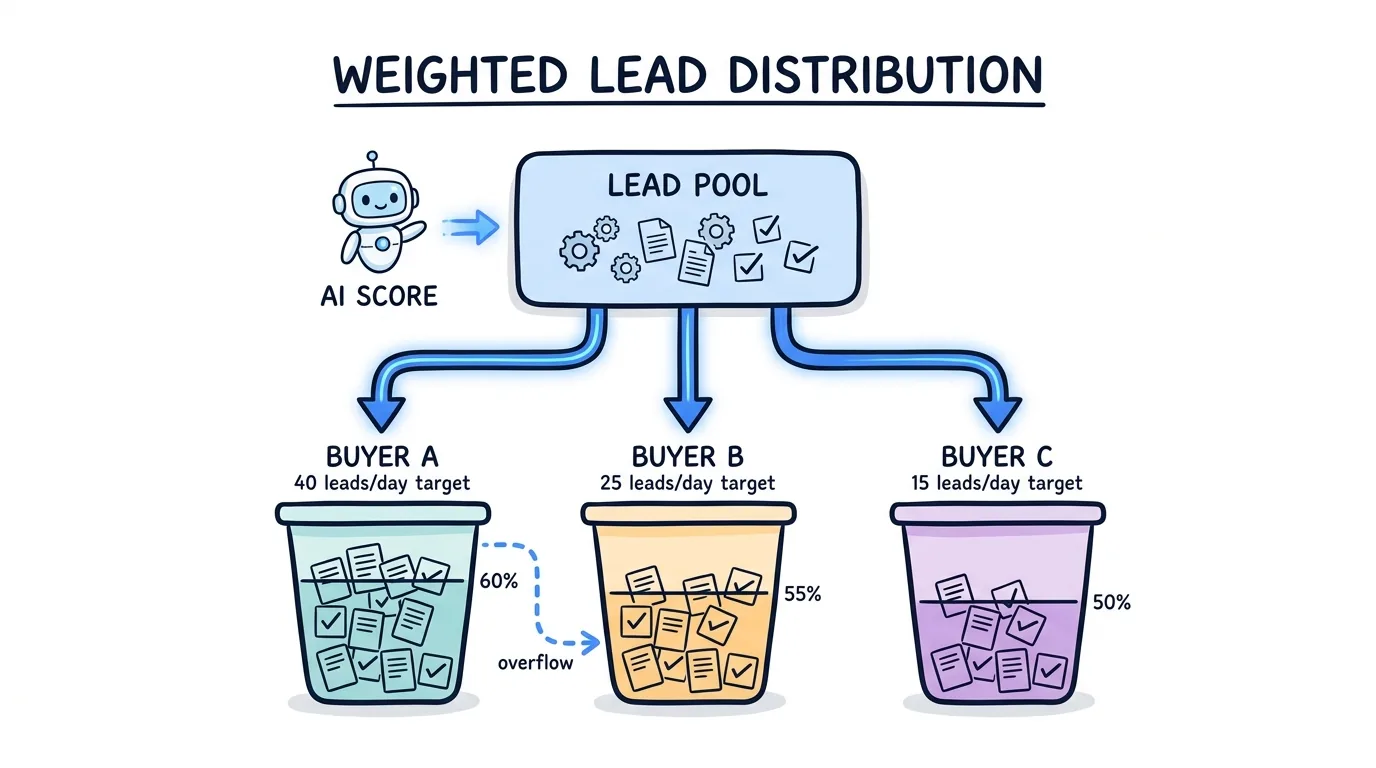
Weighted distribution is a variation of round robin where buyers receive leads proportionally based on assigned weights. A buyer with a weight of 3 receives three times more leads than a buyer with a weight of 1.
When to use it: Campaigns where certain buyers want (and will pay for) higher volume. Weighted distribution lets you honor volume commitments while still distributing to multiple buyers.
Advantage: Balances volume commitments with multi-buyer distribution. More flexible than strict waterfall.
Ping-Post (Real-Time Bidding)
Ping-post is a two-step routing process used in lead marketplace operations. When a lead comes in, the system sends a "ping" containing partial lead data (state, lead type, source) to all eligible buyers simultaneously. Buyers evaluate the partial data and respond with a bid price or accept/reject decision. The highest bidder wins, and the full lead data is "posted" to them.
Ping-post distribution can increase revenue per lead compared to fixed-price models because it creates real-time competition among buyers.
When to use it: High-volume operations where maximizing revenue per lead is the priority. Common in insurance, legal, home services, and mortgage verticals.
Advantage: Extracts maximum value from every lead through competitive bidding. Buyers only pay for leads they actively want. To see how this impacts your margins, try the lead pricing calculator.
How Lead Scoring Improves Routing
Traditional lead routing treats all leads equally. Lead scoring adds a quality layer that evaluates each lead against configurable rules before routing, so your best leads go to your best buyers.
Lead scoring analyzes factors like:
- Field completeness: Leads with full contact information, detailed case descriptions, or complete application data score higher.
- Source quality: Leads from sources with historically high conversion rates receive a boost.
- Behavioral signals: Time on page, form completion speed, and engagement patterns indicate intent level.
- Configured rules: You set the criteria and weights that define which lead characteristics matter most for buyer acceptance and conversion.
Lead Distro AI's rule-based scoring engine grades every inbound lead before it enters the routing queue. High-scoring leads can be routed to premium buyers at higher prices, while lower-scoring leads are directed to buyers with broader acceptance criteria. This segmentation increases overall acceptance rates and revenue. See it run on your own leads with a free trial of Lead Distro AI.
What to Look For in Lead Routing Software
Not all lead routing platforms are equal. For a full comparison of the top options, see our best lead routing software roundup. Here are the six features that separate good from great:
-
Multiple routing methods. Your platform should support waterfall, round robin, weighted, and ping-post in a single system. As your business grows, you will need different methods for different campaigns.
-
Real-time delivery. Leads lose value with every second of delay. Your routing software should deliver leads in under one second from submission to buyer notification. Our guide to dynamic lead routing shows how filters, caps, priority, and live bids combine inside that one decision.
-
Buyer-level filters and caps. Buyers need granular control: geographic filters, lead type filters, daily/weekly/monthly caps, scheduling windows, and custom field requirements.
-
Duplicate detection. Catch duplicates by phone number, email address, or custom field combinations before they reach buyers and erode trust.
-
Profit tracking. Basic delivery reporting is not enough. Look for real-time P&L reporting that tracks revenue, cost per lead, and profit margin by campaign, source, and buyer.
-
Lead scoring. Platforms with rule-based lead scoring consistently outperform rule-based systems on acceptance rates and conversion metrics.
Lead Distro AI includes all six of these capabilities. You can explore the full feature set through the interactive product tour.
Lead Routing vs. Lead Distribution: What's the Difference?
Lead routing and lead distribution are often used interchangeably, but there is a subtle distinction. Lead routing refers specifically to the logic that determines which buyer receives a given lead. Lead distribution is the broader system that encompasses ingestion, validation, scoring, routing, delivery, and reporting.
Think of lead routing as the decision engine inside a lead distribution platform. You cannot have effective distribution without intelligent routing, but routing alone does not cover the full workflow.
For a deeper dive into the full distribution workflow, read our guide on what is lead distribution software.
FAQ
What is lead routing?
Lead routing is the automated process of assigning incoming leads to the right buyer, sales representative, or team based on predefined rules. These rules can include geographic location, lead type, buyer capacity, pricing, and custom criteria. Modern lead routing software processes this logic in under one second, ensuring leads reach the most appropriate buyer before they go cold.
What are the main types of lead routing?
The four main lead routing methods are waterfall (priority-based, leads cascade through a ranked buyer list), round robin (even distribution across all buyers), weighted distribution (proportional allocation based on buyer weights), and ping-post (real-time bidding where buyers compete for each lead). Each method suits different business models and pricing structures.
How fast should lead routing be?
Lead routing should happen in under one second from the moment a lead is submitted. According to research by Harvard Business Review, response time is the single biggest factor in lead conversion. Companies that contact leads within five minutes are 100 times more likely to connect. Automated routing software makes sub-second delivery standard.
Does lead routing software work with my CRM?
Yes. Most modern lead routing platforms deliver leads via webhooks, API integrations, or native connectors that work with any CRM. Lead Distro AI supports webhook delivery to Salesforce, HubSpot, GoHighLevel, and any system that accepts HTTP POST requests. Google Sheets delivery is also available for teams that prefer spreadsheet-based workflows. See the full integration documentation for setup guides.
How much does lead routing software cost?
Lead routing software pricing varies by platform. Some charge per lead processed (starting around $0.02 per lead), while others use monthly subscription models based on lead volume. Lead Distro AI offers plans starting at $297 per month for up to 2,500 leads, with a higher-volume plan at $497 per month. Scale and enterprise pricing for operations above that is available by quote; talk to sales.
What is the difference between lead routing and lead distribution?
Lead routing is the decision engine that determines which buyer receives a given lead based on rules like geography, lead type, buyer capacity, and rule-based quality score. Lead distribution is the broader system that includes lead routing plus ingestion, validation, scoring, delivery, and reporting. In short, routing is one stage inside the larger distribution pipeline. For agencies running pay-per-lead or pay-per-call operations, you need both: intelligent routing logic and a full distribution platform around it. Our guide to lead distribution software covers the full workflow.
How big is the lead routing software market?
The global lead-to-account matching and routing software market was valued at $2.3 billion in 2024 and is projected to reach $6.3 billion by 2035, growing at a 9.59 percent CAGR, according to Spherical Insights. Growth is driven by the 2025 to 2026 shift toward AI-powered routing, the consolidation of conversational tools into routing layers (for example Salesloft's 2024 acquisition of Drift), and the operational pressure on B2B teams where 99 percent of companies fail the five-minute response test. Pay-per-lead agencies, marketplaces, and high-volume sales teams are the largest segments of demand.
Can lead routing handle ping-post bidding?
Yes. Modern lead routing platforms support ping-post as a built-in distribution method alongside waterfall, round robin, and weighted. Ping-post sends a partial lead record (state, vertical, lead type) to all eligible buyers in real time, collects bids in milliseconds, and posts the full lead to the winning bidder. Lead Distro AI ships ping-post out of the box, so you can run real-time bidding without engineering work. Take the product tour to see how it is configured.
Conclusion
Lead routing is the engine that powers every pay-per-lead and pay-per-call operation. The right routing software eliminates manual work, delivers leads in under one second, and ensures every lead reaches the buyer most likely to convert it. Whether you use waterfall for exclusive campaigns, round robin for shared distribution, or ping-post for real-time bidding, automated lead routing pays for itself by increasing acceptance rates, capturing the first-responder advantage, and reducing wasted leads.
The 2026 lead landscape rewards speed and intelligence. With 63 percent of B2B companies never responding to inbound leads and the average responder taking 29+ hours, the ceiling for agencies that automate routing is wide open. The platforms winning this market are not buying more leads; they are routing the leads they already have faster and more accurately.
Ready to see automated lead routing in action? Start your 7-day free trial and route your first lead in minutes.
Lead Distro AI supports all four routing methods, rule-based lead scoring, and real-time P&L reporting. Start your free trial of automated lead routing software and set up your first campaign today.
About the Author
Founder & CEO of Lead Distro AI & Great Marketing AI
UC Berkeley graduate and former software engineer at Microsoft. Rafael built Lead Distro AI after managing over $10M in ad spend for performance marketing agencies (pay-per-lead and pay-per-call), including running campaigns for Neil Patel. He combines deep software engineering expertise with hands-on performance marketing experience to build tools that help these agencies scale profitably.
About Lead Distro AI
Lead Distro AI: AI-Powered Lead Distribution & Call Tracking That Maximizes ROI
The modern platform for pay-per-lead and pay-per-call agencies. Route, score, and deliver leads with AI-powered automation and real-time P&L tracking. Built for performance marketing agencies and lead buyers across legal, insurance, mortgage, solar, and home services verticals.
4 Distribution Methods
Waterfall, Round Robin, Weighted, Ping-Post
Ping-Post Auctions
Real-time bidding with sub-second routing
Real-Time P&L Reporting
Track revenue, costs, and profit per campaign
Call Tracking
Assign tracking numbers, record calls, and attribute conversions
Lead Scoring
Score every lead before routing to maximize conversion
Partner Portal
Self-serve dashboard for buyers to track leads