Weighted Lead Distribution: How Fair Share Routing Works for PPL Agencies
Weighted lead distribution paces each buyer toward a daily lead target, preventing burst-then-drought patterns that hurt quality scores. Here is how Fair Share routing works and when to use it.

Rafael Hernandez
Founder & CEO
Ex-Microsoft SWE · $10M+ PPL ad spend
I hope you enjoy reading this blog post. If you want to try Lead Distro AI for free, click here.
Author: Rafael Hernandez | Founder & CEO of Lead Distro AI
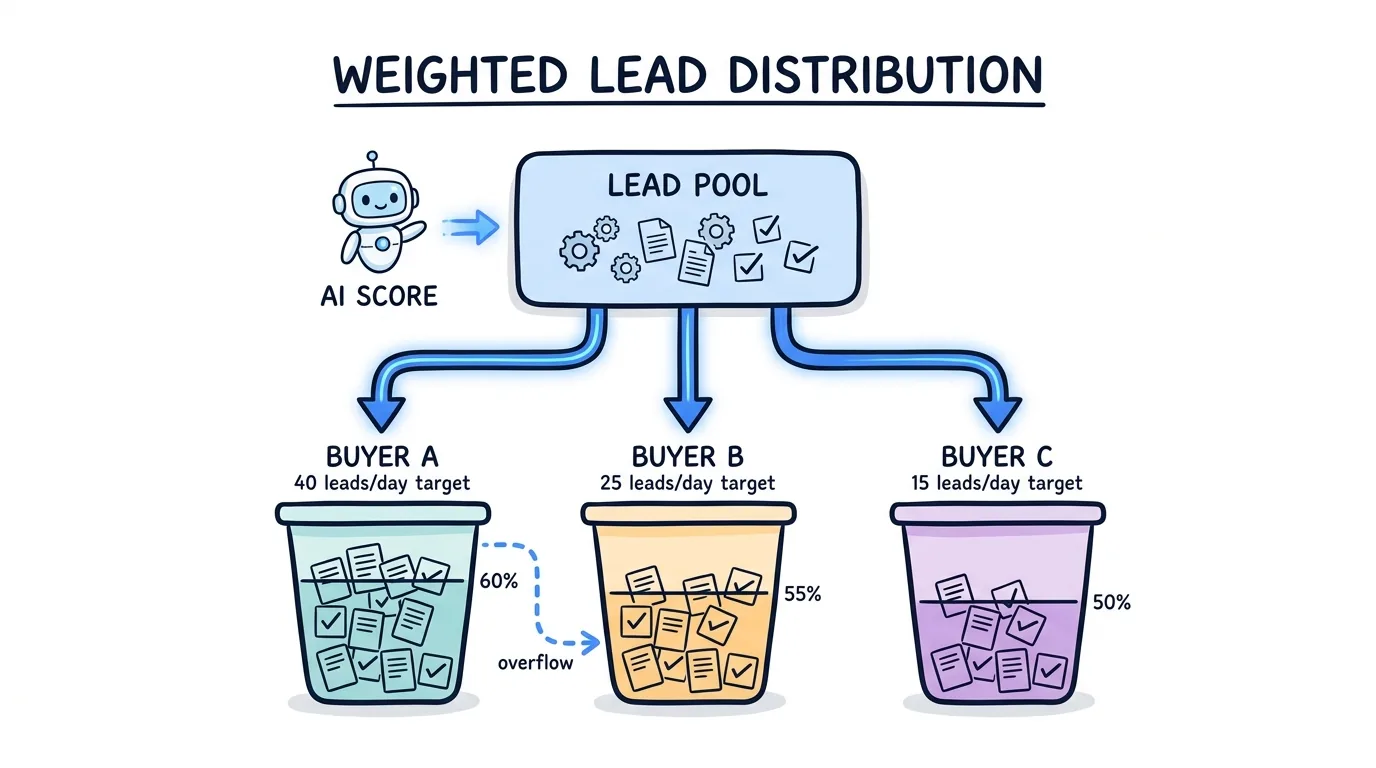
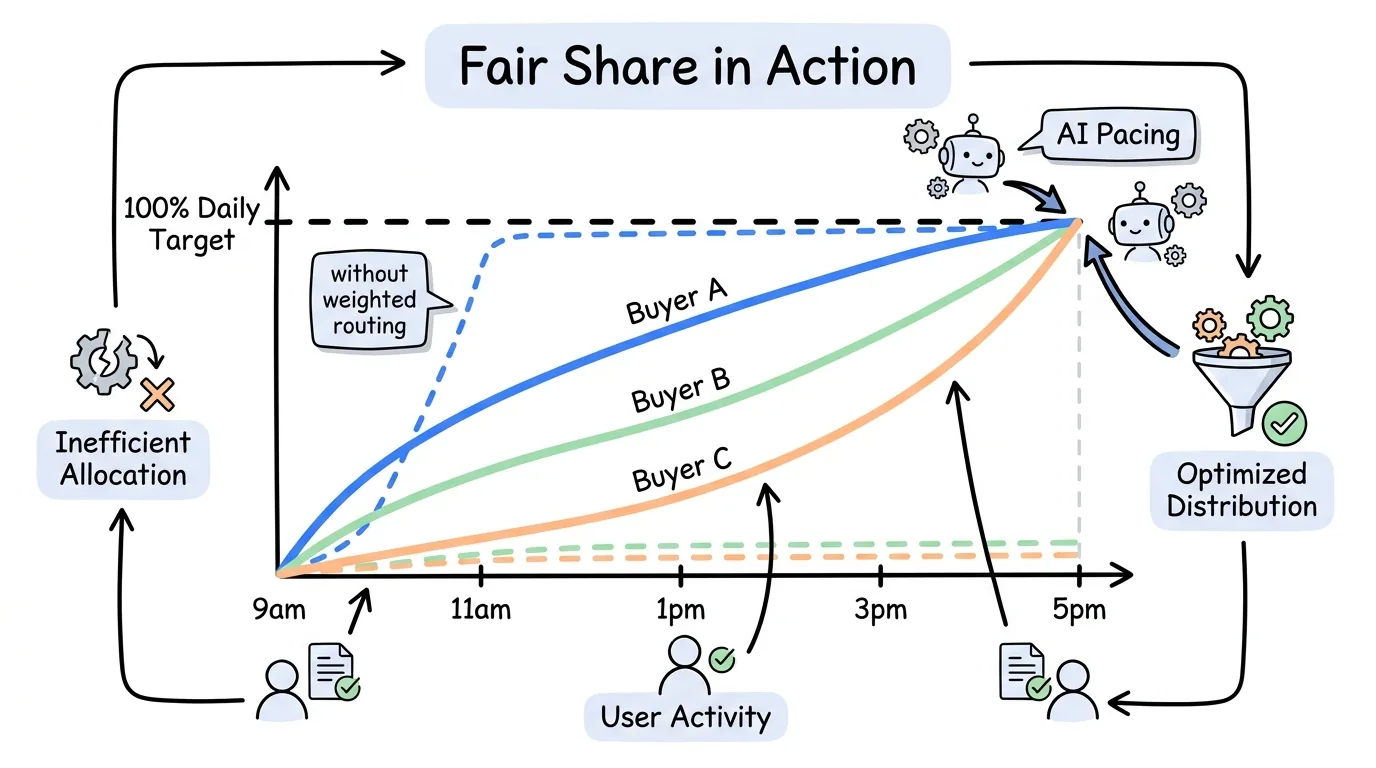
Weighted lead distribution is a routing method that assigns each buyer a daily lead target and distributes incoming leads to move every buyer toward that target at roughly the same pace. Rather than sending one buyer a burst of 30 leads before 10 a.m. and leaving other buyers starved by afternoon, Weighted (Fair Share) routing spreads inflows proportionally across the day so no buyer finishes with 200% of their target while another gets 40%.
For pay-per-lead agencies and lead brokers managing multiple buyers with different capacity and different quality tolerances, this pacing matters. A buyer who receives twice their desired volume in the first four hours of the day often returns leads, disputes charges, or reduces their cap, which ripples into your payouts for the rest of the month. Weighted distribution is designed to prevent that cycle by keeping all buyers in range of their targets throughout the day.
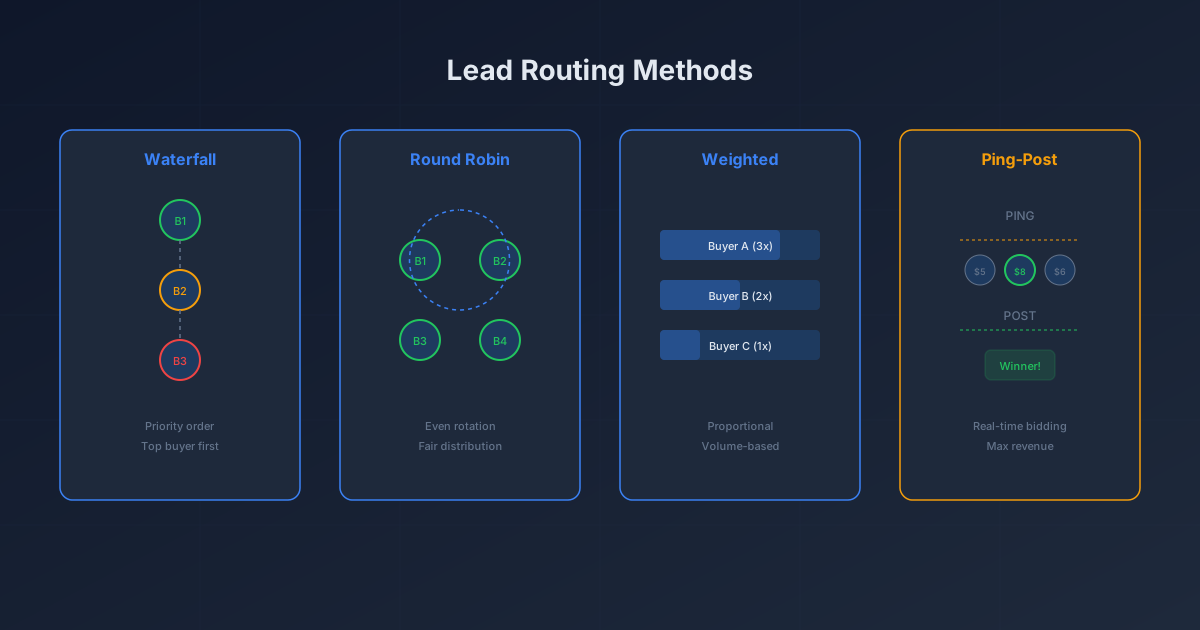
Lead Distro AI added Weighted (Fair Share) distribution in August 2026 as a fourth distribution method alongside Priority, Round Robin, and Weighted. The Fair Share mechanism paces each buyer toward their daily target and spreads any overflow evenly across buyers who still have capacity.
Key Takeaways
- Weighted lead distribution gives each buyer a daily target and paces incoming leads to fill those targets proportionally, preventing one buyer from getting all available leads early in the day.
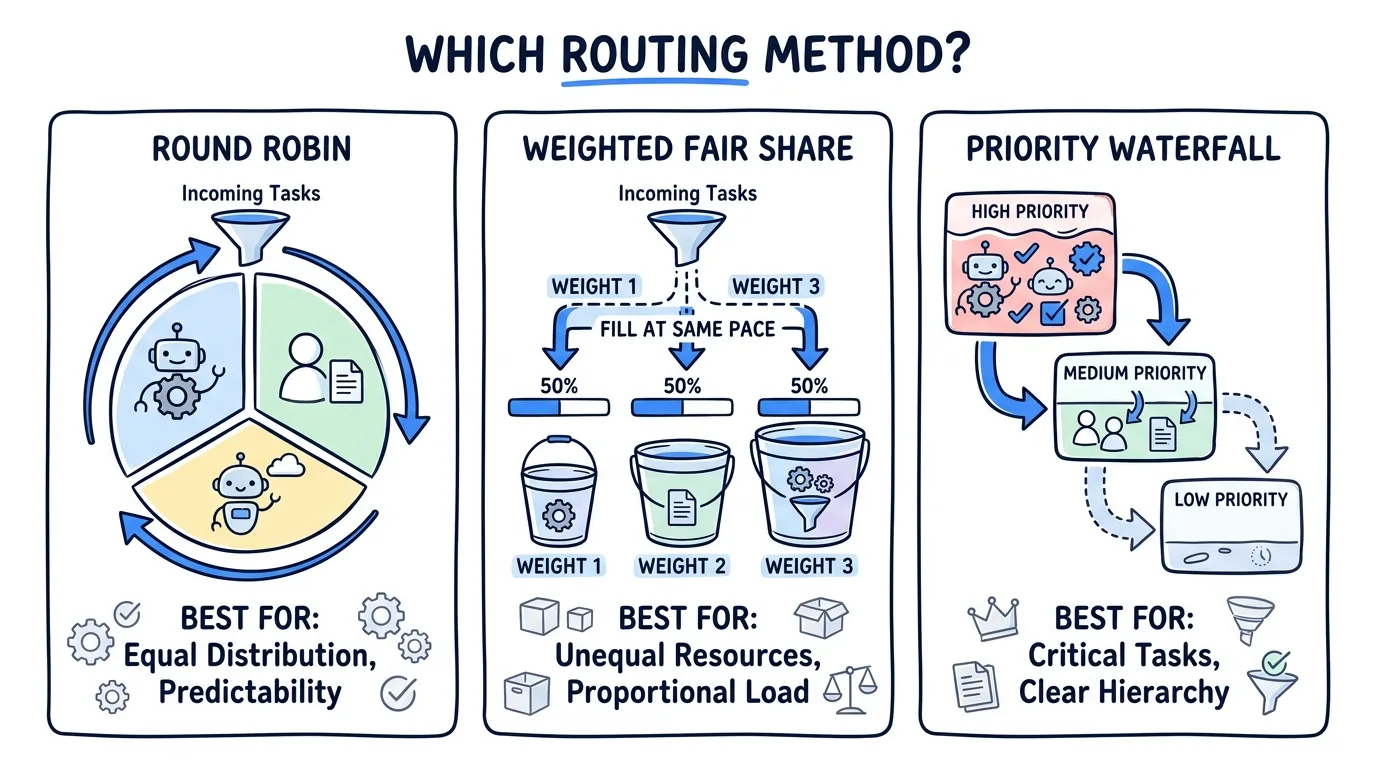
- Fair Share routing is distinct from Round Robin (which splits equally regardless of capacity) and from Priority/Waterfall (which sends everything to the highest-priority buyer until they are full).
- Use it when buyers have different capacity requirements, different lead quality tolerances, or when you want to manage pacing across time zones and business hours.
- Overflow handling sends leads that exceed one buyer's capacity to the next buyer with the most remaining capacity, so no lead is dropped when a buyer temporarily reaches their target.
- Lead Distro AI's Weighted (Fair Share) lets you set a daily lead target per buyer, define overflow routing, and combine it with existing filters (state, vertical, source quality) so you route only the right leads before applying the pacing logic.
What Is Weighted Lead Distribution?
Weighted lead distribution is a routing rule that controls how an agency or lead broker distributes leads across multiple buyers based on each buyer's capacity target rather than equal division or fixed priority.
In a standard Round Robin setup, leads cycle through buyers in sequence regardless of how many each buyer has already received. A buyer at 150% of their target gets leads at the same rate as a buyer at 40% of their target. Round Robin optimizes for simplicity, not buyer balance.
In a Priority or Waterfall setup, the highest-priority buyer receives all available leads first, and lower-priority buyers only receive leads when the top buyer is capped out. Priority optimizes for funneling volume to your best buyer, not for spreading it.
Weighted distribution sits between these two patterns. Each buyer receives leads in proportion to their target, and the algorithm tracks each buyer's running total throughout the day. If Buyer A has a daily target of 40 and has received 30, while Buyer B has a target of 20 and has received 5, the next lead goes to Buyer B because they are further behind their proportional pace.
This approach is sometimes called "Fair Share" routing because it gives every buyer a fair share of available volume relative to what they asked for, rather than giving the most to whoever is first in the queue.
How Weighted (Fair Share) Routing Works
The core mechanism tracks three values for each buyer throughout the day: the daily lead target, the current received count, and the current pace percentage (received divided by target).
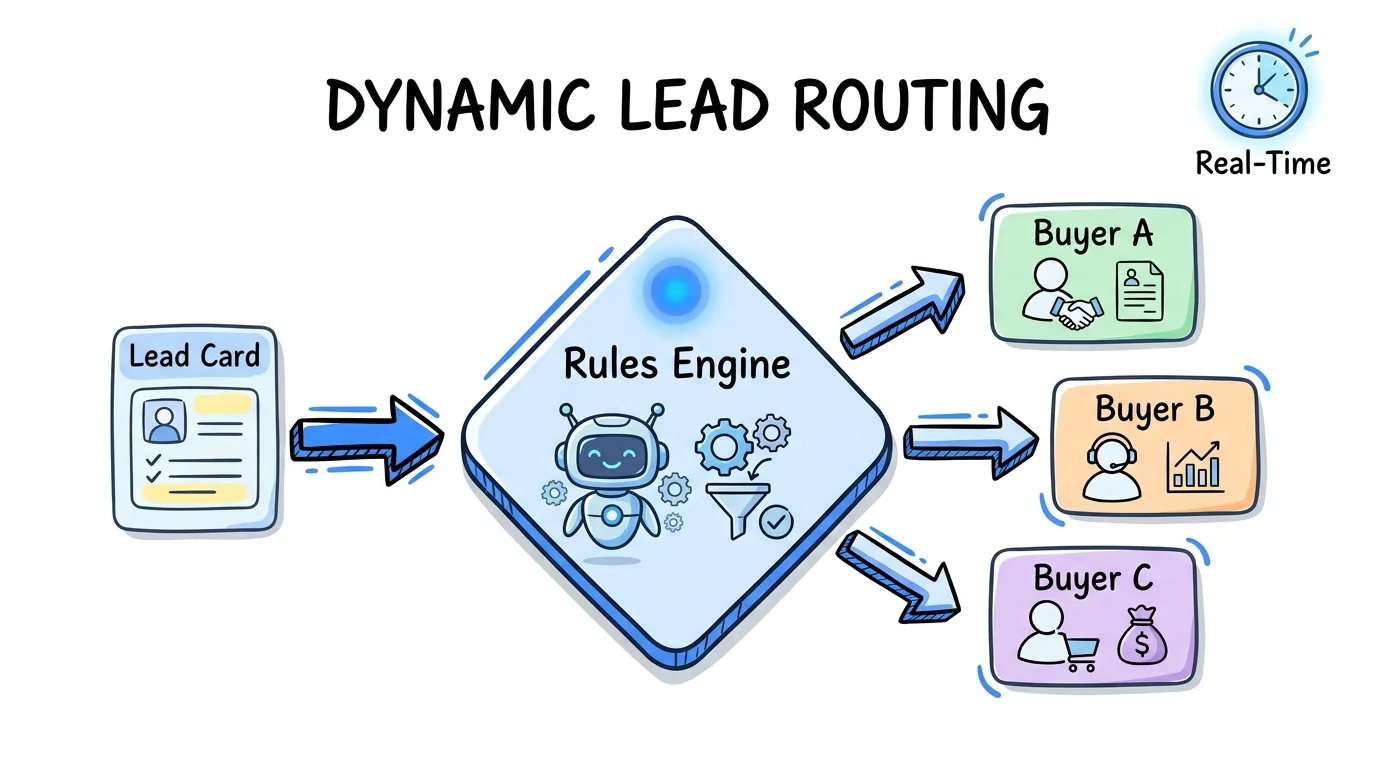
When a new lead arrives, the algorithm compares the pace percentage of all eligible buyers and routes the lead to the buyer with the lowest pace percentage, meaning the buyer who is furthest behind their target relative to where they should be at the current time of day.
Overflow is handled in two ways. If a buyer has reached 100% of their daily target and more leads are still incoming, those leads route to the next buyer with the most remaining capacity. If all buyers have reached their targets, the routing rule applies the campaign's fallback behavior (hold, reject, or route to a secondary buyer pool).
The Fair Share label refers to how overflow is distributed across multiple buyers. When inflows are unevenly timed (a spike at 9 a.m. followed by slow afternoon volume), the algorithm does not starve late-day buyers. Instead, it absorbs morning spikes into the buyers with the most remaining capacity and continues pacing throughout the day.
Weighted vs. Other Lead Distribution Methods
| Method | Logic | Best For | Risk |
|---|---|---|---|
| Weighted (Fair Share) | Route to buyer furthest below daily target | Multiple buyers, different capacities | Requires accurate daily targets per buyer |
| Round Robin | Rotate equally across all buyers | Identical buyers, simple equal split | No volume balancing or pacing |
| Priority / Waterfall | Fill top buyer first, cascade down | One premium buyer plus backups | Lower-priority buyers get irregular volume |
| Ping-Post | Real-time bid, highest bid wins | Revenue optimization across many buyers | Buyers must support bid API |
| Weighted (Share) | Route a fixed share of volume to each buyer | Contractual allocation splits | Ignores how full each buyer already is that day |
Weighted distribution is usually the right choice when you have two or more active buyers with different daily caps and want to keep all of them consistently close to their targets. It is less useful when you have a single premium buyer who should receive everything first, which is the Priority pattern.
When to Use Weighted Lead Distribution
Multiple buyers with different capacity. If Buyer A wants 50 leads per day and Buyer B wants 20, a Round Robin split would give each 35 and leave Buyer A undersupplied. Weighted routing fills each to their actual target.
Buyers in different time zones. A buyer in the Eastern time zone and a buyer in the Pacific time zone experience different business hours. Morning volume in the East can exhaust a buyer before the West Coast is fully open. Weighted distribution naturally paces inflows so late-day buyers still receive their share.
Protecting buyer relationships. Buyers who consistently receive significantly more or fewer leads than they expected tend to reduce their caps or leave the network. Consistent pacing toward daily targets reduces cap disputes and improves buyer retention.
Testing quality across sources. When you are running multiple lead sources and want each buyer to receive a representative sample, Weighted distribution ensures each source's leads are spread across buyers rather than all routing to a single buyer from one source.
When round-robin causes morning spikes. If your Round Robin setup results in certain buyers hitting their daily cap before noon and others receiving only a few leads by end of day, Weighted distribution solves that pacing problem without requiring you to manually adjust caps each morning.
Setting Up Weighted Distribution in Lead Distro AI
Lead Distro AI's Weighted (Fair Share) routing is configured at the campaign level. You set a daily lead target for each buyer destination and the platform handles the pacing and overflow automatically.
Step 1: Create or open your campaign. In your Lead Distro AI dashboard, navigate to the campaign you want to configure. Weighted distribution is available on any campaign with two or more active buyer destinations.
Step 2: Select Weighted (Fair Share) as the distribution method. Under the campaign's Distribution settings, switch from Round Robin or your current method to Weighted (Fair Share). This turns the per-destination Share column into a Daily Target.
Step 3: Set daily targets for each buyer. For each buyer destination in the campaign, enter their daily lead target. These targets represent the maximum number of leads you want each buyer to receive in a 24-hour window. The platform resets targets at midnight in your configured time zone.
Step 4: Configure overflow behavior. Choose what happens when a buyer reaches their daily target before the day ends: route to the next buyer with remaining capacity, hold the lead, or mark it as unclaimed. Most agencies route to secondary buyers so volume is never wasted.
Step 5: Combine with existing filters. Weighted distribution stacks with Lead Distro AI's other routing filters. You can restrict a buyer to specific states, verticals, lead sources, or quality tiers and the Weighted algorithm only applies among buyers who pass those filters. This lets you run Fair Share pacing within a segment rather than across all buyers.
Step 6: Review the daily report. Lead Distro AI's P&L and distribution reports show each buyer's received count versus target at any point in the day. If a buyer is consistently hitting 100% before 2 p.m., raise their target or open additional overflow capacity. If a buyer is routinely ending the day at 60%, their target may be set too high relative to your actual inflow volume.
Start your 7-day free trial to test Weighted distribution with your live traffic. You can configure a campaign and route your first lead in under an hour.
Common Mistakes with Weighted Distribution
Setting targets higher than your total inflow volume. If you set combined buyer targets at 200 leads per day but your campaigns only generate 120, every buyer will end the day below target. This is an inflow problem, not a routing problem. Use the campaign's daily lead volume report to align targets with real supply.
Not configuring overflow. Without an overflow rule, leads that arrive after a buyer hits their target have no destination. Set a secondary buyer pool or a fallback behavior so no leads are dropped when any single buyer is capped out.
Mixing Weighted and Priority in the same campaign. Some platforms let you assign a priority tier AND a weight to the same buyer, which creates conflicts when a lead arrives. In Lead Distro AI, choose one method per campaign. If you need some buyers to receive everything first and others to receive overflow on a weighted basis, create two campaign stages: a Priority stage for your premium buyers and a Weighted stage for your secondary pool.
Resetting targets manually mid-day. If you raise a buyer's target at 2 p.m. because they had extra capacity, the algorithm recalculates their pace percentage from the current point in the day. This is usually fine, but be aware that a mid-day target raise will pull more leads toward that buyer for the rest of the day as the algorithm tries to close the gap.
FAQ
What is the difference between weighted and round robin lead distribution?
Round Robin distributes leads in equal rotation across all buyers, giving each buyer the same count regardless of how many they requested. Weighted (Fair Share) distribution routes leads proportionally based on each buyer's daily target, so a buyer who wants 50 leads per day receives roughly twice as many as a buyer who wants 25 per day. Round Robin optimizes for simplicity; Weighted optimizes for keeping every buyer close to their individual capacity target.
How does Lead Distro AI handle overflow in Weighted distribution?
When a buyer reaches their daily lead target, Lead Distro AI routes incoming leads to the next buyer with the most remaining capacity. If all buyers are at 100% of their targets, the campaign's fallback rule applies: hold the lead, mark it unclaimed, or send it to a secondary buyer pool. The goal is that no lead is dropped as long as any buyer has remaining capacity.
Can I combine Weighted distribution with state or vertical filters?
Yes. In Lead Distro AI, Weighted distribution applies within the set of buyers who pass your active routing filters. If you restrict Buyer A to insurance leads from California and Buyer B to all leads from the Western region, the Weighted pacing algorithm only compares buyers that are eligible for each individual lead. A California insurance lead only competes among buyers who accept it, not across your full buyer pool.
Does Weighted distribution reset daily?
Yes. Lead Distro AI resets each buyer's received count at midnight in your campaign's configured time zone. Targets and overflow rules remain in place indefinitely until you change them. You can also reset a buyer's count manually if you need to accommodate a special volume request mid-cycle.
When is Priority routing better than Weighted distribution?
Priority routing is better when you have a premium buyer who should receive all available leads first and secondary buyers who only receive volume the primary buyer cannot absorb. It is also better when buyers have contractual exclusivity on certain lead types. Weighted distribution is better when you have multiple buyers with similar importance but different daily capacity, and you want all of them to consistently hit their targets rather than one buyer getting everything and others getting only overflow.
What happens if my inflow volume is much lower than my total buyer targets?
If your total daily inflow is 100 leads and your combined buyer targets are 300, every buyer will end the day at roughly one-third of their target. Weighted distribution will still pace those 100 leads proportionally (a buyer with a target of 100 receives roughly twice as many as a buyer with a target of 50), but the shortfall is an inflow problem that routing cannot solve. Check your campaign's source performance and adjust targets to reflect realistic daily inflow.
Conclusion
Weighted lead distribution solves a specific problem: keeping multiple buyers at their preferred volume level when inflows are uneven or when buyers have very different daily capacity needs. It is more sophisticated than Round Robin (which ignores capacity) and less restrictive than Priority routing (which sends everything to one buyer first). For most pay-per-lead agencies managing two or more active buyers, Weighted distribution is the default to reach for.
Lead Distro AI's Weighted (Fair Share) method lets you set per-buyer daily targets, configure overflow routing, and combine pacing with your existing source and quality filters. For a deeper look at how to choose between routing methods, see how to choose lead routing software for your agency or the overview of lead distribution options in 2026.
Start your 7-day free trial and configure your first Weighted campaign in under an hour. Cancel anytime before the trial ends and you will not be charged.
About the Author
Founder & CEO of Lead Distro AI & Great Marketing AI
UC Berkeley graduate and former software engineer at Microsoft. Rafael built Lead Distro AI after managing over $10M in ad spend for performance marketing agencies (pay-per-lead and pay-per-call), including running campaigns for Neil Patel. He combines deep software engineering expertise with hands-on performance marketing experience to build tools that help these agencies scale profitably.
About Lead Distro AI
Lead Distro AI: AI-Powered Routing for Your Leads, Calls, and Appointments
The modern platform for pay-per-lead and pay-per-call agencies. Route, score, and deliver leads with AI-powered automation and real-time P&L tracking. Built for performance marketing agencies and lead buyers across legal, insurance, mortgage, solar, and home services verticals.
4 Distribution Methods
Waterfall, Round Robin, Weighted, Ping-Post
Ping-Post Auctions
Real-time bidding with sub-second routing
Real-Time P&L Reporting
Track revenue, costs, and profit per campaign
Call Tracking
Assign tracking numbers, record calls, and attribute conversions
Lead Scoring
Score every lead before routing to maximize conversion
Partner Portal
Self-serve dashboard for buyers to track leads