TCPA Quiet Hours: The 8am to 9pm Rule for Lead Sellers
TCPA quiet hours bar telephone solicitations before 8 a.m. and after 9 p.m. at the called party's location. See the rule, state limits, and what to log.

Rafael Hernandez
Founder & CEO
Ex-Microsoft SWE · $10M+ PPL ad spend
I hope you enjoy reading this blog post. If you want to try Lead Distro AI for free, click here.
Author: Rafael Hernandez | Founder & CEO of Lead Distro AI
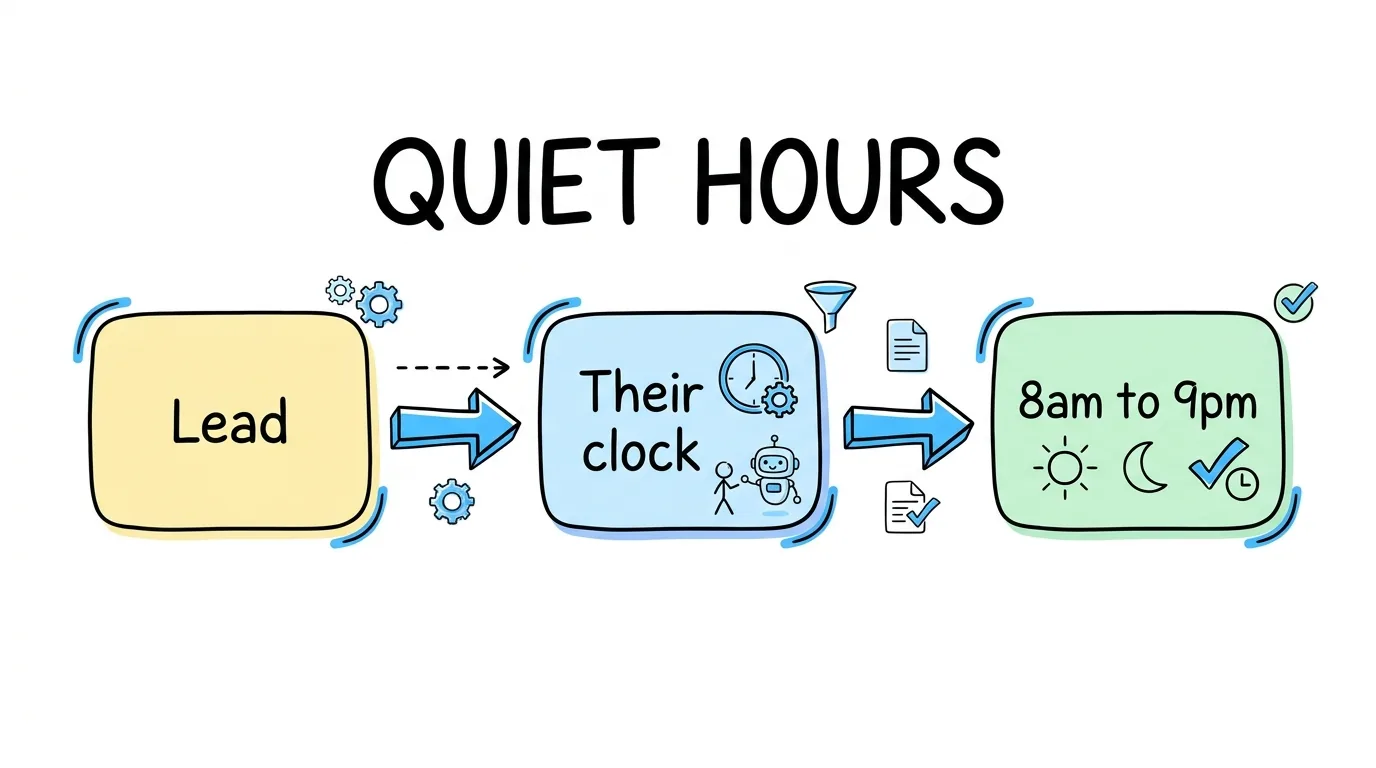
TCPA quiet hours are the federal rule that bars a telephone solicitation to a residential subscriber before 8 a.m. or after 9 p.m., measured in local time at the called party's location, not yours. For lead sellers and buyers, that means every lead needs a recorded time zone before anyone calls it back.
This page is the operations version of the rule, written for people who sell and route leads and calls. It sits under our guide to TCPA compliance for lead generation. It is general information, not legal advice. Last verified against the sources linked below on November 14, 2026.
Key Takeaways
- The federal window is 8 a.m. to 9 p.m. The rule is 47 CFR 64.1200(c)(1), and it counts local time at the called party's location.
- Your server clock and your buyer's clock do not count. A lead's own time zone decides whether a callback is inside the window.
- Consent may not settle the question. The rule excludes calls to people who gave prior express permission, but courts and the FCC have not closed that issue for texts.
- Some states are tighter or differ. Maryland, Washington and Texas set their own hours, and Maryland also caps repeat calls.
- Record the time zone and its source on every lead. That record is how you show reasonable practices if a claim arrives.
The federal rule in one table
The TCPA calling hours rule is short. The table below lists each part of it with its source, so you can check the wording yourself in 47 CFR 64.1200 and 47 U.S.C. 227.
| Part of the rule | What it says | Source |
|---|---|---|
| The window | No telephone solicitation to a residential telephone subscriber before 8 a.m. or after 9 p.m. | 64.1200(c)(1) |
| Whose clock | Local time at the called party's location | 64.1200(c)(1) |
| Texts | Paragraph (c) applies to telemarketing texts to wireless numbers, to the extent described in the FCC's 2003 order (CG Docket 02-278, FCC 03-153) | 64.1200(e) |
| Consent carve-out | "Telephone solicitation" does not include a call or message to a person with prior express invitation or permission, or with an established business relationship | 64.1200(f)(15) |
| Private suit | More than one call in 12 months in violation of the rule can support a suit for up to $500 per violation, raised up to three times if willful | 47 U.S.C. 227(c)(5) |
| Defense | Reasonable practices and procedures to prevent violations are an affirmative defense | 47 U.S.C. 227(c)(5) |
Federal rules are a floor. Where a state sets a narrower window, follow the narrower one.
Whose clock counts: the called party, not yours
The rule says "local time at the called party's location." It does not say the caller's time, the account's time, or the time where the lead was stored. A seller in Los Angeles who dials a lead in Miami at 9:41 p.m. Pacific is calling at 12:41 a.m. Eastern. Inside the seller's building the call looks fine. Under the TCPA quiet hours rule it is not.
The consent carve-out is where people get confused. The definition in 64.1200(f)(15) leaves out calls to a person who gave prior express invitation or permission. Some defendants argue that takes a consented call outside the quiet hours rule. Nobody should build a calling system on that argument. In March 2025 the FCC's Consumer and Governmental Affairs Bureau asked for public comment on a petition from the Ecommerce Innovation Alliance on exactly this question for texts. Its public notice, DA 25-216, asks whether people who gave written consent can claim damages for texts received outside 8 a.m. to 9 p.m. Check the docket for any ruling before relying on either side.
Courts also decide for themselves. In McLaughlin Chiropractic v. McKesson, decided June 20, 2025, the Supreme Court held that district courts are not bound by the FCC's reading of the TCPA. So the safe operating rule is simple: hold the call until the window opens, consent or not.
Where lead flow breaks it
Quiet hours rarely fail because a rep chose to call at midnight. They fail because the flow does it for them. Four places to look:
- Late-night form submits with instant callbacks. A lead who submits at 12:40 a.m. wants a fast answer, but a dial at 12:41 a.m. is outside the window. Speed to lead is a real advantage, and it stops at 8 a.m. local.
- Buyers in another time zone. A buyer in Pacific time who receives a lead from the Eastern seaboard may start dialing at 5:30 a.m. Eastern without knowing it.
- Transfers and ring trees after hours. A warm transfer or a ring tree can ring a lead's phone at any hour the tree is live.
- Retry loops. A dialer that retries every 30 minutes can cross 9 p.m. in the lead's zone while the retry log still looks in-hours in yours.
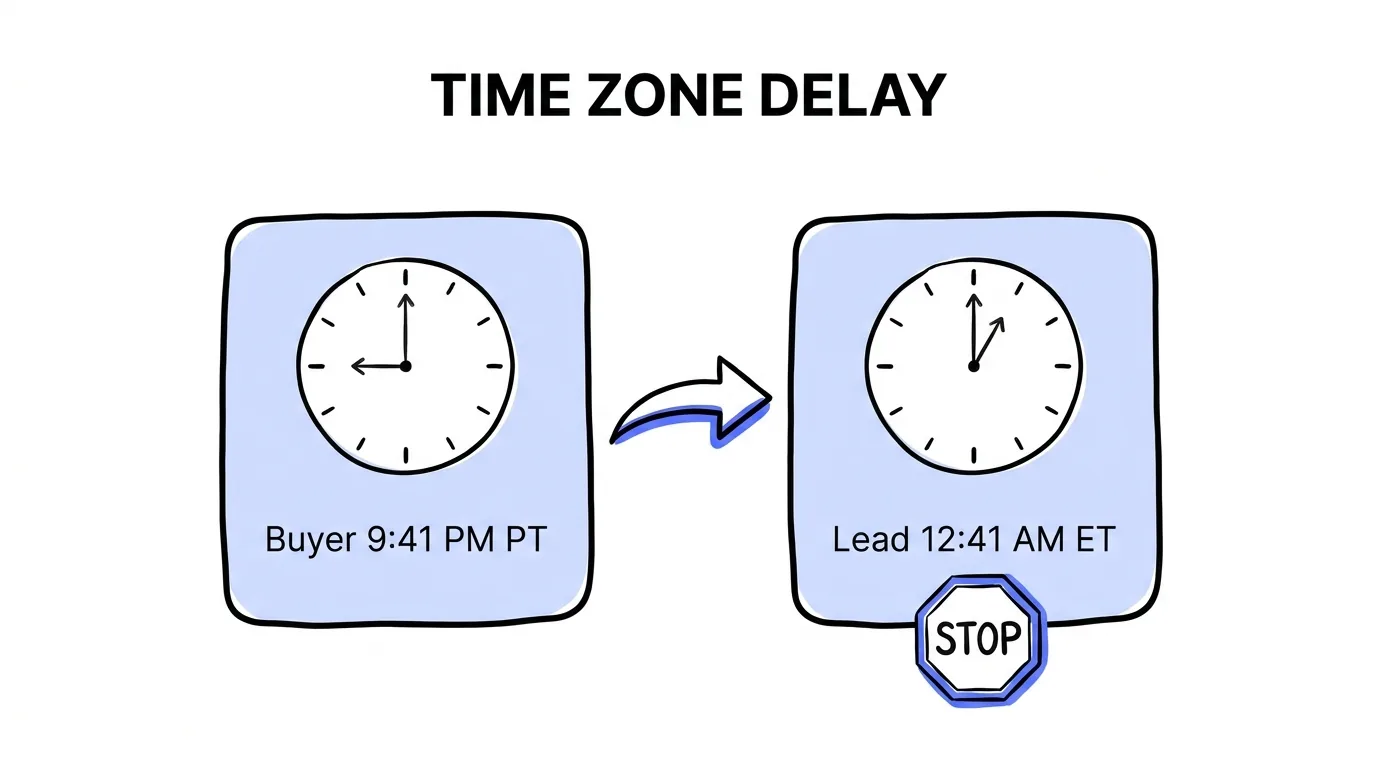
The fix is a hold-until-open step. Compute the earliest allowed call time from the lead's own time zone, queue the callback for that moment, and release it only when the window is open. Lead Distro AI can restrict delivery to buyer-specified days and hours with its campaign scheduling filters. Those schedules run on your account's time zone, not the lead's, so for a buyer in another zone you set the equivalent hours yourself. That is a delivery control. It does not check the lead's local time, and it does not make a call compliant. Compliance stays with whoever places the call.
Working out recipient time zone
You need a time zone for the person called, so use the best evidence you captured, in this order:
- ZIP code or address from the form. This is the strongest signal. Capture it as a required field.
- State, when no ZIP is given. Mind the states split across two zones, such as Florida's panhandle and the El Paso area of Texas.
- IP geolocation. Weak, because phones on cellular data and VPNs often report another city.
- Area code, last. A mobile number keeps its area code when its owner moves, so the area code shows where the number started, not where the person is.
That last point is not settled law. The same petition behind DA 25-216 asks the FCC to rule that the area code and exchange (the NPA-NXX) can be treated as indicating a wireless caller's location. That request tells you area code is not a safe default today. When two signals disagree, use the one that gives the narrower window.
Stricter state rules on telemarketing calling hours
A few states set their own telemarketing calling hours by state law. The table lists only states whose statute text we read and linked. Other states have rules too, so check the statute for each state you sell into.
| State | Window | Source |
|---|---|---|
| Maryland | Not between 8 p.m. and 8 a.m. in the called party's time zone, and not more than three calls in 24 hours on the same subject | Com. Law 14-4502(c) |
| Washington | Not before 8:00 a.m. or after 8:00 p.m. at the call recipient's local time | RCW 80.36.390(8) |
| Texas | After 9 a.m. and before 9 p.m. on weekdays and Saturdays; after 12 noon and before 9 p.m. on Sunday | Bus. & Com. Code 301.051(b)(2) |
Last verified: November 14, 2026. Two of these close an hour earlier than the federal 9 p.m. Texas adds a later Sunday start. Texas section 301.051(a) also exempts calls made in response to the consumer's express request and calls to a person with an existing business relationship, so read the full section before you apply it to a lead call. Statutes change, so confirm the current text before you build a rule on this table.
TCPA text message rules: what is settled and what is not
Settled: the FCC's rules treat paragraph (c) as applying to telemarketing texts to wireless numbers, as 64.1200(e) says, so a text sent at 11 p.m. in the lead's zone belongs in the same hold queue as a call.
Not settled: who can sue over it. On July 14, 2026, the Seventh Circuit held in Steidinger v. Blackstone Medical Services (No. 25-2398) that texts are not calls under the 227(c)(5) private right of action, the section that lets people sue over violations of the 227(c) rules. The opinion binds only courts in Illinois, Indiana and Wisconsin, and as Cooley's summary notes, other circuits have read the term differently. It did not decide whether texts are calls under the separate autodialer rules. State laws can also reach texts.
For TCPA text message rules, the practical answer is the same as for calls: queue the message and send it inside the window.
What to record on every lead
Section 227(c)(5) gives a defendant an affirmative defense for "reasonable practices and procedures." You cannot show a practice you did not record. Save these fields on each lead:
- Captured at, in UTC and in the lead's local time.
- ZIP code and state from the form.
- Time zone assigned, and the source that produced it (ZIP, state, IP, area code).
- Earliest permitted call time, based on the federal window or the stricter state window.
- Every call or text attempt, with the time and the zone used to approve it.
- Consent proof, stored per our TCPA compliance checklist.
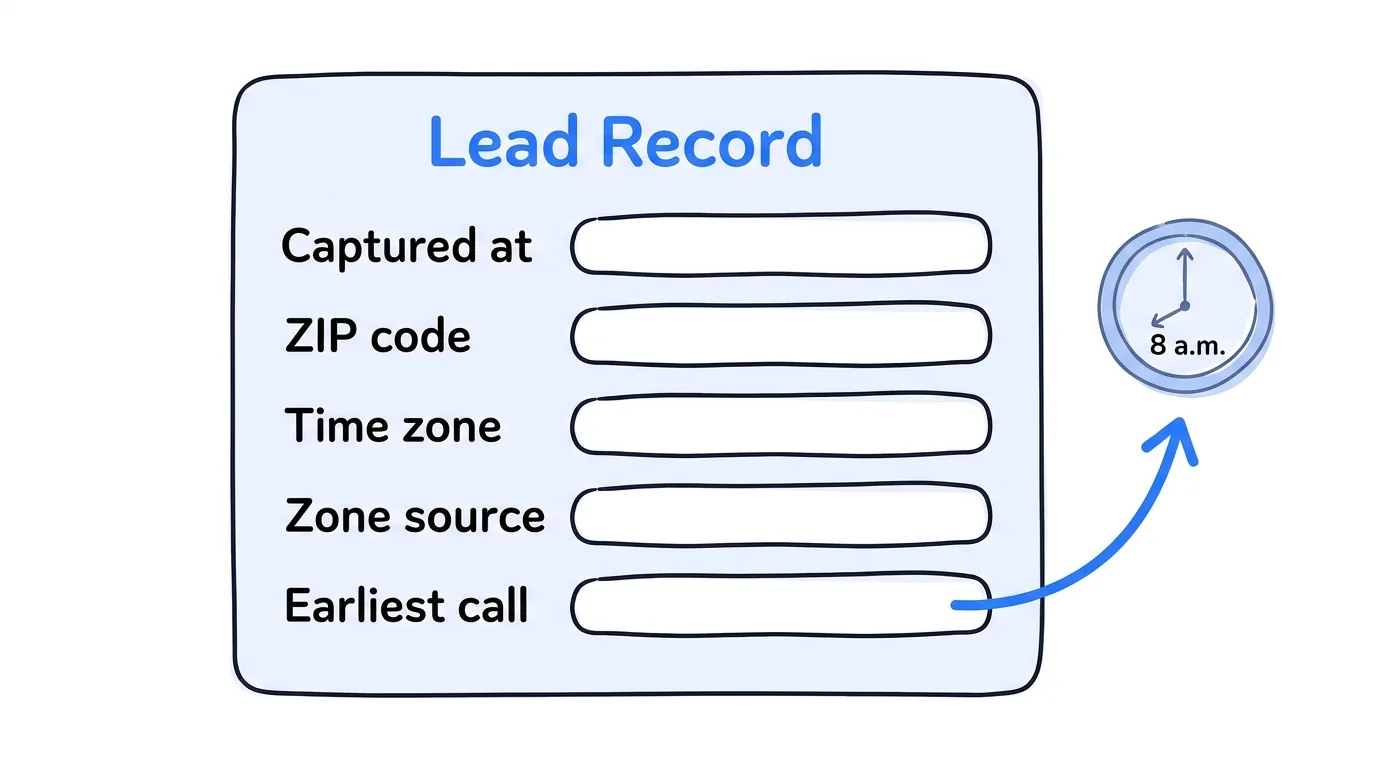
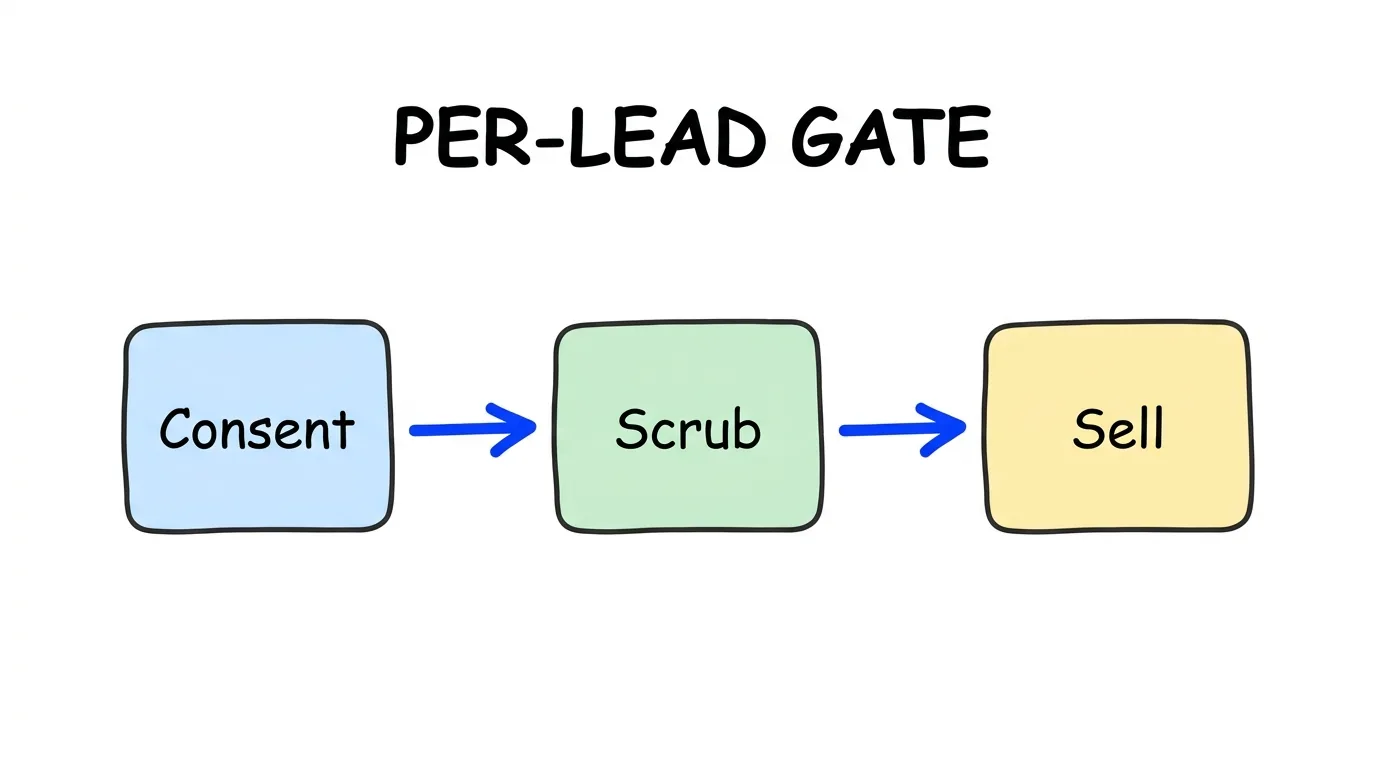
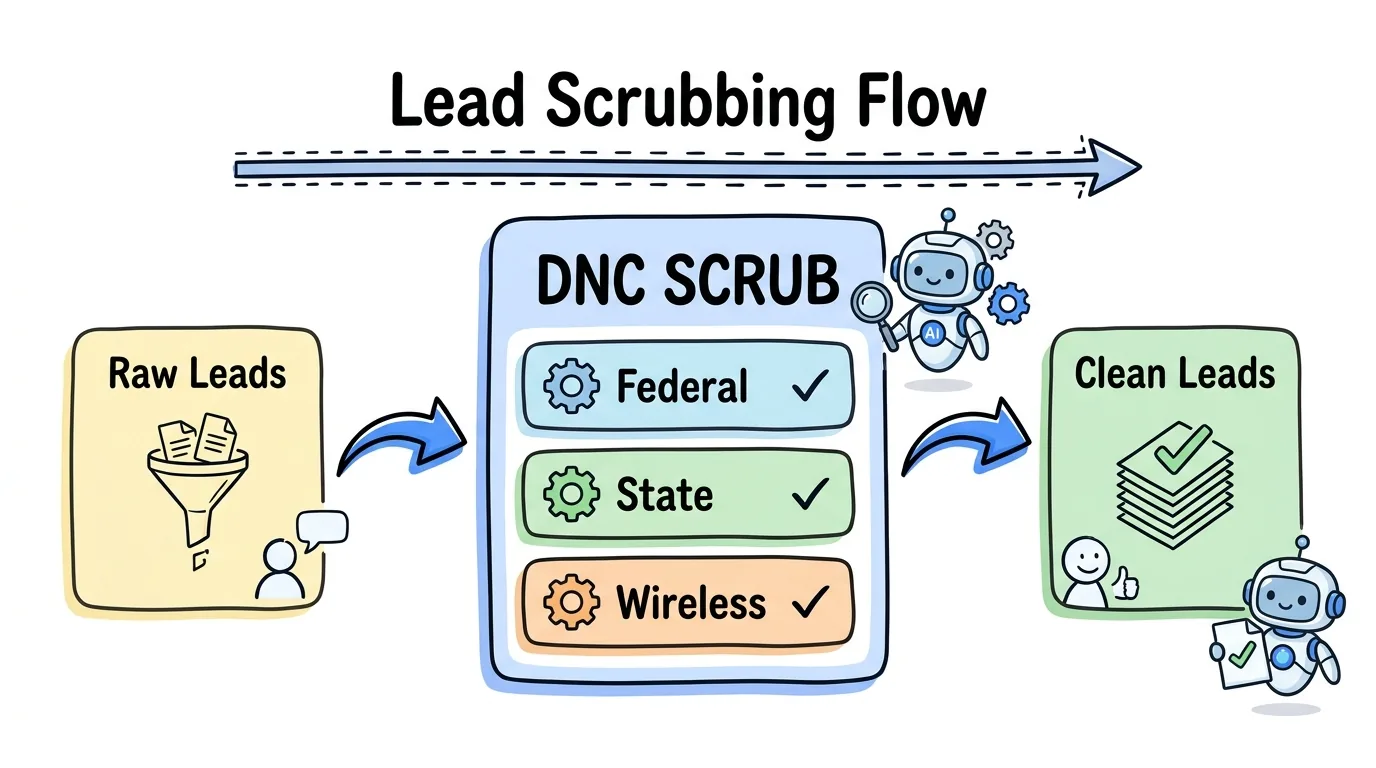
Scrubs sit beside this record. A number that passes the time check still has to clear DNC scrubbing, and buyers weigh the same records when they read about TCPA litigation risks for lead buyers.
FAQ
What are TCPA quiet hours?
TCPA quiet hours are the hours when a telephone solicitation to a residential subscriber is not allowed: before 8 a.m. and after 9 p.m., in local time at the called party's location. The rule is 47 CFR 64.1200(c)(1). Some states use narrower windows, such as 8 a.m. to 8 p.m. in Maryland and Washington. Follow the stricter rule where two apply, and have counsel confirm how it applies to your calls.
What time can telemarketers call?
Under the federal rule, a telemarketer may call a residential subscriber between 8 a.m. and 9 p.m. in the called party's local time. That window is the outer limit, not a target. Maryland and Washington close at 8 p.m., and Texas opens at noon on Sundays. A caller who works across time zones should compute the window from each lead's own zone, not from the caller's office clock or the buyer's. Hold anything that falls outside the window until it reopens.
Do TCPA quiet hours apply to text messages?
The FCC's rules apply paragraph (c) to telemarketing texts sent to wireless numbers, as described in 64.1200(e). Whether a person can sue over a late text is less clear. The Seventh Circuit held in July 2026 that texts are not calls under section 227(c)(5), but that ruling binds only that circuit and leaves other claims open. Treat texts like calls and send them inside the window until your counsel advises otherwise.
Does consent let me call outside the 8am to 9pm window?
Do not assume it does. The definition of telephone solicitation excludes calls to people who gave prior express invitation or permission, and some defendants rely on that. The FCC asked for comment on the point for texts in March 2025, and courts decide the meaning of the TCPA for themselves after McLaughlin v. McKesson. The cautious practice is to hold every call and text until 8 a.m. in the lead's zone, even with consent on file.
Which time zone counts, mine or the lead's?
The lead's. The rule measures local time at the called party's location, so your server, your account setting and your buyer's office do not decide it. Use the ZIP code or state captured on the form, store which source you used, and treat the area code as a last resort, since mobile numbers move with their owners. When signals disagree, pick the one that gives the narrower window. Keep the evidence with the lead record, so you can show later how you chose the zone.
Do calling hours differ by state?
Yes. Maryland bars calls between 8 p.m. and 8 a.m. and limits repeat calls, Washington uses 8 a.m. to 8 p.m., and Texas uses 9 a.m. to 9 p.m. on weekdays and Saturdays and noon to 9 p.m. on Sunday. Other states have their own rules. Read the statute for each state you sell into, and use the stricter of the federal and state windows when both apply to a lead. Confirm the current statute text before you set a rule, because states amend these laws.
Conclusion
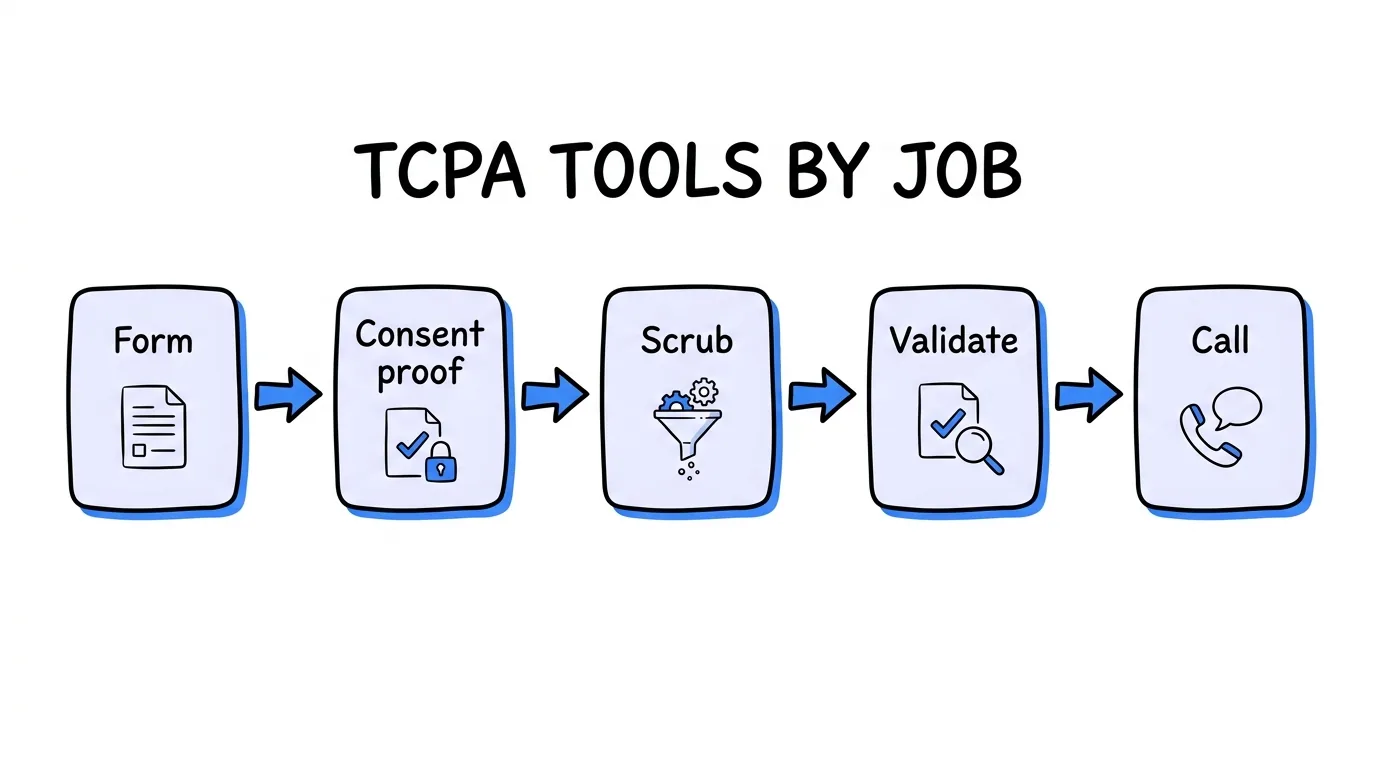
TCPA quiet hours come down to one habit: know the lead's time zone before anyone dials, and hold the call until the window is open. Record the zone and its source on every lead so you can show your practice later. For the full list of per-lead checks, read the TCPA compliance checklist, and for tools that run those checks, see TCPA compliance software.
Want delivery limited to the days and hours each buyer sets? Start a 7-day free trial and set campaign scheduling filters per buyer. You can cancel anytime during the 7 days.
About the Author
Founder & CEO of Lead Distro AI & Great Marketing AI
UC Berkeley graduate and former software engineer at Microsoft. Rafael built Lead Distro AI after managing over $10M in ad spend for performance marketing agencies (pay-per-lead and pay-per-call), including running campaigns for Neil Patel. He combines deep software engineering expertise with hands-on performance marketing experience to build tools that help these agencies scale profitably.
About Lead Distro AI
Capture, Route, and Sell Every Lead, Call, and Appointment
Capture, route, and sell leads, calls, and appointments from one platform, with funnels, call tracking, ping-post, and billing built in. Set it all up in minutes by chatting with AI.
Funnels
Quiz, form, appointment, VSL, and webinar templates
Call Tracking
Tracking numbers, call recordings, and per-call billing
4 Distribution Methods
Priority/Waterfall, Round Robin, Weighted, Ping-Post
Ping-Post and Live Bidding
Sell each lead and call to the highest bid
Real-Time P&L
Revenue, cost, and profit per campaign
Partner Portal
Your Destinations see their own leads and results