Best WhatConverts Alternatives in 2026: 7 Call & Lead Tracking Platforms Compared
Looking for WhatConverts alternatives? We compared 7 call and lead tracking platforms on attribution, AI scoring, ring tree routing, and pricing. See the picks.

Rafael Hernandez
Founder & CEO
Ex-Microsoft SWE · $10M+ PPL ad spend
I hope you enjoy reading this blog post. If you want to try Lead Distro AI for free, click here.
Author: Rafael Hernandez | Founder & CEO of Lead Distro AI
The best WhatConverts alternative for most agencies in 2026 depends on whether you need to report on leads or actually distribute and monetize them. WhatConverts is excellent at what it does: capturing and attributing every lead across calls, forms, chat, and e-commerce, then handing clean attribution data to clients. For agencies that move beyond reporting into selling leads and calls to buyers, Lead Distro AI is the strongest alternative because it adds AI lead scoring, four data distribution methods, ring tree routing for pay-per-call payouts, and a self-serve buyer portal on top of call tracking, all at a flat platform price. The seven platforms below cover every reason teams evaluate WhatConverts alternatives, from pure call tracking depth to full lead monetization.
WhatConverts built its reputation as a lead-centric attribution platform. Where CallRail tracks calls first, WhatConverts treats calls, forms, chats, and transactions as one unified lead feed, each tagged with the full attribution chain of source, medium, campaign, keyword, and landing page. Its "Quotable" lead filtering lets agencies qualify and tag leads before pushing them to client dashboards. That makes WhatConverts a great fit for agencies whose job ends at proving which marketing channels drive real leads. Agencies search for alternatives when they hit a different wall: they need predictive AI scoring, ring tree routing for pay-per-call payouts, or the ability to distribute and bill leads to multiple buyers, not just report on them. Each entry below names a real fit, an honest limitation, and a pricing position.
Key Takeaways
- Lead Distro AI is the best WhatConverts alternative for pay-per-lead and pay-per-call agencies that sell leads and calls to buyers rather than only reporting attribution to clients.
- WhatConverts itself remains the strongest pure attribution platform for agencies whose deliverable is clean multi-channel lead reporting across calls, forms, and chat.
- CallRail wins on conversation intelligence, with a transcription model trained on over 2 million hours of speech for best-in-class keyword spotting.
- Ringba and Retreaver own real-time bidding for pay-per-call brokering, a capability WhatConverts does not offer at all.
- WhatConverts pricing is usage-credit based, so overages at $0.10 per lead action above the included credit can push the real monthly bill well above the headline tier price.
Why Agencies Look for WhatConverts Alternatives
WhatConverts is genuinely strong. Its unified lead feed, 100-plus integrations included on every plan, and Quotable lead filtering make it one of the cleanest attribution tools for agencies that report on marketing performance. That said, three patterns drive teams to evaluate alternatives.
No lead distribution or monetization. WhatConverts captures and attributes leads, then sends them onward. It does not distribute leads to multiple buyers, run ping-post auctions, route calls through a ring tree to competing buyers, or bill those buyers. Agencies that sell leads and calls, rather than only report on them, need a distribution and billing layer WhatConverts does not provide.
Usage-credit pricing that compounds. WhatConverts plans include a fixed usage credit ($30 on single-account tiers), and every form, chat, or transaction beyond it costs about $0.10. High-volume agencies routinely pay well above the headline tier price once overages stack up (WhatConverts pricing).
No predictive AI scoring before routing. WhatConverts tags and filters leads, but it does not score each call and lead with predictive AI in under a second to decide where it should go. For agencies routing leads to buyers by quality, that scoring is the difference between margin and waste.
Quick Comparison: 7 WhatConverts Alternatives
| Platform | Best For | Multi-Channel Attribution | Ring Tree / RTB | AI Scoring | Lead Distribution | Pricing |
|---|---|---|---|---|---|---|
| Lead Distro AI | Pay-per-lead and pay-per-call agencies | Yes (calls + forms) | Yes | Yes (Claude AI) | Yes (4 methods) | $297/mo flat + usage |
| CallRail | B2B service businesses, SMBs | Calls first, forms add-on | No | No | No | From $45/mo |
| CallTrackingMetrics | Mid-market agencies, contact centers | Yes | Limited | No | No | From $79/mo |
| Ringba | Pay-per-call agencies | Calls only | Yes (bid-based) | No | No | From $147/mo |
| Retreaver | Agencies, networks | Calls only | Yes (RTB API) | No | No | Custom / pay-as-you-go |
| Invoca | Enterprise marketing teams | Calls, deep CI | Limited | Signal AI (CI, not routing) | No | Custom enterprise |
| Nimbata | Cost-conscious marketers | Calls + forms | No | AI call analysis | No | From $0/mo + usage |
1. Lead Distro AI: Best Overall WhatConverts Alternative
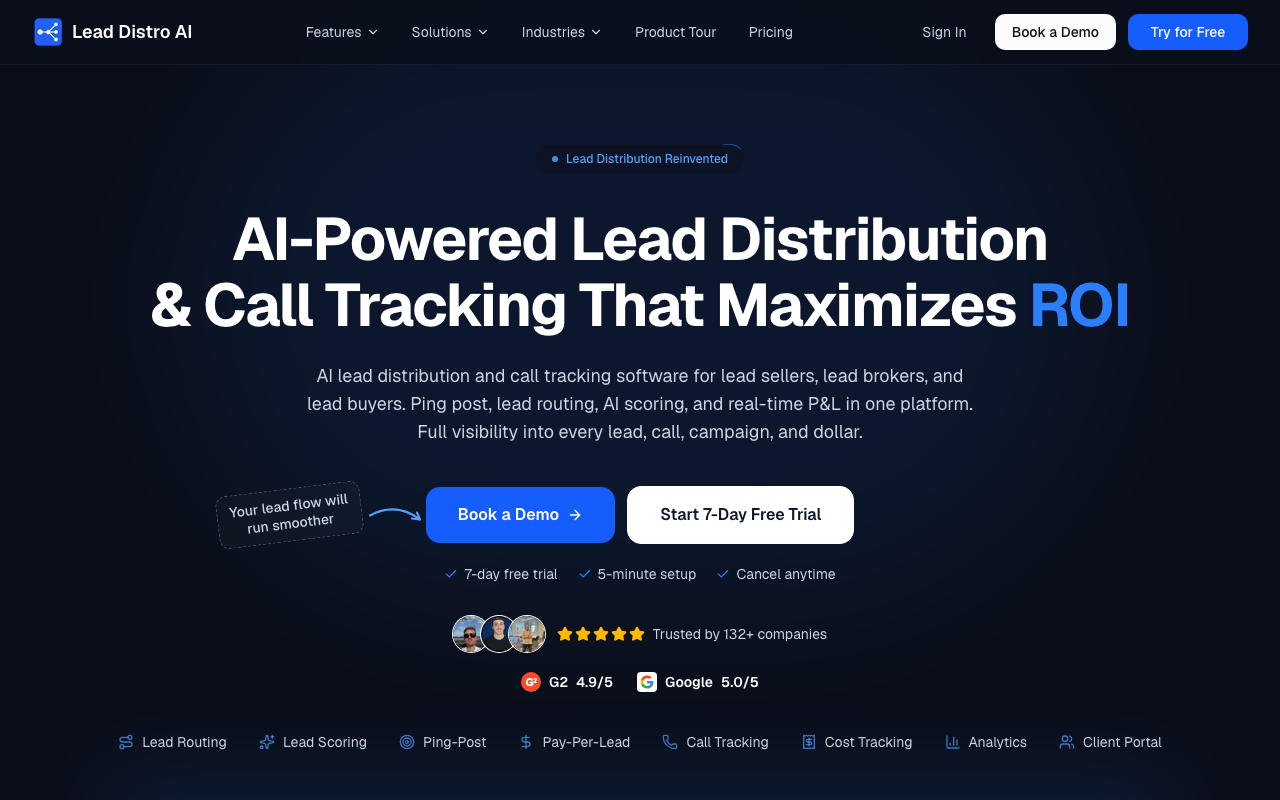
Lead Distro AI is the strongest WhatConverts alternative for agencies that monetize leads and calls, not just report on them. WhatConverts captures and attributes leads beautifully, then hands them off. Lead Distro AI picks up where attribution ends: every inbound call and web form lead is scored by Claude AI in under one second, then routed to the right buyer through one of four data distribution methods or a ring tree for pay-per-call payouts. For pay-per-lead and pay-per-call agencies running both channels, one platform handles capture, scoring, distribution, billing, and a real-time P&L by source, campaign, and buyer.
Where it beats WhatConverts:
- AI lead scoring on every call and form lead in under one second (WhatConverts tags and filters, but does not predictively score before routing)
- Four data distribution methods: Round Robin, Weighted, Priority/Waterfall, and Ping-Post (WhatConverts does not distribute leads to buyers)
- Ring tree routing for pay-per-call payouts where multiple buyers compete for each inbound call (WhatConverts has no call brokering)
- Self-service buyer portal with cap management and buyer billing (WhatConverts reports to clients, it does not bill buyers)
- Real-time P&L tracking with revenue, cost, and margin per source, campaign, and buyer
- Native TrustedForm integration for TCPA consent verification, plus Meta CAPI and Google Ads sync
- Spanish-language IVR routing for bilingual call flows
Where WhatConverts still wins: Deeper multi-channel attribution out of the box, including chat and e-commerce transaction tracking that Lead Distro AI does not focus on. Cleaner client-reporting dashboards for agencies whose deliverable is attribution. Lower entry price for tiny single-account operations. If your job ends at proving which channels drive leads, WhatConverts is purpose-built for it.
Pricing: Flat platform subscription starting at $297/mo, with volume-based tiers above it. Call tracking is usage-based on top of the subscription (a per-number monthly fee plus a per-minute inbound rate), the same usage model every call tracking platform runs. The 7-day free trial requires a credit card and can be canceled anytime before it ends.
Best for: Pay-per-lead agencies, pay-per-call agencies, lead brokers, and lead marketplaces that capture leads and calls and need to score, distribute, and bill them to buyers in one platform.
Take the interactive product tour to see how AI scoring and ring tree routing work end-to-end. For the broader category roundup, see best call tracking software in 2026, and for the cost breakdown, see call tracking software pricing.
 Lead Distro AI
Better Than WhatConverts
Better Features · Better Pricing · More Value
Start FreeFull access for 7 days.
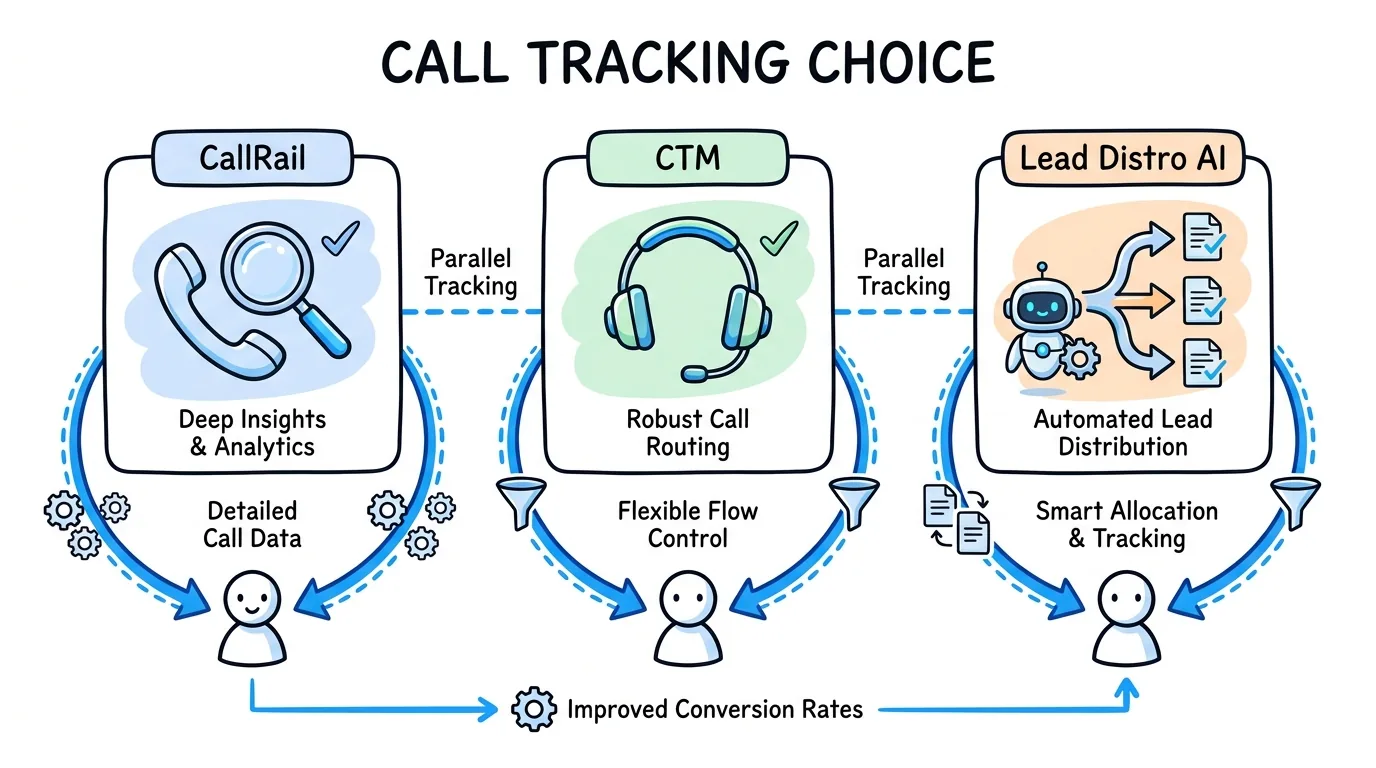
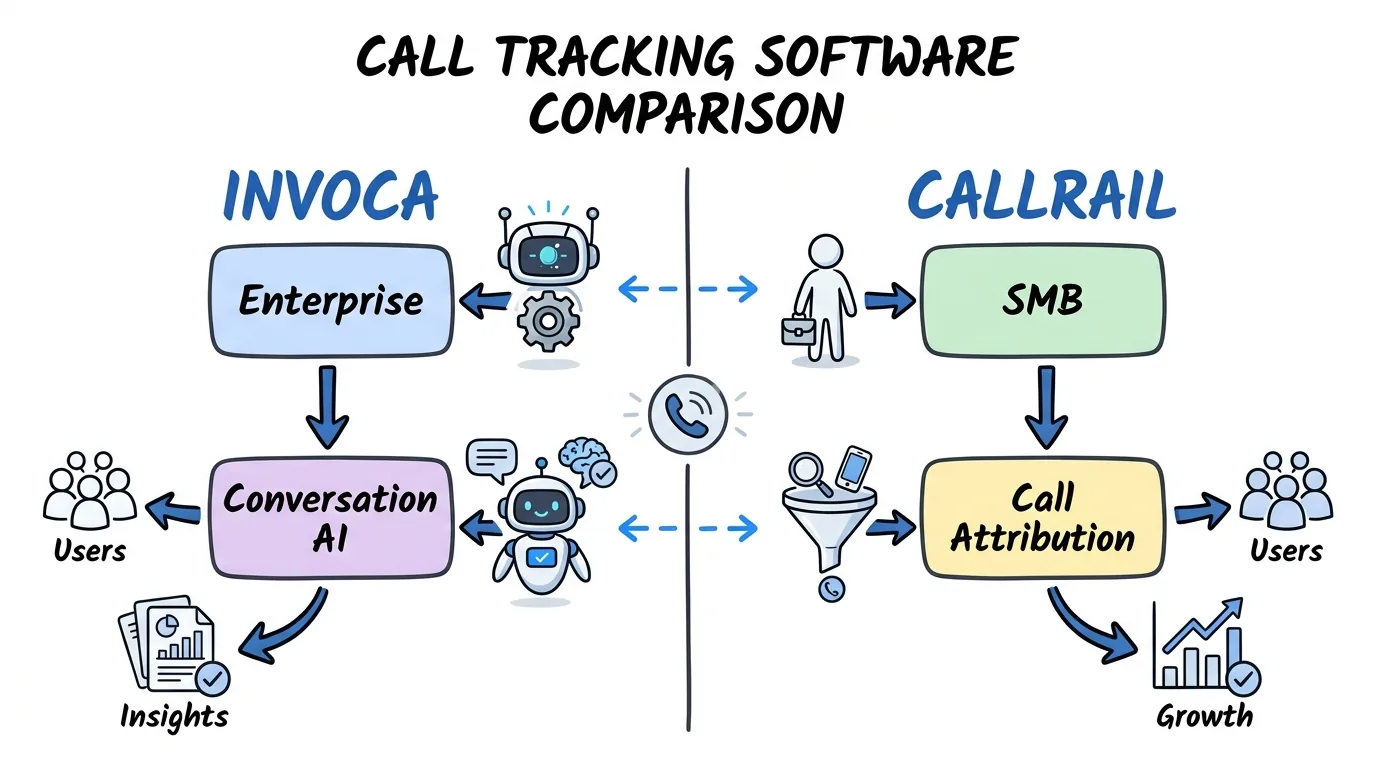
2. CallRail: Best for Conversation Intelligence
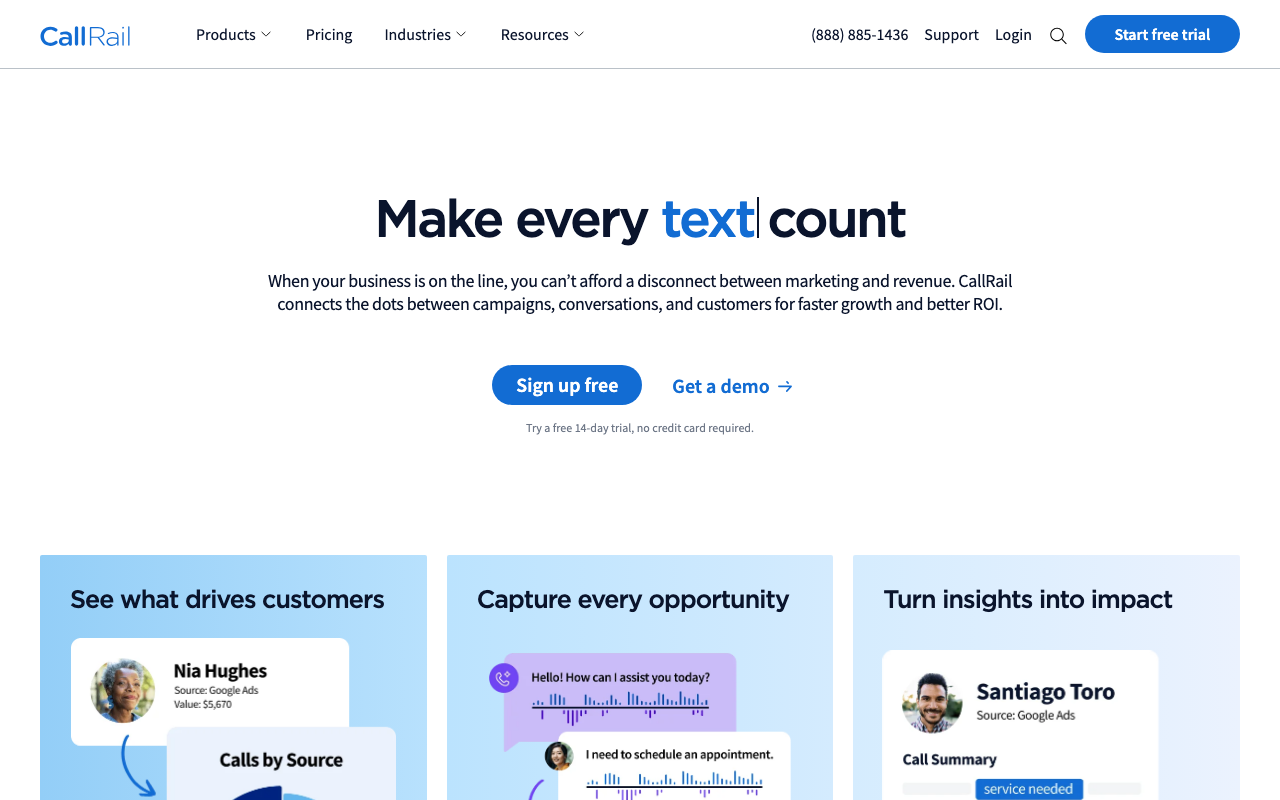
CallRail is the most common WhatConverts comparison because the two overlap on lead tracking while approaching it differently. CallRail leads with calls: its dynamic number insertion is rock-solid, and its Premium Conversation Intelligence runs on a transcription model trained on over 2 million hours of speech to spot keywords, questions, and call outcomes with near-human accuracy (CallRail vs WhatConverts). Form tracking is available as an add-on, but it is clearly secondary to the call features.
Where it beats WhatConverts: Deeper conversation intelligence and call transcription. Larger agency adoption and Google Ads integration maturity. Best-in-class DNI for keyword-level call attribution.
Where it falls short: No lead distribution, ring tree routing, or buyer billing. Form, chat, and transaction tracking are weaker than WhatConverts' unified lead feed. Some integrations cost an extra monthly fee that WhatConverts includes free.
Pricing: Starts at $45/mo for the Call Tracking plan; Conversation Intelligence and form tracking add cost.
Best for: B2B service businesses and agencies whose priority is call attribution and deep conversation analysis.
See best CallRail alternatives in 2026 for the full head-to-head.
3. CallTrackingMetrics: Best for Mid-Market Agencies and Contact Centers
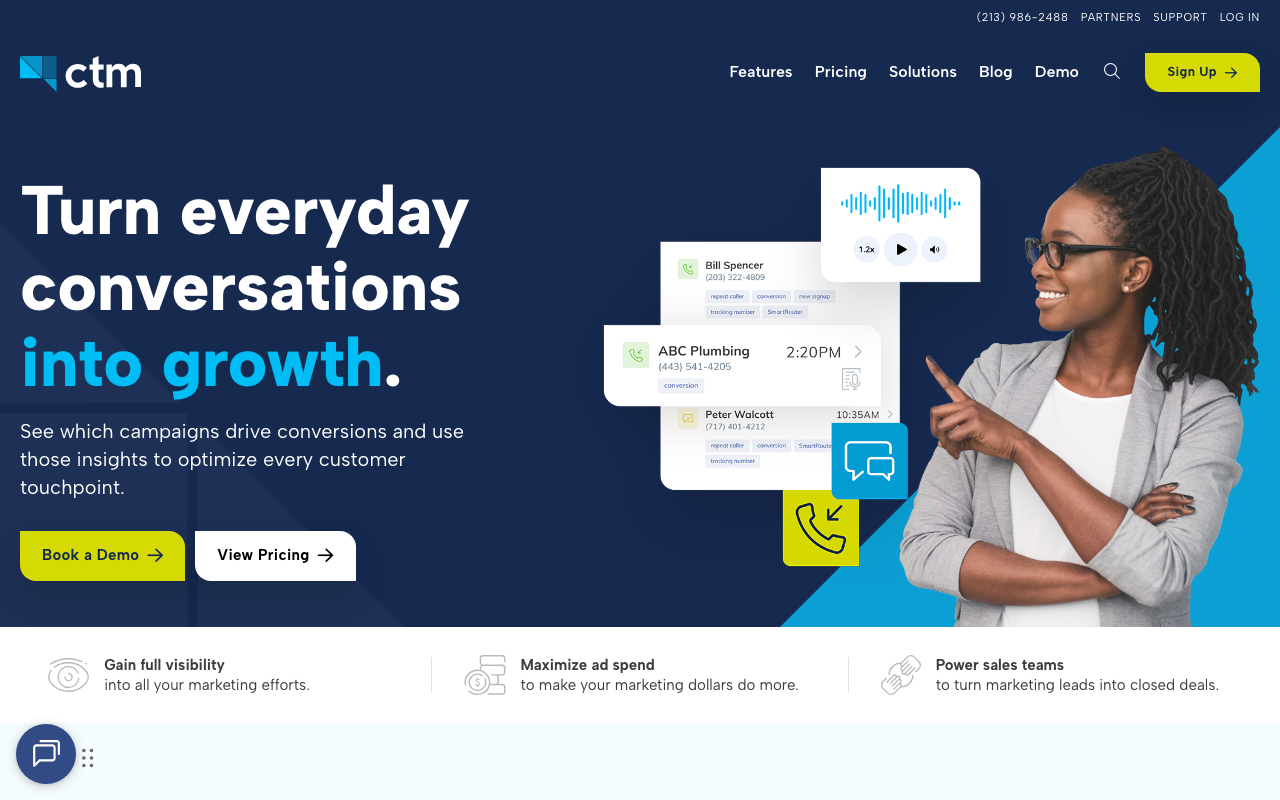
CallTrackingMetrics (CTM) sits upmarket from both WhatConverts and CallRail on the call operations side. It pairs DNI and multi-touch attribution with contact center features: multi-channel routing, queue management, live agent monitoring, and IVR menu trees. For mid-market agencies that have outgrown a pure attribution tool and need to run agents and queues, CTM is a stronger fit than WhatConverts.
Where it beats WhatConverts: Contact center operations, IVR depth, and call queue management WhatConverts does not offer. Usage-based billing where you pay for the data you use rather than bundled numbers and minutes (CTM plans and pricing).
Where it falls short: No predictive AI lead scoring. Limited ring tree functionality for bid-based pay-per-call payouts. No data lead distribution to multiple buyers. Attribution reporting is solid but less the central product than it is in WhatConverts.
Pricing: Starts at $79/mo, with higher tiers for larger contact center needs.
Best for: Mid-market agencies and contact centers that need DNI plus agent and queue management.
4. Ringba: Best for Pay-Per-Call Agencies
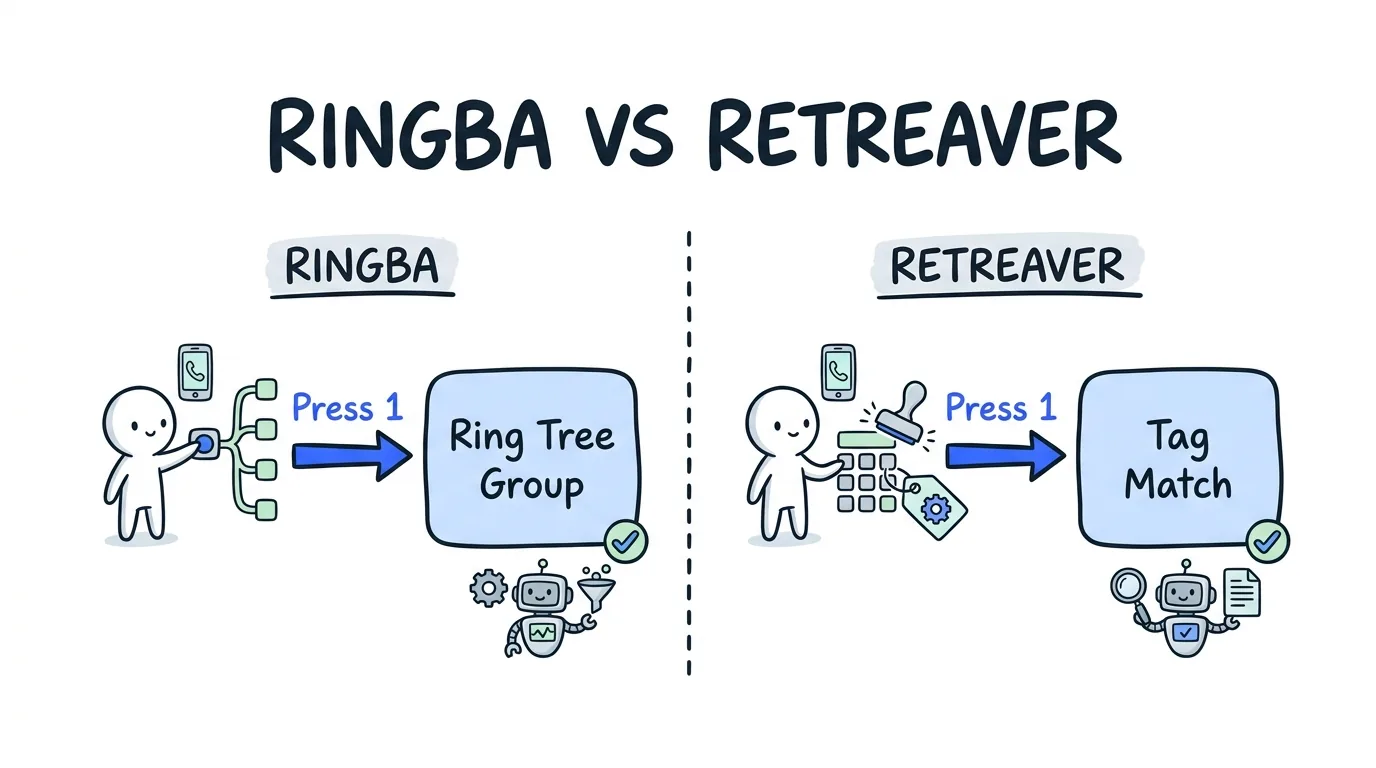
Ringba is built for pay-per-call agencies and call brokers, which makes it a fundamentally different tool than WhatConverts. Its core strength is real-time bidding through ring trees: each inbound call is pinged to eligible buyers at once, and the platform routes the call to the highest predicted-value bidder (Ringba real-time bidding). For agencies brokering calls between affiliate publishers and end-buyer call centers in insurance, legal, or home services, Ringba's ring tree depth is best in class.
Where it beats WhatConverts: Native ring tree routing with bid-based call payouts that WhatConverts does not support at all. Purpose-built pay-per-call attribution and buyer management.
Where it falls short: Call-only, so agencies running web form leads alongside calls need a separate tool for the data side. No AI lead scoring. Ring Trees and Real-Time Bidding unlock on higher tiers.
Pricing: Business at $147/mo, Professional at $297/mo, Enterprise custom (Enterprise adds Real-Time Bidding and Ping/Post call trading).
Best for: Pay-per-call agencies and call brokers operating primarily on the phone side.
See best Ringba alternatives in 2026.
5. Retreaver: Best for Custom Tag-Based Call Routing
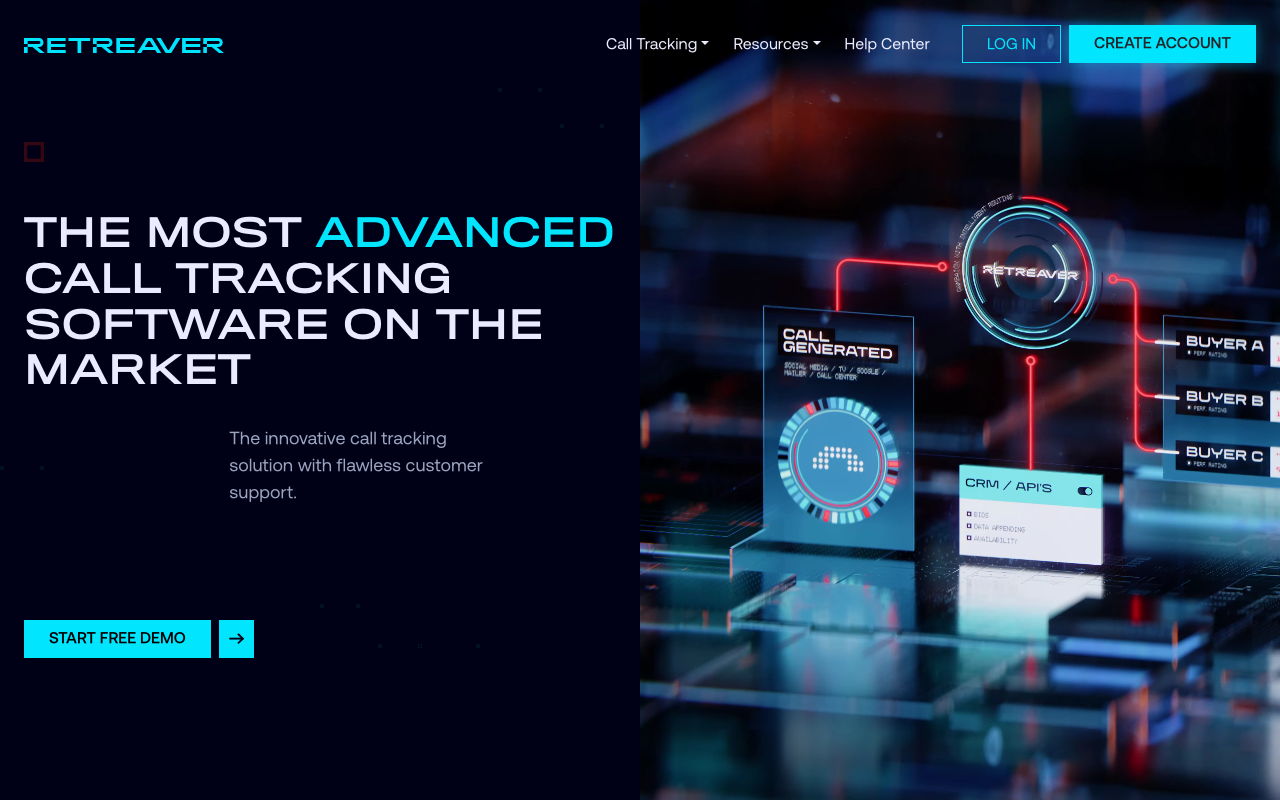
Retreaver is positioned for agencies and networks that need flexible, tag-based call routing logic. Calls are tagged with publisher IDs and dynamic data at call time, then routed by those tags, and its Real-Time-Bidding API lets lead generators run a ping/post system that reserves an available buyer and routes the call to the highest bidder (Retreaver RTB API). That depth on routing customization goes beyond WhatConverts' attribution focus.
Where it beats WhatConverts: Tag-based custom routing and a real-time-bidding API for pay-per-call brokering. Stronger fit for networks with non-standard routing requirements.
Where it falls short: No native data lead distribution for web form leads. No predictive AI scoring. Pricing is largely custom and pay-as-you-go, which makes budgeting harder than WhatConverts' published tiers.
Pricing: Custom, pay-as-you-go usage rates (real-time bidding and dropped calls are not charged as call events).
Best for: Agencies and networks that need flexible tag-based call routing and RTB.
See best Retreaver alternatives in 2026.
6. Invoca: Best for Enterprise Conversation Intelligence
Invoca is the enterprise leader in conversation intelligence. Its Signal AI builds custom classification models on your actual call outcomes rather than spotting fixed keywords, then feeds intent, qualification, and conversion signals back into Google Ads, Meta, and Microsoft Ads for bid optimization against call quality. For large marketing teams whose call volume drives material P&L, Invoca's conversation depth is unmatched, well beyond what WhatConverts offers on the analytics side.
Where it beats WhatConverts: Predictive Signal AI conversation intelligence and ad-platform bid optimization against call quality. Enterprise-grade contact center and industry accelerators.
Where it falls short for agencies: No ring tree routing for pay-per-call payouts. No data lead distribution to buyers. Quote-based enterprise pricing with no free trial, no self-serve tier, and a multi-week procurement process (Invoca pricing guide).
Pricing: Custom enterprise; typical deployments run roughly $25,000 to $75,000 per year depending on volume and modules.
Best for: Enterprise marketing teams optimizing paid media against call quality at scale.
7. Nimbata: Best for Cost-Conscious Marketers
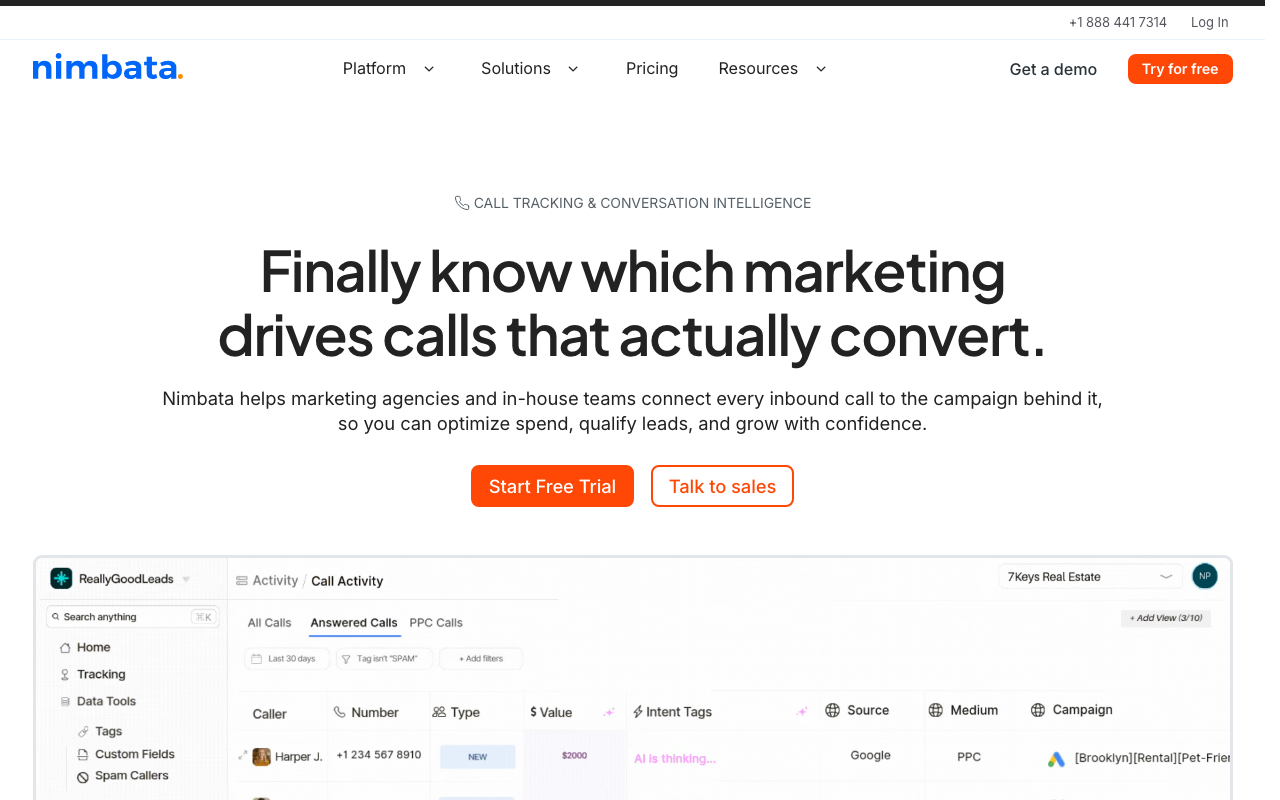
Nimbata is the budget-friendly entry on this list. Plans start at $0/mo with usage-based pricing as low as $1 per tracking number and a per-answered-call rate, and AI automatically analyzes call transcripts to fill caller profiles with sentiment, service type, urgency, and buyer stage (Nimbata pricing). It tracks calls and forms with real-time analytics, IVR, call routing, and 70-plus-country number coverage.
Where it beats WhatConverts: Lower entry cost and a pay-only-for-answered-calls model that suits low-volume marketers. Solid AI call summaries at a fraction of enterprise tooling cost.
Where it falls short: No lead distribution to buyers, no ring tree routing, and no buyer billing. Attribution and reporting are lighter than WhatConverts' unified multi-channel feed. Less suited to high-volume agency operations.
Pricing: From $0/mo plus usage; rates vary by number type, country, and volume.
Best for: Cost-conscious marketers and small agencies that need affordable call tracking with AI call analysis.
How to Choose the Right WhatConverts Alternative
The right alternative depends on what made WhatConverts feel limiting in the first place.
Choose Lead Distro AI if you:
- Run a pay-per-lead or pay-per-call agency that sells leads and calls to buyers
- Want AI scoring on every inbound call and form lead before routing
- Need four distribution methods plus ring tree routing for pay-per-call payouts
- Want a buyer portal, buyer billing, and a real-time P&L by source and buyer
- Need one platform for both data leads and calls
Stay on WhatConverts if you:
- Deliver multi-channel lead attribution reporting to clients
- Need unified call, form, chat, and e-commerce tracking in one feed
- Do not distribute or bill leads to multiple buyers
Choose CallRail if you:
- Prioritize deep conversation intelligence and call transcription
- Run B2B service or SMB call attribution
Choose CallTrackingMetrics if you:
- Run a mid-market agency or contact center needing IVR and queue management
Choose Ringba or Retreaver if you:
- Run a pay-per-call-only agency that needs real-time bidding and ring trees
Choose Invoca if you:
- Run an enterprise program where call quality drives material P&L
Choose Nimbata if you:
- Need affordable call tracking with AI call summaries at low volume
Frequently Asked Questions
What is the best alternative to WhatConverts in 2026?
For agencies that sell leads and calls to buyers, Lead Distro AI is the best WhatConverts alternative because it adds AI lead scoring, four distribution methods, ring tree routing, and buyer billing on top of call tracking, all at a flat platform price starting at $297/mo. For agencies whose deliverable is multi-channel attribution reporting, WhatConverts itself remains hard to beat. For deep conversation intelligence, CallRail and Invoca lead.
How much does WhatConverts cost?
WhatConverts single-account plans run $30/mo for Call Tracking, $60/mo for Plus, $100/mo for Pro, and $160/mo for Elite, each including a $30 usage credit. Agency plans start at $500/mo with a $250 credit. The catch is usage-credit pricing: form, chat, and transaction actions above the included credit cost about $0.10 each, plus separate per-minute and per-number charges, so high-volume bills run above the headline tier price.
What is the difference between WhatConverts and Lead Distro AI?
WhatConverts captures and attributes leads across calls, forms, chat, and e-commerce, then reports them to clients. Lead Distro AI picks up after attribution: it scores each call and lead with Claude AI, distributes leads to buyers through four methods or a ring tree, bills those buyers through a self-serve portal, and tracks real-time margin. WhatConverts is built for reporting on leads. Lead Distro AI is built for distributing and monetizing them.
WhatConverts vs CallRail: which should I pick?
WhatConverts treats calls, forms, chats, and transactions as one unified lead feed with full attribution and includes 100-plus integrations on every plan. CallRail leads with calls and has deeper conversation intelligence, with transcription trained on over 2 million hours of speech, but its form tracking is a secondary add-on. Pick WhatConverts for unified multi-channel attribution; pick CallRail when call conversation analysis is the priority.
Does any WhatConverts alternative include lead distribution and pay-per-call payouts?
Yes. Lead Distro AI distributes data leads through four methods (Round Robin, Weighted, Priority/Waterfall, and Ping-Post) and routes calls through a ring tree for pay-per-call payouts, with a buyer portal and billing built in. Ringba and Retreaver handle ring tree call brokering on the phone side only. WhatConverts, CallRail, CallTrackingMetrics, Invoca, and Nimbata do not distribute or bill leads to buyers.
Conclusion
WhatConverts is a genuinely strong platform with real strengths in unified, multi-channel lead attribution. If your job ends at proving which marketing channels drive leads and reporting that cleanly to clients, it is one of the best tools for the job. Where it leaves room is lead distribution, AI scoring before routing, ring tree pay-per-call payouts, and buyer billing. For pay-per-lead and pay-per-call agencies that sell leads and calls to buyers rather than only reporting on them, Lead Distro AI is the best overall alternative because it covers capture and attribution, then adds the scoring, distribution, ring tree routing, and billing layer WhatConverts does not. Mid-market contact centers should evaluate CallTrackingMetrics. Pay-per-call brokers belong on Ringba or Retreaver. Enterprise teams should look at Invoca, and cost-conscious marketers at Nimbata.
Whichever direction you go, match the alternative to the specific reason WhatConverts felt limiting. Attribution depth, conversation intelligence, ring tree routing, AI scoring, and full lead distribution are the axes that decide.
Want to see lead scoring, distribution, and ring tree routing in one platform? Start your 7-day free trial and route your first lead in under an hour, or take the product tour to see AI scoring and pay-per-call routing in action. For the head-to-head, read Lead Distro AI vs WhatConverts or scan the side-by-side comparison. For the broader category overview, see best call tracking software in 2026.
About the Author
Founder & CEO of Lead Distro AI & Great Marketing AI
UC Berkeley graduate and former software engineer at Microsoft. Rafael built Lead Distro AI after managing over $10M in ad spend for performance marketing agencies (pay-per-lead and pay-per-call), including running campaigns for Neil Patel. He combines deep software engineering expertise with hands-on performance marketing experience to build tools that help these agencies scale profitably.
About Lead Distro AI
Lead Distro AI: AI-Powered Lead Distribution & Call Tracking That Maximizes ROI
The modern platform for pay-per-lead and pay-per-call agencies. Route, score, and deliver leads with AI-powered automation and real-time P&L tracking. Built for performance marketing agencies and lead buyers across legal, insurance, mortgage, solar, and home services verticals.
4 Distribution Methods
Waterfall, Round Robin, Weighted, Ping-Post
Ping-Post Auctions
Real-time bidding with sub-second routing
Real-Time P&L Reporting
Track revenue, costs, and profit per campaign
Call Tracking
Assign tracking numbers, record calls, and attribute conversions
AI Lead Scoring
Score every lead before routing to maximize conversion
Partner Portal
Self-serve dashboard for buyers to track leads