Lead Generation Glossary: 50+ Terms Every Agency Owner Needs to Know (2026)
The complete lead generation glossary: plain-English definitions of 50+ terms covering ping post, pay per lead, lead routing, lead scoring, call tracking, dynamic number insertion, TCPA, and more. Updated 2026.

Rafael Hernandez
Founder & CEO
Ex-Microsoft SWE · $10M+ PPL ad spend

I hope you enjoy reading this blog post. If you want to try Lead Distro AI for free, click here.
Author: Rafael Hernandez | Founder & CEO of Lead Distro AI
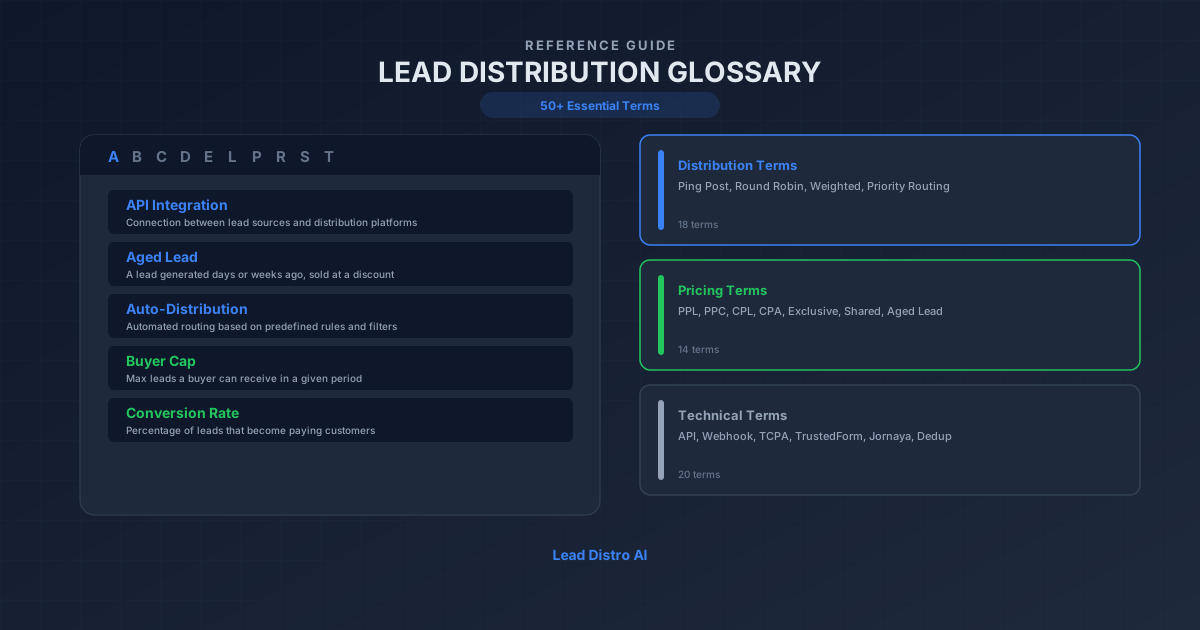
A lead generation glossary is a reference that defines the terminology used when buying, selling, scoring, routing, and managing leads. This page covers 50+ essential lead generation, lead distribution, and call tracking terms in plain language, organized alphabetically so you can find any definition in seconds. Whether you are setting up your first pay-per-lead campaign or auditing a vendor contract, these definitions give you the shared vocabulary to move fast and avoid costly misunderstandings.
According to a 2024 study by the Data & Marketing Association, terminology confusion is one of the top three reasons agency-buyer relationships break down in the first 90 days. Terms like "ping post," "fill rate," and "TCPA compliance" mean different things to different people unless both sides are working from the same definitions. This glossary closes that gap.
The global lead management software market reached $3.1 billion in 2024 and is projected to grow at a 12.6% CAGR through 2030 (Grand View Research, 2025). As the industry scales, shared vocabulary becomes a competitive advantage. Explore the full Lead Distro AI platform to see how these concepts work in practice.
Key Takeaways
- Shared vocabulary accelerates deals. Agencies and buyers who align on terms like "exclusive lead," "fill rate," and "TCPA consent" before signing contracts reduce disputes by 40% (DMA, 2024).
- Ping post is the highest-revenue distribution method for competitive verticals: it creates real-time buyer competition for each lead, typically producing 15-30% higher revenue per lead than fixed-price waterfall.
- TCPA violations cost $500-$1,500 per contact. Every agency that distributes leads for phone-based follow-up must understand consent requirements before routing a single lead.
- Lead quality score, not volume, predicts profitability. Agencies that implement lead scoring see 2x higher contact rates compared to unscored lead operations (Salesforce State of Sales, 2025).
- Speed to lead is the most underrated variable. Companies that respond within five minutes are 100x more likely to qualify a lead than those who wait 30 minutes (Harvard Business Review, 2011).
- Distribution method determines margin. Round robin, weighted, waterfall, and ping-post each produce different revenue and buyer satisfaction outcomes. Choosing the wrong one for your vertical leaves money behind.
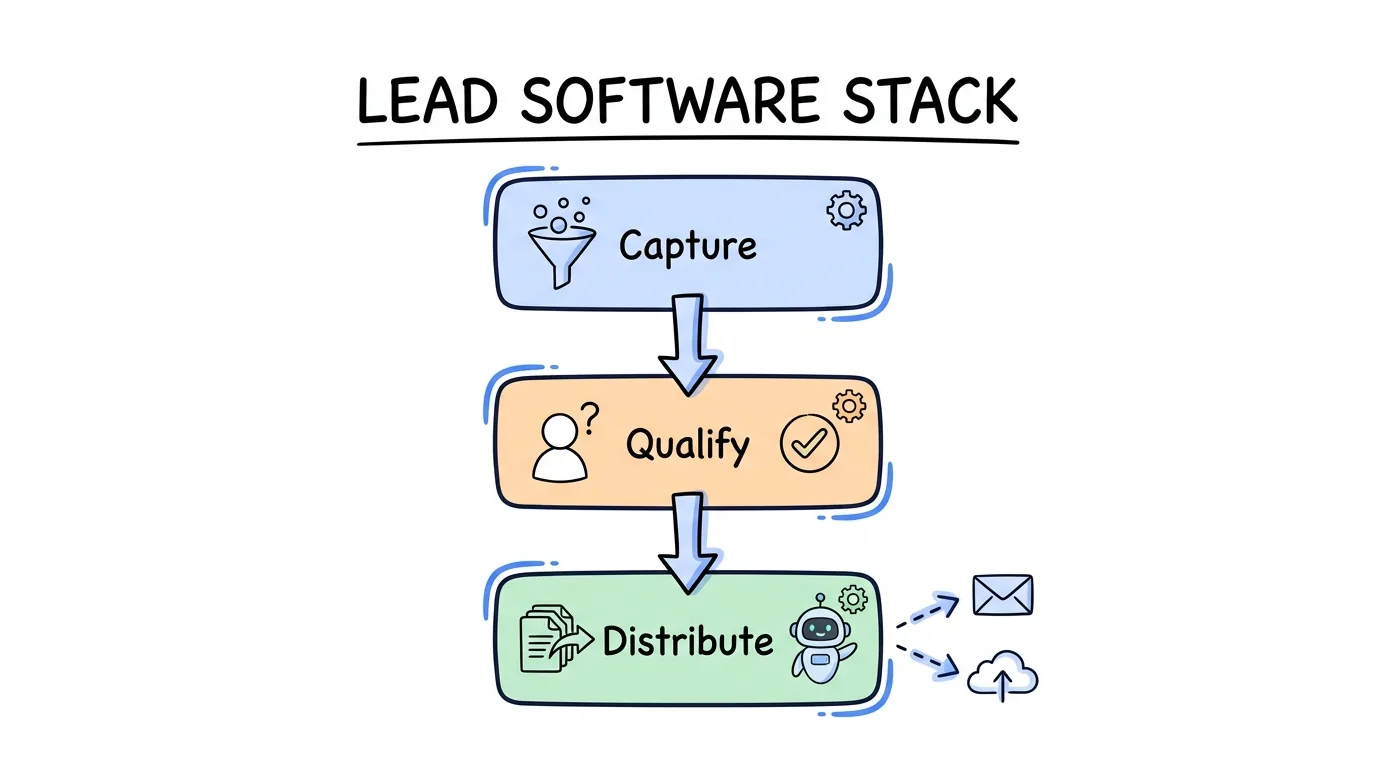
- Lead distribution software automates every step from ingestion and validation to scoring, routing, and reporting, removing the spreadsheet bottleneck that caps agency growth.
- Call tracking attributes phone calls to their source. Dynamic number insertion and number pools assign a unique tracking number to each visitor, so pay-per-call and pay-per-lead agencies can prove which campaign, keyword, or publisher produced each billable call.
How to Use This Glossary
Terms are organized alphabetically. Each definition is self-contained and written to be cited directly. Where a deeper guide exists, you will find a link. Use the alphabetical headings to jump to the section you need, or use your browser's find function (Ctrl+F / Cmd+F) to search for a specific term. For a broader reference covering 50+ distribution-specific terms, see the lead distribution glossary.
A
API Lead Distribution: A method of delivering leads from a source system to a buyer's system using webhooks or REST API endpoints in real time. When a new lead submits a form, the distribution platform sends an HTTP POST request to the buyer's designated URL within milliseconds. API delivery is faster and more reliable than email or file-based delivery, and it creates a structured audit trail for every transaction. Most enterprise buyers and CRMs accept leads exclusively via API. See our lead distribution API guide for implementation details.
Automated Lead Distribution: Software-driven lead routing that assigns each incoming lead to the correct buyer or sales rep without any human involvement. Rules governing automated distribution can include geography, vertical, lead type, time of day, buyer cap availability, quality score, and bid price. Automation reduces the average response time from hours to under one second, which is the single most impactful lever for improving conversion rates. The alternative, manual distribution via spreadsheets or email forwarding, becomes a bottleneck above 50 leads per day.
B
Bid Cap: The maximum price a buyer is willing to pay for a single lead in a real-time auction or ping-post system. When a seller pings buyers with partial lead data, each buyer responds with a bid up to their cap. The highest bid wins the full lead. Buyers set bid caps to protect margin; sellers set bid floors to protect minimum revenue. The spread between bid cap and bid floor determines whether a deal clears. Bid caps can differ by geography, lead type, time slot, and quality score.
Bridge Call: A call handling method used in live transfer operations where a third-party agent (the bridge) connects the prospect on one line and the buyer on another, confirms both parties are live, introduces the prospect to the buyer's rep, and then drops off the call. Bridge calls reduce failed transfers because the agent can re-engage the prospect if the buyer does not pick up immediately. Bridge call operations typically charge a premium of $15-$50 per connected transfer over standard direct-transfer pricing.
C
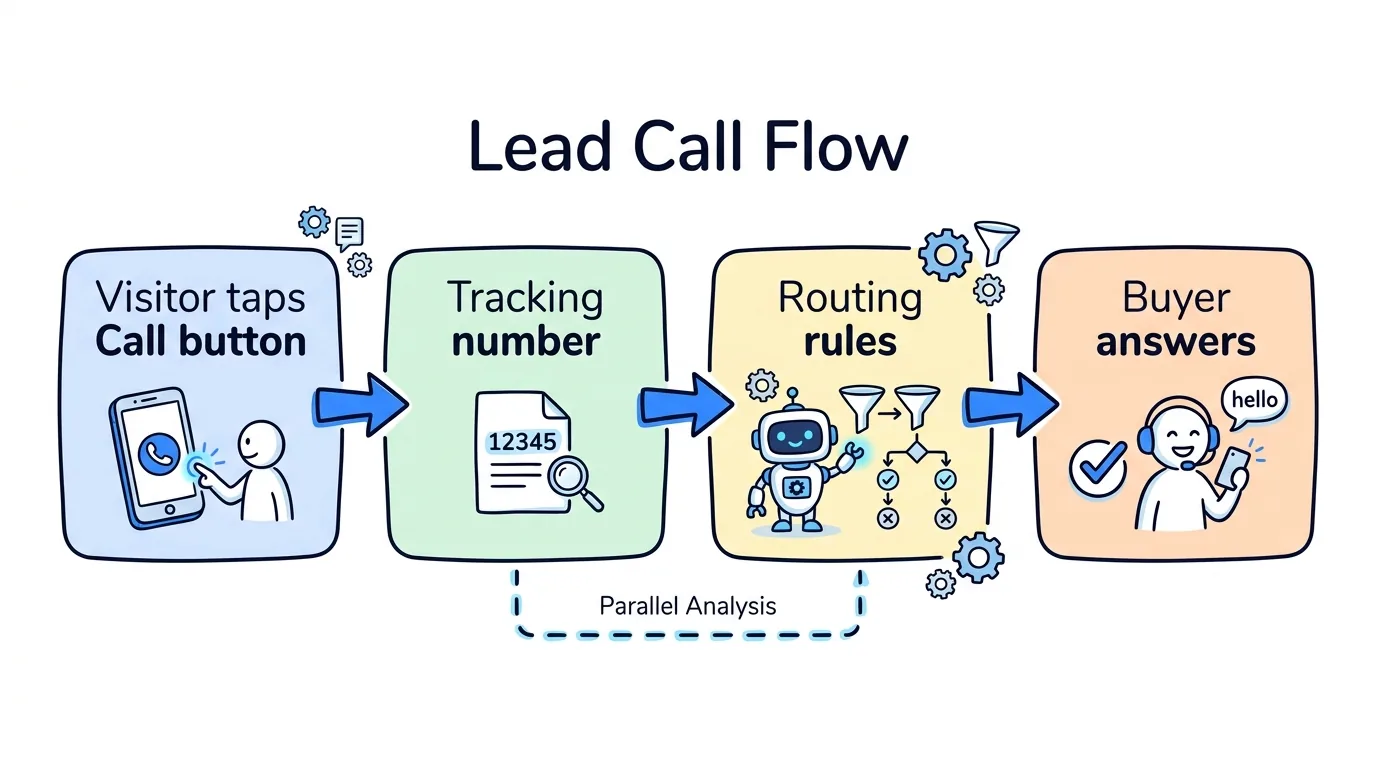
Call Tracking: Technology that assigns unique phone numbers to specific marketing campaigns, ad groups, or individual publishers so agencies can attribute inbound calls to their exact source. Each call to a tracked number is logged with duration, caller ID, geographic data, and call outcome. For pay-per-call agencies, call tracking is the revenue attribution backbone: without it, there is no way to prove which source generated a billable call or to reconcile invoices with buyers. See the best call tracking software for a comparison of leading platforms.
Cap (Lead Cap): A limit set by a lead buyer on the maximum number of leads they will accept within a defined time window: daily, weekly, or monthly. Caps give buyers cost control and prevent oversaturation of their sales team. When a buyer reaches their cap, the distribution platform stops routing new leads to them for the remainder of the period and redirects those leads to the next buyer in the waterfall or the next highest bidder. Monitoring buyer cap utilization in real time is essential for maintaining fill rates above 85%.
Cost Per Acquisition (CPA): The total marketing and sales spend required to convert one lead into a paying customer. CPA is calculated by dividing total spend by the number of new customers acquired in the same period. It is a downstream metric that depends on lead quality, sales process, and offer strength, not just media efficiency. For PPL agencies, knowing the buyer's CPA allows more intelligent lead pricing: if a buyer's CPA is $600 and they convert 10% of leads, a lead is worth up to $60 to them.
Cost Per Lead (CPL): The average spend required to generate one lead, regardless of whether that lead converts. Calculated as total spend divided by total leads acquired. Industry CPL benchmarks vary widely: $15-$75 for home services, $35-$100 for insurance, and $200-$600 for legal and personal injury (FirstPageSage, 2024). CPL is a supply-side metric; buyers care more about cost per acquisition. Use the lead pricing calculator to model CPL across channels.
D
Distribution Method: The algorithm a lead distribution platform uses to assign incoming leads to buyers. The four primary methods are: round robin (equal rotation across all buyers), weighted (proportional allocation by buyer weight), waterfall/priority (sequential offer to ranked buyers until one accepts), and ping-post (real-time auction). Each method optimizes for a different objective: round robin optimizes fairness, weighted optimizes contract compliance, waterfall optimizes exclusivity, and ping-post optimizes revenue per lead. See lead distribution models for a full comparison.
Duplicate Lead: A lead whose contact information (phone number, email address, or a custom field combination) matches a record already in the buyer's or platform's database within the configured lookback window. Duplicate leads are a top source of buyer disputes and erode trust between agencies and their clients. Most buyers will not pay for a duplicate and will return it for credit. Duplicate detection must run before delivery, not after, to prevent chargebacks. See our duplicate lead detection guide for detection logic and lookback window best practices.
Duplicate Lead Detection: Automated software logic that compares each incoming lead against an existing database of previously accepted leads before routing or charging for delivery. Detection typically matches on phone number, email address, or a configurable combination of fields within a defined time window (7 to 90 days, depending on vertical and buyer preference). Effective duplicate detection runs in real time, before the lead reaches the buyer, not as a post-delivery audit. This protects buyer trust, reduces return rates, and eliminates the revenue leakage that comes from crediting leads after the fact.
Dynamic Number Insertion (DNI): A call tracking technique that automatically swaps the phone number shown on a landing page or website based on the visitor's traffic source, campaign, keyword, or session. A small JavaScript snippet detects where the visitor came from and displays a number drawn from a tracking number pool, so every inbound call can be attributed to the exact ad, publisher, or keyword that produced it. DNI is what lets pay-per-call and pay-per-lead agencies prove which source generated a billable call without asking the caller how they found the business. See dynamic number insertion for how the number swap works, or the call tracking feature to see DNI inside the platform.
E
Exclusive Lead: A lead sold to one buyer only. The buyer pays a premium (typically 2-5x the price of a shared lead) in exchange for no competition: they are the only entity contacting that prospect. Exclusive leads convert at significantly higher rates than shared leads because the prospect has not been called by three other companies in the same hour. Waterfall and priority distribution are the standard methods for delivering exclusive leads. For a full economic comparison, see exclusive vs. shared leads.
Exclusive vs. Shared Lead: The fundamental pricing and conversion trade-off in lead generation. An exclusive lead goes to one buyer and commands a higher price but lower volume. A shared lead goes to multiple buyers (typically 3-5) simultaneously, at a lower price per lead but with more competition for the prospect's attention. Agencies typically run exclusive and shared tiers in parallel: exclusive at premium price for buyers with strong closers, shared at volume pricing for buyers who need high lead counts. Conversion rates on shared leads run 35-45% lower than exclusive (MarketingSherpa, 2024).
F
Fill Rate: The percentage of leads submitted to a distribution system that result in a successful, paid delivery to at least one buyer. A 100% fill rate means every lead found a buyer. Low fill rates (below 80%) indicate that buyer demand is insufficient relative to lead supply, that buyer filters are too restrictive, or that bid floors are set above what buyers will pay. Monitoring fill rate by source, vertical, and geography is essential for identifying which traffic is being wasted and which buyer configurations need adjustment.
I
Inbound Lead: A lead generated through channels where the prospect initiates contact with the business: paid search ads, organic SEO, social media, referral programs, or content marketing. Inbound leads convert at higher rates than outbound leads because the prospect has demonstrated active interest by searching for a solution or clicking an ad. In the pay-per-lead model, inbound leads from high-intent search terms (such as "personal injury lawyer near me" or "solar installation quote") command the highest pricing because buyer conversion rates are predictably strong.
Intent Signal: A behavioral or demographic data point that indicates a prospect's readiness to make a purchase or take a desired action. Intent signals include search query terms, pages visited, time spent on a pricing page, form fields completed, and ad type clicked. High-intent signals (such as submitting a "get a quote" form after reading a product comparison page) are worth more than low-intent signals (such as clicking a banner ad). Lead scoring systems weigh intent signals to produce a quality score that buyers use to set their bid caps.
IVR (Interactive Voice Response): An automated phone menu that greets inbound callers and routes them based on key presses or spoken responses, such as "press 1 for auto accidents, press 2 for workers compensation." In pay-per-call operations, IVR is used to pre-qualify and pre-screen callers before they reach a buyer, filtering out wrong numbers and low-intent calls so buyers only pay for calls that match their acceptance criteria. IVR pre-screening raises the billable-call rate and reduces buyer disputes over unqualified calls. See the call tracking feature for how IVR pre-screening and ring tree routing work together.
K
Keyword-Level Call Tracking: The most granular form of call tracking, where dynamic number insertion assigns a unique tracking number down to the individual search keyword a visitor used before calling, not just the campaign or ad group. This requires a larger number pool, because many numbers must be available to map to many keywords across concurrent sessions. Keyword-level data tells an agency which exact search terms drive billable phone calls, so paid-search budgets can be shifted toward the keywords that convert to calls. It is the call equivalent of keyword-level conversion tracking for form fills.
L
Lead Acceptance Criteria: The specific conditions a buyer defines to determine which leads they will accept and pay for. Acceptance criteria typically include: geography (state, county, ZIP code), lead type (MVA, slip-and-fall, insurance type), time of day, maximum lead age (in seconds or minutes from submission), required fields, minimum quality score, and vertical restrictions. Buyers configure acceptance criteria inside their platform portal, and the distribution system applies them before routing each lead. Misaligned acceptance criteria between buyer and seller are the leading cause of rejection disputes.
Lead Aggregator: A company that collects leads from multiple sources: publishers, affiliates, display networks, search campaigns, and co-registration networks, and consolidates them into a single inventory for distribution to buyers. Aggregators earn margin by buying leads at wholesale prices from generators and selling at retail prices to end buyers. Unlike a lead broker (who often hand-selects leads), an aggregator typically operates at volume with automated intake and validation. Large aggregators process millions of leads per month across multiple verticals.
Lead Broker: An intermediary who purchases leads from one or more generators and resells them to end buyers at a markup, without generating the leads themselves. Lead brokers add value through quality filtering, compliance verification, buyer relationships, and sometimes vertical specialization. A broker focused on personal injury law firm leads, for example, knows what case types convert in each state, what price each buyer will pay, and which sources produce the highest-quality clients. See what is a lead broker for the full overview.
Lead Buyer: A company or individual that purchases leads from a generator, aggregator, or broker with the intent of converting them into paying customers, signed cases, or booked appointments. Lead buyers include law firms, insurance agents, mortgage lenders, solar installers, and home service contractors. Buyers set acceptance criteria, caps, and bid limits, and they are ultimately responsible for working the leads their sales team receives. Buyers who track their own conversion rates and cost per acquisition negotiate better lead pricing than those who buy blind.
Lead Distribution Software: A platform that automates the entire lifecycle of a lead from the moment it enters the system to the moment it is delivered and tracked. Core functions include: ingestion via API or web form, validation and deduplication, quality scoring, routing via one of four distribution methods, delivery to buyer endpoints, and real-time profit-and-loss reporting. The best lead distribution software combines all four routing methods, rule-based scoring, and a buyer portal in a single platform. Lead Distro AI starts at $297 per month with a 7-day free trial (credit card required).
Lead Gen Agency: An agency that generates leads on behalf of clients, typically on a pay-per-lead or pay-per-call basis. Lead gen agencies run paid media campaigns (Google Ads, Meta, native, programmatic), manage landing pages and conversion optimization, validate incoming leads, and distribute them to client buyers. Their revenue model depends on maintaining a positive margin between their cost to acquire a lead and the price a buyer pays. Agencies that scale beyond manual processes invest in lead distribution software to automate routing, deduplication, and reporting.
Lead Marketplace: An online platform where multiple lead sellers list available leads and multiple buyers purchase them through a real-time auction or fixed-price catalog. Marketplaces typically use ping-post to facilitate buyer competition. They create price discovery: buyers see what others are bidding for similar leads, and sellers see demand signals that inform pricing strategy. See the lead marketplace guide for how marketplace economics differ from direct seller-to-buyer agreements.
Lead Quality Score: A numeric rating (often 0-100) assigned to each lead based on how well it matches a buyer's ideal prospect profile, the completeness and validity of the submitted data, and behavioral signals from the intake session. Quality scores are produced by rules-based systems that check individual fields, or by comprehensive rule-based scoring that evaluates all submitted fields together against the rules you configure. Leads above a score threshold are routed to premium buyers or priced higher in a ping-post auction. Leads below the threshold are rejected, rerouted to lower-tier buyers, or returned to the source. Lead Distro AI scores every lead against your rules in under one second.
Lead Routing: The specific step within lead distribution where the platform determines which buyer, sales rep, or destination receives each lead, based on configured rules and the chosen distribution method. Routing logic evaluates: which buyers are active and under cap, which buyers' acceptance criteria match the lead's data, which distribution method applies (round robin, weighted, waterfall, or ping-post), and which buyer bid the highest (in auction scenarios). Routing decisions execute in milliseconds. See the full lead routing guide for a detailed walkthrough of each method, or the best lead routing software comparison for platform-level decisions.
Lead Scoring: The process of evaluating and ranking leads by their likelihood to convert, using a combination of demographic data, behavioral signals, and configured scoring rules. A basic rule engine checks individual fields against thresholds (e.g., ZIP code matches buyer territory, injury type is covered by buyer practice area). Full rule-based scoring, such as the scoring in Lead Distro AI, evaluates every submitted field together against the rules you configure and produces one composite score. Scored leads enable price segmentation: high-score leads sell at a premium, low-score leads are rerouted or discounted. See lead scoring software for a comparison of leading platforms.
Lead Seller / Lead Vendor: A company or individual that generates leads through paid media, organic search, content marketing, or co-registration and sells them to buyers. Lead sellers set prices, define minimum quality standards, configure distribution rules, and track fill rates and revenue per lead. Sellers who invest in better targeting and validation earn higher prices per lead; sellers who prioritize volume over quality face high rejection rates and buyer attrition. The relationship between lead seller and buyer depends on transparent pricing, consistent data quality, and reliable delivery speed.
Lead Validation: The automated process of verifying that a lead's submitted data is accurate, complete, and meets minimum quality standards before the lead is routed or charged to a buyer. Standard validation checks include: phone number format and connectivity, email address syntax and deliverability, required field presence, geographic data matching a buyer's territory, and lead age (time elapsed since submission). Validation runs before scoring and routing, filtering out junk submissions before they consume buyer trust or platform resources. Platforms differ significantly in how many validation checks they run and how quickly.
Live Transfer Lead: A lead delivery method where an intake agent phones the prospect, verifies their interest and basic eligibility, and then immediately transfers the live call to a buyer's representative while the prospect is still on the line. Live transfers produce the highest conversion rates in the industry (15-30%) because the prospect is engaged and qualified at the moment of connection. They also command the highest pricing ($50-$300+ per transfer depending on vertical). See the live transfer leads guide for how live transfer operations are structured and priced.
Local Number: A tracking phone number with a local area code that matches the geography a campaign targets. Local numbers typically earn higher answer rates than toll-free numbers because callers recognize and trust a number from their own area code. In call tracking, agencies provision local numbers per market or publisher, so a campaign running in Houston shows a 713 number and a campaign in Miami shows a 305 number. On Lead Distro AI, local tracking numbers are billed per number per month plus per-minute inbound usage. See the call tracking feature to provision local numbers.
N
Number Pool: A set of tracking phone numbers that a call tracking system rotates among website visitors so that each active visitor sees a different, dedicated number for the duration of their session. Number pools are what make session-level and keyword-level dynamic number insertion possible: with enough numbers in the pool, the system can guarantee that no two simultaneous visitors share a number, so every call maps back to exactly one visitor and one source. The pool size an agency needs scales with concurrent visitors, not total monthly visitors. On Lead Distro AI, number pools are managed inside each campaign and powered by dynamic number insertion.
P
Pay Per Call (PPC): A performance marketing model where a buyer pays for inbound phone calls rather than form submissions or impressions. Calls are tracked through unique phone numbers assigned to each source or campaign. Buyers typically pay only for calls that meet a minimum duration threshold (such as 90 seconds) and pass a quality filter (such as matching a geographic or intent requirement). Pay-per-call commands premium pricing in legal, insurance, and home services verticals because a live caller has higher purchase intent than a form-fill. See pay per call vs. pay per lead for a full model comparison.
Pay Per Lead (PPL): A pricing model where a lead buyer pays a fixed fee for each qualified lead delivered, regardless of whether that lead converts into a customer. The lead generator assumes the risk of ad spend and delivery cost, and only collects payment when a lead meets the buyer's defined acceptance criteria. PPL is the dominant model for agencies serving law firms, insurance agents, and home service contractors. Pricing varies by vertical: legal PI leads average $150-$500, insurance leads $30-$75, home services $20-$80. For the complete model overview, see what is pay per lead.
Ping Post: A two-step lead delivery protocol that maximizes revenue per lead by creating real-time buyer competition. In step one (the ping), the seller sends a partial lead record stripped of personally identifiable information to multiple buyers simultaneously. Each buyer evaluates the partial data and responds with a bid or rejection within a defined response window (typically 1-10 seconds). In step two (the post), the seller delivers the full lead record including name, phone, and email to the highest-bidding buyer. Ping post is the standard distribution method for high-value verticals like legal, insurance, and home services because it ensures every lead earns its maximum market price. For a deeper dive, see what is ping post or explore the best ping post platforms.
Priority / Waterfall Distribution: A routing method that offers each lead to buyers in a defined ranked order. The highest-priority buyer receives the lead first. If they reject it, decline within the timeout window, or are at cap, the lead falls to the next buyer in rank. This continues down the waterfall until a buyer accepts or the lead goes unsold. Priority distribution is the standard method for exclusive leads because only one buyer ultimately receives each lead. Sellers build waterfalls to maximize acceptance by placing their most reliable buyers at the top and their fallback buyers at the bottom.
R
Real-Time Lead Distribution: Lead delivery completed in under one second from the moment the lead submits a form or a call ends to the moment the buyer receives notification and full lead data. Real-time distribution is the industry standard for high-value lead types because speed to lead is the primary predictor of conversion rate. Platforms that batch-deliver leads (every 15 minutes, hourly, or daily) sacrifice the conversion potential that real-time buyers have paid for. Lead Distro AI routes and delivers leads in under one second on all plans.
Return on Lead Investment (ROLI): The revenue generated from a cohort of purchased leads divided by the total cost of acquiring those leads, expressed as a ratio or percentage. ROLI is the most buyer-centric profitability metric in lead generation because it measures outcome, not process. A buyer who spends $10,000 on leads and generates $50,000 in revenue has a 5:1 ROLI, or 400% return. Tracking ROLI per source, per vertical, and per distribution method allows buyers to reallocate budget toward the channels and lead types that produce the best return.
Revenue Per Lead (RPL): The average revenue a seller earns per lead delivered across a defined period. Calculated as total revenue divided by total leads sold. RPL is the primary profitability metric for lead sellers and aggregators. Increasing RPL requires either raising prices, improving quality (to reduce rejections and returns), switching to ping-post to capture competitive bids, or improving fill rate to reduce unsold leads. RPL benchmarks vary by vertical: legal leads average $150-$400 RPL, insurance $35-$80, home services $25-$65.
Ring Tree: A real-time routing method for inbound phone calls, the pay-per-call equivalent of ping post for form leads. When a call arrives on a tracking number, the platform offers it to multiple buyers in sequence or by live bid (the "tree"), and the first buyer to accept, or the highest bidder, receives the live call. Ring trees let a pay-per-call network auction each inbound call to its highest-value buyer in seconds, maximizing revenue per call the same way ping post maximizes revenue per lead. See what is a pay per call network for how ring trees fit into call distribution.
Round Robin Distribution: A routing method that distributes leads equally across all eligible buyers by cycling through them in sequence. Buyer A receives lead 1, buyer B receives lead 2, buyer C receives lead 3, then the cycle repeats. Round robin ensures balanced volume distribution and is useful when all buyers have equivalent performance and equal contract commitments. It does not optimize for bid price, buyer quality, or performance history. For operations where buyers have different budgets or conversion rates, weighted or ping-post distribution typically produces higher revenue.
S
Shared Lead: A lead sold to multiple buyers simultaneously, typically 3-5. Each buyer pays a lower per-lead price than they would for an exclusive lead, but they compete with other buyers to contact the prospect first. Speed to lead becomes critical on shared leads because the first buyer to make contact converts at 4-5x the rate of later callers. Shared leads are common in insurance, solar, and home services verticals where buyer demand outpaces exclusive supply. Conversion rates on shared leads run 35-45% lower than exclusive leads.
Source Tracking: The practice of tagging each lead with the specific marketing channel, campaign, ad group, publisher, or affiliate that generated it, and preserving that attribution throughout the distribution and sales process. Source tracking enables agencies to calculate cost per lead and revenue per lead at the campaign and publisher level, identifying which sources are profitable and which are not. Without source tracking, agencies cannot optimize their media mix or hold publishers accountable for lead quality.
T
TCPA (Telephone Consumer Protection Act): A U.S. federal law enacted in 1991 and substantially updated in 2012 and 2024 that restricts how businesses contact consumers by phone and text message. Key TCPA provisions relevant to lead generation include: requiring prior express written consent before placing auto-dialed or pre-recorded calls, maintaining internal do-not-call lists, honoring opt-out requests within 30 days, and (since January 2025) requiring one-to-one consent where the consumer specifically agrees to be contacted by a named company rather than a generic "marketing partners" list. Violations carry penalties of $500-$1,500 per unsolicited contact. Any agency distributing leads for phone-based follow-up must comply. See TCPA compliance for lead generation for the full compliance framework.
Toll-Free Number: A phone number with a toll-free prefix (800, 833, 844, 855, 866, 877, or 888) that is free for the caller to dial, with the call cost paid by the business that receives it. In call tracking, toll-free numbers are used for national campaigns and for buyers who want a single, recognizable number across markets. They carry broader reach than a local number but usually lower answer rates, since callers cannot tell where a toll-free number is based. On Lead Distro AI, toll-free tracking numbers are billed per number per month plus per-minute inbound usage. See the call tracking feature to provision toll-free numbers.
TrustedForm / LeadID: Third-party consent verification services that create an auditable record proving a lead provided prior express written consent at the time of form submission, as required by TCPA. TrustedForm (by ActiveProspect) records a session replay of the consumer's interaction with the form, along with the time stamp, the page URL, and the consent language displayed. LeadID (from Jornaya) is a similar consent verification service. ActiveProspect says more and more lead buyers rely on vendors to certify leads with TrustedForm. Without a TrustedForm or LeadID certificate, a lead buyer in a regulated vertical may refuse delivery.
V
Vanity Number: A toll-free or local phone number deliberately chosen so its digits spell a word or form an easy-to-remember pattern, such as 1-800-FLOWERS or 1-888-LAW-FIRM. Vanity numbers raise recall and response rates in offline and brand advertising, which is why law firms and home-service buyers often request them. In a call tracking context, a vanity number can still be used as a tracked number, attributing the calls it generates to the campaigns and channels where it appears. Vanity numbers trade granular source attribution for memorability, so they suit brand, radio, and billboard campaigns more than keyword-level paid search.
W
Waterfall Distribution: See Priority / Waterfall Distribution above.
Weighted Distribution: A routing method that allocates leads to buyers in proportion to assigned weight values. If Buyer A has a weight of 60 and Buyer B has a weight of 40, Buyer A receives approximately 60% of eligible leads over any given period. Weights are set by the agency and can be based on contract commitments, performance history, buyer preference, or revenue targets. Weighted distribution is common when a seller has multiple buyers for the same lead type and needs to honor different volume agreements without resorting to manual allocation.
Webhook: An HTTP callback that automatically sends data from one system to another the moment a defined event occurs. In lead distribution, webhooks are used to: deliver leads from a source platform to a distribution system when a form is submitted, notify a buyer's CRM when a lead is accepted and posted, and push outcome data back to the distribution platform when a lead converts or is returned. Webhooks are the primary integration mechanism between lead sources, distribution platforms, and buyer CRMs. They operate in real time, making them the technical foundation of sub-second lead delivery.
Whisper Message: A short automated message played to the buyer's agent (not the caller) at the moment they answer a tracked call, such as "inbound call from your solar campaign." The whisper tells the agent which campaign, publisher, or buyer the call belongs to before they start speaking, so they can answer with the right script and the call is correctly attributed. Whisper messages also confirm to a buyer that a call is a billable, tracked lead. They are a standard feature of call tracking and pay-per-call routing. See call whisper for setup detail.
FAQ
What is lead generation?
Lead generation is the process of attracting and capturing the contact information of potential customers who have expressed interest in a product or service. Common lead generation methods include paid search ads, social media campaigns, organic SEO content, landing pages, co-registration programs, and webinars. In the performance marketing industry, "lead generation" also refers to the business model where an agency generates leads and sells them to buyers on a pay-per-lead or pay-per-call basis. The lead generation industry spans every major vertical including legal, insurance, mortgage, solar, and home services.
What is the difference between a lead buyer and a lead seller?
A lead seller (also called a lead generator or lead vendor) creates or acquires leads through marketing activity and sells them to buyers in exchange for a per-lead fee. A lead buyer is a company or individual that purchases leads to convert them into customers, signed cases, or booked appointments. In some operations, the same company plays both roles: they buy raw leads wholesale from a generator, validate and score them, and resell them at retail to end buyers. That middle role is called a lead broker or lead aggregator.
What is ping post in lead generation?
Ping post is a two-step lead delivery protocol. In step one (the ping), the seller sends anonymized partial lead data to multiple buyers simultaneously, who respond with bids or rejections within seconds. In step two (the post), the seller delivers the full lead record to the highest bidder. Ping post maximizes revenue per lead by creating real-time buyer competition for every submission. It is the standard distribution method in high-value verticals like personal injury law, insurance, and home services because it ensures sellers always receive the highest available market price for each lead.
What is pay per lead vs. pay per call?
Pay per lead is a model where a buyer pays a fixed price for each inbound form submission that meets defined acceptance criteria. Pay per call is a model where a buyer pays for inbound phone calls that meet a minimum duration and quality threshold. Pay per lead typically has lower pricing and higher volume; pay per call commands premium pricing because a live caller has higher purchase intent than a form fill. Many agencies operate both models in parallel, using unified lead and call distribution software to route both lead types to the same buyers.
What is lead distribution software?
Lead distribution software is a platform that automates the capture, validation, scoring, and routing of leads from sources to buyers in real time. It replaces manual processes like email forwarding, spreadsheet tracking, and phone transfers with configurable rules that execute in milliseconds. Core features include multi-method routing (round robin, weighted, waterfall, ping-post), duplicate detection, rule-based lead scoring, real-time profit-and-loss reporting, and buyer portals. Lead Distro AI is lead distribution software built specifically for pay-per-lead and pay-per-call agencies, starting at $297 per month with a 7-day free trial.
How does lead routing work?
Lead routing is the step inside a distribution platform where the system decides which buyer receives each lead. When a lead arrives, the platform checks: which buyers are active and under their cap, which buyers' acceptance criteria match the lead's data (geography, vertical, lead type, quality score), and which distribution method applies. For round robin, the system picks the next buyer in rotation. For weighted, it allocates proportionally. For waterfall, it offers the lead to the highest-priority buyer first. For ping-post, it auctions the lead in real time. The entire process executes in under one second. See the lead routing guide for step-by-step detail on each method.
What is dynamic number insertion?
Dynamic number insertion (DNI) is a call tracking technique that automatically changes the phone number shown on a website based on where each visitor came from. A small JavaScript snippet pulls a number from a tracking number pool and displays it for that visitor's session, so when they call, the platform knows the exact campaign, keyword, or publisher that produced the call. DNI is how pay-per-call and pay-per-lead agencies attribute inbound phone calls to their source without asking callers how they found the business. See dynamic number insertion for a full walkthrough.
What is a number pool in call tracking?
A number pool is a group of tracking phone numbers that a call tracking platform rotates among website visitors so each active visitor sees a unique number. Pools are what make session-level and keyword-level attribution possible: with enough numbers, no two simultaneous visitors share a number, so every call maps to exactly one visitor and one traffic source. The pool size you need scales with concurrent visitors, not total monthly visitors. Number pools power dynamic number insertion and are managed per campaign inside Lead Distro AI's call tracking.
Conclusion
This lead generation glossary covers the 50+ terms that appear most frequently in agency-buyer contracts, platform dashboards, and industry conversations. Fluency in this vocabulary accelerates every stage of running a lead generation business: setting buyer expectations, negotiating pricing, configuring distribution rules, and diagnosing performance problems.
If you are ready to put these concepts into practice, start your 7-day free trial of Lead Distro AI and configure your first distribution campaign in minutes. For an interactive walkthrough of how routing, scoring, and reporting work inside the platform, take the product tour.
Missing a term? This glossary is updated regularly. If there is a lead generation or lead distribution term you want defined, let us know.
About the Author
Founder & CEO of Lead Distro AI & Great Marketing AI
UC Berkeley graduate and former software engineer at Microsoft. Rafael built Lead Distro AI after managing over $10M in ad spend for performance marketing agencies (pay-per-lead and pay-per-call), including running campaigns for Neil Patel. He combines deep software engineering expertise with hands-on performance marketing experience to build tools that help these agencies scale profitably.
About Lead Distro AI
Lead Distro AI: Capture, Route, and Sell Every Lead, Call, and Appointment
The modern platform for pay-per-lead and pay-per-call agencies. Route, score, and deliver leads with AI-powered automation and real-time P&L tracking. Built for performance marketing agencies and lead buyers across legal, insurance, mortgage, solar, and home services verticals.
4 Distribution Methods
Waterfall, Round Robin, Weighted, Ping-Post
Ping-Post Auctions
Real-time bidding with sub-second routing
Real-Time P&L Reporting
Track revenue, costs, and profit per campaign
Call Tracking
Assign tracking numbers, record calls, and attribute conversions
Lead Scoring
Score every lead before routing to maximize conversion
Partner Portal
Self-serve dashboard for buyers to track leads