What Is a Pay Per Call Network? How They Work and How to Run Your Own
Learn what a pay per call network is, how publishers, buyers, and calls flow through it, and how to build and run your own profitable call marketplace.

Rafael Hernandez
Founder & CEO
Ex-Microsoft SWE · $10M+ PPL ad spend
I hope you enjoy reading this blog post. If you want to try Lead Distro AI for free, click here.
Author: Rafael Hernandez | Founder & CEO of Lead Distro AI
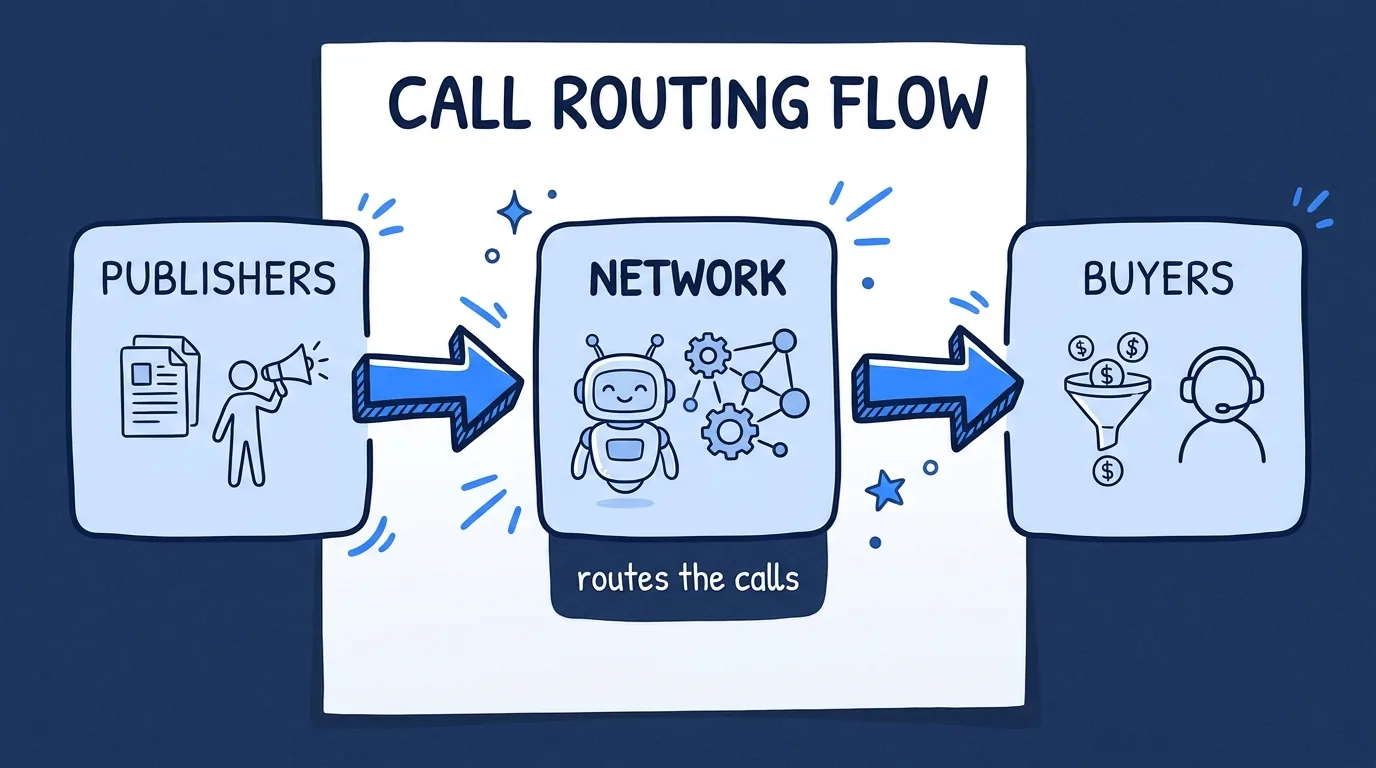
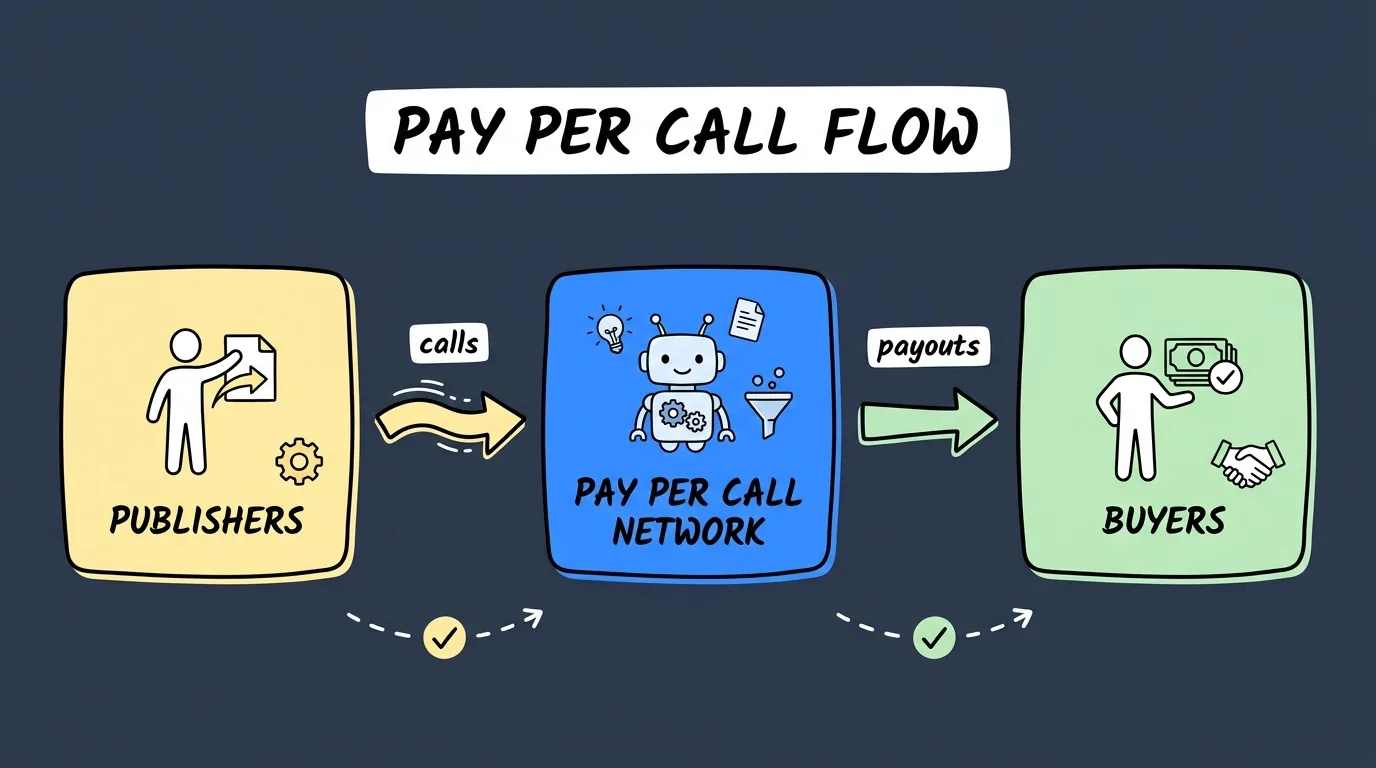
A pay per call network is a marketplace that connects publishers who generate inbound phone calls with buyers who pay a fixed fee for each qualified call delivered. The network sits in the middle: publishers drive calls through ads, SEO, or offline channels, the network qualifies and routes each call to the right buyer in real time, and the buyer pays out only when the call meets agreed criteria like minimum duration. It is the phone-call equivalent of an affiliate network, except the unit of value is a live, high-intent caller rather than a click or a form fill.
Networks exist because phone calls convert far better than web leads. Research cited by BIA Advisory Services shows inbound calls convert to revenue 10 to 15 times more frequently than web form leads, which is why buyers will pay $25 to $400 per qualified call depending on the vertical. This guide explains what a pay per call network is, how the publisher-buyer-call flow works, and how to build and run your own using call routing and lead and call distribution software.
Key Takeaways
- A pay per call network is a three-sided marketplace connecting publishers (who generate calls), the network operator (who routes and tracks), and buyers (who pay per qualified call).
- The call flow has five stages: traffic generation, call tracking, IVR qualification, real-time routing, and payout, with the whole journey taking 30 to 90 seconds from dial to connected call.
- Ring tree routing is the engine that lets multiple buyers compete for each call in real time, sending it to the highest bidder with available capacity.
- You can run your own network with three components: a publisher acquisition strategy, a buyer network, and a distribution platform that handles tracking, routing, and reconciliation.
- Lead Distro AI powers networks end to end with ring tree routing, call scoring on every call, four distribution methods, and usage-based call tracking, starting at $297 per month (ring tree routing and ping-post from $497).
What Is a Pay Per Call Network?
A pay per call network is a performance marketing platform where one party generates inbound phone calls and another party pays for them, with the network operator brokering the connection. Publishers (also called affiliates or lead generators) own the traffic. Buyers (advertisers, law firms, insurance agents, home service companies) own the demand. The network owns the infrastructure that tracks, qualifies, routes, and reconciles every call.
Unlike a pay per lead network that delivers form data, a pay per call network delivers a live human on the phone. That live connection eliminates the contact-rate problem that plagues web leads, which is the entire reason buyers pay a premium for calls.
How a Pay Per Call Network Works
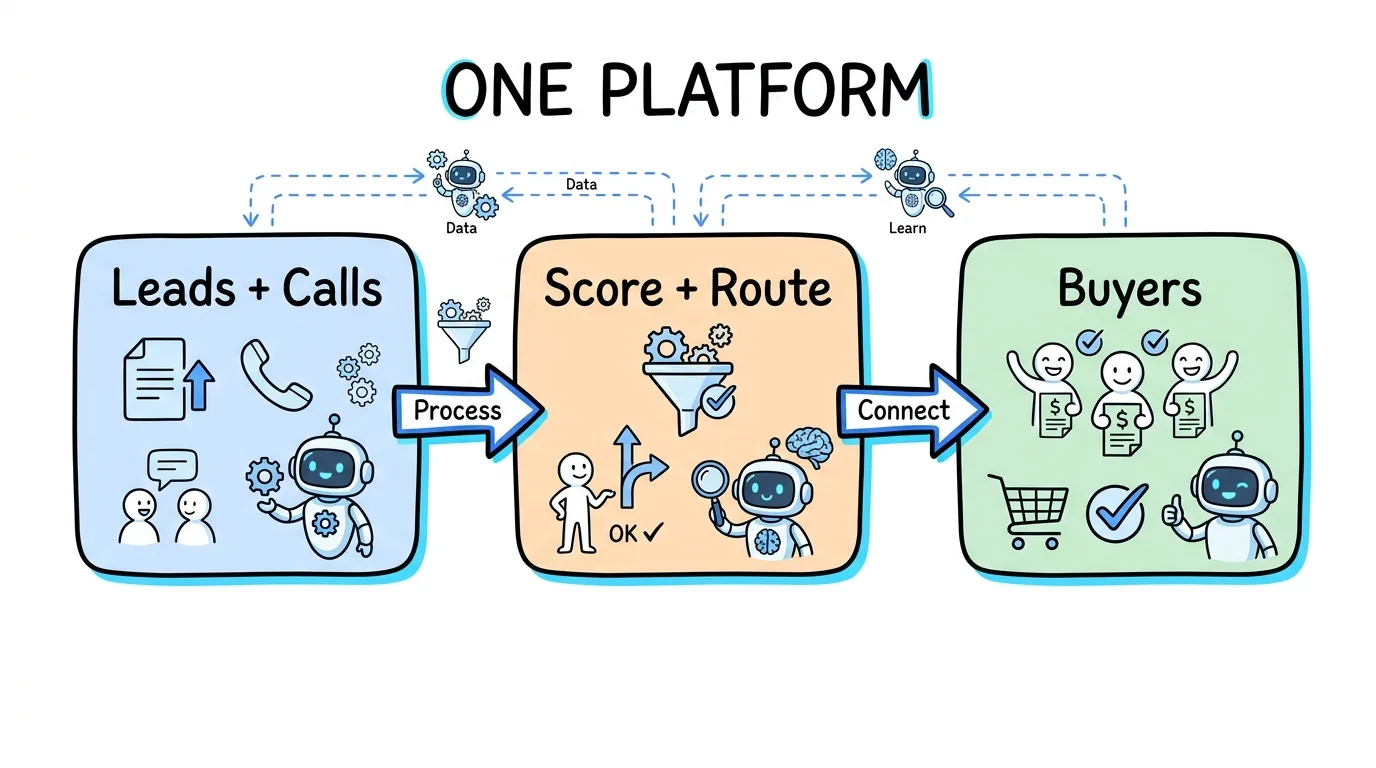
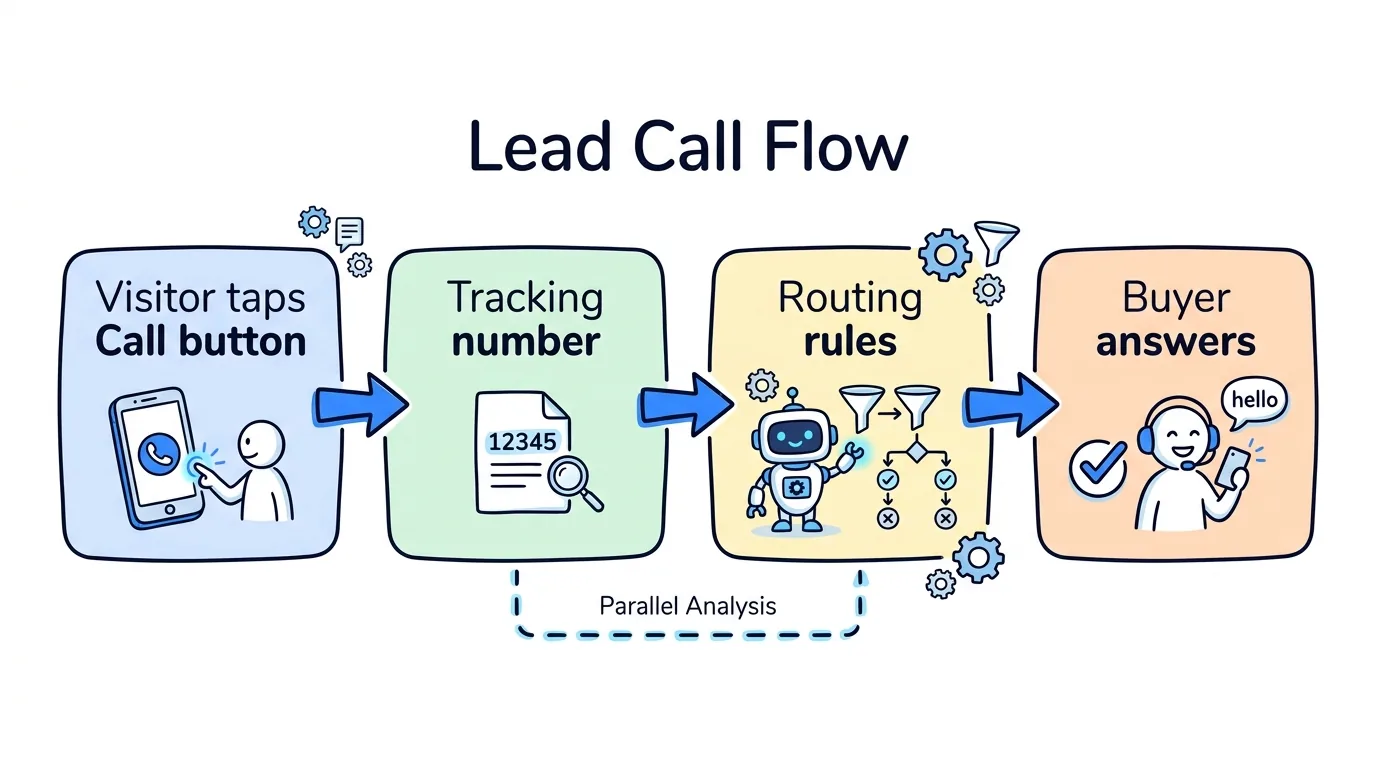
The network workflow follows five stages from ad impression to payout. Each call passes through the same pipeline regardless of vertical.
- Traffic generation. Publishers run Google Ads call-only campaigns, Facebook click-to-call ads, or local SEO pages, each displaying a unique tracking number.
- Call tracking. When a prospect dials, the platform logs the source, timestamp, caller ID, and geographic data, then attributes the call to the right publisher and campaign.
- IVR qualification. An interactive voice response menu filters wrong numbers, collects intent (zip code, case type), and confirms the caller matches buyer criteria before connecting anyone.
- Routing. The qualified call routes to the best buyer based on geography, time of day, capacity, payout tier, and quality score. With Lead Distro AI, routing happens in under one second.
- Payout. If the call meets the minimum duration (commonly 60 to 120 seconds) and qualification rules, the publisher earns the payout and the network takes its margin.
The entire flow from dial to connected call takes 30 to 90 seconds, which is why automation is non-negotiable past a handful of buyers.
The Three Roles in a Pay Per Call Network
Every pay per call network balances the interests of three parties. Understanding what each one wants is the key to running a healthy marketplace.
| Role | Who they are | What they provide | What they want |
|---|---|---|---|
| Publisher | Affiliates, lead generators, media buyers | Inbound call volume from paid or organic traffic | High payouts, fast reconciliation, reliable buyer demand |
| Network operator | You, the marketplace owner | Tracking, IVR, routing, billing, dispute resolution | Healthy margin, low fraud, retained publishers and buyers |
| Buyer | Law firms, insurers, home service companies, call centers | Budget and payout per qualified call | High call quality, geographic match, no junk calls |
The network operator's job is to keep both sides happy at once. Publishers leave if payouts are low or calls go unsold. Buyers leave if call quality drops. The platform you choose determines how well you can serve both, which is why lead and call distribution software is the foundation of the business.
Ring Tree Routing: The Engine Behind Networks
The technology that makes a pay per call network competitive is ring tree routing. A ring tree (sometimes called a call tree or waterfall auction) lets multiple buyers bid on the same inbound call in real time. When a qualified call arrives, the platform pings every eligible buyer, collects their bids and availability, then routes the call to the buyer offering the best payout who still has open capacity.
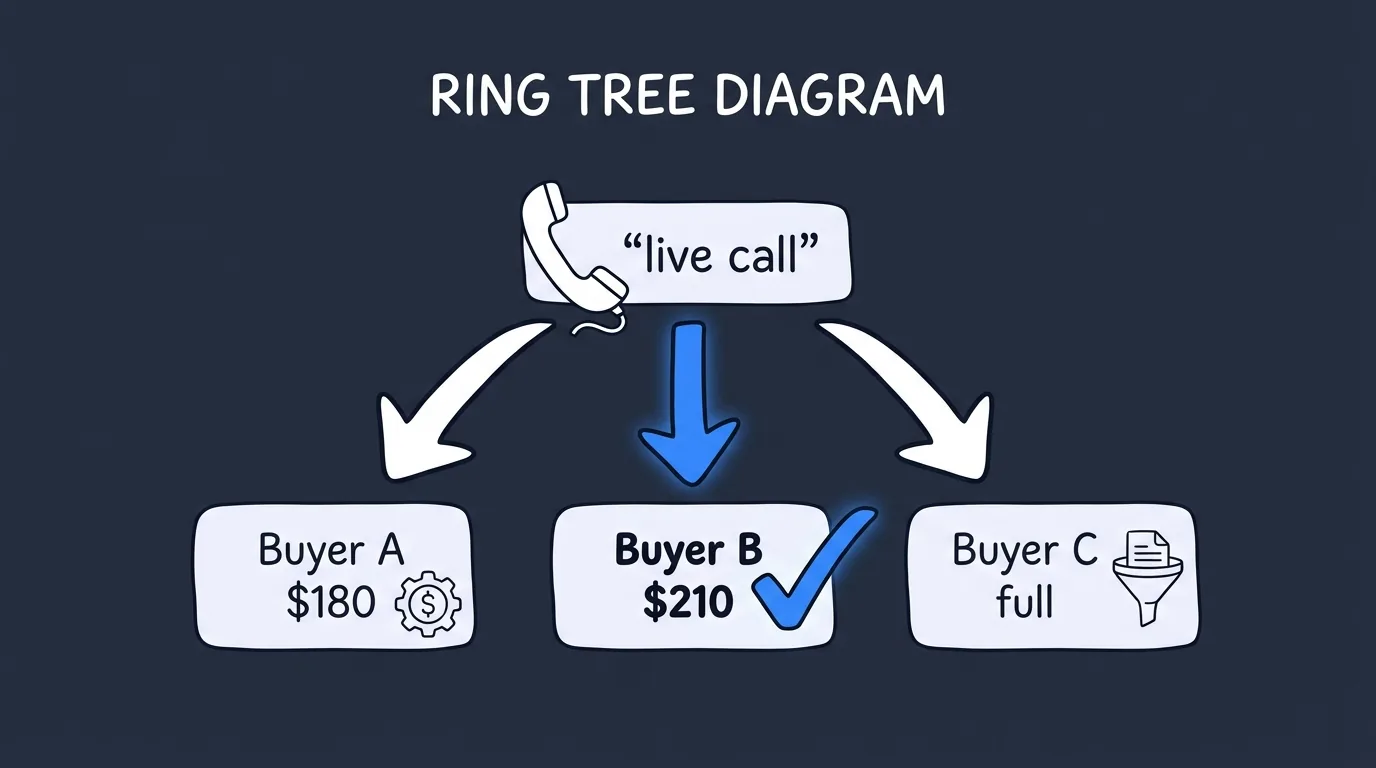
This is what separates a real network from a single buyer relationship. With ring tree routing, no high-value call goes to waste: if the top buyer is at capacity, the call falls through to the next-best bidder. Lead Distro AI supports ring tree alongside its four core distribution methods, so you can run live auctions for premium calls and simple round robin for steady-volume verticals. To compare routing approaches across platforms, see our best Ringba alternatives breakdown.
How to Build and Run Your Own Pay Per Call Network
Running a network is a step beyond running a single pay per call campaign. Here is the path from zero to operational marketplace.
Step 1: Pick a vertical and define quality
Start with one vertical (legal, insurance, home services, or healthcare) and define exactly what a billable call looks like: minimum duration, geographic coverage, and IVR pre-screen questions. Clear quality rules protect both sides and reduce disputes.
Step 2: Recruit buyers first
Demand is the bottleneck. Sign 3 to 5 buyers before you onboard publishers so every call you receive has somewhere to go. Local service businesses often pay more than larger aggregators because you cut out the middleman.
Step 3: Recruit publishers
Once buyers are in place, recruit publishers from affiliate communities, performance marketing forums, and direct outreach to existing call generators. Offer competitive payouts and transparent reporting; publishers move volume to whoever pays fast and fair.
Step 4: Stand up the platform
You need tracking numbers, IVR, ring tree routing, capacity caps, and reconciliation in one system. Lead Distro AI provides all of this with sub-second routing, so you can launch without stitching together a phone provider, a spreadsheet, and a billing tool.
Step 5: Reconcile and optimize
Run weekly reconciliation: match billable calls to payouts, resolve disputes using call recordings, and prune publishers or buyers who drag down quality. The networks that scale treat data as the product.
How Lead Distro AI Powers a Pay Per Call Network
Lead Distro AI is built to run the entire pay per call network stack from a single dashboard, which removes the need to assemble a network from separate tools.
- Ring tree routing and four distribution methods. Run live buyer auctions with ring tree, or use Round Robin, Weighted, Priority/Waterfall, and Ping-Post for steady-volume verticals.
- Call scoring on every call. Lead Distro AI scores every lead and every call against your rules before routing, so junk calls get filtered and high-value callers reach your best buyers first.
- Usage-based call tracking. Call tracking is priced on actual usage: a per-number monthly fee plus a per-minute rate for inbound calls, layered on top of the flat platform subscription, so you only pay for the call volume you handle.
- Capacity, geo, and time-of-day rules. Set caps per buyer so you never overdeliver, and enforce geographic and business-hours routing automatically.
- Reconciliation and reporting. Track spend, revenue, and margin by publisher, buyer, and vertical in real time, with call recordings on hand for disputes.
Pricing starts at $297 per month (Starter), with Growth at $497 as your call volume grows, and Scale priced by quote above that. For a deeper look at call infrastructure, read our guides on call routing software and the best call tracking software.
Pay Per Call Network vs Direct Buyer Relationships
Should you run through an existing network, build your own, or sell directly to buyers? Here is how the options compare.
| Factor | Existing Network | Your Own Network | Direct Buyer |
|---|---|---|---|
| Payout to publisher | Lower (network takes margin) | You set the margin | Highest (no middleman) |
| Time to revenue | Fast (offers ready) | Slow (build both sides) | Moderate (one buyer) |
| Control over quality | Low | High | High |
| Scalability | High (many offers) | High (you own demand) | Limited (one relationship) |
| Best for | New publishers testing offers | Operators with buyer access | Generators with a niche buyer |
Most operators start by running offers on an existing network to learn what converts, then build their own once they have buyer relationships and steady volume. To understand where calls fit against form leads, read pay per call vs pay per lead.
Who a Pay Per Call Network Is Best For
A pay per call network is best for pay-per-call agencies and pay-per-lead agencies that want to monetize call volume at scale, plus lead brokers and lead buyers or sellers who already move performance traffic. If you generate more calls than a single buyer can absorb, or you want to broker calls between many generators and many buyers, a network is the model that captures the most value. For a step-by-step on the agency side, see how to start a pay per call agency.
FAQ
What is the difference between a pay per call network and a pay per call agency?
A pay per call agency generates calls and sells them, usually to a small set of buyers it manages directly. A pay per call network is a marketplace that brokers calls between many publishers and many buyers, taking a margin on each transaction. An agency owns traffic; a network owns the infrastructure and the relationships on both sides. Many operators start as an agency and evolve into a network once they have enough publishers and buyers to support live auctions and real-time routing.
How does a pay per call network make money?
A network earns the spread between what buyers pay per call and what it pays publishers. For example, if a buyer pays $250 for a qualified legal call and the network pays the publisher $200, the network keeps $50 as margin. Networks also earn from platform fees and usage-based call tracking charges. The margin compensates the operator for providing buyer demand, tracking, routing, fraud prevention, and dispute resolution, which is the value publishers and buyers pay for.
What is ring tree routing in a pay per call network?
Ring tree routing is a real-time auction where an inbound call is offered to multiple buyers at once. The platform pings every eligible buyer, collects their bids and capacity, then routes the call to the highest bidder with availability. If that buyer is full, the call falls through to the next-best option, so no high-value call is wasted. Ring tree is what lets a network maximize revenue per call instead of routing each call to a single fixed buyer.
Do I need my own call center to run a pay per call network?
No. A network generates and routes calls; it does not answer them. Your buyers handle the sales conversation on their end. The network's job is tracking, qualification, routing, and reconciliation. Some operators add a thin live-qualification layer for premium live-transfer calls, but standard pay per call runs entirely on IVR menus and automated routing through a distribution platform, with no call center required on your side.
How much does it cost to start a pay per call network?
Software is the main fixed cost. A distribution platform like Lead Distro AI starts at $297 per month, with usage-based call tracking (a per-number monthly fee plus a per-minute rate for inbound calls) layered on top. Beyond software, your costs are buyer and publisher acquisition, which can be done through outreach at low cash cost. You do not need to spend on traffic yourself if publishers bring their own, which makes a network leaner to launch than a single-publisher agency.
Run Your Own Pay Per Call Network
A pay per call network turns scattered call volume into a real marketplace: publishers bring traffic, buyers bring budget, and you broker the connection with tracking, qualification, ring tree routing, and reconciliation. The model works because phone calls convert 10 to 15 times more often than web leads, so there is genuine margin to capture between what buyers pay and what publishers earn.
The operators who win build on a platform that handles routing, call scoring, capacity management, and usage-based call tracking from day one, rather than stitching tools together and rebuilding later. Start your 7-day free trial and configure ring tree routing, buyer caps, and call tracking in one dashboard. For a side-by-side of the major platforms, read our best call tracking software comparison, and to see how routing logic works under the hood, walk through call routing software.
Ready to broker your first calls? Start your 7-day free trial and set up ring tree routing, call scoring, and usage-based call tracking in one platform built for pay per call networks.
About the Author
Founder & CEO of Lead Distro AI & Great Marketing AI
UC Berkeley graduate and former software engineer at Microsoft. Rafael built Lead Distro AI after managing over $10M in ad spend for performance marketing agencies (pay-per-lead and pay-per-call), including running campaigns for Neil Patel. He combines deep software engineering expertise with hands-on performance marketing experience to build tools that help these agencies scale profitably.
About Lead Distro AI
Lead Distro AI: Capture, Route, and Sell Every Lead, Call, and Appointment
The modern platform for pay-per-lead and pay-per-call agencies. Route, score, and deliver leads with AI-powered automation and real-time P&L tracking. Built for performance marketing agencies and lead buyers across legal, insurance, mortgage, solar, and home services verticals.
4 Distribution Methods
Waterfall, Round Robin, Weighted, Ping-Post
Ping-Post Auctions
Real-time bidding with sub-second routing
Real-Time P&L Reporting
Track revenue, costs, and profit per campaign
Call Tracking
Assign tracking numbers, record calls, and attribute conversions
Lead Scoring
Score every lead before routing to maximize conversion
Partner Portal
Self-serve dashboard for buyers to track leads