Call Tracking Metrics: The 10 Numbers Every Agency Tracks
The 10 call tracking metrics every pay-per-call agency must track, from answer rate to cost per call and billable-call rate, each defined with how to improve it.

Rafael Hernandez
Founder & CEO
Ex-Microsoft SWE · $10M+ PPL ad spend
I hope you enjoy reading this blog post. If you want to try Lead Distro AI for free, click here.
Author: Rafael Hernandez | Founder & CEO of Lead Distro AI
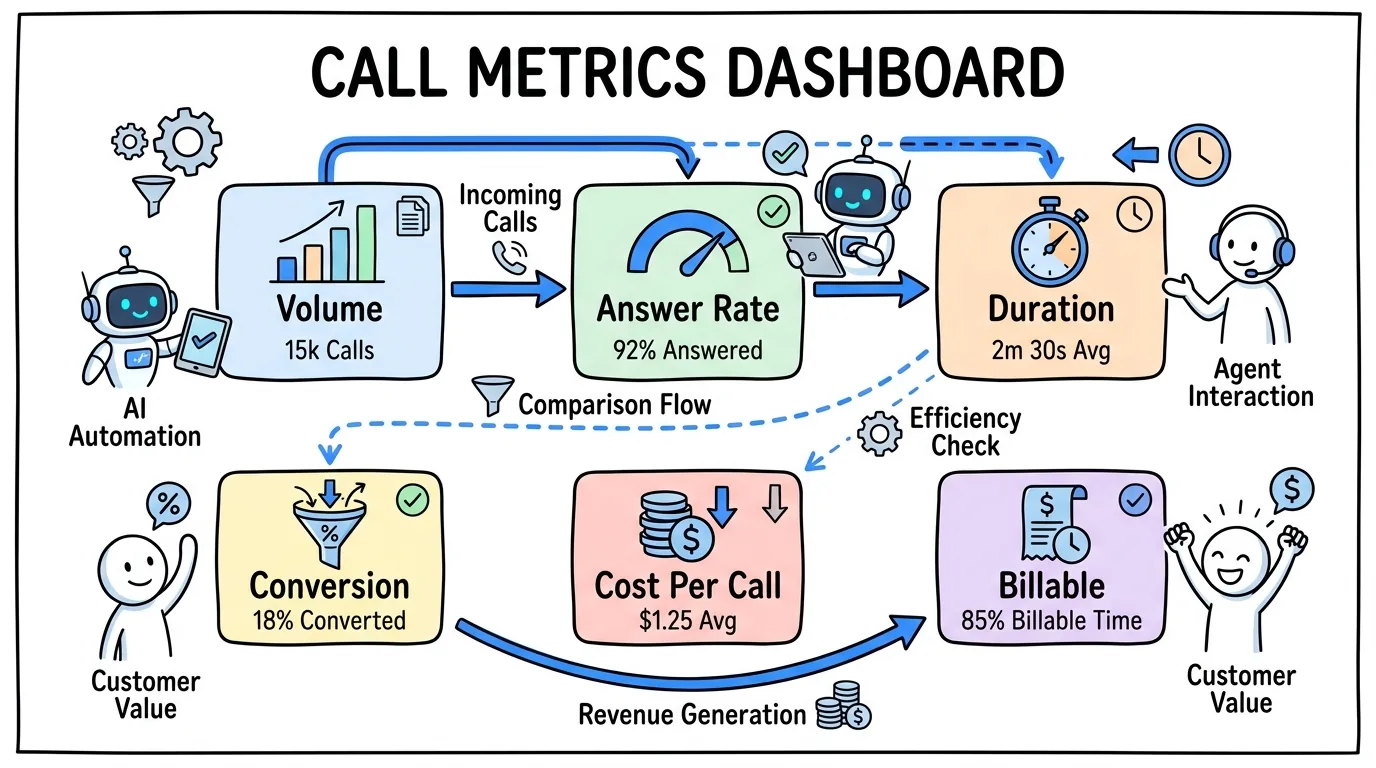
The most important call tracking metrics are the ten numbers that tell you whether your phone calls actually make money: call volume, answer rate, average call duration, first-call resolution, call conversion rate, cost per call, missed-call rate, peak call times, source and attribution, and billable (qualified) call rate. Together these call tracking metrics to track move you from "the phone is ringing" to "this campaign produced 22 calls, 14 were qualified, 9 converted, and we billed for 11 at a cost per call of $38." For a pay-per-call agency, that distinction is the whole business: you get paid on billable calls, so a tracked call you cannot measure for quality, source, and conversion is margin you are leaking. Phone calls convert to revenue 10 to 15 times more than web form leads (Invoca, 2024), which is exactly why these call tracking KPIs deserve a real dashboard rather than a spreadsheet you update once a week. Lead Distro AI surfaces all ten of these pay per call metrics in one real-time view, with Claude AI scoring every call so the billable-call number is calculated, not guessed. Start your 7-day free trial to see your own call metrics in one place.
Key Takeaways
- Ten core
call tracking metricsmatter most: call volume, answer rate, average call duration, first-call resolution,call conversion rate,cost per call, missed-call rate, peak call times, source and attribution, and billable-call rate. - Volume is a vanity number on its own. A high call count means nothing until you layer in answer rate, conversion, and the
billable callrate that decides what you actually get paid for. Cost per callis your real unit economics. Total qualified-call spend divided by qualified calls tells you whether a campaign is profitable before you scale it, not after.- Answer rate and missed-call rate decide how many calls survive the handoff: an unanswered call on a pay-per-call campaign is paid traffic you can never bill.
- The billable-call rate is the agency metric. For
pay per call metrics, the percentage of calls that meet the buyer's duration and quality criteria is what turns ad spend into revenue. - Source and attribution tie every call to a campaign and keyword through dynamic number insertion, so you optimize against calls instead of guessing.
- Lead Distro AI tracks all ten
call tracking KPIsin one dashboard and scores each call with Claude AI, so the qualified-call rate is measured in under a second per call.
Why Call Tracking Metrics Matter More Than Call Counts
Most teams watch one number: how many calls came in. That single figure is the least useful of all the numbers on the report because it hides everything that decides whether those calls were worth generating. A campaign driving 200 calls a month where only 30 are qualified is worse than one driving 80 calls where 55 are billable.
Call tracking turns the phone into a measurable conversion channel using dynamic number insertion (DNI), the script that swaps the number on your page for a unique tracking number per visitor session (Google Ads Help). Once every call carries its source, you can finally measure quality, not just count rings.
The reason this matters financially: BIA Advisory Services projects phone calls will influence over $1 trillion in US consumer spending, and calls close at far higher rates than digital leads (BIA Advisory Services). Tracking the right call tracking metrics to track is how you protect the margin on that traffic.
The 10 Call Tracking Metrics Every Agency Should Track
These are the numbers that belong on every pay-per-call and pay-per-lead dashboard, in priority order. Each one is defined plainly, with why it matters and the lever you pull to improve it.
1. Call Volume
What it is: The total number of inbound calls a number, campaign, or source generates in a period. It is the top of every report and the easiest figure to read.
Why it matters: Volume sets the ceiling on revenue, but it is only a denominator. Judge it against answer rate and conversion before celebrating a spike.
How to improve it: Scale the traffic sources that already produce qualified calls, and add tracking numbers per channel so you can see which source the volume actually comes from.
2. Answer Rate
What it is: The percentage of inbound calls a live agent or buyer actually picks up. Industry call centers commonly target the 80/20 service level, answering 80 percent of calls within 20 seconds, the classic benchmark (Talkdesk, call center service level).
Why it matters: An unanswered call is a paid-for conversion thrown away. For a pay-per-call agency, an answered call is the only call you can bill.
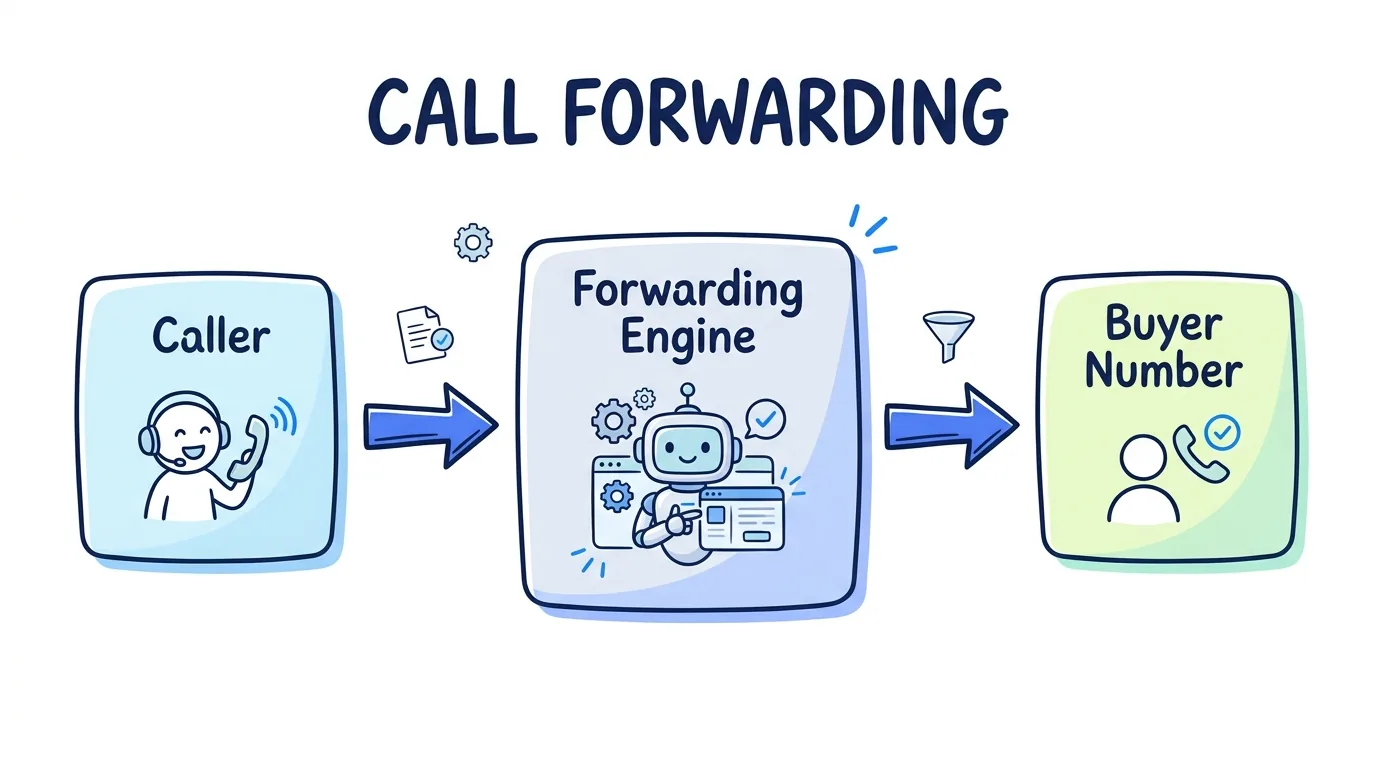
How to improve it: Route calls with availability-aware logic so they never ring a buyer who is at capacity. Lead Distro AI offers Round Robin, Weighted, Priority/Waterfall, and Ping-Post routing so a missed call rolls to the next available buyer instead of dropping.
3. Average Call Duration
What it is: The mean length of answered calls. It is a fast proxy for caller intent and quality.
Why it matters: Most pay-per-call buyers only pay for calls that exceed a minimum duration (often 60 or 90 seconds), so duration is tied directly to whether a call is billable.
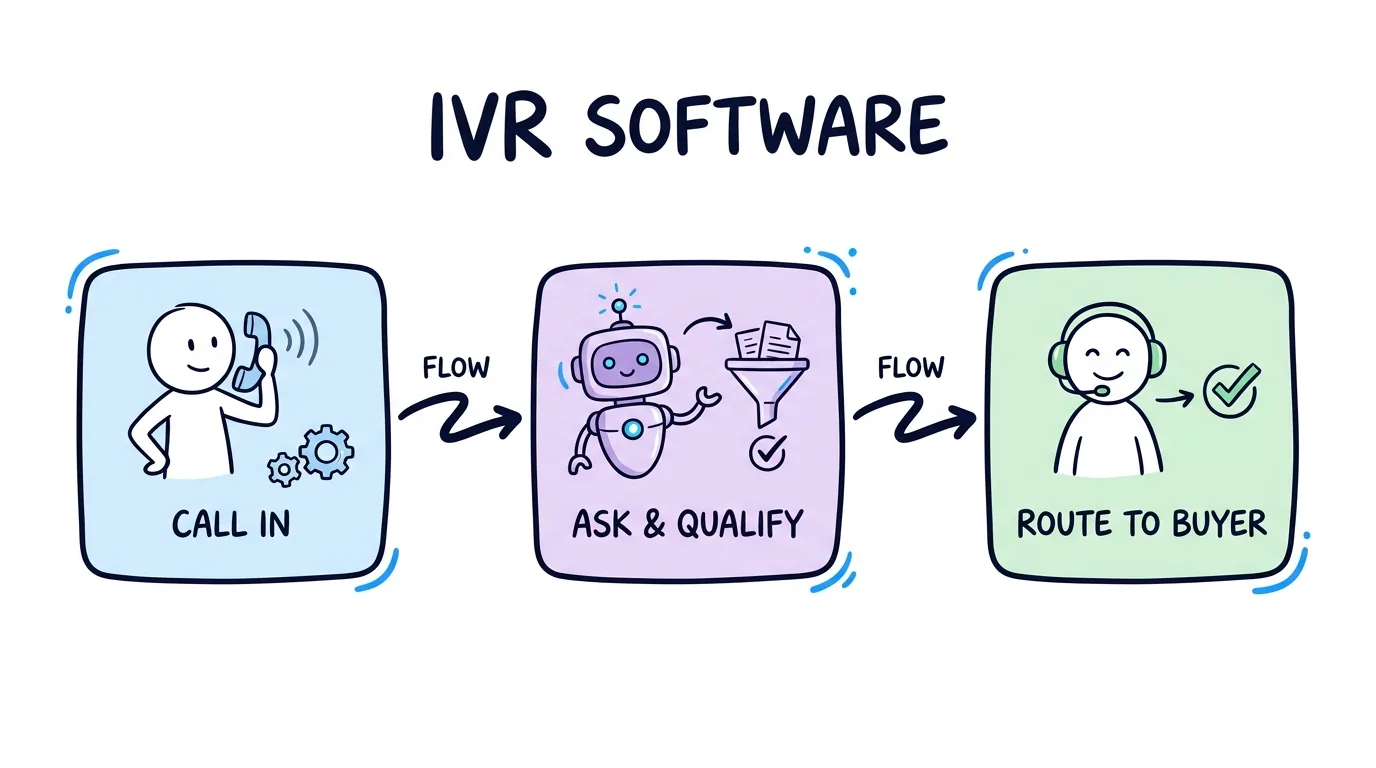
How to improve it: Tighten targeting so callers arrive with real intent, and pre-qualify with an IVR menu so short, off-topic calls never reach a billable agent.
4. First-Call Resolution
What it is: The share of callers whose need is fully handled on the first call, with no callback required. It is a service-quality metric borrowed from contact centers.
Why it matters: High first-call resolution signals that traffic and routing are matched to the right buyer, which protects buyer relationships and repeat spend.
How to improve it: Route by vertical and intent so a solar caller reaches a solar buyer, and feed call-scoring data back into your campaigns to cut mismatched traffic.
5. Call Conversion Rate
What it is: The percentage of tracked calls that complete the desired action, a sale, a booked appointment, or a qualified handoff. This is one of the two call tracking metrics to track that most directly maps to revenue.
Why it matters: A strong call conversion rate is what justifies bidding up a campaign. A low one tells you the traffic is wrong long before the monthly invoice does.
How to improve it: Score every call for quality so you only push converting traffic, and send call conversions back into Google Ads and Meta so the bidding algorithms optimize toward calls, not just clicks.
6. Cost Per Call
What it is: Total media spend divided by the number of calls generated. The sharper version, cost per qualified call, divides spend by billable calls only.
Why it matters: Cost per call is your unit economics. If a campaign costs $42 per qualified call and your buyer pays $65 per payable call, you have a margin; if it costs $70, you are losing money on every ring.
How to improve it: Cut the sources with high cost per qualified call, and use real-time profit-and-loss reporting so you catch a rising figure mid-flight instead of at month-end.
7. Missed-Call Rate
What it is: The inverse of answer rate, the percentage of inbound calls that go unanswered, to voicemail, or abandoned in queue.
Why it matters: Every missed call on a pay-per-call campaign is paid traffic with zero chance to bill. Missed-call rate is the clearest leak in the entire set of pay per call metrics.
How to improve it: Add overflow routing and after-hours fallback buyers, and alert on missed-call spikes so a buyer outage does not quietly burn a day of spend.
8. Peak Call Times
What it is: The hours and days when call volume concentrates, mapped across the week.
Why it matters: If your peak hours fall when buyers are offline, your answer rate and billable-call rate collapse no matter how good the traffic is.
How to improve it: Schedule buyer capacity and ad delivery to match the peaks, and use weighted routing to send more volume to buyers who staff your busiest windows.
9. Source and Attribution
What it is: The campaign, keyword, channel, and landing page tied to each call through DNI. It is the metric that makes every other number actionable.
Why it matters: Without source attribution you cannot tell which traffic produces payable calls, so every optimization is a guess. Calls drive an enormous share of high-intent contacts, and attributing them is the closed loop that web forms already have.
How to improve it: Use visitor-level tracking with a rotating number pool, and pass the source data downstream so the buyer and the billing record both carry the call's origin.
10. Billable (Qualified) Call Rate
What it is: The percentage of tracked calls that meet the buyer's criteria, minimum duration, target geography, and quality, so the call is payable.
Why it matters: This is the agency metric. For a pay-per-call business, the billable-call rate is the line between revenue and wasted spend, which is why it sits at the top of every serious dashboard.
How to improve it: Score each call automatically against buyer rules, filter duplicates and spam before delivery, and route only qualified calls to paying buyers.
Call Tracking Metrics Summary Table
This table is the at-a-glance reference for the ten metrics, what each one tells you, and the one lever that moves it.
| # | Metric | What it measures | Primary lever to improve |
|---|---|---|---|
| 1 | Call volume | Total inbound calls per source | Scale qualified-call sources |
| 2 | Answer rate | Percent of calls picked up live | Availability-aware routing |
| 3 | Average call duration | Mean length of answered calls | Intent targeting + IVR pre-qualify |
| 4 | First-call resolution | Calls fully handled on first contact | Route by vertical and intent |
| 5 | Call conversion rate | Calls that complete the goal action | Score + push converting traffic |
| 6 | Cost per call | Spend per call (or per qualified call) | Cut high-cost sources, watch live P&L |
| 7 | Missed-call rate | Percent of calls unanswered | Overflow + after-hours fallback |
| 8 | Peak call times | When volume concentrates | Match buyer capacity to peaks |
| 9 | Source and attribution | Campaign/keyword behind each call | Visitor-level DNI tracking |
| 10 | Billable call rate | Percent of calls that are payable | Automated scoring + duplicate filtering |
A useful way to read these together is what we call the Margin-First Stack: volume and source tell you where calls come from, answer rate and missed-call rate tell you how many survive the handoff, conversion and billable rate tell you how many earn money, and the cost figure tells you whether the math works. You read them top-down once a day, not column-by-column once a month.
How These Metrics Connect: From Tracked Call to Billed Revenue
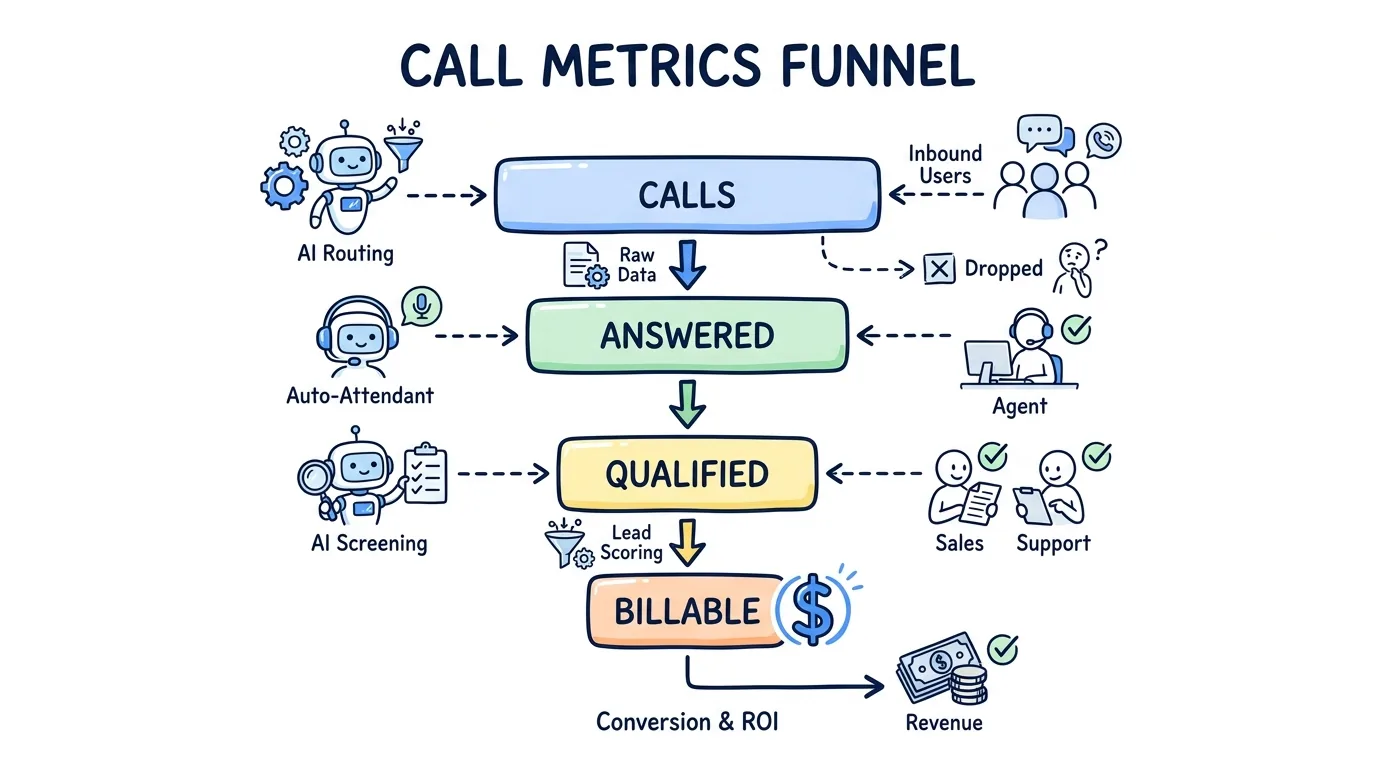
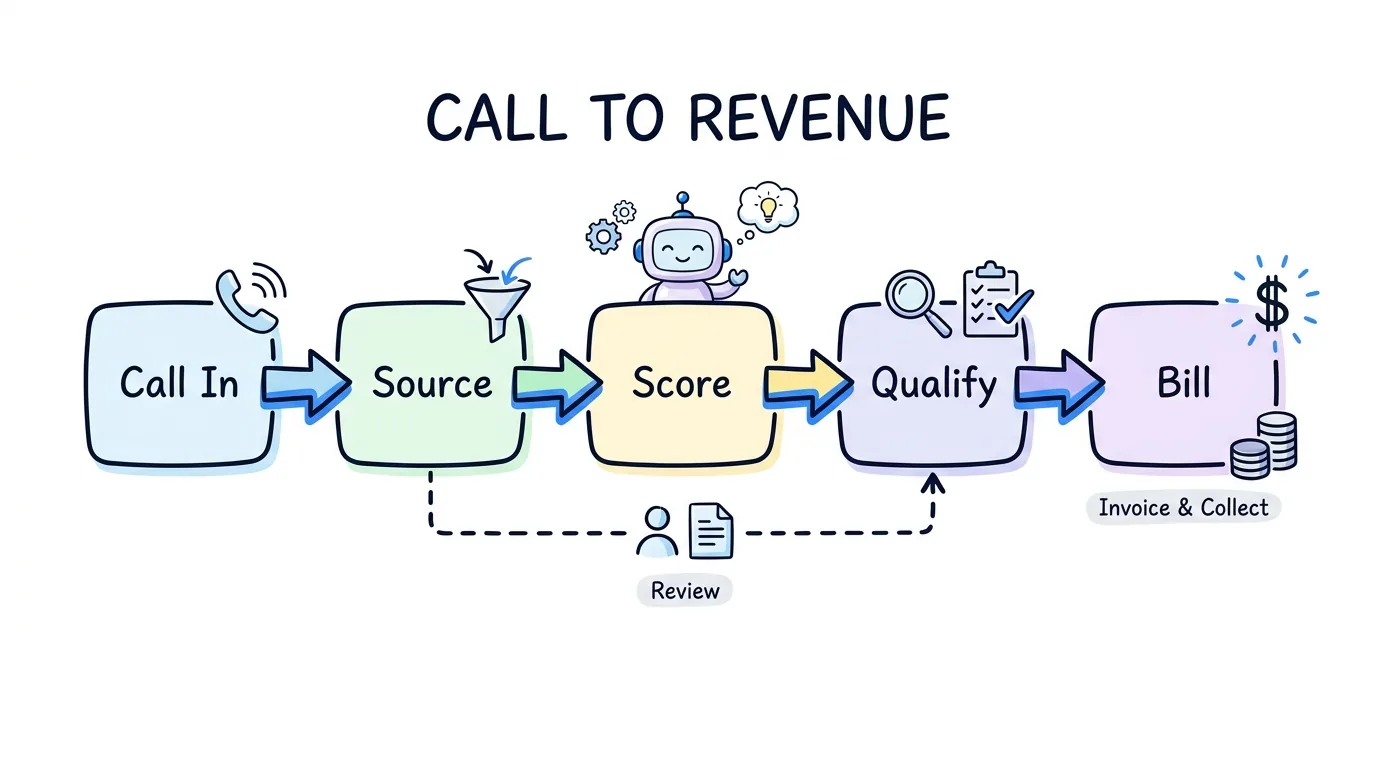
The ten metrics are not ten separate dashboards. They are one chain. A call enters with a source attached (metric 9), gets answered or missed (metrics 2 and 7), runs for some duration (metric 3), resolves or does not (metric 4), converts or does not (metric 5), and finally qualifies as billable or not (metric 10), all measured against its cost per call (metric 6).
"The agencies that win at pay-per-call stop reporting on call volume and start reporting on payable calls per dollar spent," says Rafael Hernandez, Founder and CEO of Lead Distro AI. "The moment you can see cost per qualified call next to your call conversion rate in real time, you make different decisions, and you make them on day three of a campaign instead of day thirty."
This is the gap most attribution-only tools leave open. They tell you the call's source but not its quality, so the qualified-call number stays a manual estimate. Lead Distro AI scores every call with Claude AI in under a second and tracks all ten call tracking KPIs in one real-time view, alongside data leads, so leads and calls live on the same profit-and-loss dashboard. Turning these numbers into decisions is the job of call analytics software, which adds attribution, conversation intelligence, and routing on top of the raw metrics. For the deeper setup mechanics, our call tracking software for pay-per-call agencies guide walks through the full configuration, and the what is call tracking primer covers the fundamentals if you are new to it.
Tracking Metrics for Pay-Per-Call vs Pay-Per-Lead
Pay-per-call and pay-per-lead agencies watch overlapping but distinct numbers. A pay-per-lead operation cares most about source attribution, conversion rate, and cost per lead, because it bills on delivered form data. A pay-per-call operation lives and dies by answer rate, average call duration, and the billable-call rate, because the buyer pays only when a call clears a duration and quality bar.
The agencies that sell both data leads and calls need every metric in one place, which is the practical reason to run leads and calls on a single platform instead of bolting a call-tracking tool onto a separate lead-distribution system. Running them apart means two dashboards, two billing records, and two versions of the truth. For how the underlying routing works on the call side, see our marketing call tracking breakdown, and for how to benchmark platforms, the best call tracking software comparison ranks the field. Agencies building a buyer network should also read how a pay-per-call network routes and bills calls across multiple buyers.
A quick honest note on pricing, since it affects your cost math: call tracking is usage-based. The platform subscription is flat (Lead Distro AI starts at $297 per month), and call tracking adds a per-number monthly fee plus a per-minute inbound rate on top. Build those into your cost-per-qualified-call target so the unit economics are real.
Conclusion: Measure What You Bill, Not What Rings
The phone ringing is not the goal; a billable call you can attribute, score, and profit from is. Track the ten call tracking metrics above as one connected chain, lead with billable-call rate and cost per call, and you will scale the campaigns that pay and kill the ones that do not, in days instead of months. Most agencies are still reporting on call volume, which means the ones who measure quality and unit economics have a real edge right now. To verify the billable-call rate behind these numbers, pair your dashboard with call monitoring software that records and scores every conversation. Put these call tracking KPIs on one real-time dashboard before your next campaign goes live, or you will be optimizing blind while a competitor optimizes on data. Start your 7-day free trial and see every call metric, for both leads and calls, in one view.
Frequently Asked Questions
What are the most important call tracking metrics to track?
The most important call tracking metrics are call volume, answer rate, average call duration, first-call resolution, conversion rate, cost per call, missed-call rate, peak call times, source and attribution, and the billable-call rate. Lead with the last two and with the cost figure: source attribution tells you which campaign produced each call, and cost per qualified call plus the billable rate tell you whether that campaign actually makes money. Volume and answer rate set the ceiling, but quality and unit economics decide the outcome.
What is a good call conversion rate?
A good call conversion rate varies by vertical and offer, but inbound phone calls convert far better than web forms, often 10 to 15 times higher, because callers self-select as high intent. Rather than chase a universal benchmark, set a baseline from your own first 30 days of tracked calls, then optimize against it. A healthier signal than the raw number is that rate segmented by source, because it shows which campaigns deserve more budget and which are quietly dragging the average down.
How do you calculate cost per call?
Cost per call is total media spend for a campaign divided by the number of calls it generated. The version that actually protects margin is cost per qualified call: divide spend by payable calls only, since those are the calls you get paid for. If a campaign costs $40 per qualified call and your buyer pays $65 per payable call, you have a workable margin; if it climbs to $70, the campaign is losing money on every call. Watch it in real time so you catch a rising cost mid-campaign, not at month-end.
What is a billable call in pay-per-call?
A billable call is an inbound call that meets the buyer's payment criteria, usually a minimum duration (often 60 or 90 seconds), the right geography, and a quality or intent threshold. Calls that hang up early, come from the wrong area, or fail quality checks are not billable. The billable-call rate, the share of total calls that qualify, is the single most important agency metric because it is the direct line between your ad spend and your revenue. Automated scoring and duplicate filtering raise that rate by keeping junk calls out of billing.
Can call tracking metrics live in the same dashboard as lead metrics?
Yes, and for agencies that sell both data leads and calls, they should. Running call tracking metrics and lead metrics in separate tools means two dashboards, two billing systems, and conflicting numbers. Lead Distro AI keeps leads and calls on one real-time profit-and-loss view, with Claude AI scoring every call and lead, so the billable-call rate, conversion rate, and cost per call all sit beside your lead metrics. One source of truth makes optimization faster and billing cleaner across pay per call metrics and lead metrics alike.
About the Author
Founder & CEO of Lead Distro AI & Great Marketing AI
UC Berkeley graduate and former software engineer at Microsoft. Rafael built Lead Distro AI after managing over $10M in ad spend for performance marketing agencies (pay-per-lead and pay-per-call), including running campaigns for Neil Patel. He combines deep software engineering expertise with hands-on performance marketing experience to build tools that help these agencies scale profitably.
About Lead Distro AI
Lead Distro AI: AI-Powered Lead Distribution & Call Tracking That Maximizes ROI
The modern platform for pay-per-lead and pay-per-call agencies. Route, score, and deliver leads with AI-powered automation and real-time P&L tracking. Built for performance marketing agencies and lead buyers across legal, insurance, mortgage, solar, and home services verticals.
4 Distribution Methods
Waterfall, Round Robin, Weighted, Ping-Post
Ping-Post Auctions
Real-time bidding with sub-second routing
Real-Time P&L Reporting
Track revenue, costs, and profit per campaign
Call Tracking
Assign tracking numbers, record calls, and attribute conversions
AI Lead Scoring
Score every lead before routing to maximize conversion
Partner Portal
Self-serve dashboard for buyers to track leads