Pay-Per-Call for Legal: Mass Tort, PI & Attorney Lead Calls (2026)
Pay per call legal explained for 2026: how inbound attorney calls work across PI, mass tort, criminal, and immigration, with payouts, qualification filters, and TCPA rules.

Rafael Hernandez
Founder & CEO
Ex-Microsoft SWE · $10M+ PPL ad spend
I hope you enjoy reading this blog post. If you want to try Lead Distro AI for free, click here.
Author: Rafael Hernandez | Founder & CEO of Lead Distro AI
Pay per call legal is the model where inbound phone calls from people seeking an attorney are sold to a law firm or legal intake center on a per-call basis rather than per form fill. A publisher generates the call through search ads, SEO, or a case-evaluation site, a tracking number routes the live caller to a buyer, and the buyer pays an agreed price once the call clears a duration or qualification threshold. For law firms, this converts faster than data leads because the prospective client is already on the phone describing their case. For agencies, pay per call for law firms is the highest-payout vertical in the entire pay-per-call industry, because a single signed case (a personal injury claim, a mass tort plaintiff, a criminal defense retainer) can be worth tens of thousands of dollars in attorney fees.
This guide breaks down how pay per call works for law firms, which legal case categories run on it, how to qualify callers, the two compliance layers that govern attorney lead calls (state bar advertising rules plus the TCPA), and how to set up routing, billing, and tracking with Lead Distro AI. It closes by comparing pay per call against shared and exclusive legal data leads. If you also buy form leads, the product tour shows how one platform routes both calls and data leads.
Key Takeaways
- Pay per call legal bills per qualified attorney call, not per form fill, so the firm pays for a live prospect already describing their case rather than a contact record it still has to reach.
- Legal is the highest-payout pay-per-call vertical because a signed case can be worth tens of thousands in attorney fees, with mass tort and personal injury commanding the top per-call prices.
- The core legal case categories are personal injury and MVA, mass tort, criminal defense, immigration, bankruptcy, and workers' compensation, each with its own intent, payout, and qualification profile.
- Caller qualification filters decide whether a call bills: case type, jurisdiction or state, injury or incident facts, statute-of-limitations window, and whether the caller is already represented.
- Two compliance layers govern legal pay per call: each state bar's attorney-advertising and lawyer-referral rules (with ABA Model Rules 7.1 to 7.3) and the federal TCPA for autodialed or prerecorded calls and texts.
- Routing, billing, and tracking run on a distribution platform using Round Robin, Weighted, Priority/Waterfall, or Ping-Post, with usage-based call tracking layered on the flat subscription.
How Pay-Per-Call Works for Law Firms
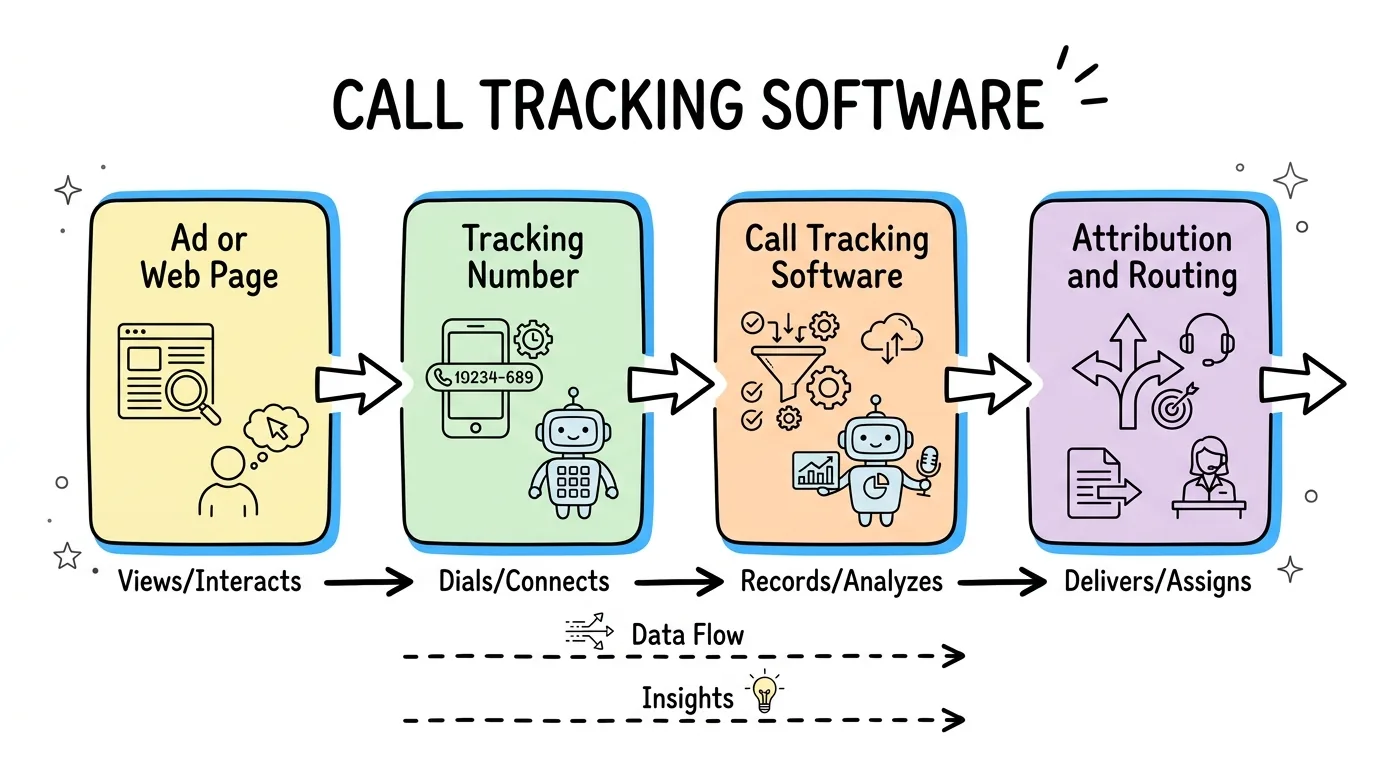
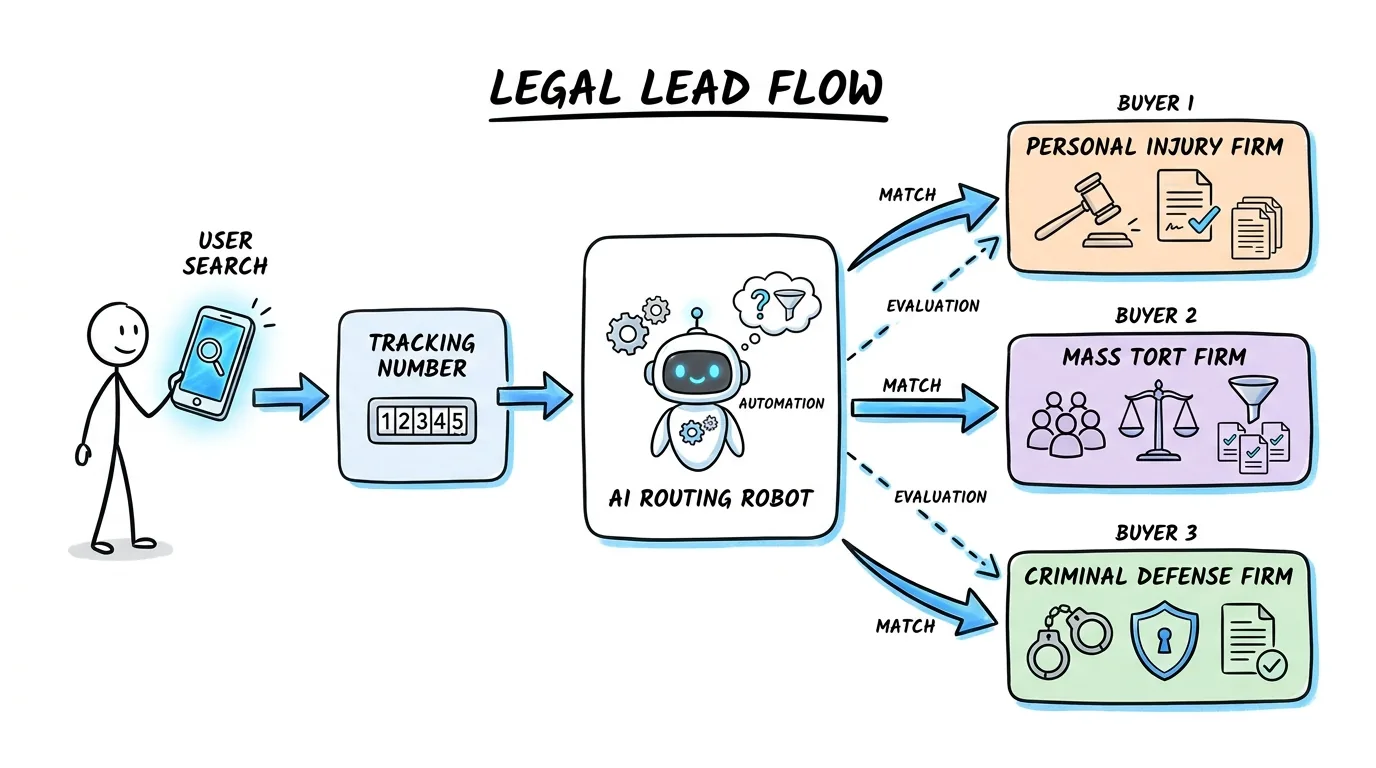
Pay per call for law firms inserts a tracked phone number between a publisher and a buyer. The publisher runs a legal campaign (a Google search ad for "car accident lawyer near me," a mass tort case-evaluation landing page, a criminal defense intake site) and displays a tracking number. When a person calls, the platform's Dynamic Number Insertion (DNI) ties that call to its source, scores it, and routes the live caller to a buyer based on rules the buyer set: practice area, state, time of day, and bid.
The buyer pays only when the call clears a threshold, usually a minimum connected duration (commonly 60 to 120 seconds) plus any IVR pre-qualification answers. That billable event protects firms from junk calls and pushes publishers to send genuinely qualified callers. The result is a marketplace where law firms buy live case intent at a known unit cost, and pay-per-call agencies monetize call inventory across multiple firms without practicing law or signing the case themselves.
Legal Case Categories That Run on Pay-Per-Call
Legal pay-per-call inventory splits into buyer-defined case categories. Each behaves differently on payout, urgency, and the filters a firm applies before a call bills. These are the legal pay per call leads firms compete hardest for.
Personal Injury and MVA
Personal injury, led by motor vehicle accident (MVA) cases, is the highest-volume legal call vertical because accidents happen year-round and intent is immediate. Calls are filtered on injury severity, fault, whether a police report exists, and time since the incident. Pay per call attorney leads in PI command strong payouts because a single signed MVA case can be worth a large contingency fee. These pay per call attorney leads convert fast because speed-to-contact matters most here, since injured callers often retain the first responsive firm.
Mass Tort
Mass tort calls (defective drug, medical device, and product-liability matters such as talc, Roundup, or CPAP claims) are the highest-payout category in legal pay per call. Buyers filter tightly on the specific product, exposure dates, diagnosis, and qualifying injury. Because plaintiff acquisition cost is high and case value is large, mass tort pay per call sits at the top of the payout scale and is often routed by real-time bidding to the firm or lead aggregator willing to pay the most per qualified caller. For agencies, mass tort pay per call is where the largest per-call payouts live, which is why it anchors most legal portfolios.
Criminal Defense
Criminal defense calls carry urgent, high-intent demand: a caller (or a family member) needs a lawyer now, often around an arrest, DUI, or pending charge. Calls are filtered on charge type, jurisdiction, and custody status. Payouts are solid because retainers are paid up front, and connection speed is critical since these callers will not wait. Buyers want callers in the county where the firm practices.
Immigration, Bankruptcy, and Workers' Compensation
Immigration calls (deportation defense, visas, green cards, asylum) filter on matter type and language, with Spanish-language intake often essential. Bankruptcy calls (Chapter 7 and Chapter 13) filter on debt level and filing status. Workers' compensation calls filter on injury type, employment status, and state. All three are steady, year-round practice areas with moderate to strong payouts depending on case complexity and state.
Caller Qualification Filters for Legal Calls
In pay per call legal, qualification is a set of enforced rules that decide whether a call bills, not a subjective judgment. The most common filters law firms apply are:
- Case type matching. The call must match the firm's practice area (a workers' comp firm should never be billed for an immigration call).
- Jurisdiction and state. Law is state-specific and often county-specific, so calls route only to a firm licensed and practicing in the caller's jurisdiction.
- Injury or incident facts. PI and mass tort buyers filter on injury severity, diagnosis, fault, exposure dates, and whether a report or treatment exists.
- Statute-of-limitations window. A claim filed after the deadline is worthless, so buyers screen out incidents that fall outside the state's statute-of-limitations period.
- Not already represented. Contacting a person already represented by counsel raises ethics concerns, so intake confirms the caller has no current attorney before the call bills.
An original insight from running mixed call-and-lead operations: in legal, the gap between gross calls and billable calls is wider than in any other vertical, because the qualification bar (statute window, jurisdiction, representation status, injury facts) is the strictest. Two publishers quoting the same per-call price can deliver completely different net economics once those legal filters are applied. Firms that measure billable-rate by publisher, not raw call volume, consistently pay less for cases that actually sign. That is why scoring and filtering before routing, rather than after billing, protects margin most in the legal vertical.
Compliance for Legal Pay-Per-Call
Legal is the most heavily governed pay-per-call vertical because two compliance layers apply at once: attorney-advertising ethics rules and the federal TCPA. This is general information, not legal advice. Confirm your obligations with your state bar and qualified counsel before launching.
State Bar Attorney-Advertising and Referral Rules
Lawyer advertising and client solicitation are governed by each state's bar, generally tracking ABA Model Rules 7.1 to 7.3: a lawyer must not make false or misleading claims about services, must not guarantee outcomes, and faces limits on direct in-person and live-telephone solicitation (ABA Model Rules of Professional Conduct, Information About Legal Services). Some states restrict or regulate for-profit lawyer referral services and require specific disclosures or a "this is attorney advertising" label. These rules vary by state, so the buying firm, not the agency, must confirm its own bar's requirements before running campaigns. Frame intake scripts and landing pages as case-evaluation requests, never as outcome guarantees.
TCPA for Attorney Calls and Texts
The federal Telephone Consumer Protection Act (TCPA) governs autodialed and prerecorded calls and texts. It requires prior express written consent before making autodialed or prerecorded or artificial-voice telemarketing calls and texts to consumers, and it restricts calls to numbers on the National Do-Not-Call Registry (FCC, Telemarketing and Robocalls). Statutory damages run from $500 to $1,500 per violating call or text under the statute.
One development is widely misreported, so state it accurately: the FCC's 2023 "one-to-one consent" rule, which would have required separate consent for each individual seller, was vacated by the U.S. Court of Appeals for the Eleventh Circuit in Insurance Marketing Coalition Ltd. v. FCC on January 24, 2025, before it took effect (Eleventh Circuit decision coverage, Kelley Drye). The pre-existing prior-express-written-consent standard remains in force. Do not market a "one-to-one consent required" rule as current law.
Routing, Billing, and Tracking With Lead Distro AI
Once legal calls are flowing, the platform layer decides who gets each call, how it bills, and how it is tracked. Lead Distro AI handles legal pay-per-call with four distribution methods:
- Round Robin spreads calls evenly across a firm pool so no single intake desk is starved or flooded.
- Weighted sends a higher share of calls to your best-converting or highest-paying buyers.
- Priority/Waterfall offers each call to the top buyer first and falls down the list if they decline or are capped (the same model often called a waterfall).
- Ping-Post broadcasts the call's qualifying attributes to multiple buyers in real time, collects bids, and routes the live caller to the highest bidder, the revenue-maximizing model for high-payout lines like mass tort and PI.
Every inbound call is scored with AI before routing, so firms receive pre-qualified callers rather than raw inbound volume. Tracking runs on Dynamic Number Insertion, attributing each call to its publisher and campaign. Billing is reconciled per buyer in real time with P&L by source. On pricing: the platform subscription starts at $297 per month flat. Call tracking is billed separately and is usage-based, a per-tracking-number monthly fee plus a per-minute rate for inbound calls, layered on top of the subscription. A 7-day free trial is available with a credit card required. To see routing, scoring, and ping-post bidding in a legal workflow, start your free trial or read the legal vertical overview.
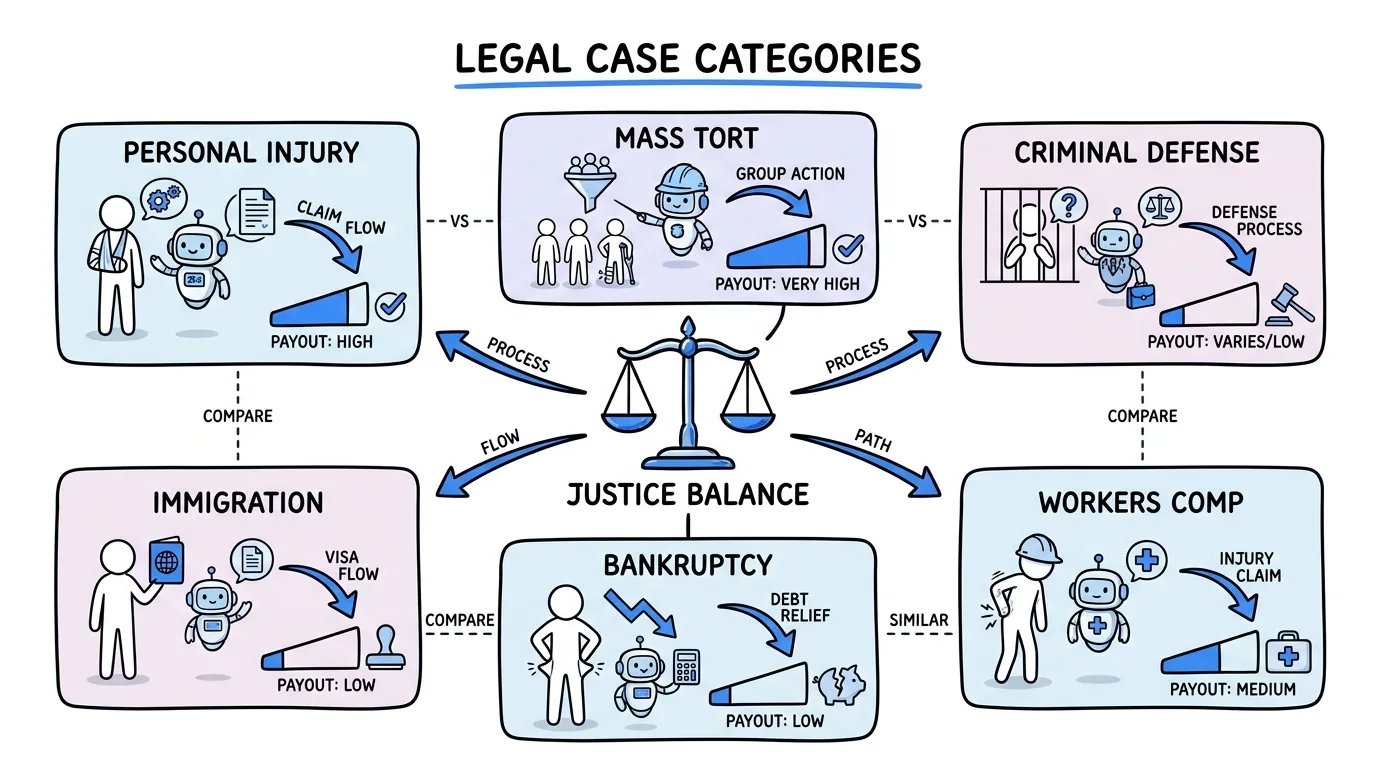
Legal Case Types by Intent and Typical Payout
The table below summarizes how the main legal categories compare on buyer intent, urgency, and where each tends to fall on the payout scale. Exact payouts vary by buyer, state, and call quality, so treat these as relative positioning, not fixed prices.
| Legal Call Type | Buyer Intent | Urgency | Typical Payout Tier | Primary Caller Filters |
|---|---|---|---|---|
| Personal Injury / MVA | High, recent accident | Very high | Higher | Injury severity, fault, time since incident, state |
| Mass Tort | High, qualifying exposure | Moderate | Highest | Product, exposure dates, diagnosis, statute window |
| Criminal Defense | Very high, active charge | Very high | Higher | Charge type, jurisdiction, custody status |
| Immigration | High, pressing matter | High | Mid | Matter type, language, state |
| Bankruptcy | Moderate to high | Moderate | Mid | Debt level, filing status, state |
| Workers' Compensation | High, work injury | High | Mid to higher | Injury type, employment status, state |
The pattern that matters: payout follows case value and signed-case worth, not call volume. PI and criminal defense send the most calls; mass tort sends fewer calls but commands the highest payouts because each signed plaintiff is worth the most to the buyer. A pay-per-call agency building a legal portfolio usually anchors on mass tort and PI for margin, then layers criminal defense, immigration, and workers' comp for steady year-round volume.
Pay-Per-Call vs Shared and Exclusive Legal Leads
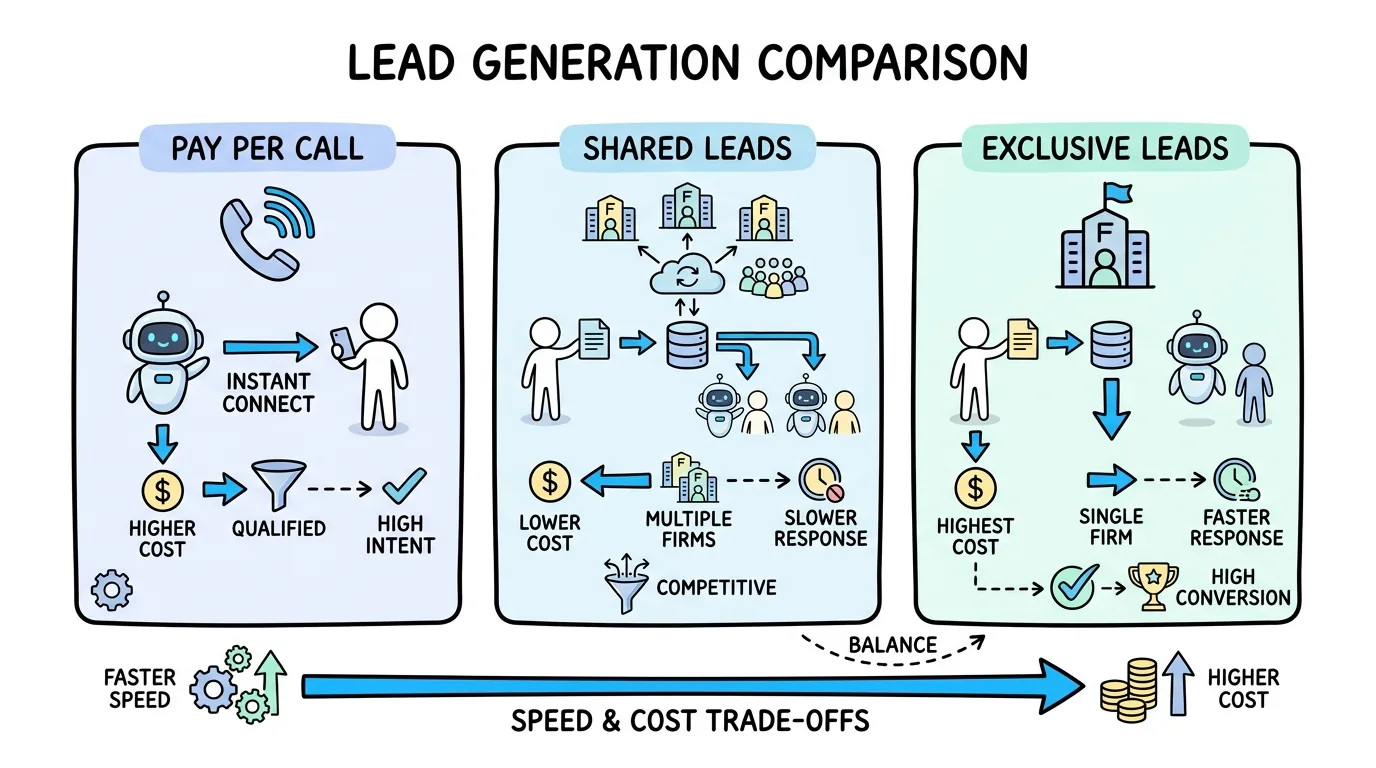
Pay per call is one of three ways to buy legal demand. Each fits a different operation, and the inbound-call angle here is distinct from the form-lead distribution model.
Pay per call delivers live, phone-ready clients and bills per qualified call. Legal pay per call leads arrive as a person already on the line describing the case, so speed-to-contact is instant, which is the biggest advantage over data leads where contact rates can be low. The trade-off is less control over the client record and higher per-unit cost.
Shared legal data leads are form fills (case evaluations) sold to several firms at once, cheaper per lead but with lower sign rates because the prospect is fielding multiple firms. They suit high-volume intake teams that dial fast and win on speed. For how form leads are routed and deduplicated, see our guide to the best ping post software for legal.
Exclusive legal data leads are sold to one firm, cost more per lead, and let a firm own the client record and nurture over time. They suit firms running a CRM-driven intake motion. For the full breakdown of distributing exclusive legal form leads, read the best lead distribution software for personal injury law firms guide. The strongest legal operations run both: pay per call for high-intent PI and mass tort volume, exclusive data leads for steady nurture, distributed from one platform so the P&L is unified. For other top call verticals, see pay-per-call for solar and pay-per-call for medicare.
FAQ
What is pay per call for legal?
Pay per call for legal is the model where inbound phone calls from people seeking an attorney are sold to a law firm or intake center on a per-qualified-call basis rather than per form fill. A publisher generates the call through ads, SEO, or a case-evaluation site, a tracking number routes the live caller to a buyer, and the firm pays once the call clears a duration or qualification threshold. It favors speed-to-contact because the prospective client is already on the phone describing their case with active intent.
Which legal case types pay the most per call?
Payout follows signed-case value, not call volume. Mass tort calls (defective drug and product-liability claims) typically command the highest per-call payouts because each qualifying plaintiff is worth the most to the buyer, followed by personal injury and MVA, then criminal defense. Immigration, bankruptcy, and workers' compensation sit in the mid tier. Exact payouts vary by buyer, state, and call quality, so a pay-per-call agency usually anchors margin on mass tort and PI, then layers the steadier practice areas for year-round volume.
Is legal pay per call TCPA compliant?
Legal pay per call can be fully TCPA compliant when consent and Do-Not-Call rules are followed. The TCPA requires prior express written consent for autodialed or prerecorded telemarketing calls and texts and restricts calls to numbers on the National Do-Not-Call Registry. The FCC's 2023 one-to-one consent rule was vacated by the Eleventh Circuit in January 2025 and never took effect, so the prior written-consent standard governs. Retain per-lead consent records and scrub DNC lists. This is general information, not legal advice; confirm with qualified counsel.
Do attorney advertising rules apply to pay per call legal leads?
Yes. Beyond the TCPA, each state bar regulates lawyer advertising and client solicitation, generally tracking ABA Model Rules 7.1 to 7.3: no false or misleading claims, no guaranteed outcomes, and limits on direct live-telephone solicitation. Some states regulate for-profit lawyer referral services or require an attorney-advertising disclosure. These rules vary by state, so the buying firm must confirm its own bar's requirements. Frame intake as a case-evaluation request, never an outcome guarantee. This is general information, not legal advice.
How are legal calls qualified before they bill?
Legal calls are qualified with enforced filters applied before a call bills: case-type matching to the firm's practice area, jurisdiction and state matching, injury or incident facts (severity, fault, diagnosis, exposure dates), the statute-of-limitations window, and confirmation the caller is not already represented by counsel, plus a minimum connected duration and IVR pre-qualification. These rules decide whether a call counts as billable, which protects firms from unqualified inventory and pushes publishers to send genuinely viable case calls.
How do I route and bill attorney calls?
Attorney calls are routed and billed on a distribution platform. Lead Distro AI supports Round Robin, Weighted, Priority/Waterfall, and Ping-Post distribution, scores each call with AI before routing, and attributes calls with Dynamic Number Insertion. The platform subscription starts at $297 per month flat, and call tracking is usage-based on top of that, a per-number monthly fee plus a per-minute inbound rate. A 7-day free trial is available with a credit card required. For the form-lead side, see how firms distribute exclusive case leads on the same platform.
Conclusion
Pay per call legal is the fastest path to live case intent, and across personal injury and MVA, mass tort, criminal defense, immigration, bankruptcy, and workers' compensation it gives law firms a per-call cost they can model and pay-per-call operators the highest-payout vertical in the business. The economics turn on qualification and compliance: enforce case-type, jurisdiction, statute-window, and representation filters before routing, document consent under the current TCPA standard, confirm your state bar's advertising rules, and route with the method that fits each line, with Ping-Post earning the most on high-payout mass tort and PI calls.
If you want to run attorney calls and case data leads from one dashboard with AI scoring and real-time P&L, start your free 7-day trial and route your first call in under an hour. To understand the foundation first, read what is pay per call, or if you are building an operation, see how to start a pay-per-call agency and the sibling pay-per-call for insurance guide.
Building a legal pay-per-call book? Start your 7-day free trial and see how Lead Distro AI scores, routes, and bills personal injury, mass tort, criminal defense, and immigration calls from one platform. Credit card required.
About the Author
Founder & CEO of Lead Distro AI & Great Marketing AI
UC Berkeley graduate and former software engineer at Microsoft. Rafael built Lead Distro AI after managing over $10M in ad spend for performance marketing agencies (pay-per-lead and pay-per-call), including running campaigns for Neil Patel. He combines deep software engineering expertise with hands-on performance marketing experience to build tools that help these agencies scale profitably.
About Lead Distro AI
Lead Distro AI: AI-Powered Lead Distribution & Call Tracking That Maximizes ROI
The modern platform for pay-per-lead and pay-per-call agencies. Route, score, and deliver leads with AI-powered automation and real-time P&L tracking. Built for performance marketing agencies and lead buyers across legal, insurance, mortgage, solar, and home services verticals.
4 Distribution Methods
Waterfall, Round Robin, Weighted, Ping-Post
Ping-Post Auctions
Real-time bidding with sub-second routing
Real-Time P&L Reporting
Track revenue, costs, and profit per campaign
Call Tracking
Assign tracking numbers, record calls, and attribute conversions
AI Lead Scoring
Score every lead before routing to maximize conversion
Partner Portal
Self-serve dashboard for buyers to track leads