Call Queue Software: Cut Missed Calls for Pay-Per-Call
Call queue software holds, prioritizes, and routes inbound calls so fewer ring out unanswered. Here is how queuing cuts missed calls and lifts billable calls.

Rafael Hernandez
Founder & CEO
Ex-Microsoft SWE · $10M+ PPL ad spend
I hope you enjoy reading this blog post. If you want to try Lead Distro AI for free, click here.
Author: Rafael Hernandez | Founder & CEO of Lead Distro AI
Last Updated: June 21, 2026
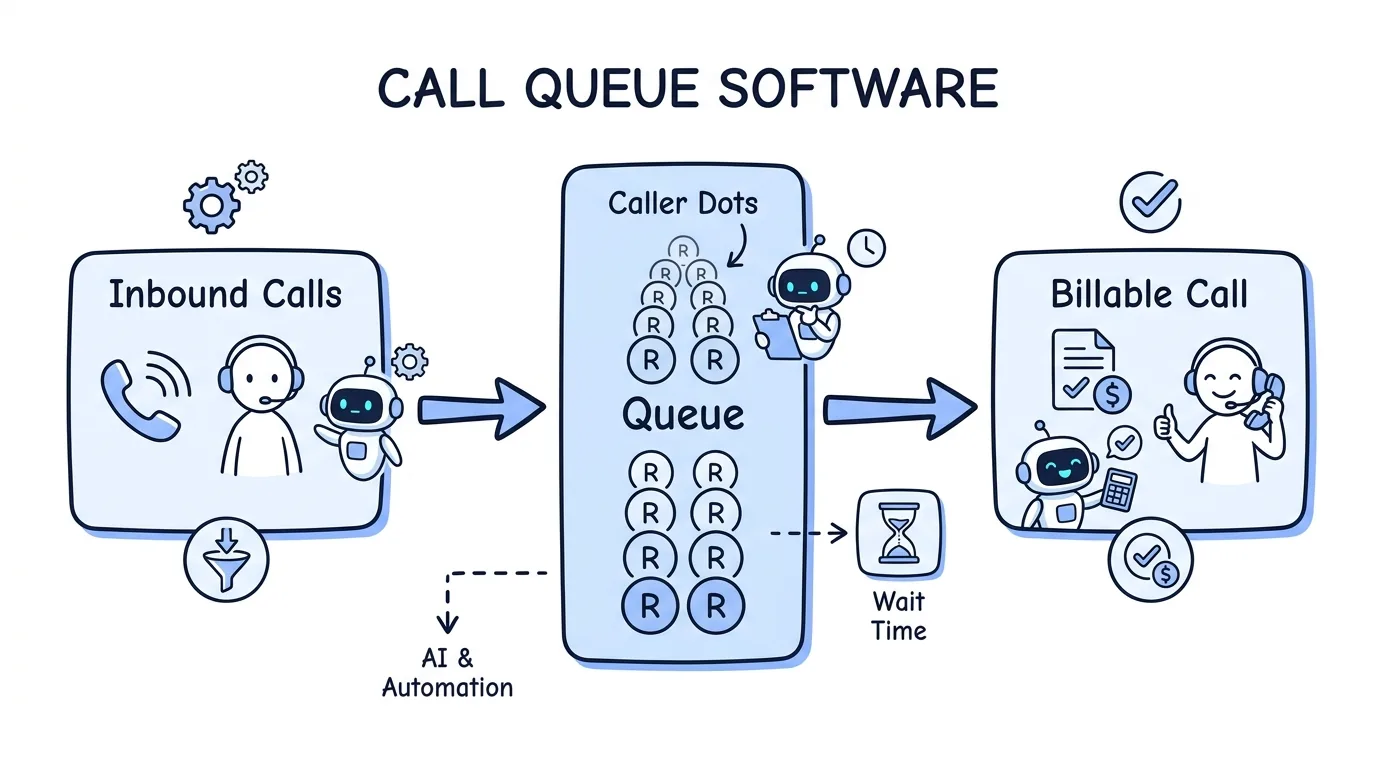
Call queue software is the system that holds inbound callers in an orderly line and connects each one to the next available buyer or agent instead of letting the call ring out, hit a busy signal, or drop. When more calls arrive than your destinations can answer at once, the queue parks each caller, plays hold messaging, applies priority rules, and releases callers in order as capacity frees up. For a pay-per-call agency, that line is the difference between a billable connected call and lost revenue, because every caller who hangs up before connecting is a sale you generated and then dropped. Good call queuing software adds queue callback, priority queuing, overflow routing, and business-hours rules so the smallest possible share of your inbound calls go unanswered.
The stakes are concrete. According to Voiso's call abandonment analysis, the average contact center loses 27% of its inbound calls to abandonment, and nearly 6 out of 10 callers will not call back after being held too long. With inbound calls converting at 25.56% versus 9.38% for cold outreach per Focus Digital's 2025 report, a dropped call is an expensive miss. Lead Distro AI pairs queuing with routing so agencies can connect more inbound calls to live buyers instead of leaking them.
Key Takeaways
- Call queue software holds inbound callers in line and connects each to the next available buyer, so calls that would ring out or hit a busy signal become billable connected calls instead.
- Missed call reduction is the core ROI, since the average contact center abandons 27% of inbound calls and most abandoned callers never call back.
- Key features are hold handling, queue callback, priority queue, overflow routing, and business-hours rules, each aimed at keeping a caller engaged until a buyer can take them.
- For pay-per-call agencies, the queue feeds the buyer waterfall, holding the caller while the platform pings buyers in order until one accepts at the agreed price.
- Lead Distro AI combines call queuing and lead distribution in one platform starting at $297/month, with a 7-day free trial that requires a credit card.
What Call Queue Software Is
A call queue system is the holding-and-ordering layer that sits between your tracking numbers and your buyers. When a caller dials one of your advertised numbers and every destination is busy, the queue parks the caller, plays hold music or a position message, and connects them the moment a line opens. AVOXI defines call queuing as intelligent queueing that uses queue callback, IVR routing, and timeout limits to enhance every interaction. Without a queue, a busy line gives the caller a dead end.
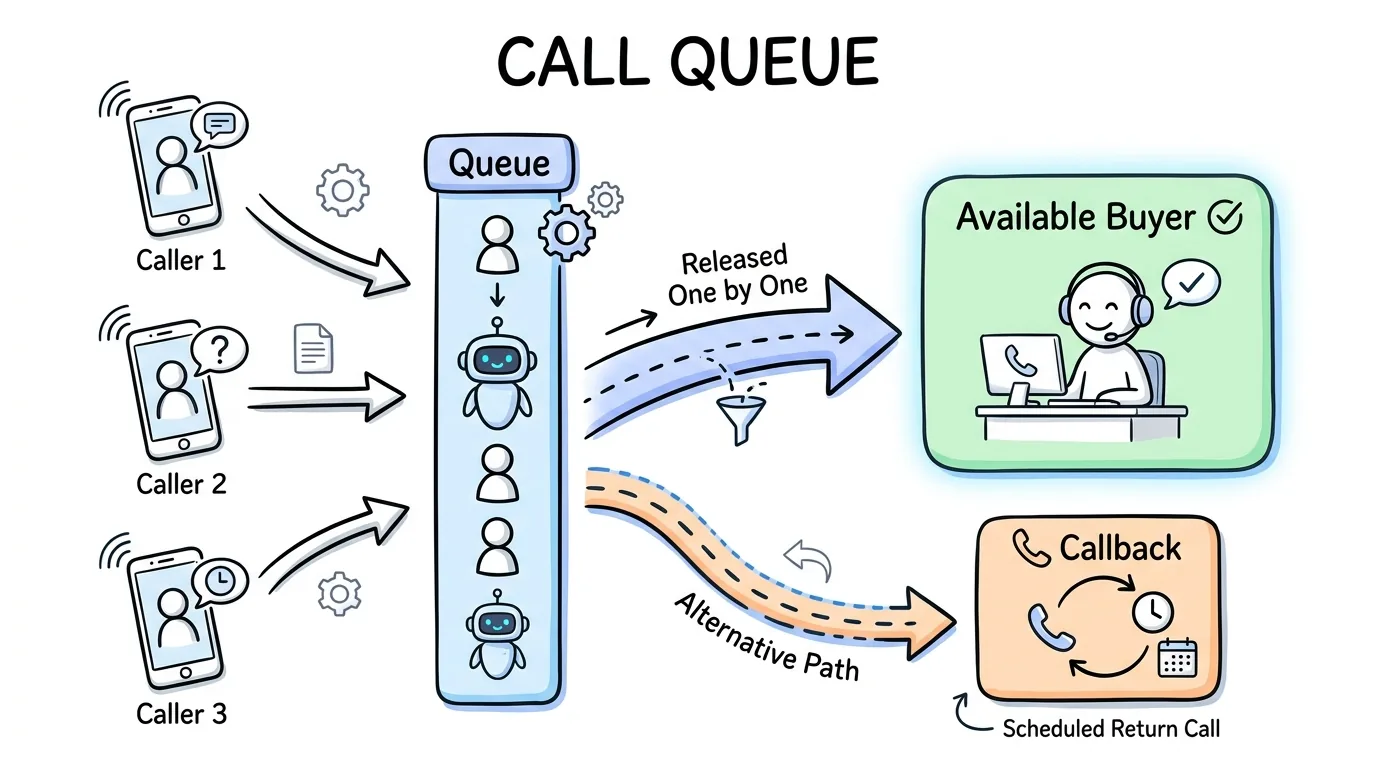
The distinction matters for an agency because the queue is what turns burst traffic into orderly, sellable volume. A radio spot or a click-to-call ad can fire 40 calls in two minutes. Inbound queueing absorbs that spike, holds each caller for a few seconds, and meters them out to buyers as capacity allows, instead of forcing 35 of them into a busy signal. The queue is the buffer that protects the inventory you paid to generate.
How Queuing Reduces Missed and Abandoned Calls
Missed call reduction is the single clearest reason to run a call queue system. The math is direct: every caller the queue holds and connects is a call you can bill, and every caller who abandons is one you cannot. Voiso reports that one fintech team cut its abandonment by 4.2% in a single queue just by adjusting hold logic, which added more than 600 answered calls per week. At a pay-per-call price of $40 to $200 per call, that recovered volume pays for the platform many times over.
The reason queuing works is behavioral. Callers tolerate a short, transparent wait far better than silence or a busy tone. A position-in-line message or estimated hold time keeps people on the call, while Voiso notes that 32% of callers never return after abandoning midway. A call queuing software setup that tells the caller "you are next" buys the seconds your buyer waterfall needs to find a taker. The queue does not eliminate waits; it makes them survivable, which is what protects your connected-call rate.
Core Features of a Call Queue System
A capable inbound call queue is more than a holding pen. The features below each attack a specific cause of dropped calls, and the best tools combine all of them rather than offering one in isolation.
| Feature | What it does | Why it cuts missed calls |
|---|---|---|
| Hold handling | Plays music, position, and estimated wait messaging | Keeps callers engaged instead of hanging up in silence |
| Queue callback | Lets the caller hang up and get called back in turn | Removes the wait entirely for callers who will not hold |
| Priority queue | Moves higher-value calls to the front of the line | Protects your most billable call types from abandonment |
| Overflow routing | Diverts to backup buyers when the queue is full | Prevents busy signals during traffic spikes |
| Business-hours rules | Routes by time, day, and buyer schedule | Stops sending live calls to closed call centers |
Queue callback is the highest-leverage of these. As AVOXI describes, it lets the caller hang up and receive an automated call once an agent is free, which removes the wait for anyone unwilling to hold. Priority queuing matters for agencies selling multiple call types, since a $180 legal call should never sit behind a $20 call. You can see how these rules are configured inside the platform.
Queuing Inside the Pay-Per-Call Waterfall
For a pay-per-call agency, the queue does not feed your own agents; it feeds a buyer waterfall. The platform holds the caller while it pings buyers in ranked order, connecting the call to the first buyer who accepts at the agreed price. This is where queuing and routing become one motion: the queue buys time, and the call routing software spends that time finding the best-paying buyer who wants that caller, in that state, right now.
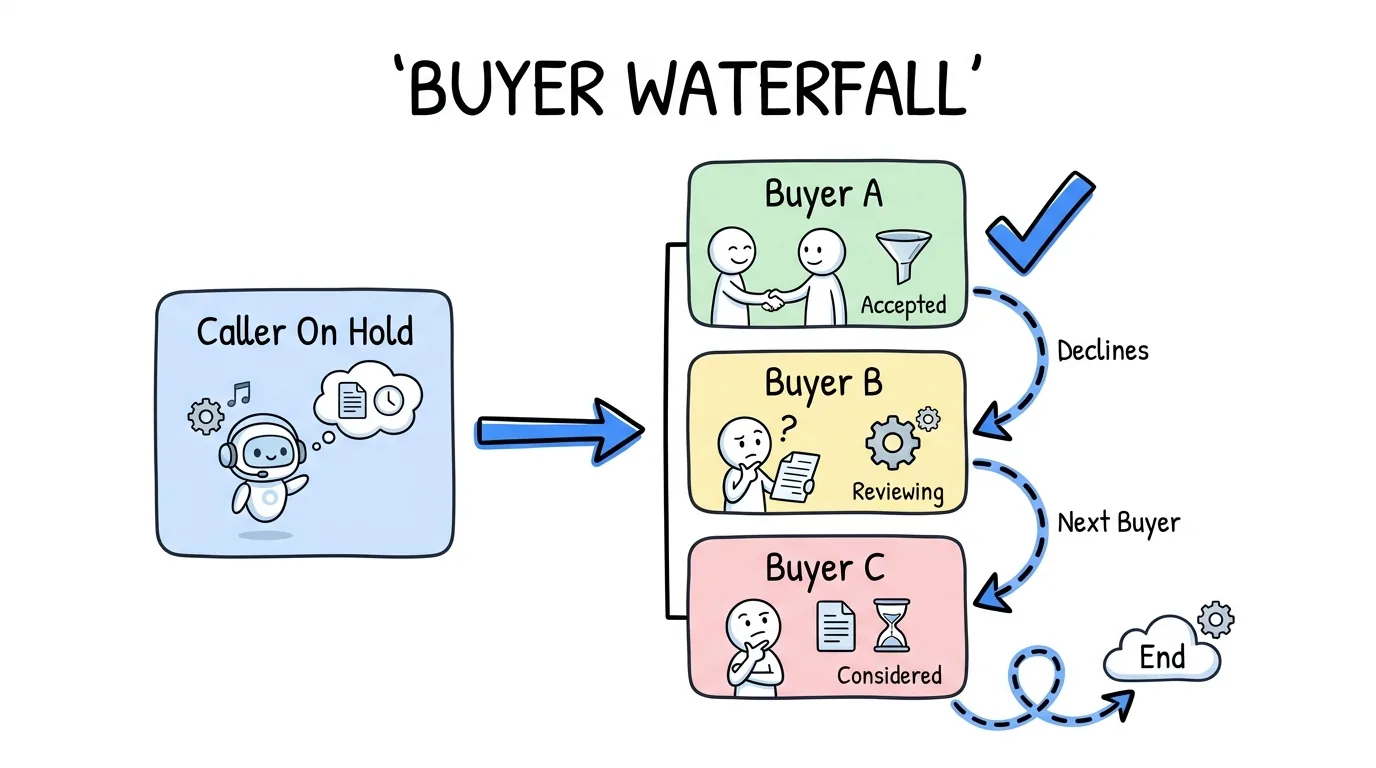
This is the same multi-buyer logic behind lead and call distribution software, applied to live phone calls. Lead Distro AI supports Round Robin, Weighted, Priority/Waterfall, and Ping-Post distribution, so the queue can release a held caller into whichever method fits the campaign. The result is that a caller who would have hit a busy signal instead waits a few seconds, gets offered to three buyers in priority order, and connects, which is one more billable call instead of one more leak. Agencies running this model can read our pay-per-call network guide for the buyer-side mechanics.
Why This Matters More for Agencies Than Call Centers
A traditional call center loses a customer when it abandons a call. A pay-per-call agency loses inventory it already paid to acquire, which makes the call queue software decision a direct margin question. "When you are billing buyers per connected call, your abandonment rate is your shrinkage rate," says Rafael Hernandez, Founder and CEO of Lead Distro AI. "Every percentage point of calls you drop in the queue is a percentage point of media spend you torched. We built queuing and routing into one platform because splitting them is where agencies leak the most billable calls."
The economics compound with scale. The pay-per-call market is projected to surpass $12 billion by 2025, and the agencies winning that volume treat connected-call rate as a core KPI, not an afterthought. Running queuing on a separate tool from distribution forces you to reconcile two dashboards and two bills, which is exactly the disorganized tracking operators tell us bleeds their margins. Note that call tracking itself is usage-based: a per-number monthly fee plus a per-minute rate for inbound calls, layered on top of the flat platform subscription.
Choosing Call Queue Software for Pay-Per-Call
The right call queue system for a pay-per-call agency is judged on whether it connects more calls to paying buyers, not on contact-center polish. Three criteria separate the contenders. First, does the inbound call queue run a buyer waterfall, or only queue to internal agents? Most contact-center queue tools assume you answer the calls yourself. Second, is queuing unified with lead distribution and billing, so a connected call flows straight into buyer invoicing? Third, is the pricing transparent rather than per-seat enterprise pricing built for call centers?
This is where unified platforms pull ahead of call-tracking-only tools. A standalone queue from a call-tracking vendor still leaves you bolting on a distribution and billing layer, the same gap operators describe when comparing tools in our marketing call tracking guide and our breakdown of call tracking software for pay-per-call agencies. Lead Distro AI starts at $297/month with all four distribution methods, lead scoring, and real-time profit-and-loss reporting included, so the queue, the routing, and the bill live in one place. You can compare it against your current stack on the pricing page.
FAQ
What is call queue software?
Call queue software holds inbound callers in an orderly line when every destination is busy, then connects each caller to the next available buyer or agent as capacity frees up. It plays hold messaging, applies priority and overflow rules, and can offer a callback so callers do not have to wait on the line. For pay-per-call agencies, the queue is what turns a busy-signal moment into a billable connected call instead of a lost one.
How does call queue software reduce missed calls?
It reduces missed calls by parking callers during traffic spikes instead of giving them a busy signal, and by keeping them engaged with position messages and estimated wait times until a buyer is free. Queue callback removes the wait entirely for callers who will not hold. Voiso found one team cut abandonment by 4.2% in a single queue through better hold logic, adding over 600 answered calls per week, which for a pay-per-call agency is recovered billable volume.
What is the difference between a call queue and call routing?
A call queue holds and orders callers while they wait, deciding who is next in line. Call routing decides where each caller goes once it is their turn, applying geography, skill, and bid rules to pick a destination. In pay-per-call they work together: the queue buys the seconds, and routing spends them finding the best-paying buyer through a waterfall. Lead Distro AI runs both in one platform so a held caller flows straight into the buyer waterfall.
Does a call queue help pay-per-call agencies bill more?
Yes, directly. A pay-per-call agency bills buyers per connected call, so every caller the queue holds and connects is revenue, and every abandoned caller is media spend wasted. Because most abandoned callers never call back, recovering even a few percentage points of abandonment converts straight into billable calls. The queue protects the call inventory you already paid to generate by giving each caller a survivable wait instead of a dead end.
Is call tracking included with call queue software?
Call tracking and queuing often live in the same platform, but they are priced differently. On Lead Distro AI the platform subscription is flat starting at $297/month, while call tracking is usage-based: a per-number monthly fee plus a per-minute rate for inbound calls layered on top. That keeps your base cost predictable while you only pay tracking costs on the call volume you actually run. Queuing, routing, distribution, and billing are part of the core platform.
Conclusion
Call queue software is the unglamorous layer that decides how much of your hard-won inbound volume actually turns into billable connected calls. For pay-per-call agencies, the queue is not a customer-service nicety; it is shrinkage control. Hold handling, queue callback, priority queuing, overflow routing, and business-hours rules each close a specific leak, and the agencies that treat connected-call rate as a core KPI keep the most of the media spend they put in. Lead Distro AI builds queuing, routing, distribution, and billing into one platform starting at $297/month so a held caller flows straight into the buyer waterfall and onto an invoice.
Ready to connect more of your inbound calls to paying buyers? Start your 7-day free trial and route your first held caller in minutes.
About the Author
Founder & CEO of Lead Distro AI & Great Marketing AI
UC Berkeley graduate and former software engineer at Microsoft. Rafael built Lead Distro AI after managing over $10M in ad spend for performance marketing agencies (pay-per-lead and pay-per-call), including running campaigns for Neil Patel. He combines deep software engineering expertise with hands-on performance marketing experience to build tools that help these agencies scale profitably.
About Lead Distro AI
Lead Distro AI: AI-Powered Lead Distribution & Call Tracking That Maximizes ROI
The modern platform for pay-per-lead and pay-per-call agencies. Route, score, and deliver leads with AI-powered automation and real-time P&L tracking. Built for performance marketing agencies and lead buyers across legal, insurance, mortgage, solar, and home services verticals.
4 Distribution Methods
Waterfall, Round Robin, Weighted, Ping-Post
Ping-Post Auctions
Real-time bidding with sub-second routing
Real-Time P&L Reporting
Track revenue, costs, and profit per campaign
Call Tracking
Assign tracking numbers, record calls, and attribute conversions
Lead Scoring
Score every lead before routing to maximize conversion
Partner Portal
Self-serve dashboard for buyers to track leads