How Bid Requests Work in Ping Post Lead Distribution (2026)
Learn how a bid request works in ping post lead distribution, which fields matter, how to set bid floors, and how Lead Distro AI handles real-time bidding.

Rafael Hernandez
Founder & CEO
Ex-Microsoft SWE · $10M+ PPL ad spend

I hope you enjoy reading this blog post. If you want to try Lead Distro AI for free, click here.
Author: Rafael Hernandez | Founder & CEO of Lead Distro AI
A bid request in ping post is the structured data packet a seller's platform broadcasts to registered buyers the moment an inbound lead is received. It contains a partial preview of the lead: enough information for buyers to evaluate fit and return a price, but withholds the full contact record until a winner is chosen. Bid requests are the engine of competitive pricing in pay-per-lead and pay-per-call distribution: they replace fixed-rate deals with a real-time auction that surfaces what the market will actually pay for each lead.
According to a 2023 IAB Tech Lab study on programmatic bidding latency, the median round-trip for a bid request and response cycle in competitive digital marketplaces is under 100 milliseconds. In lead distribution, most platforms target a 500-millisecond to 2-second bid window, which is long enough for buyers to run their own scoring logic before responding. Lead Distro AI implements bid requests natively inside its ping post module, routing each winning bid to the highest-qualified buyer automatically. Start a 7-day free trial to see how bid requests work inside a live ping post campaign.
Key Takeaways
- A bid request sends partial lead data to all eligible buyers simultaneously. Each buyer evaluates the ping and responds with a price or a pass before a configurable timeout.
- Bid request fields control how much information buyers see before bidding. State, vertical, lead type, and age are common; PII (name, phone, email) is withheld until post.
- Bid floors protect seller revenue. Any response below the floor is automatically rejected, so the auction only delivers leads to buyers willing to pay a minimum price.
- The highest qualifying bid above the floor wins the post. Lead Distro AI resolves ties and boundary cases in real time, then delivers the full lead record to the winner within the configured post timeout.
- Bid requests differ from direct post and waterfall distribution in speed, pricing flexibility, and buyer competition; each method fits a different operational profile.
- Agencies using bid-request-based ping post on Lead Distro AI can set per-vertical floors, cap buyer daily volume, and track bid-win rates from a single dashboard without writing custom auction code.
Lead Distro AI's ping post engine handles bid requests, floor prices, and fallback routing on every campaign.
How Bid Requests Work in Ping Post
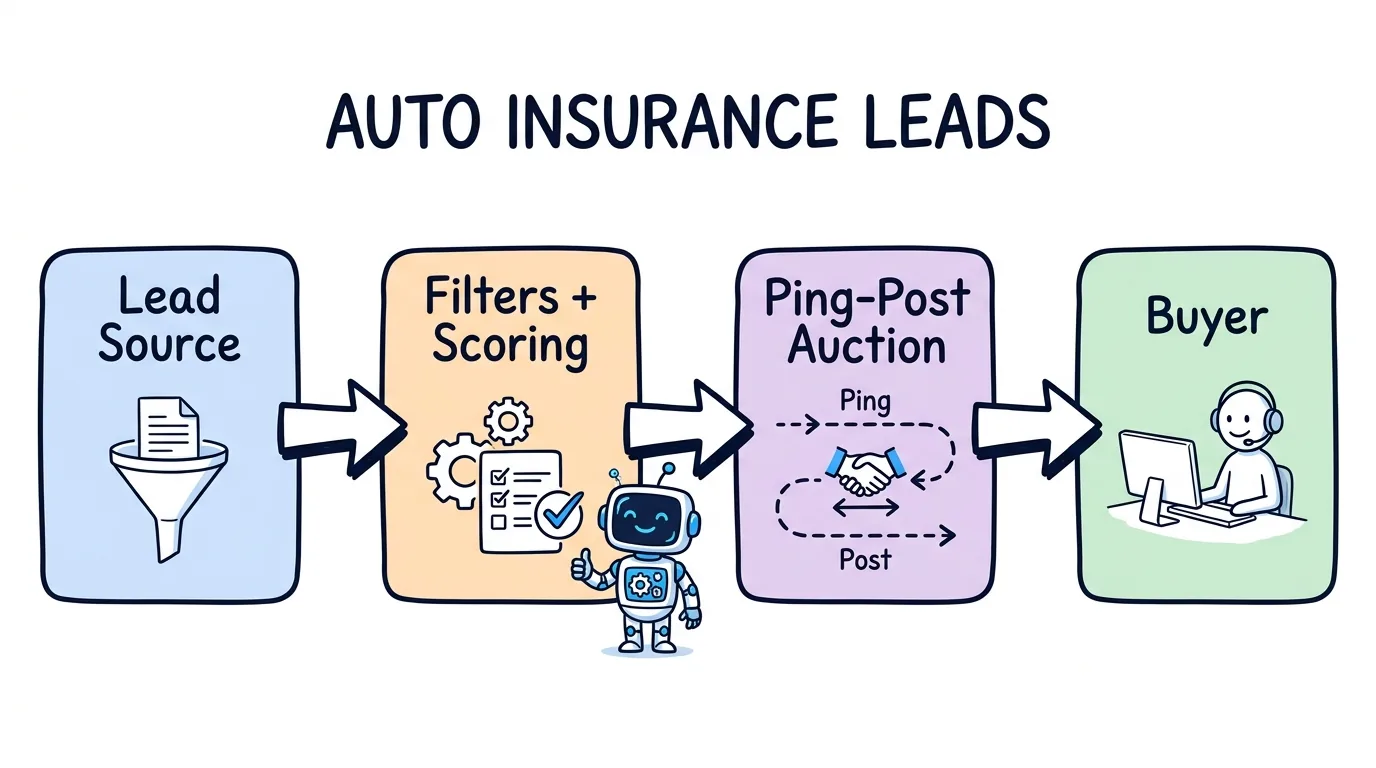
When a new lead arrives at a seller's platform, the bid request sequence runs in four stages. First, the platform constructs a bid request payload from the lead's partial data and broadcasts it to every buyer who has opted into that vertical and geography. Second, each buyer's system receives the request and applies its own filters: daily cap remaining, state eligibility, lead type match, and internal pricing logic. Buyers who want the lead return a numeric bid in dollars; buyers who pass return a zero or no response before the timeout expires.
Third, the platform sorts all valid bids above the seller's floor and selects the highest. If two bids tie, most platforms resolve by submission timestamp (earliest wins). Fourth, the platform delivers the full lead record, including PII, to the winning buyer via the post. The losing buyers receive no lead data at all, which protects the lead from over-delivery and shields buyers from paying for leads they cannot contact.
Well-tuned bid request auctions can reduce unsold lead inventory compared to fixed-rate exclusive deals, because competitive pressure from multiple buyers tends to find a clearing price above the floor.
Key Bid Request Fields
A bid request payload is not a full lead record. Platforms deliberately limit the fields so buyers can price the lead without receiving enough data to contact the prospect before winning. Common fields across verticals include:
- Vertical or lead type: auto insurance, personal injury, mortgage, solar, home services
- Geography: state, and sometimes ZIP code or DMA for verticals with tight geo-pricing
- Lead age: seconds since the form was submitted, critical for pay-per-call where recency drives contact rates
- Lead source or campaign: the traffic origin, which correlates with quality tiers buyers have already observed
- Opt-in language: a boolean or short text excerpt confirming that the consumer agreed to contact, a TCPA compliance signal
- Estimated score: a quality score the platform pre-computes against the seller's rules so buyers can price without running their own scrub
Fields that are always withheld at ping time include full name, phone number, email address, home address, and any financial or health data. Those fields travel only in the post, to the winning buyer, after the auction closes.
Lead Distro AI lets sellers configure exactly which fields appear in the ping payload on a per-campaign basis from the product tour, so sellers in regulated verticals like legal or insurance can satisfy their data-sharing agreements without modifying integration code.
Setting Bid Floors in Ping Post Campaigns
A bid floor is the minimum price a buyer must offer for a seller to consider the bid valid. Any response below the floor is automatically discarded, even if no other buyer bids higher. If no bid clears the floor, the lead is either held and re-pinged to a backup pool, routed to a waterfall fallback, or marked as unsold.
Choosing the right floor is a revenue-risk tradeoff. Floors set too high leave leads unsold and generate no revenue; floors set too low train buyers to anchor bids near the floor instead of competing toward true market value. A common starting approach is to analyze 30 days of historical bid data, identify the 25th percentile of all winning bids, and set the floor 10 to 15 percent below that percentile. This captures most auction outcomes while cutting the long tail of low-quality buyer responses.
Lead Distro AI supports per-vertical, per-geography, and per-buyer-tier floor configurations without requiring engineering changes. Sellers on the Growth plan at $497 per month and above can set dynamic floors that adjust automatically based on bid volume, time of day, and lead-source quality signals. The Starter plan at $297 per month supports static floors per campaign. Call Tracking Only is available from $147 per month for agencies focused purely on call routing.
Bid Request vs Direct Post vs Waterfall: Which Method Fits Your Operation?
Sellers who are new to lead distribution often ask whether to use ping post with bid requests, direct post, or Priority/Waterfall routing. The right answer depends on lead volume, buyer relationships, and tolerance for operational complexity.
| Criteria | Bid Request (Ping Post) | Direct Post | Priority/Waterfall |
|---|---|---|---|
| Pricing model | Real-time auction, buyers compete | Fixed rate, pre-negotiated | Tiered fixed rates, sequential |
| Revenue per lead | Highest (market-clearing price) | Lower (single buyer's rate) | Moderate (first-qualified buyer) |
| Setup complexity | High (buyer onboarding, timeout tuning, floor-setting) | Low (one endpoint, one buyer) | Medium (priority tiers, fallback rules) |
| Lead delivery speed | 500ms to 2 seconds per auction | Under 100ms | 2 to 10 seconds (sequential checks) |
| Best for | High-volume verticals with 5+ active buyers | Exclusive contracts, pay-per-call | Mixed buyer pools, overflow management |
| Unsold lead risk | Moderate (floors can block all bids) | None (dedicated buyer always receives) | Low (sequential fallback covers gaps) |
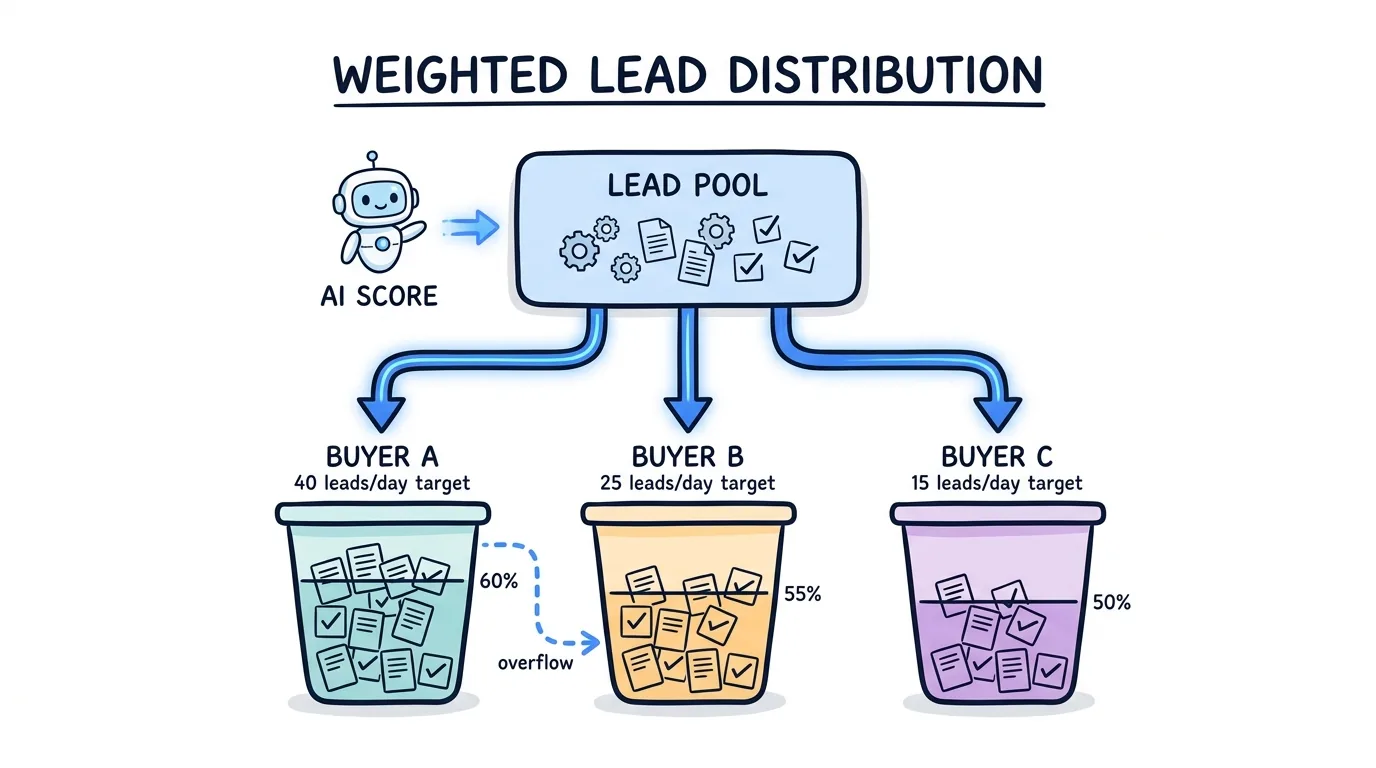
Most agencies running best ping post platforms at scale use all three methods in parallel: bid requests for competitive tier-one inventory, direct post for contracted exclusives, and Priority/Waterfall as a catch-all for leads that do not clear the auction floor. Lead Distro AI supports all four distribution methods, including Round Robin and Weighted routing, on a single platform so agencies can assign each campaign to the right method without maintaining separate systems.
How Lead Distro AI Handles Bid Requests
Lead Distro AI's ping post engine handles bid request orchestration natively. When a seller creates a ping post campaign, the platform registers the eligible buyer list, sets the bid timeout (default 2 seconds, configurable from 500ms to 5 seconds), and stores the floor per geography and vertical. Each inbound lead triggers a broadcast to all registered buyers simultaneously, not sequentially, which keeps auction latency consistent regardless of how many buyers participate.
The platform validates each bid response for format, buyer account status, and daily cap before including it in the sort. Buyers who have hit their daily lead cap are automatically excluded even if they return a valid bid, protecting buyers from overspend and sellers from delivering to buyers who cannot process additional volume. After the auction resolves, the full lead record posts to the winner, and the platform logs the bid amounts, winner, post status, and timestamp for real-time P&L reporting.
Bid-win rate, average bid above floor, and unsold lead rate are visible in the seller dashboard without requiring custom reports. According to the Lead Distro AI platform changelog, version 3.2 (released August 2026) added per-buyer bid analytics so sellers can see which buyers are consistently underbidding their floor and adjust negotiations accordingly.
Agencies interested in exploring the full bid request configuration can view the product tour or start a 7-day free trial; a credit card is required at signup, and the trial can be cancelled at any time within the 7 days without a charge.
FAQ
What is a bid request in ping post lead distribution?
A bid request is a structured data packet sent from a seller's platform to all registered buyers at the same moment a new lead arrives. It contains partial lead information (vertical, geography, lead age, and opt-in confirmation), but withholds PII like name, phone, and email. Each buyer evaluates the request and returns a price or a pass before a timeout expires. The seller's platform selects the highest bid above the floor and delivers the full lead to the winner.
What fields are typically included in a ping post bid request?
Common bid request fields include vertical (auto insurance, legal, mortgage), state or geography, lead age in seconds, traffic source or campaign ID, opt-in language, and a pre-computed quality score. Full contact information (name, phone number, email, and address) is always withheld until the post stage. Sellers configure which fields appear in the ping on a per-campaign basis, often to satisfy data-sharing agreements or TCPA compliance requirements in regulated verticals.
How is a bid floor different from a fixed rate in direct post?
A bid floor is a minimum price threshold in a real-time auction. Any buyer response below the floor is rejected, and the auction continues with the remaining valid bids. A fixed rate in direct post is a pre-negotiated price agreed between seller and buyer before any lead arrives; every qualifying lead delivers at that rate, and there is no competition. Bid floors protect sellers from underselling competitive inventory; fixed rates give both parties revenue predictability and eliminate auction overhead.
How does Lead Distro AI determine the winner when two buyers bid the same amount?
Lead Distro AI resolves tied bids by submission timestamp: the buyer whose response arrives first wins the lead. If the platform cannot differentiate timestamps at millisecond resolution, it applies a configurable tiebreaker, either the buyer with the lower daily fill rate (to balance volume across the buyer pool) or a random selection. Sellers can review tiebreaker settings in the campaign configuration panel. Tied bids at the floor are both rejected unless one arrives within the valid response window.
What happens to a lead that does not receive any bid above the floor?
When no bid clears the floor, Lead Distro AI can route the lead through a configurable fallback sequence. Options include: re-ping to an expanded buyer pool with a temporarily reduced floor, route to a Priority/Waterfall fallback campaign at a fixed rate, hold the lead for a defined requeue window (up to 24 hours), or mark the lead as unsold and notify the seller. The fallback sequence is configured per campaign and does not require code changes. Sellers on the Growth plan at $497 per month can set automated fallback rules; Starter plan sellers at $297 per month manage fallbacks through manual campaign settings.
Conclusion
Bid requests are what make ping post distribution competitive. By broadcasting partial lead data to multiple buyers simultaneously and letting price settle through a real-time auction, sellers consistently earn more per lead than any fixed-rate model can deliver. The mechanics (payload fields, timeout windows, floor-setting logic, and fallback rules) are the levers that separate agencies earning market-rate revenue from those leaving money on the table.
Lead Distro AI handles all of those mechanics natively, with bid request configuration, per-buyer analytics, and real-time P&L reporting built into a single platform. Start your 7-day free trial and run your first bid request auction in under an hour.
Ready to run real-time bid request auctions on your leads? Start your 7-day free trial and configure your first ping post campaign today. A credit card is required; cancel anytime within 7 days.
About the Author
Founder & CEO of Lead Distro AI & Great Marketing AI
UC Berkeley graduate and former software engineer at Microsoft. Rafael built Lead Distro AI after managing over $10M in ad spend for performance marketing agencies (pay-per-lead and pay-per-call), including running campaigns for Neil Patel. He combines deep software engineering expertise with hands-on performance marketing experience to build tools that help these agencies scale profitably.
About Lead Distro AI
Lead Distro AI: Capture, Route, and Sell Every Lead, Call, and Appointment
The modern platform for pay-per-lead and pay-per-call agencies. Route, score, and deliver leads with AI-powered automation and real-time P&L tracking. Built for performance marketing agencies and lead buyers across legal, insurance, mortgage, solar, and home services verticals.
4 Distribution Methods
Waterfall, Round Robin, Weighted, Ping-Post
Ping-Post Auctions
Real-time bidding with sub-second routing
Real-Time P&L Reporting
Track revenue, costs, and profit per campaign
Call Tracking
Assign tracking numbers, record calls, and attribute conversions
Lead Scoring
Score every lead before routing to maximize conversion
Partner Portal
Self-serve dashboard for buyers to track leads