Lead Quality: How Lead Sellers Measure and Improve It
Lead quality explained: what makes a lead worth buying, how agencies score it before distribution, and the platform settings that protect buyer close rates without killing fill volume.

Rafael Hernandez
Founder & CEO
Ex-Microsoft SWE · $10M+ PPL ad spend
I hope you enjoy reading this blog post. If you want to try Lead Distro AI for free, click here.
Author: Rafael Hernandez | Founder & CEO of Lead Distro AI
Last Updated: October 16, 2026
Lead quality is the probability that a lead will convert into a paying customer for the buyer who receives it. A high-quality lead matches the buyer's target profile, arrives in real time from a consented source, and has not already been sold to a competing buyer. For a pay-per-lead or pay-per-call agency, lead quality is not a vague idea: it is a measurable score that determines whether buyers reorder and whether the agency keeps its margins.
The gap between "we need more leads" and "we need better leads" is where most agencies stall. Below, we cover how to define lead quality for your vertical, how to score it before distribution, and the settings in your lead distribution platform that protect buyer close rates without killing fill volume.
Key Takeaways
- Lead quality means conversion probability. A high-quality lead matches the buyer's profile, arrives fresh, and was not already sold. Those three factors determine whether buyers renew.
- Score before you distribute. Rule-based scoring at intake catches bad leads before they reach buyers. Buyers who receive bad leads stop buying; buyers who receive good leads increase their caps.
- Freshness is the biggest single quality lever. Harvard Business Review research on lead response shows that a lead's conversion probability drops sharply in the first five minutes. Real-time delivery is not a nice-to-have: it is a quality requirement.
- Duplicate leads destroy buyer trust quickly. A buyer who receives the same lead twice, or one already contacted by a competitor, will reduce their lead cap or cancel. Track duplicates per buyer and per source.
- Your distribution rules are your quality controls. Lead caps, source filters, duplicate windows, and buyer-level scoring thresholds are what turn raw volume into a defensible quality claim.
- Call quality has different metrics than form-lead quality. For pay-per-call, the markers are call duration, geographic match, caller intent, and whether the caller expected to talk to a buyer in that vertical.
What Makes a Lead High Quality?
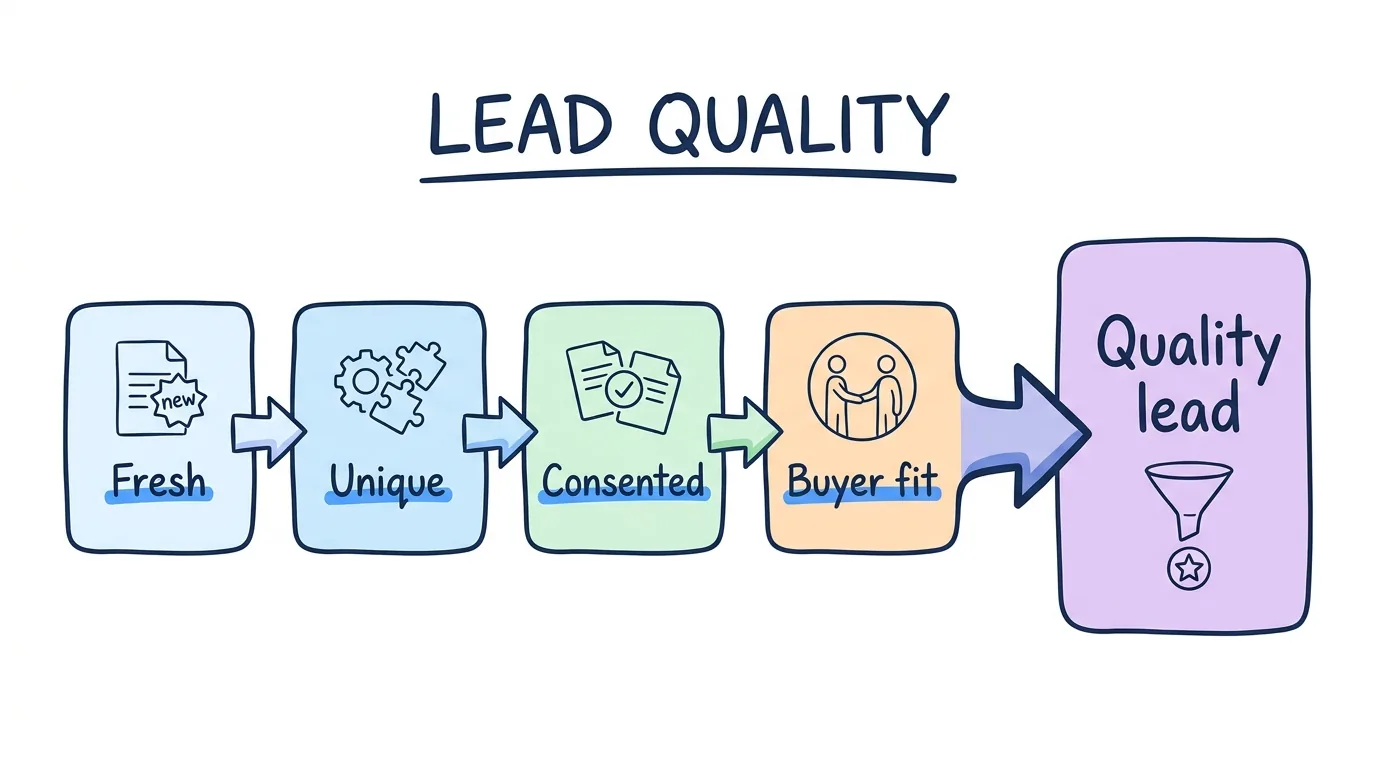
Quality means different things depending on what a buyer is trying to accomplish and what vertical they operate in. Across every pay-per-lead category, three factors appear consistently:
Profile fit. The lead matches the buyer's stated targeting criteria: geography, intent signals, income range, injury type, coverage need, or whatever the vertical tracks. A law firm buying MVA leads from California needs California leads with accident language, not general PI inquiries from Florida. Profile fit is what the buyer's filter rules define, so a lead is only as qualified as the targeting rules the buyer has set.
Freshness. Research from MIT and InsideSales.com (HBR, 2011) showed that a lead contacted within five minutes is 100 times more likely to qualify than one contacted 30 minutes later. For insurance and legal verticals, the drop-off is steeper. Real-time delivery, measured from form submission or call initiation to buyer receipt, is the single biggest quality driver a distribution platform controls.
Exclusivity. A shared lead is a lower-quality lead. A lead sold to five other buyers has a fraction of the close rate of an exclusive one. Your distribution platform needs to track how many times each lead has been sold (a "sold count" per lead), and buyers should know this number when they buy.
For pay-per-call, quality adds a fourth dimension: caller intent. A caller who dialed after seeing a targeted ad and asked a specific question about their situation is higher quality than one who answered a robocall. Call duration is the standard proxy: a call under 60 seconds almost never converts in high-value verticals; calls over 90 seconds convert at multiples of shorter ones.
How to Score Lead Quality Before Distribution
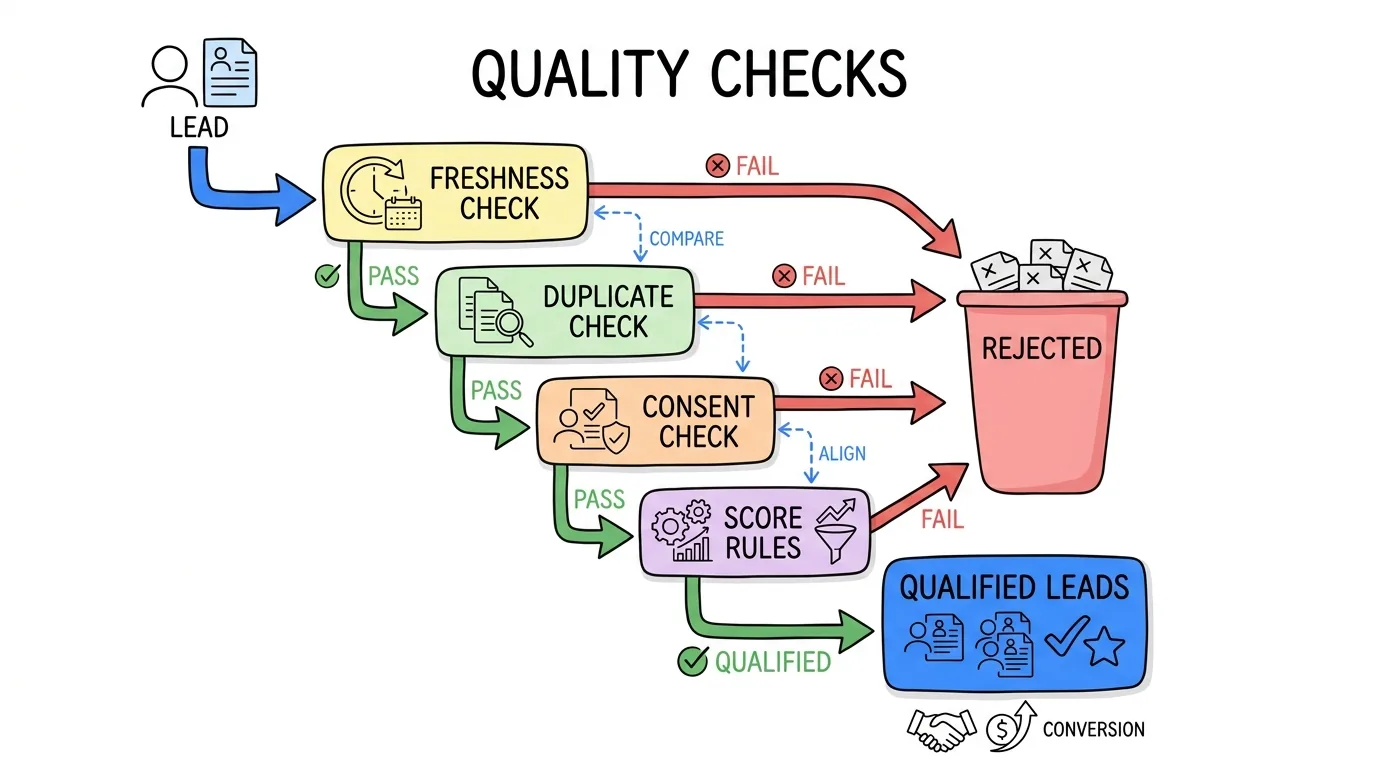
Rule-based lead scoring assigns a numeric score to each incoming lead before routing, based on fields the buyer's filter rules check. The score is a pre-distribution gate, not a post-routing explanation. A standard scoring model for a pay-per-lead vertical looks like this:
| Signal | Points | Logic |
|---|---|---|
| Geography match | +25 | State or zip in buyer's targeting area |
| Intent keyword present | +20 | Relevant term in incident description or form field |
| Form completed in more than 30 seconds | +10 | Fast fills are often bots or misdials |
| No duplicate in past 30 days | +20 | Not already in the system for this buyer |
| Consent timestamp present | +15 | TCPA-required for lead selling |
| Source quality tier | +10 | Premium source vs. network source |
A lead scoring above 80 routes to premium buyers first. A lead scoring below 40 is rejected before distribution. The cutoffs are set per campaign. Buyers should be able to see a lead's score and the reasons behind it, because a score they can explain is one they trust.
Lead Distro AI supports rule-based scoring on every plan. Rules are configured per campaign; buyers see each lead's score in the buyer portal alongside the field values that drove it. For details on how routing and scoring work together, see the product tour.
The Distribution Settings That Control Quality
A lead distribution platform's quality controls are its routing configuration, not its marketing claims. Four settings determine whether buyers experience your leads as high quality:
Lead caps. Per-buyer daily, weekly, and monthly volume limits. Buyers set caps for a reason: they have a fixed sales capacity. Sending more leads than a buyer can work means the extras get ignored, which hurts their close rate and the relationship. Caps keep fill volume at a level buyers can actually convert.
Duplicate windows. A duplicate window defines how long a lead stays "seen" for a given buyer. A 30-day window means any lead matching a prior lead in that buyer's history is flagged as a duplicate and either rejected or flagged for review. The right window length depends on your vertical's sales cycle.
Source-level quality tiers. Not all lead sources perform equally. Track each source's close rates, return rates, and dispute rates separately. Route higher-converting sources to premium buyers and lower-performing sources to buyers who pay less. This matching between source performance and buyer tier is how the best agencies protect both relationships.
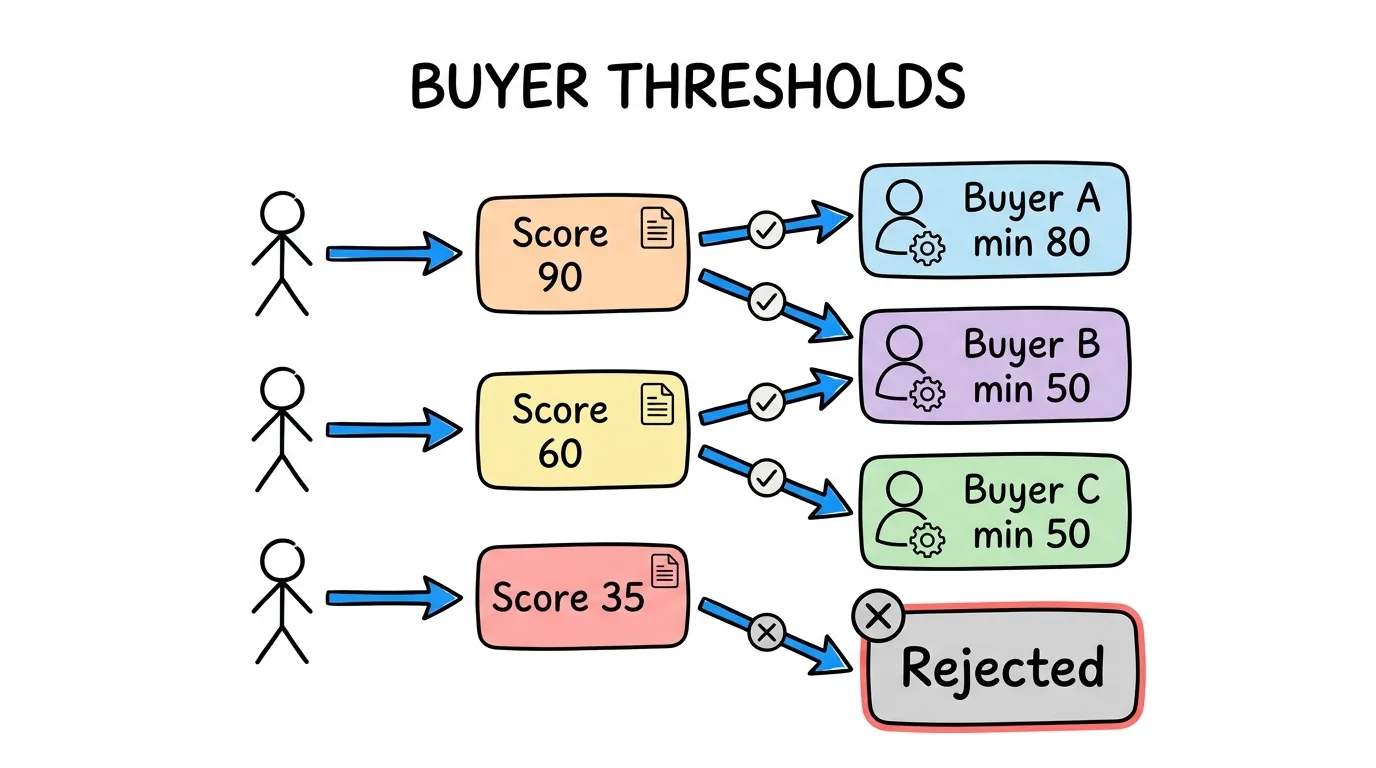
Buyer-level scoring thresholds. (For how rule-based scoring works and which tools offer it, see our guide to lead scoring software.) Let buyers set a minimum lead score threshold below which they will not receive leads. A buyer willing to pay more per lead can set a higher threshold and receive lower volume but better-matched leads. A buyer optimizing for volume sets a lower threshold. Matching buyer tolerance to lead quality is the core of a well-run pay-per-lead operation.
Lead Quality Metrics to Track
If you distribute leads to outside buyers, these are the numbers that tell you whether your quality controls are working:
| Metric | What It Tells You | Red Flag |
|---|---|---|
| Return rate | Percentage of leads buyers dispute or return | Above 10% for any source or vertical |
| Close rate by source | Buyer revenue per lead by source | A source with less than 0.5x the average close rate is leaking margin |
| Duplicate rate | Percentage of leads matched as previously seen | Above 5% indicates a source quality problem |
| Time-to-delivery | Median seconds from submission to buyer receipt | Above 30 seconds degrades freshness materially |
| Buyer renewal rate | Percentage of buyers who renew or increase caps | Below 80% renewal is a quality signal |
| Dispute rate by buyer | Percentage of leads a buyer disputes | A buyer above 15% dispute rate either has misconfigured targeting or is receiving mismatched source traffic |
Track these per source and per buyer. A problem with one buyer but not others points to buyer-side targeting. A problem across multiple buyers from the same source points to source quality.
Lead Quality for Pay-Per-Call: What Is Different
Call lead quality follows the same three-factor model (profile fit, freshness, exclusivity) but adds duration and caller intent as separate quality markers. The metrics that matter:
- Call duration. Under 90 seconds is typically a non-convert for most verticals. Premium buyers in insurance, legal, and home services set minimum duration filters at 90 to 120 seconds before counting a call as billable.
- Geographic match. A caller in a state without a licensed buyer gets routed to a fallback or rejected. Tight geo-targeting matters more for regulated verticals like legal and insurance.
- Caller intent. Was the caller responding to a targeted ad or did they misdial? This is harder to measure from distribution data alone, but it shows in duration and post-call outcome rates.
- Repeat caller. A phone number that called ten times in the past 30 days is not a quality lead. Duplicate detection for calls uses a phone-number-based window, not a form-field match.
Ring-tree routing (available on Growth plans in Lead Distro AI) routes calls to buyers in a real-time priority order, similar to how weighted or priority routing works for form leads, which lets buyers who value longer-duration calls position themselves accordingly.
Improving Lead Quality Over Time
Agencies that defend the highest margins do two things consistently: they give buyers clean data about their lead quality, and they cut underperforming sources before buyers ask them to. The feedback loop is:
- Track return and close rates weekly. Know before your buyers do when a source's quality is declining. A written lead return policy keeps those numbers honest, and TrustedForm certificates prove consent when a buyer disputes a lead.
- Adjust source weights before buyer disputes arrive. Down-weight sources with rising return rates. Up-weight sources with strong close rates. In a weighted routing setup, this is a configuration change per source.
- Share quality data with buyers. Buyers who can see their lead's score, source, and delivery timestamp are buyers who understand your process. Transparency reduces disputes and builds longer contracts.
- Review your scoring rules quarterly. Fraud patterns, traffic sources, and form fields change. A scoring rule calibrated to last year's traffic may not catch this year's low-quality patterns.
If you manage lead distribution for a pay-per-lead or pay-per-call agency, Lead Distro AI provides rule-based scoring, real-time delivery, source-level quality tracking, and buyer-facing transparency on every lead. The 7-day free trial requires a credit card; cancel anytime within seven days without being charged.
FAQ
What is lead quality in lead generation?
Lead quality in lead generation is the likelihood that a specific lead will convert into a paying customer for the buyer who receives it. High-quality leads match the buyer's targeting criteria (geography, intent, vertical), arrive in real time, and have not been previously sold to competing buyers. Lead quality is not a subjective impression: it is a score based on the field values the lead carries and the source it came from.
How do you measure lead quality?
Measure lead quality with four metrics: return rate (the percentage of leads buyers dispute), close rate by source (buyer revenue per lead by originating source), duplicate rate (leads matched as previously seen), and time-to-delivery (seconds from form submission to buyer receipt). Track all four per source and per buyer. A problem across multiple buyers from the same source points to source quality; a problem with one buyer only points to buyer-side targeting.
What is a lead quality score?
A lead quality score is a numeric value assigned to each lead before distribution, based on how well it matches buyer criteria. Scores are computed by a rule-based engine that checks geography, intent signals, consent data, form fill time, source tier, and duplicate history. Buyers use the score to decide whether to accept a lead, and agencies use it to route leads to buyers with matching quality thresholds.
What is a good lead return rate?
A return rate under 5% per source is generally healthy for a pay-per-lead operation. Above 10% for any source indicates a quality problem: either the source traffic does not match buyers' targeting, or the source has a consent or freshness issue. Return rates above 15% typically trigger buyer renegotiations or cancellations. Track return rate per source, not as a blended number, because one bad source can hide otherwise healthy performance.
How does lead distribution software improve lead quality?
Lead distribution software improves lead quality by scoring each incoming lead against buyer rules before routing, tracking duplicate detection windows per buyer, enforcing per-buyer and per-source caps, and delivering leads in real time. It also gives buyers and agencies a shared record of each lead's source, score, delivery timestamp, and field values, so disputes are based on data rather than claims. The controls a platform offers (rule-based scoring, caps, source tiers, duplicate windows) are what make "lead quality" a measurable standard rather than a marketing claim.
What is the difference between lead quality and lead quantity?
Lead quantity is volume: how many leads arrive. Lead quality is conversion probability: how many of those leads will close. Most agencies optimize for quantity early because it is easier to measure, and then hit a wall when buyers' close rates drop and they start disputing or canceling. Agencies that scale sustainably optimize for quality first by scoring at intake, tracking close rates by source, and matching volume to what buyers can actually work. A smaller volume of high-quality leads is almost always more profitable than a large volume of mixed-quality leads. For a broader view of how distribution platforms support this, see our guide on lead distribution software.
Can I improve lead quality without reducing volume?
Yes, with targeted improvements. Tighten duplicate windows for high-value buyers without changing fill volume for mid-tier buyers. Add intent-signal scoring rules that flag low-intent patterns without rejecting anything outright. Route premium sources to premium buyers rather than mixing your best and worst traffic. Volume stays the same; distribution quality improves because your best buyers get your best leads. The only time volume reduction is necessary is when a source has no redeemable leads, in which case cutting it improves overall quality immediately.
Conclusion
Lead quality is the measure that determines whether buyers stay or leave. The three factors (profile fit, freshness, exclusivity) are measurable, and the distribution platform settings that control them (scoring rules, caps, duplicate windows, source tiers) are what agencies use to defend their margins. Building a formal lead quality process, where every lead has a score and every source has a tracked close rate, is the difference between a pay-per-lead business that grows and one that churns through buyers.
Lead Distro AI supports rule-based lead scoring, real-time routing, and per-source quality tracking on every lead distribution plan. The Starter plan is $297 per month; the Growth plan at $497 per month adds ping-post, ring trees, and white-label options for agencies that need them. Start with a 7-day free trial (credit card required; cancel anytime within seven days).
Managing lead quality for a pay-per-lead or pay-per-call agency? Start your 7-day free trial of Lead Distro AI and set up rule-based lead scoring in minutes. Credit card required; cancel anytime within seven days.
About the Author
Founder & CEO of Lead Distro AI & Great Marketing AI
UC Berkeley graduate and former software engineer at Microsoft. Rafael built Lead Distro AI after managing over $10M in ad spend for performance marketing agencies (pay-per-lead and pay-per-call), including running campaigns for Neil Patel. He combines deep software engineering expertise with hands-on performance marketing experience to build tools that help these agencies scale profitably.
About Lead Distro AI
Lead Distro AI: Capture, Route, and Sell Every Lead, Call, and Appointment
The modern platform for pay-per-lead and pay-per-call agencies. Route, score, and deliver leads with AI-powered automation and real-time P&L tracking. Built for performance marketing agencies and lead buyers across legal, insurance, mortgage, solar, and home services verticals.
4 Distribution Methods
Waterfall, Round Robin, Weighted, Ping-Post
Ping-Post Auctions
Real-time bidding with sub-second routing
Real-Time P&L Reporting
Track revenue, costs, and profit per campaign
Call Tracking
Assign tracking numbers, record calls, and attribute conversions
Lead Scoring
Score every lead before routing to maximize conversion
Partner Portal
Self-serve dashboard for buyers to track leads