Round Robin Lead Distribution: How It Works and When to Use It
Round robin lead distribution assigns leads equally across buyers or reps in rotation. Here is how it works, when to use it, and how it compares to weighted and waterfall routing.

Rafael Hernandez
Founder & CEO
Ex-Microsoft SWE · $10M+ PPL ad spend
I hope you enjoy reading this blog post. If you want to try Lead Distro AI for free, click here.
Author: Rafael Hernandez | Founder & CEO of Lead Distro AI
Round robin lead distribution assigns each incoming lead to the next buyer or rep in a rotating sequence: lead 1 goes to Buyer A, lead 2 goes to Buyer B, lead 3 goes to Buyer C, then the cycle restarts. Every buyer receives an equal share of total lead volume over time, regardless of their bid price or individual performance.
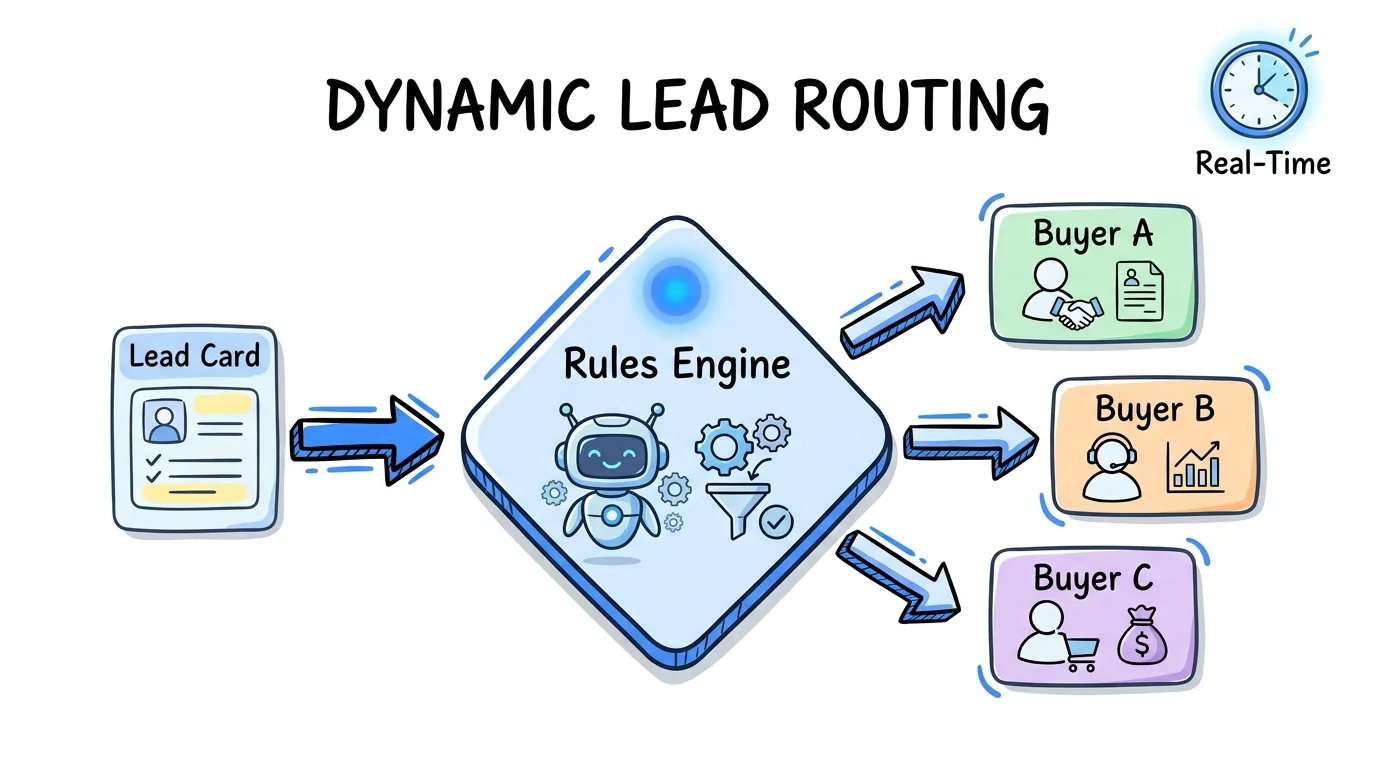
It is the simplest distribution method available and the right choice for specific scenarios: equal-cap buyer pools, new buyer relationships before performance data exists, or compliance requirements that prohibit performance-based routing. Outside those scenarios, weighted or ping post distribution will almost always produce higher revenue per lead.
This guide covers how round robin works mechanically, when it is the right choice, when it is not, and how to configure it alongside smarter routing methods in Lead Distro AI.
Key Takeaways
- Round robin distributes leads equally across all active buyers in a pool, one per turn. No bid pricing, no performance weighting.
- Best use cases: equal-cap contracts, new buyer pools with no performance history, internal rep teams where fairness matters more than conversion optimization.
- Limitation: round robin ignores buyer quality. A buyer converting 40% of leads gets the same volume as one converting 5%, until you intervene manually.
- Hybrid approach: most agencies use round robin for intake fairness, then switch to weighted or ping post once 30 to 60 days of data exists.
- Lead Distro AI supports round robin, weighted, waterfall, and ping post distribution — switchable per buyer pool without rebuilding the campaign.
How Round Robin Lead Distribution Works
In a round robin pool, the distribution system maintains a position pointer that advances by one after each successful lead delivery.
Example with 4 buyers:
| Lead # | Assigned To | Notes |
|---|---|---|
| 1 | Buyer A | Pointer advances to B |
| 2 | Buyer B | Pointer advances to C |
| 3 | Buyer C | Pointer advances to D |
| 4 | Buyer D | Pointer wraps to A |
| 5 | Buyer A | Cycle restarts |
If a buyer rejects a lead (over cap, wrong geography, duplicate), most platforms skip that buyer for that turn and advance the pointer to the next active buyer. This is called rejection-aware round robin. Without it, a buyer who rejects most leads still "uses up" their slot, and other buyers lose volume unnecessarily.
Lead Distro AI uses rejection-aware round robin by default. Buyers who hit their daily cap are automatically skipped until their cap resets.
Round Robin vs Other Distribution Methods
| Method | How It Decides | Best For | Weakness |
|---|---|---|---|
| Round robin | Equal turn rotation | Equal-cap pools, new buyers, internal teams | Ignores buyer quality |
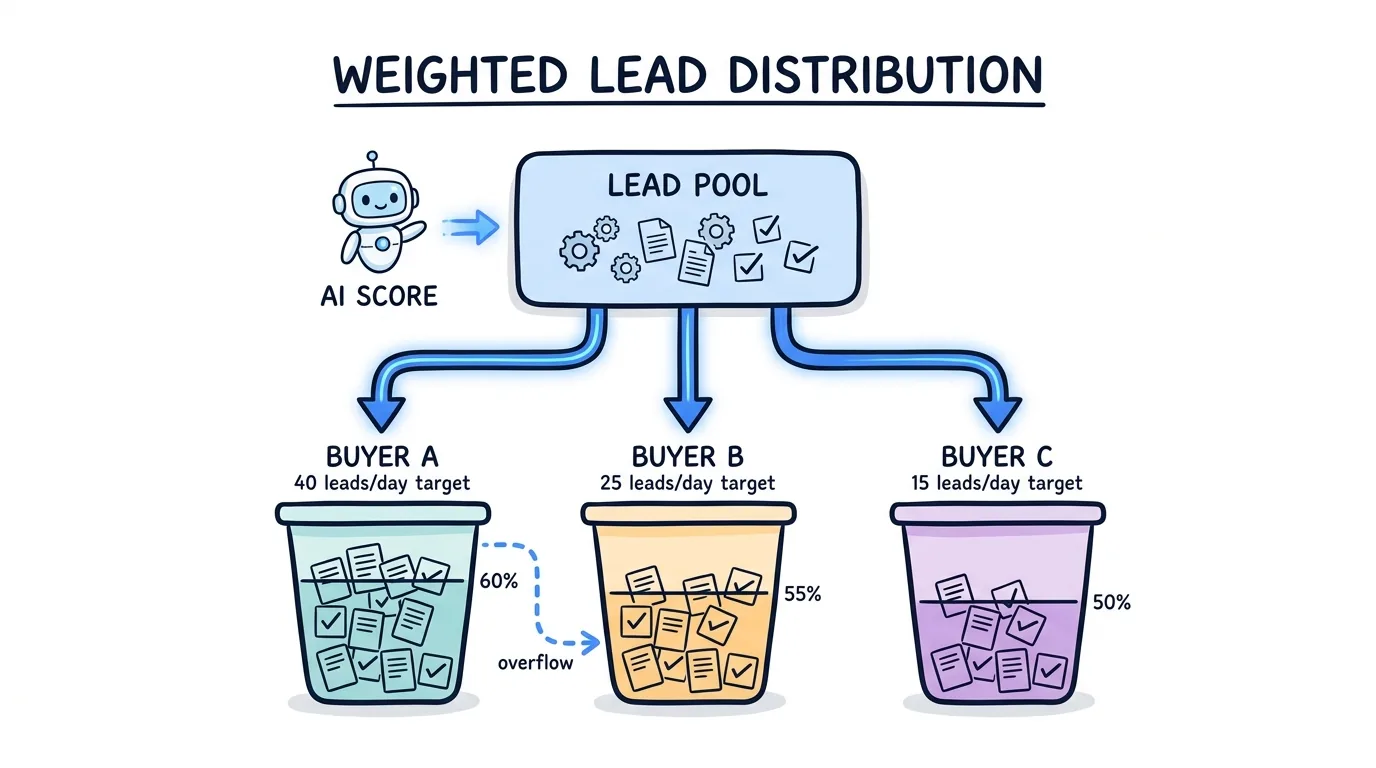
| Weighted distribution | Allocation percentage per buyer | Buyers with different cap sizes or priority tiers | Requires manual weight-setting upfront |
| Waterfall (priority) | Ranked list — try #1 first, fall to #2 on rejection | Single preferred buyer with overflow | Primary buyer gets all volume; fallbacks get leftovers |
| Ping post auction | Real-time bidding — highest accepted bid wins | Maximizing revenue per lead | Requires multiple active bidders |
For a deeper comparison of all four methods, see automated lead routing rules for agencies. For guidance on choosing among them, see what is lead routing.
When to Use Round Robin
Equal-cap contracts. If every buyer in a pool has the same daily or monthly cap, round robin is the cleanest option. No weighting needed; the equal-turn logic enforces equal volume automatically.
New buyer relationships. Before you have 30 to 60 days of acceptance rate and conversion data, you do not know which buyers perform best. Round robin gives every new buyer a fair sample of your leads so you can compare them with real data.
Internal sales rep teams. Many agencies route leads to their own sales team before selling to external buyers. Round robin prevents rep favoritism: the highest-paid rep does not automatically get the freshest leads.
Compliance requirements. Some buyer contracts require equal distribution as a condition of the relationship, especially in regulated verticals where buyers cannot legally pay different prices for the same lead type.
Testing new lead sources. When you add a new traffic source and want to understand how its leads perform across your buyer pool without biasing any one buyer.
When NOT to Use Round Robin
When buyer quality differs significantly. A buyer converting 35% of leads and one converting 8% both receiving equal volume means you are wasting roughly 73% of your lower-performing buyer's allotment. Switch to weighted distribution once you have performance data.
When revenue per lead is a priority. Round robin will never surface the highest-bidding buyer for each lead. Ping post auctions generate 15% to 30% more revenue per lead by letting buyers compete.
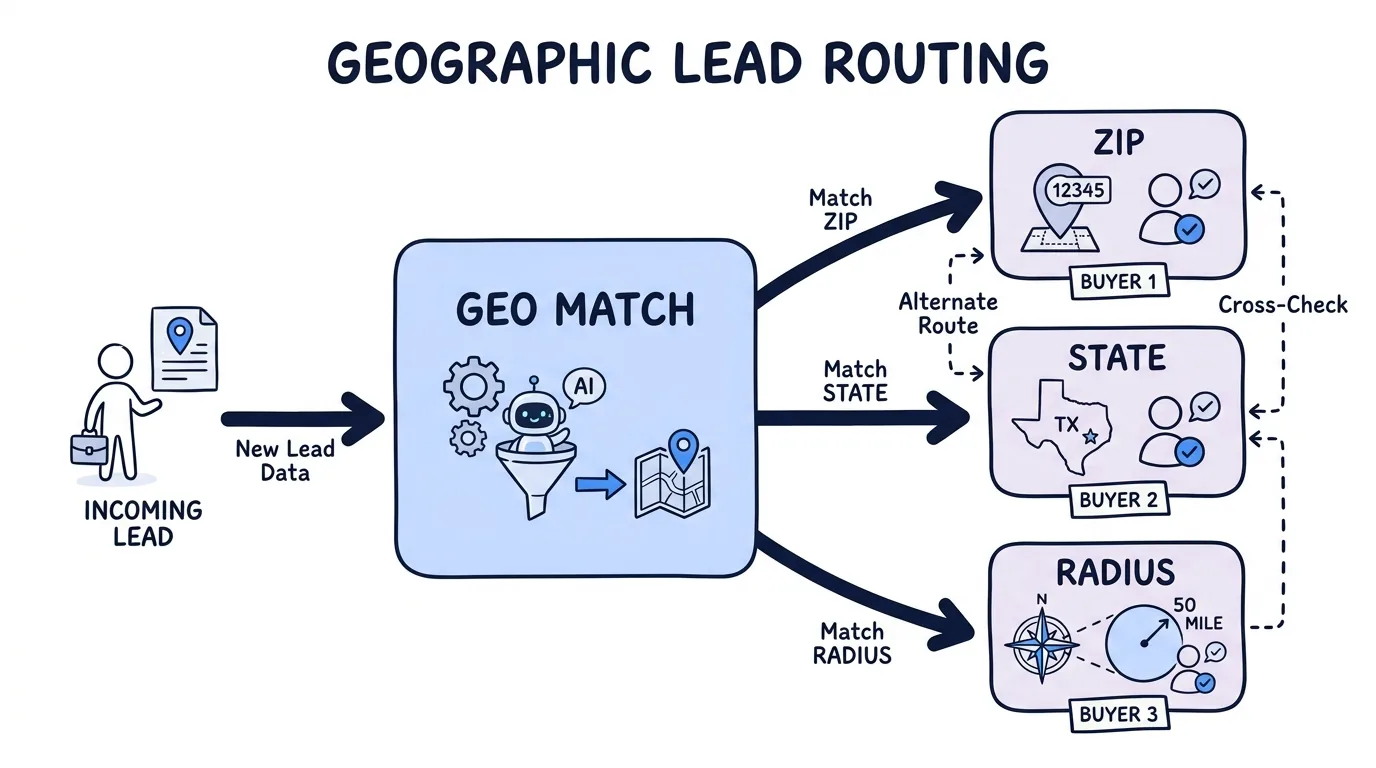
When geographic coverage varies. If Buyer A covers 20 states and Buyer B covers 3, round robin will generate constant rejections from Buyer B on out-of-territory leads. Use waterfall or weighted distribution with geography filters instead.
When one buyer has a dominant cap. If Buyer A wants 500 leads/day and Buyer B wants 50, round robin is wrong. Each would get 50% of volume, but Buyer A would fill in hours and go inactive. Use weighted distribution with proportional allocations.
Round Robin with Cap Management
The practical version of round robin in production adds three refinements:
Daily and monthly caps per buyer. Once a buyer hits their cap, they drop out of the rotation until the cap resets (midnight or the 1st of the month, depending on the contract).
Acceptance rate monitoring. Most platforms track the rolling 7-day acceptance rate per buyer. If a buyer's rate drops below a threshold (for example, below 60%), the system can flag them for review or temporarily pause their slot.
Fallback rules. When all buyers in the round robin pool reject a lead or are over cap, a fallback rule fires: park the lead for later, route to a secondary pool, or trigger an alert.
Lead Distro AI handles all three automatically. Buyer caps, fallback routing, and acceptance monitoring are configured in the buyer settings panel.
Setting Up Round Robin in Lead Distro AI
- Navigate to Distribution and create a new buyer pool.
- Select Round Robin as the distribution method.
- Add buyers to the pool with their accepted geographies, verticals, and daily caps.
- Set a fallback rule for leads that all buyers in the pool reject.
- Enable rejection-aware rotation (on by default) so capped buyers are skipped.
- Run a test lead end-to-end before activating.
Once the pool has 30 days of data, the best lead routing software dashboard surfaces acceptance rates and conversion signals per buyer. At that point, consider switching to weighted distribution with allocations based on actual performance.
For a walkthrough of every distribution method including round robin, take the product tour or start a 7-day free trial. Credit card required.
FAQ
Does round robin guarantee equal lead volume to every buyer?
Over time, yes. On any given day, rounding effects or cap differences can create small imbalances. Rejection-aware round robin reduces imbalance by skipping capped buyers, but perfect equality is only achievable when all buyers have identical caps and acceptance rates.
What happens when a buyer rejects a lead in round robin?
In rejection-aware round robin (the standard behavior in Lead Distro AI), the pointer advances past the rejecting buyer and the lead is offered to the next buyer in rotation. The rejecting buyer does not lose their next turn. On the next new lead, rotation resumes from wherever the pointer is.
Can I combine round robin with bid pricing?
No. Round robin does not use pricing to decide allocation. If revenue per lead matters, use ping post. If you want price-weighted allocation without an auction, use weighted distribution with a higher percentage allocation to your highest-paying buyer.
How often should I review a round robin buyer pool?
Every 30 days minimum. Review acceptance rate, contact rate, and any buyer feedback on lead quality. Buyers with consistently low acceptance rates (below 50% after 30 days) are either receiving off-target leads or have a performance problem worth investigating before they consume more rotation slots.
What is the difference between round robin and weighted distribution?
Round robin gives each buyer one turn per cycle, producing equal lead counts. Weighted distribution gives each buyer a percentage allocation, producing proportional lead counts. If Buyer A has a 70% weight and Buyer B has a 30% weight, Buyer A gets 70% of leads and Buyer B gets 30%. Use weighted distribution when buyers have different caps, different performance tiers, or different contract values.
Conclusion
Round robin lead distribution is the right starting point for new buyer pools, equal-cap contracts, and any situation where fairness or simplicity matters more than revenue optimization. Once 30 to 60 days of performance data exists, most agencies migrate to weighted or ping post distribution to capture the revenue upside that round robin leaves behind.
Lead Distro AI supports all four distribution methods and lets you switch between them without rebuilding your campaign. Start with round robin, collect data, and let performance drive your routing decisions.
About the Author
Founder & CEO of Lead Distro AI & Great Marketing AI
UC Berkeley graduate and former software engineer at Microsoft. Rafael built Lead Distro AI after managing over $10M in ad spend for performance marketing agencies (pay-per-lead and pay-per-call), including running campaigns for Neil Patel. He combines deep software engineering expertise with hands-on performance marketing experience to build tools that help these agencies scale profitably.
About Lead Distro AI
Lead Distro AI: Capture, Route, and Sell Every Lead, Call, and Appointment
The modern platform for pay-per-lead and pay-per-call agencies. Route, score, and deliver leads with AI-powered automation and real-time P&L tracking. Built for performance marketing agencies and lead buyers across legal, insurance, mortgage, solar, and home services verticals.
4 Distribution Methods
Waterfall, Round Robin, Weighted, Ping-Post
Ping-Post Auctions
Real-time bidding with sub-second routing
Real-Time P&L Reporting
Track revenue, costs, and profit per campaign
Call Tracking
Assign tracking numbers, record calls, and attribute conversions
Lead Scoring
Score every lead before routing to maximize conversion
Partner Portal
Self-serve dashboard for buyers to track leads