Prime vs Subprime Leads: What the Difference Costs You
Prime leads convert at 3-5x the rate of subprime leads. Learn how lead quality tiers work, how agencies price each tier, and how to filter and route by quality.

Rafael Hernandez
Founder & CEO
Ex-Microsoft SWE · $10M+ PPL ad spend
I hope you enjoy reading this blog post. If you want to try Lead Distro AI for free, click here.
Author: Rafael Hernandez | Founder & CEO of Lead Distro AI
Last Updated: May 26, 2026
Prime leads are high-intent prospects who meet every buyer's acceptance criteria: the right geography, the right timeframe, a verified contact, and a genuine need. Subprime leads are everyone else, prospects who may have filled out a form but fail on one or more dimensions that predict conversion. The gap between these two quality tiers determines whether a pay-per-lead agency turns a profit or bleeds margin on every campaign.
According to a 2024 study by the Performance Marketing Association, prime leads in high-value verticals like personal injury law, insurance, and solar convert at 3 to 5 times the rate of subprime leads, yet agencies consistently overpay for subprime traffic when they lack the filtering infrastructure to tell the difference at intake. The result is a hidden tax on every campaign: inflated cost per acquisition, frustrated buyers, and churn.
In short: Prime leads make you more per lead. Subprime leads cost you more per closed deal. The difference comes down to how you define, score, and route by quality tier before the lead ever reaches a buyer.
Key Takeaways
Prime leadsconvert 3-5x better than subprime leads in verticals like legal, insurance, and solar, justifying a 2-5x price premium per lead.- Lead quality is not binary. Most agencies use three to five tiers (A, B, C or Prime, Standard, Subprime) to segment inventory and price accordingly.
- The defining attributes of a prime lead are: verified contact information, stated intent within a qualifying timeframe, geographic match to buyer coverage, and no recent duplicate in the buyer's CRM.
- Subprime leads still have value when routed to the right buyer at the right price; the mistake is routing them at prime prices or to buyers with no tolerance for lower conversion rates.
Lead gradingand rule-based scoring automate quality classification at intake, eliminating the manual review bottleneck that slows down high-volume agencies.- Lead Distro AI's scoring engine applies configurable quality criteria at the moment of submission, so prime leads go to premium buyers instantly and subprime leads are either re-priced, re-routed, or rejected.
What Makes a Lead "Prime"
A prime lead satisfies every criterion a buyer has defined for a high-probability prospect. The exact criteria differ by vertical, but the underlying framework is consistent across insurance, legal, solar, and mortgage.
Intent signal: The prospect stated a specific need within a qualifying timeframe. In personal injury, that means an accident within the past 30 days. In solar, it means they own the property and want a quote within 90 days. A vague "just looking" response drops a lead out of prime classification.
Contact verification: The phone number connects on the first dial, the email format is valid, and the address falls within the buyer's service area. Leads with disconnected numbers, role-based email addresses (like info@ or admin@), or P.O. box addresses are structurally subprime regardless of stated intent.
Exclusivity window: A lead sold within 30 minutes of submission holds far more value than one that has aged 24 hours. Speed-to-contact rates drop sharply after the first 5 minutes according to a 2023 analysis by InsideSales (now XANT). Prime classification typically requires a freshness threshold: leads older than a defined window, often 4 to 24 hours depending on vertical, automatically tier down.
Duplicate status: A lead that already exists in a buyer's CRM is worth zero to that buyer. Deduplication against buyer-specific records is a prerequisite for prime classification, not an optional feature.
What Makes a Lead "Subprime"
Subprime is not a single failure state. It is a spectrum of deficiencies, each with a different impact on close rate and a different market price. Understanding exactly where a lead falls on that spectrum is what allows agencies to monetize subprime inventory rather than discard it.
Partial intent: The prospect expressed general interest but did not meet the timeframe, ownership, or qualification threshold. A homeowner who "might consider solar in a couple years" has real intent but fails the 90-day window criterion for most solar buyers.
Contact friction: The primary phone number does not connect, but a secondary number is available. The email bounces but a form-provided phone is valid. These leads require more effort per contact attempt, which buyers price into their acceptance rate.
Geographic edge cases: A prospect in a ZIP code that is 80% within a buyer's territory but crosses a county line is a borderline case. Buyers with strict geo fencing reject these outright; buyers with flexible coverage accept them at a discount.
Aged inventory: Any lead older than the buyer's freshness threshold, whether because it was rejected by the first buyer in the waterfall, was held in a pending queue, or came from a batch upload, carries a staleness discount, because contact rates drop the longer a lead waits.
Prior contact: A prospect who has already spoken with a competing buyer, received a quote, or explicitly declined follow-up is subprime by consent signal. Ping-post systems catch this through buyer feedback loops, but direct-post flows often miss it entirely.
Lead Quality Tiers: How Agencies Structure Pricing
Most high-volume agencies operate three to five quality tiers rather than a binary prime vs reject model. The tiered model lets agencies maximize revenue across the full quality distribution rather than discarding leads that have real, if discounted, value.
| Tier | Label | Criteria Met | Typical Price vs Prime | Best Distribution Method |
|---|---|---|---|---|
| 1 | Prime / A | All criteria: intent, contact, geo, freshness, no duplicate | Baseline (100%) | Priority or Weighted to top buyers |
| 2 | Standard / B | 4 of 5 criteria; minor contact or freshness issue | 50-70% of prime | Round Robin among mid-tier buyers |
| 3 | Subprime / C | 2-3 criteria; aged or partial intent | 20-40% of prime | Waterfall to high-volume, price-sensitive buyers |
| 4 | Return / D | Failed post-delivery on contact or qualification | Refund or credit | Re-route to recovery buyer pool |
The specific percentages vary by vertical and buyer competition. In personal injury law, where a signed case can be worth $5,000 to $50,000 to a firm, prime leads in major metro markets trade at $200 to $600 each. Subprime leads in the same markets trade at $30 to $80. Knowing which tier each lead belongs to before routing is the difference between a 40% margin campaign and a breakeven one.
Prime vs Subprime Leads: Side-by-Side Comparison
| Attribute | Prime Lead | Subprime Lead |
|---|---|---|
| Intent signal | Specific, within qualifying timeframe | Vague or outside timeframe |
| Contact verification | Phone connects, email valid, geo match | One or more contact fields fails |
| Freshness | Under 4-24 hours (vertical-dependent) | Aged, often 24+ hours |
| Duplicate status | No match in buyer CRM | Existing record found |
| Close rate | 15-40% depending on vertical | 3-12% depending on vertical |
| Typical price (legal) | $200-$600 | $30-$80 |
| Typical price (insurance) | $40-$120 | $8-$25 |
| Typical price (solar) | $50-$150 | $10-$35 |
| Best routing method | Priority / Weighted to premium buyers | Waterfall / high-volume buyers |
| Buyer tolerance | Low; expects near-prime close rates | High; built refund/return buffer into margin |
How Lead Scoring Automates Quality Classification
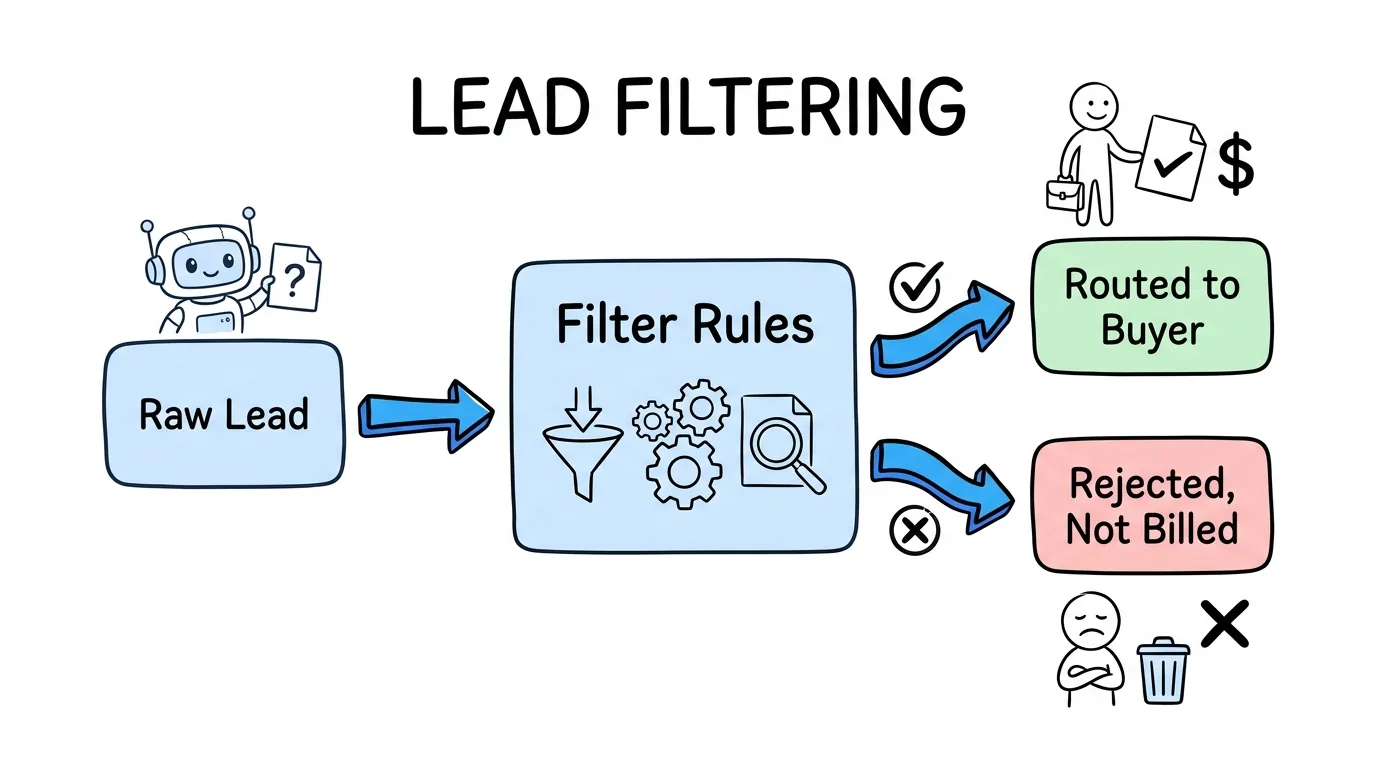
Manual lead grading does not scale. An agency processing 500 leads per day cannot afford a human reviewer assigning quality scores to each submission. Rule-based lead scoring automates the classification in real time, applying the same configured criteria consistently at the moment of intake rather than hours later when the lead has already aged.
Lead Distro AI's scoring engine evaluates each incoming lead against a configurable set of quality criteria before routing decisions are made. Buyers set their own acceptance thresholds: a personal injury firm might require a score of 80 or above; a high-volume insurance aggregator might accept anything above 50 at adjusted pricing. The platform routes automatically based on these thresholds, eliminating manual triage.
The scoring model pulls from several signal categories. Contact validation checks phone format and carrier lookup. Intent parsing scores the form responses against vertical-specific timeframe and ownership criteria. Geo matching compares the submitted ZIP code against each buyer's coverage polygon. Freshness timestamping penalizes leads based on elapsed time since submission. Duplicate detection runs a hash match against buyer-specific suppression lists.
The output is a numeric score, a tier classification, and a routing decision, all produced before a buyer ever sees the lead. Explore the full feature set through the interactive product tour to see how the scoring interface works in practice.
Prime Lead Pricing by Vertical
Understanding the price differential across verticals helps agencies set realistic buyer pricing and manage seller expectations. The figures below are derived from 2024 and 2025 market data published by LeadsCon, the Performance Marketing Association, and vertical-specific industry reports.
Personal Injury Law
Personal injury firms pay a premium for prime leads because the contingency fee model means a single signed case can return 30 to 150 times the cost of acquisition. Prime auto accident leads in competitive markets like Los Angeles, Miami, and New York trade at $300 to $600. Subprime leads, those with older accidents, incomplete contact info, or geographic edge cases, trade at $40 to $100.
The lead distribution model for personal injury law firms is built around this pricing gap: buyers accept a higher cost per prime lead because their cost per signed case is still far below the case value.
Insurance
Insurance carriers and independent agencies operate on tighter margins. Prime health, auto, and home insurance leads with stated enrollment intent within 30 days trade at $40 to $120 depending on the line of business and state. Subprime leads in the same verticals trade at $8 to $25. The lower absolute prices reflect shorter sales cycles and lower average policy values compared to legal.
Solar
Solar leads carry wide price variance based on system size, homeownership confirmation, and roof suitability. Prime solar leads with confirmed ownership, qualifying roof, and a 90-day purchase intent trade at $50 to $150 in most U.S. markets. Subprime leads, typically renters, non-qualifying roofs, or intent beyond 12 months, trade at $10 to $35.
The solar lead distribution guide covers how buyer caps and coverage maps interact with quality tier routing.
MVA and Workers Comp
Motor vehicle accident leads and workers compensation leads command the highest prime prices per vertical because of extended litigation timelines and large settlement potential. Prime MVA leads in Texas and Florida trade at $200 to $500. Subprime MVA leads, those with older accidents or prior attorney contact, trade at $25 to $75.
How to Route Subprime Leads Profitably
The most common mistake agencies make with subprime inventory is treating it as waste. Subprime leads are not worthless; they are mismatched to the wrong buyer at the wrong price. Profitable routing of subprime leads requires three things: a willing buyer segment, transparent pricing, and a return policy that protects the buyer without bleeding the supplier.
Build a secondary buyer pool. Some buyers have the staff and follow-up cadence to work lower-close-rate leads profitably. High-volume insurance aggregators, direct mail marketers, and call centers with aggressive contact sequences often outperform boutique buyers on subprime inventory precisely because their cost per contact is lower.
Price transparently. Buyers who know they are receiving subprime leads at subprime prices and have calibrated their acceptance rates accordingly rarely churn. Buyers who receive subprime leads at prime prices and discover the quality mismatch post-campaign always churn. The lead distribution waterfall model explains how multi-tier routing keeps pricing transparent across buyer segments.
Build in a return window. A 72-hour return or credit window for leads that fail contact within three attempts protects buyers and incentivizes suppliers to invest in quality. Lead Distro AI supports configurable return policies per buyer, per tier, so the rule is enforced automatically rather than negotiated on each bad batch.
Use ping-post for real-time quality signaling. Ping-post lets buyers bid on leads before accepting them, which means the market sets the price for each quality tier in real time. A subprime lead that gets one ping response at $25 is priced correctly. A prime lead that gets three ping responses at $400, $350, and $280 goes to the highest bidder at full value. For a deeper look at how this works, read our guide on what is a ping post system and how does it work.
Cannibalization Risk: Prime vs Subprime vs Exclusive vs Shared
A common point of confusion in agency pricing strategy is the relationship between quality tiers (prime/subprime) and ownership models (exclusive/shared). These are separate dimensions that interact but do not overlap.
An exclusive prime lead is sold to one buyer only and meets all quality criteria: the highest-value inventory class. An exclusive subprime lead is sold to one buyer only but fails on one or more quality dimensions: valuable for the right buyer, problematic if priced at prime rates.
A shared prime lead is sold to multiple buyers simultaneously and meets all quality criteria: common in insurance and mortgage where multiple carriers compete for the same prospect. A shared subprime lead is sold to multiple buyers at discounted rates: the lowest value class, often used for list-building and retargeting campaigns.
The exclusive vs shared leads guide covers the ownership dimension in depth. This post focuses on the quality dimension, which is a prerequisite to pricing either ownership model correctly.
FAQ
What is the difference between prime leads and subprime leads?
Prime leads meet every buyer-defined quality criterion: verified contact information, stated intent within a qualifying timeframe, geographic match, freshness within the buyer's window, and no duplicate in the buyer's CRM. Subprime leads fail one or more of these criteria and convert at a lower rate. In practice, subprime leads are not worthless; they require a different buyer segment, a lower price, and a more aggressive contact cadence to generate a positive ROI.
How much more do prime leads cost compared to subprime leads?
The price premium for prime leads ranges from 3x to 10x the subprime price depending on vertical. In personal injury law, prime leads trade at $200 to $600 while subprime leads trade at $30 to $80. In insurance, prime leads trade at $40 to $120 while subprime leads trade at $8 to $25. The premium reflects the close rate differential, which typically runs 3 to 5 times higher for prime inventory in high-value verticals.
How do lead agencies classify leads as prime or subprime?
Lead classification happens through a combination of intake form scoring, contact validation, geo matching, freshness timestamping, and duplicate detection. Manual classification does not scale beyond a few hundred leads per day. High-volume agencies use rule-based lead scoring platforms that evaluate every lead against configurable criteria at the moment of submission and assign a numeric score and tier classification before routing decisions are made.
Can subprime leads be profitable?
Yes, when routed to the right buyer at the right price. High-volume buyers, call centers, and direct mail marketers with low cost-per-contact economics often generate positive ROI on subprime inventory that boutique buyers reject. The key is transparent pricing, a secondary buyer pool calibrated to lower close rates, and a return policy that limits buyer exposure on non-contactable leads. Treating subprime leads as waste rather than re-routing them at appropriate prices is one of the most common margin leaks in pay-per-lead operations.
What vertical has the biggest price gap between prime and subprime leads?
Personal injury law has the largest absolute price gap: prime leads can trade at $600 and subprime at $40, a 15x differential. The gap is driven by the contingency fee model, where a single signed case can be worth $5,000 to $50,000 to a firm, making the cost of a missed conversion from a subprime lead extraordinarily high. Solar and insurance have narrower gaps in absolute dollar terms but similar percentage differentials.
How does Lead Distro AI handle lead quality tiers?
Lead Distro AI applies a configurable scoring model at intake that evaluates each lead against contact validation, intent signals, geo matching, freshness, and duplicate detection criteria. Buyers set acceptance score thresholds that determine which leads they receive. The platform routes automatically: prime leads go to buyers with high thresholds via Priority or Weighted distribution; subprime leads cascade down the waterfall to buyers with lower thresholds and price-adjusted acceptance rates. Buyers can also set automatic return windows for leads that fail contact within a defined number of attempts.
Conclusion
The prime vs subprime distinction is not just a pricing label; it is the operational foundation of a profitable pay-per-lead agency. Agencies that classify leads at intake, route by quality tier, and price each tier to a buyer segment calibrated for that close rate generate consistent margin. Agencies that treat all leads as equivalent, or that route subprime inventory at prime prices, burn buyer relationships and compress margins until the economics no longer work.
Lead Distro AI's rule-based scoring engine classifies every prime lead and every subprime submission at the moment of intake, before routing decisions are made. Start your 7-day free trial and route your first leads by quality tier in minutes.
For a deeper look at how quality-based routing interacts with your overall distribution strategy, read our guide on what is lead distribution software or use the lead pricing calculator to model the margin impact of tiered pricing across your current volume.
Ready to classify every lead by quality tier automatically? Start your 7-day free trial and configure your first scoring rules in the Lead Distro AI dashboard. Credit card required.
About the Author
Founder & CEO of Lead Distro AI & Great Marketing AI
UC Berkeley graduate and former software engineer at Microsoft. Rafael built Lead Distro AI after managing over $10M in ad spend for performance marketing agencies (pay-per-lead and pay-per-call), including running campaigns for Neil Patel. He combines deep software engineering expertise with hands-on performance marketing experience to build tools that help these agencies scale profitably.
About Lead Distro AI
Lead Distro AI: AI-Powered Routing for Your Leads, Calls, and Appointments
The modern platform for pay-per-lead and pay-per-call agencies. Route, score, and deliver leads with AI-powered automation and real-time P&L tracking. Built for performance marketing agencies and lead buyers across legal, insurance, mortgage, solar, and home services verticals.
4 Distribution Methods
Waterfall, Round Robin, Weighted, Ping-Post
Ping-Post Auctions
Real-time bidding with sub-second routing
Real-Time P&L Reporting
Track revenue, costs, and profit per campaign
Call Tracking
Assign tracking numbers, record calls, and attribute conversions
Lead Scoring
Score every lead before routing to maximize conversion
Partner Portal
Self-serve dashboard for buyers to track leads