How to Manage Lead Vendors: A Framework for Buyers
Managing multiple lead vendors without a system leads to overspending, duplicates, and poor ROI. Here is the vendor management framework that lead buyers actually use.

Rafael Hernandez
Founder & CEO
Ex-Microsoft SWE · $10M+ PPL ad spend

I hope you enjoy reading this blog post. If you want to try Lead Distro AI for free, click here.
Author: Rafael Hernandez | Founder & CEO of Lead Distro AI
Most lead buyers fail at vendor management before they ever get to conversion rate problems. They sign with a vendor based on a sales pitch, set up delivery, and then review performance only when their close rate drops and they go looking for an explanation. By that point they have spent weeks or months of budget with no benchmarks to evaluate, no cap structure to limit the damage, and no return policy language to recover losses. The fix is a vendor management framework built on five steps: score vendors on real KPIs before and after signing, set performance benchmarks and contractual protections upfront, cap spend per vendor so no single source controls your pipeline, run a structured monthly review, and replace spreadsheets with a platform that handles enforcement automatically.
According to Aberdeen Group research, top-performing sales organizations are twice as likely to have a defined lead management process compared to average performers. Vendor management is the upstream half of that process: if your vendor mix is wrong, no amount of downstream sales coaching fixes the ROI. The five-step framework below gives lead buyers the structure to hold vendors accountable, catch quality drops before they become budget crises, and cut losing vendors without guesswork.
Key Takeaways
- A vendor scorecard with five KPIs (fill rate, duplicate rate, contact rate, conversion rate, cost per acquisition) turns subjective vendor "feelings" into measurable data that drives decisions.
- Negotiate performance benchmarks and return policy terms before signing, not after you discover a quality problem. Most vendors will agree to minimums if asked upfront.
- Uncapped vendors will expand to your full budget unless you set daily, weekly, or monthly volume limits. Caps protect you from quality spikes that drain spend before you can react.
- Monthly vendor reviews using a three-strikes framework prevent the slow bleed: one warning, one performance improvement period, one cut. No guessing, no endless second chances.
- Platforms outperform spreadsheets for vendor management because they enforce caps automatically, log rejection reasons, and surface per-vendor P&L without manual data assembly.
- Lead Distro AI manages acceptance criteria, caps, and reporting per vendor in one platform, replacing the spreadsheet and email workflow most buyers currently use.
Step 1: Build a Vendor Scorecard
A vendor scorecard is a standardized set of KPIs tracked for every lead source. Without one, vendor comparisons are anecdotal. With one, you can rank every vendor from best to worst and make budget decisions from data instead of relationships.
Track these five KPIs for every vendor from day one:
| KPI | Definition | Healthy Benchmark |
|---|---|---|
| Fill Rate | Percentage of your requested volume the vendor actually delivers | 80%+ of agreed volume |
| Duplicate Rate | Percentage of leads already in your system | Under 5% |
| Contact Rate | Percentage of leads where you reached the person | 40-60% exclusive, 20-35% shared |
| Conversion Rate | Percentage of leads that became paying customers | Varies by vertical and lead type |
| Cost Per Acquisition | Total spend with vendor divided by closed deals | Below your vertical's target CPA |
The scorecard is your early warning system. Fill rate drops often precede quality drops: when a vendor starts underdelivering volume, it usually means they are having trouble sourcing leads that meet your lead acceptance criteria and are substituting lower-quality inventory. Duplicate rate spikes indicate the vendor is recycling leads or sharing your pool with too many buyers. Contact rate declines mean the vendor is pushing older or lower-intent leads.
Build the scorecard in a spreadsheet or directly in your distribution platform's reporting view. Update it weekly during the first 60 days with a new vendor and monthly after that.
Step 2: Set Performance Benchmarks Before You Sign
The most common vendor management mistake is negotiating price and volume without negotiating performance minimums and return policy terms. Those terms are much harder to add after you have already started buying. Before signing any vendor agreement, get these four protections in writing.
Minimum contact rate guarantee. Ask for a stated minimum: "If our 30-day rolling contact rate for leads from this vendor falls below 30%, we have the right to reduce volume by 50% and renegotiate pricing." Most reputable vendors will agree to this because they are confident in their quality.
Return policy clause with specific qualifying conditions. The standard is 10% to 20% return credit on leads that are invalid (disconnected phone, fake email), outside your stated geography, delivered outside your stated age threshold, or delivered in excess of your exclusivity agreement. Get the specific conditions documented so there is no ambiguity when you file returns. See our complete guide to buying leads for negotiation tactics on return policy terms.
TCPA indemnification. Your vendor should indemnify you for TCPA violations arising from consent documentation failures on their side. If the lead's consent record shows a different advertiser or a different product category than what you sell, the liability should be the vendor's, not yours. Get this in writing before you start buying.
Delivery format and timing specification. Specify exactly how leads should be delivered (webhook, API endpoint, required fields), at what maximum age (for real-time, specify sub-five-minute delivery), and what happens to leads that cannot be delivered within that window. A vendor who defaults to daily CSV exports instead of real-time API delivery will cost you conversion rate, not just convenience.
Step 3: Use Caps to Control Spend Per Vendor
A daily cap is a hard limit on how many leads or how much money you will accept from a single vendor in a given period. Without caps, a vendor whose quality drops can spend your entire monthly budget in a week of high-volume delivery before your weekly review catches it.
Set caps at three levels for each vendor: daily, weekly, and monthly. The daily cap is your circuit breaker. The weekly cap is your quality review gate. The monthly cap aligns with your budget planning.
For a new vendor in a 30-day test period, set your cap at 20% to 30% of your maximum desired monthly volume. If the vendor passes the scorecard benchmarks after 30 days, raise the cap. This prevents a new, unproven vendor from consuming your full lead budget before you know if their quality holds.
Daily caps also protect you from vendor-side technical problems. If a vendor misconfigures their integration and floods your endpoint with a duplicate payload, a daily cap stops the damage at a known maximum instead of letting it run until someone notices.
Lead Distro AI enforces daily, weekly, and monthly volume caps per supplier automatically, with delivery pausing as soon as the threshold is reached. There are no manual interventions required: the cap fires, delivery stops, and the rejection is logged with a cap-exceeded reason code.
Step 4: Run a Monthly Vendor Review
A monthly vendor review is a structured 45-minute session where you evaluate every active vendor against your scorecard benchmarks and make a keep, warn, or cut decision. Without a fixed review cadence, underperforming vendors survive on inertia.
The review covers three data sets: duplicate rate trend (is it rising, stable, or falling?), conversion rate by source (which vendors produce customers, not just contacts?), and cost per acquisition by vendor (which vendors are profitable?).
Use a three-strikes framework to make cut decisions consistent and predictable:
- Strike one: Vendor misses a benchmark in the monthly review. Send a written notice identifying the specific KPI and the minimum you expect in the next 30 days.
- Strike two: Vendor misses the same benchmark in the following month. Reduce their daily cap by 50% and send a 30-day performance improvement notice with a specific target.
- Strike three: Vendor misses the benchmark a third consecutive month. Terminate the relationship and redistribute their budget to vendors who have earned it.
The three-strikes framework removes the relationship pressure from vendor decisions. You are not cutting a vendor because you do not like them; you are cutting them because they failed a documented standard three times. That clarity makes the conversation easier and prevents the slow bleed of keeping marginal vendors because the relationship feels awkward to end.
For the duplicate lead detection portion of your review, pay attention to duplicate rate trends rather than point-in-time snapshots. A vendor with a 3% duplicate rate one month and 8% the next is getting worse. A vendor with a 7% rate that is declining toward 4% is improving. Trend direction matters as much as the absolute number.
Step 5: Use a Platform Instead of Spreadsheets
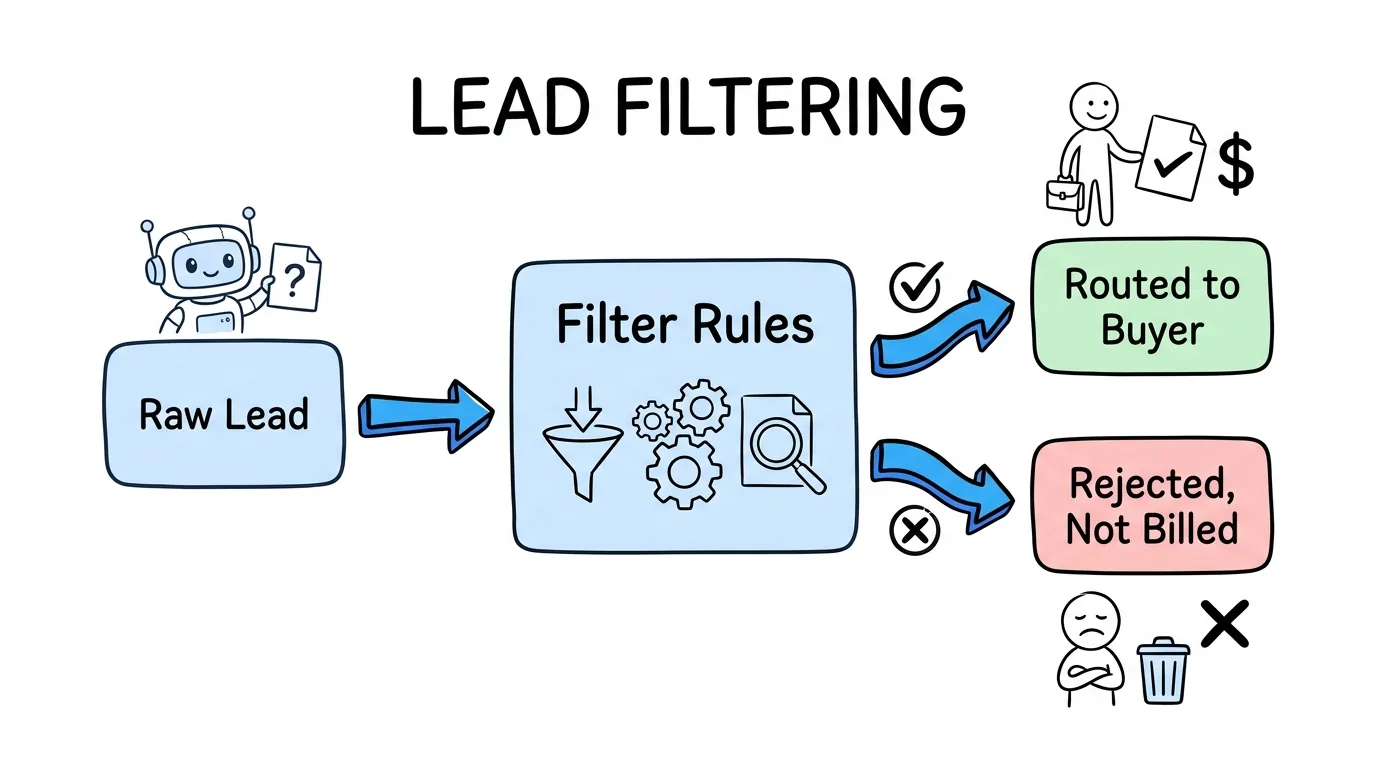
Spreadsheet-based vendor management breaks at the point where it matters most: real-time enforcement. A spreadsheet cannot pause a vendor who exceeds their daily cap. It cannot reject a lead from a state outside your allowlist at the moment of delivery. It cannot surface per-vendor P&L without manual data assembly from multiple sources.
The workflow most buyers use today: receive leads via email or CSV, manually log them in a spreadsheet, check duplicates manually or not at all, route leads to sales reps via Slack or email, and reconcile returns with vendor invoices at month end. This workflow costs time and conversion rate. Every manual step is a delay. Every delay costs contact rate.
Lead Distro AI replaces the spreadsheet workflow with automated enforcement and real-time reporting. The platform accepts leads from any vendor via API, applies your acceptance criteria and duplicate detection at ingestion, enforces per-vendor caps without manual monitoring, routes each lead to the right buyer in under one second, and surfaces per-vendor fill rate, duplicate rate, contact rate, conversion rate, and cost per acquisition in a single dashboard.
The vendor management use case in Lead Distro AI works as follows: each lead source is configured as a supplier with its own acceptance rules, daily cap, and cost mode (fixed CPL or revenue share). When a supplier delivers a lead, the platform runs every check in sequence, routes the accepted lead to the appropriate buyer, and logs the outcome. The rejection log shows exactly which criterion failed for each rejected lead, giving you the data for your monthly vendor review without any manual aggregation. The product tour shows how supplier configuration, cap management, and reporting connect in one workflow.
Plans start at $297/month. Start your 7-day free trial. Credit card required.
FAQ
How do I evaluate a lead vendor?
Evaluate a lead vendor on five KPIs over a 30-day test period: fill rate (do they deliver the volume they agreed to?), duplicate rate (are they sending leads already in your system?), contact rate (what percentage of leads answer?), conversion rate (what percentage of leads become customers?), and cost per acquisition (what do you pay per closed deal?). Before the test, negotiate a return policy in writing for invalid or out-of-area leads. Any vendor who refuses a 30-day trial batch or refuses to document return terms should be skipped.
What should a lead vendor agreement include?
A lead vendor agreement should include: the lead type and vertical (specific case type, product category, or loan type), the geographic coverage (states or ZIP codes), the maximum lead age at delivery, the exclusivity terms (exclusive vs. shared and the maximum number of buyers per lead), the return policy conditions and credit percentage (typically 10-20% of the invoice), a minimum contact rate guarantee with a remedy clause, TCPA indemnification for consent documentation failures on the vendor's side, and delivery format requirements (API endpoint, required fields, maximum delivery latency).
How many lead vendors should I use?
Run two to three vendors simultaneously, not one and not ten. A single vendor leaves you exposed to quality swings with no fallback when their performance drops. Ten vendors is unmanageable: your scorecard data fragments across too many sources to produce meaningful comparisons, and your volume per vendor drops so low that none of them prioritize your account. Two to three vendors gives you competitive redundancy, enough volume to measure each vendor statistically, and enough concentration that your account matters to each vendor.
What is a good fill rate from a lead vendor?
A healthy fill rate is 80% or higher of your agreed or requested volume. A vendor delivering 60% of your requested daily volume is either capacity-constrained or prioritizing buyers who pay more. A fill rate below 70% sustained over 30 days is a strike-one event under the three-strikes framework. Note that fill rate and quality rate are separate: a vendor can hit 95% fill rate while delivering 20% duplicates. Track both.
When should I cut a lead vendor?
Cut a vendor after three consecutive monthly reviews where they miss a documented performance benchmark. The specific benchmarks should be in your vendor agreement or, at minimum, written in a performance notice before the first strike. Common cut triggers: duplicate rate consistently above 8%, contact rate below 20% for exclusive leads, cost per acquisition 40% or more above your vertical's target, or a TCPA compliance failure that creates legal exposure. Do not cut a vendor after a single bad month if their prior performance was strong; a temporary quality dip can be a sourcing problem, not a structural one. Three consecutive misses indicate a structural problem.
Conclusion
Vendor management is the discipline that separates lead buyers who grow their ROI quarter over quarter from those who cycle through vendors hoping the next one is better. The framework is not complicated: build a scorecard, negotiate benchmarks before signing, cap every vendor's spend, review monthly, and cut vendors who fail three strikes. Do that consistently, and your vendor mix improves automatically over time because underperformers cycle out and budget concentrates in sources that earn it.
The operational version of this framework runs much more cleanly on a platform than in a spreadsheet. Caps that enforce themselves, rejection logs that surface automatically, and per-vendor P&L that does not require manual assembly give you the data to run your monthly reviews in 45 minutes instead of three hours.
For a closer look at how vendor scoring, acceptance criteria, and cap management work together at the buyer level, see our guide to lead acceptance criteria. For the full buyer playbook from vendor selection to routing setup, see our complete guide to buying leads.
Start your 7-day free trial of Lead Distro AI and centralize your vendor management in one platform. Credit card required.
Lead Distro AI gives you per-vendor fill rate, duplicate rate, and P&L reporting in one dashboard, with automatic cap enforcement and rejection logging. No spreadsheets. Start your 7-day free trial and manage your first vendor in minutes. Want to see the supplier configuration before signing up? Take the interactive product tour.
About the Author
Founder & CEO of Lead Distro AI & Great Marketing AI
UC Berkeley graduate and former software engineer at Microsoft. Rafael built Lead Distro AI after managing over $10M in ad spend for performance marketing agencies (pay-per-lead and pay-per-call), including running campaigns for Neil Patel. He combines deep software engineering expertise with hands-on performance marketing experience to build tools that help these agencies scale profitably.
About Lead Distro AI
Lead Distro AI: Capture, Route, and Sell Every Lead, Call, and Appointment
The modern platform for pay-per-lead and pay-per-call agencies. Route, score, and deliver leads with AI-powered automation and real-time P&L tracking. Built for performance marketing agencies and lead buyers across legal, insurance, mortgage, solar, and home services verticals.
4 Distribution Methods
Waterfall, Round Robin, Weighted, Ping-Post
Ping-Post Auctions
Real-time bidding with sub-second routing
Real-Time P&L Reporting
Track revenue, costs, and profit per campaign
Call Tracking
Assign tracking numbers, record calls, and attribute conversions
Lead Scoring
Score every lead before routing to maximize conversion
Partner Portal
Self-serve dashboard for buyers to track leads