Lead Acceptance Criteria: How to Filter the Right Leads for Your Business
Lead acceptance criteria are the filters that determine which leads you accept and pay for. Learn how to set geography, vertical, intent, age, and quality thresholds that actually protect your budget.

Rafael Hernandez
Founder & CEO
Ex-Microsoft SWE · $10M+ PPL ad spend

I hope you enjoy reading this blog post. If you want to try Lead Distro AI for free, click here.
Author: Rafael Hernandez | Founder & CEO of Lead Distro AI
Lead acceptance criteria are the rules that determine which leads you accept and pay for before they enter your distribution system. Without them, you pay for every lead a vendor sends regardless of geography, freshness, validity, or relevance to your business. According to a 2023 DemandGen Report survey, only 27% of leads passed to sales teams are actually qualified, which means the average lead buyer is funding a 73% rejection pile with no automated enforcement to stop it. Buyers who set explicit acceptance criteria at the platform level reject bad leads automatically, pay only for what meets their standards, and recover margin they were previously losing to junk volume.
The mistake most buyers make is treating acceptance criteria as a negotiation afterthought. They sign a vendor agreement, start buying, and only discover their criteria problems when contact rates disappoint and returns become a battle. The right approach is to define your acceptance filters before you sign anything, get them documented in the vendor agreement, and enforce them automatically at the point of lead delivery. This guide covers the six core filters every lead buyer should set, how to balance precision against volume, and how to make enforcement automatic so you never pay for a lead that fails your standards.
Key Takeaways
- Lead acceptance criteria are filters applied at the moment of delivery that determine whether a lead qualifies for payment. They are not the same as return policies, which are retroactive.
- The six core filters are geography, lead age, exclusivity, contact info validity, vertical or intent match, and duplicate status. Every buyer should configure all six.
- Lead age is the most neglected filter. Leads older than five minutes for real-time campaigns or 24 hours for batch campaigns should be auto-rejected, not returned after the fact.
- Starting tight and loosening one filter at a time is the safest way to calibrate without destroying volume from a good vendor.
- Platform-enforced criteria beat contract language because automatic rejection happens before payment, while chargebacks happen after a dispute.
- Lead Distro AI enforces acceptance criteria per buyer in real time, rejecting non-qualifying leads at ingestion and logging the rejection reason for transparency.
What Are Lead Acceptance Criteria?
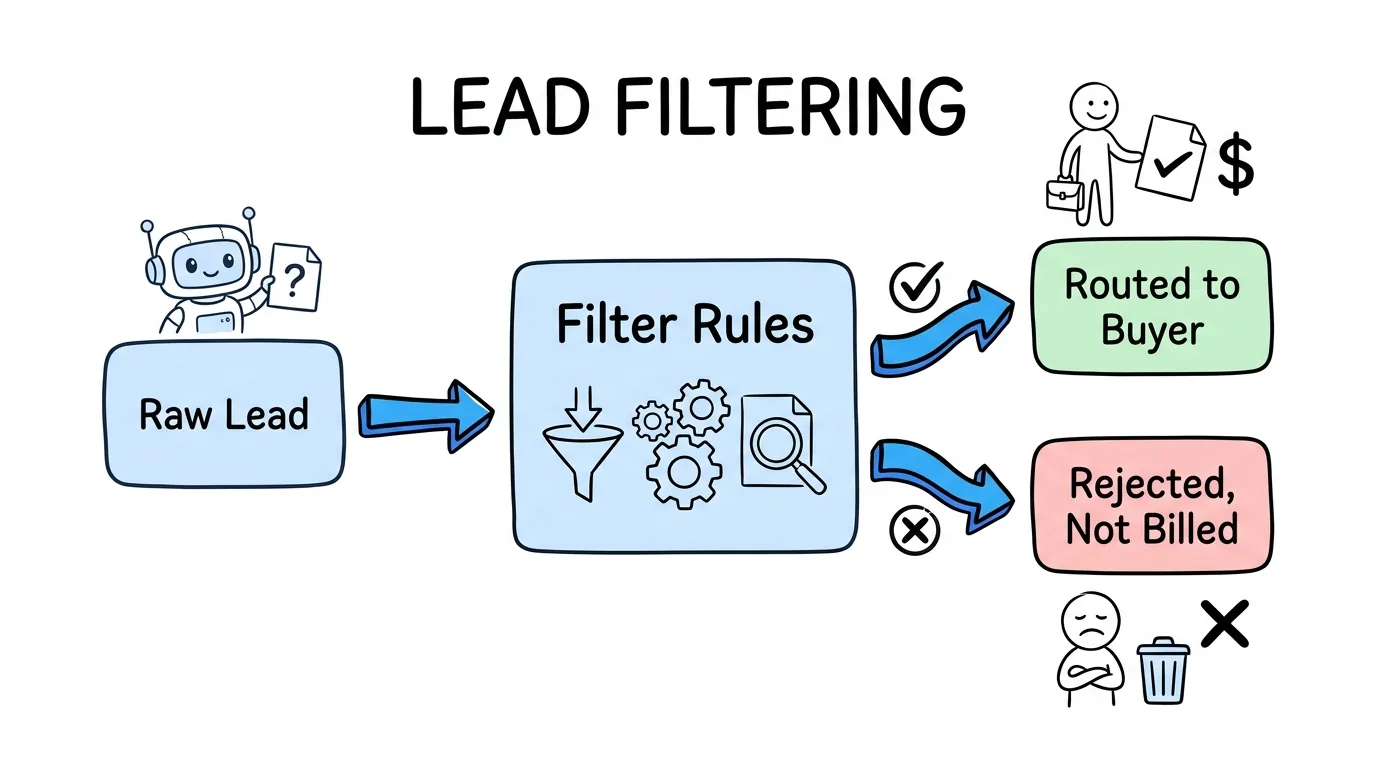
Lead acceptance criteria are the formal rules a buyer establishes to determine which leads they will accept and pay for from a vendor. They cover data fields, timing constraints, geographic scope, and quality signals. A lead that fails any criterion is rejected at the point of delivery and, depending on the vendor agreement, either returned for credit or simply not charged.
The distinction between acceptance criteria and return policies matters: acceptance criteria are proactive filters applied at delivery, while return policies are retroactive remedies applied after a bad lead slips through. The strongest buyer positions combine both: criteria that block most bad leads automatically, plus a return policy that catches edge cases.
From a contract standpoint, your vendor agreement should document your acceptance criteria as the conditions under which you are obligated to pay. If a vendor delivers a lead outside your specified geography or older than your stated age threshold, that lead is a delivery failure, not a lead that you return. Making this explicit protects you from vendors who argue that anything delivered is billable.
The 6 Core Acceptance Filters
Every lead buyer regardless of vertical should configure these six filters. The table below shows what each filter screens out and a recommended starting configuration.
| Filter | What It Screens Out | Recommended Starting Setting |
|---|---|---|
| Geography | Leads from states, ZIPs, or regions you cannot serve | State allowlist or radius from primary service area |
| Lead Age | Stale leads that have already been contacted by competitors | 0-5 minutes for real-time; max 24 hours for batch |
| Exclusivity | Shared leads when your agreement requires exclusive | Verify exclusivity flag or source-count field |
| Contact Info Validity | Disconnected phones, invalid emails, placeholder names | Valid phone format, valid email domain, name not "test" or blank |
| Vertical / Intent Match | Wrong product interest for your business | Requires correct case type, loan type, or product category |
| Duplicate Status | Leads your system has already received and paid for | Cross-check by phone and email against 90-day history |
Geography
Set a geographic allowlist before your first purchase. For most buyers this means a state-level allowlist: only accept leads from states where you are licensed to operate or where your buyers can serve. ZIP-level filtering is available in most platforms and makes sense for buyers with narrow service territories. Radius filters work well for home services buyers with a geographic service area.
Vendors often deliver "near-miss" leads from adjacent states if you do not specify your geographic limits explicitly. A personal injury law firm licensed in California should reject Nevada leads automatically rather than relying on a rep to catch the mismatch and request a credit.
Lead Age
Lead age is the acceptance filter most buyers skip, and it is one of the most expensive omissions. According to InsideSales.com, the odds of contacting a lead drop by 10 times after the first five minutes. A lead that arrives 45 minutes after form submission has already been called by competing buyers and is worth a fraction of a fresh lead.
For real-time campaigns, set a maximum lead age of five minutes. For batch purchasing, set a maximum age of 24 hours. Any lead delivered outside those windows should be auto-rejected. Document the age threshold in your vendor agreement so the rejection is not disputed.
Exclusivity
If your agreement specifies exclusive leads, your acceptance criteria should verify the exclusivity flag in the delivery payload. Some platforms pass a share_count or exclusive field; others require you to enforce it contractually. If a vendor cannot confirm exclusivity at the data level, treat those leads as shared and price accordingly.
Contact Info Validity
A lead with a disconnected phone number or a "test@test.com" email address is worth nothing. Basic contact validity checks include: phone number passes format validation and is not on a known disconnected-number list, email address has a valid domain, and name fields are not blanks, placeholder strings, or obvious test entries. Most lead distribution platforms can run these checks at ingestion before the lead touches your buyer.
Vertical and Intent Match
If you buy MVA leads, you should reject leads where the case type is workers' comp. If you buy home purchase mortgage leads, you should reject refinance submissions. Set required field values for the intent or product category your business converts, and auto-reject anything that does not match.
This filter is especially important for agencies that serve one vertical and buy from multi-vertical vendors. A vendor selling across legal, insurance, and mortgage may send you leads from campaigns that were not targeted to your specific case type unless you specify the match requirement explicitly.
Duplicate Status
Duplicate lead detection should be part of your acceptance criteria, not just your quality review process. Configure your system to reject any lead whose phone number or email address matches a lead already in your database from the past 30 to 90 days. Duplicates cost you a full lead price for a contact you have already paid for and already attempted to reach.
How to Set Your Criteria Without Over-Filtering
Tight criteria protect your budget but can reduce volume so aggressively that you struggle to hit your lead targets. Loose criteria protect volume but let quality problems through. The balance point is different for every buyer and every vendor.
The practical approach is to start with conservative criteria on the three filters that have the clearest reject logic: geography, lead age, and duplicate status. These filters screen out leads that are objectively undeliverable or already paid for. Run with those three enforced for 30 days.
Then evaluate your rejection rate. If your vendor is sending more than 15% of leads outside your geography or age window, the problem is the vendor, not your criteria. If rejections are under 5%, your criteria are calibrated correctly.
Only loosen criteria after measuring the impact. If you expand your geographic allowlist, add a state and track whether contact rate and close rate hold. If they do not, pull it back. Never loosen multiple filters at once: you cannot diagnose which change caused a quality shift if you change several variables simultaneously.
One practical rule: treat any filter that rejects more than 20% of leads as a signal to review the vendor, not a signal to loosen the filter. Your acceptance criteria should be catching vendor delivery problems, not compensating for them.
How Lead Distro AI Enforces Acceptance Criteria
Lead Distro AI enforces acceptance criteria per buyer at the moment a lead is ingested, before routing and before any payment obligation is logged. Each buyer account has its own acceptance configuration: geographic allowlists at state and ZIP level, maximum lead age, required field values, contact validity checks, and duplicate matching against a configurable lookback window.
When a lead fails a criterion, the platform automatically rejects it, logs the rejection with a specific reason code (geography-miss, too-old, duplicate, invalid-contact, intent-mismatch), and does not count the lead against the buyer's daily cap or billing. The rejection log is visible to both the operator and, optionally, to the vendor through the supplier portal, which eliminates the need for manual chargeback conversations.
The charge-back logic mirrors your acceptance criteria: leads that passed criteria at delivery but later fail on a quality basis (wrong case type discovered after contact, TCPA consent issue uncovered by the buyer) are handled through the returns flow, which is separate from automatic rejection. See the product tour for a walkthrough of how buyer acceptance rules and returns interact.
For agencies managing multiple buyers with different acceptance criteria, each buyer maintains its own independent configuration. A PI law firm buying MVA leads gets different geographic and intent filters than a workers' comp firm buying on the same campaign. Platform-level enforcement means you do not need a human to audit each delivery batch.
Start your 7-day free trial and configure your first buyer's acceptance criteria in the setup wizard. Credit card required.
FAQ
What are lead acceptance criteria?
Lead acceptance criteria are rules configured in your lead distribution system that determine whether an incoming lead qualifies for delivery and payment. They operate at the data level: geography filters, age limits, required field values, contact validity checks, and duplicate detection. A lead that fails any criterion is rejected automatically, before it enters your sales pipeline or triggers a payment. Acceptance criteria differ from return policies: criteria are proactive and instant; return policies are retroactive and require a dispute process.
How do I set lead acceptance criteria?
Start by defining four requirements before you buy a single lead: the geographic area you can serve (states or ZIPs), the maximum age you will accept (five minutes for real-time, 24 hours for batch), the product or case type required, and the contact info standards (valid phone, valid email, real name). Configure these in your lead distribution platform's buyer settings. Document the same terms in your vendor agreement so rejection is treated as a delivery failure, not a return request.
What happens to a lead that fails acceptance criteria?
A lead that fails acceptance criteria is rejected at the point of delivery and is not charged to the buyer. The rejection is logged with a reason code so both the buyer and vendor can see which criterion was missed. In Lead Distro AI, rejected leads appear in the rejection log with a timestamp and specific failure reason, and they do not count against the buyer's daily cap or billing total. Vendors with high rejection rates against a specific criterion should be reviewed, since systematic failures usually indicate a sourcing or delivery problem on their side.
Can acceptance criteria be updated after signing with a vendor?
Yes, acceptance criteria can be updated at any time at the platform level. However, contractual updates require mutual agreement with the vendor. If you tighten criteria mid-agreement (for example, adding a ZIP-level geographic restriction not in the original agreement), the vendor may dispute rejections for leads that met the original terms. Best practice is to document any criteria changes with the vendor in writing before they take effect. Most vendors will agree to reasonable updates, especially if they are accompanied by evidence that current delivery is causing quality problems.
What is a lead return policy?
A lead return policy is the retroactive remedy for leads that passed acceptance criteria at delivery but later turned out to be invalid. Common return conditions include: the phone number was disconnected, the lead was already sold to another buyer in violation of an exclusivity agreement, the case type was misrepresented, or the lead failed TCPA consent documentation review. Standard return policies provide 10% to 20% credit on qualifying returns, applied to future invoices or deducted from outstanding balances. Return policies should be negotiated and documented before your first purchase. They complement acceptance criteria but do not replace them: criteria catch most bad leads automatically; returns catch the edge cases that slip through.
Conclusion
Lead acceptance criteria are the boundary between a well-run lead buying operation and one that hemorrhages budget on unserviceable volume. Setting them before you sign with a vendor, documenting them in your agreement, and enforcing them automatically at the platform level is the difference between paying only for what converts and funding a vendor's quality problems indefinitely.
Start with the six core filters: geography, lead age, exclusivity, contact validity, vertical match, and duplicate status. Run tight, measure your rejection rate, and only loosen after you understand the impact. For a deeper look at how vendor evaluation, pricing, and negotiation work alongside your acceptance criteria, see our complete guide to buying leads.
For the lead distribution platform that enforces acceptance criteria per buyer in real time, with automatic rejection logging and chargeback documentation built in, start your 7-day free trial of Lead Distro AI. Credit card required.
Lead Distro AI enforces acceptance criteria automatically at the moment of ingestion, before routing and before billing. Start your 7-day free trial and configure your first buyer's acceptance filters in minutes. Want to see it before signing up? Take the interactive product tour.
About the Author
Founder & CEO of Lead Distro AI & Great Marketing AI
UC Berkeley graduate and former software engineer at Microsoft. Rafael built Lead Distro AI after managing over $10M in ad spend for performance marketing agencies (pay-per-lead and pay-per-call), including running campaigns for Neil Patel. He combines deep software engineering expertise with hands-on performance marketing experience to build tools that help these agencies scale profitably.
About Lead Distro AI
Lead Distro AI: Capture, Route, and Sell Every Lead, Call, and Appointment
The modern platform for pay-per-lead and pay-per-call agencies. Route, score, and deliver leads with AI-powered automation and real-time P&L tracking. Built for performance marketing agencies and lead buyers across legal, insurance, mortgage, solar, and home services verticals.
4 Distribution Methods
Waterfall, Round Robin, Weighted, Ping-Post
Ping-Post Auctions
Real-time bidding with sub-second routing
Real-Time P&L Reporting
Track revenue, costs, and profit per campaign
Call Tracking
Assign tracking numbers, record calls, and attribute conversions
Lead Scoring
Score every lead before routing to maximize conversion
Partner Portal
Self-serve dashboard for buyers to track leads