How a Ping Post System Works: 7-Layer Architecture
How does a ping post system work? Full 7-layer architecture walkthrough covering intake, TCPA compliance, dedupe, scrub, matching, auction, and post delivery.

Rafael Hernandez
Founder & CEO
Ex-Microsoft SWE · $10M+ PPL ad spend

I hope you enjoy reading this blog post. If you want to try Lead Distro AI for free, click here.
Author: Rafael Hernandez | Founder & CEO of Lead Distro AI
How a Ping Post System Works: Full Architecture Walkthrough (2026)
Last Updated: May 13, 2026
A ping post system is a real-time lead distribution engine built from seven coordinated layers: intake, compliance, dedupe, scrub, matching, auction, and post. Each lead enters at layer one, passes a TCPA gate against Jornaya and TrustedForm consent records, is deduplicated against historical data, scored against scrub rules, matched to eligible buyers, auctioned via parallel bid pings, then posted to the highest bidder above floor. End-to-end latency runs 1.8 to 2.5 seconds. That, at the engine level, is how does ping post work, and it is the architecture every PPL operation needs to capture market price on every lead.
This guide walks through every layer of a production-grade system, cites the standards that govern each one, and answers the buy-vs-build question for technical evaluators. If you want the high-level explainer first, read ping post explained at a high level.
Key Takeaways
- A modern engine runs seven layers in sequence: intake, compliance, dedupe, scrub, matching, auction, and post.
- Total end-to-end latency runs 1.8 to 2.5 seconds, with 70% of that budget spent waiting for buyer bid responses.
- Compliance and dedupe layers reject 15% to 35% of inbound leads before the auction even starts.
- Building a lead distribution system in-house takes 12 to 18 months; Lead Distro AI launches you in days.
- The buy-vs-build decision comes down to time to market, ongoing maintenance, and TCPA liability ownership.
What Is a Ping Post System?
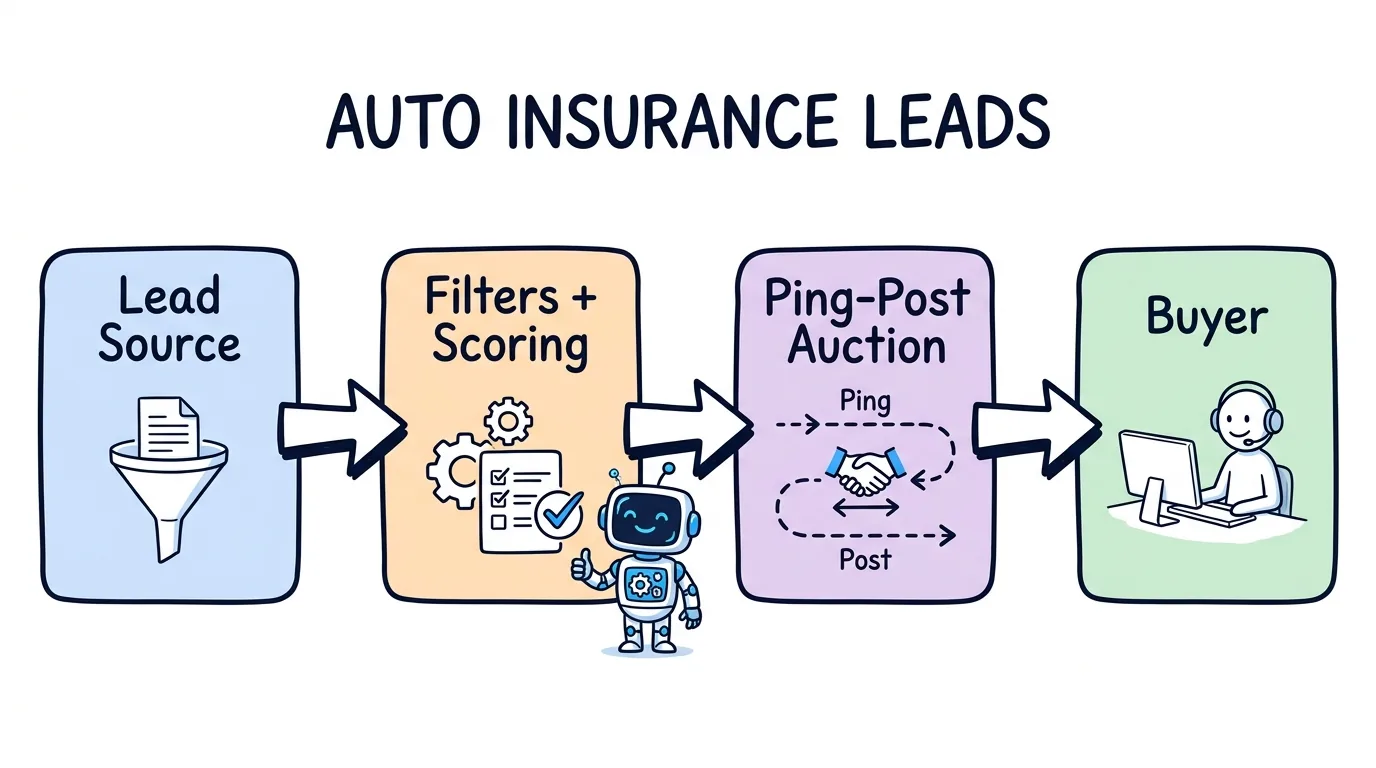
A ping post system is the engine that distributes a single inbound lead to the highest-bidding buyer in real time through a two-phase auction. Phase one is the "ping," where partial lead data fans out in parallel to every eligible buyer. Phase two is the "post," where the full lead is delivered only to the winning bidder above the configured floor.
The reason the ping post architecture matters: the engine is responsible for TCPA-compliant consent storage, duplicate suppression across millions of records, fraud detection, multi-buyer auction logic, fallback routing, and per-lead reconciliation. Get any layer wrong and you leak revenue, post non-compliant leads, or stall past buyer timeout windows.
The 7-Layer Ping Post Architecture
A modern ping post architecture decomposes the lead lifecycle into seven layers. Each layer has its own latency budget, failure mode, and compliance responsibility. Treating them as a monolith is how legacy systems became unmaintainable.
| Layer | Function | Latency Budget |
|---|---|---|
| 1. Intake | Receive and validate lead payload | 20-50ms |
| 2. Compliance | TCPA gate, Jornaya / TrustedForm verification | 100-300ms |
| 3. Dedupe | Check against historical lead store | 30-80ms |
| 4. Scrub | Rules engine, fraud detection, blacklists | 50-150ms |
| 5. Matching | Identify eligible buyers via filter logic | 20-50ms |
| 6. Auction | Parallel ping fan-out, bid collection | 1,500-4,000ms |
| 7. Post | Deliver winning lead, fallback waterfall | 100-300ms |
This structure mirrors how the LeadsCouncil describes the modern lead transaction lifecycle in its 2025 best practices guide (LeadsCouncil). Buyers expect sub-5-second total latency. See the Lead Distro AI ping post engine in action to watch the seven layers execute on a live lead.
Layer 1: Lead Intake and Validation
The intake layer is the front door. It accepts inbound leads via webhook, REST API, JavaScript form post, or server-side post-back, and validates every payload against a vertical-specific JSON schema.
A production intake layer handles three jobs: schema validation, IP rate limiting, and source attribution. Schema validation catches malformed phone numbers, invalid state codes, and missing consent flags. Rate limiting prevents a single source from flooding the queue. Source attribution tags every lead with publisher ID, sub ID, and campaign so revenue reconciles per-source at layer seven. A bad intake schema corrupts every downstream metric.
Layer 2: Compliance and Consent (TCPA, Jornaya, TrustedForm)
The compliance layer is non-negotiable. Under the TCPA, enforced by the FCC, lead buyers face statutory damages of $500 to $1,500 per non-consented contact (FCC TCPA rules). The 2024 FCC Order narrowed the consent loophole that previously allowed lead generators to share a single TCPA consent across hundreds of buyers, making per-buyer consent verification a hard requirement.
A lead distribution system built in 2026 must verify two consent artifacts before posting any lead:
- Jornaya LeadiD certificate: a tamper-proof recording of the consumer's interaction with the consent form (Jornaya documentation)
- TrustedForm certificate: a session-level recording capturing form fields, timestamps, and consent language (TrustedForm documentation)
The compliance layer fetches both certificates, verifies the timestamp falls within the buyer's accepted window (typically 30 to 90 days), and stores cert URLs in immutable audit storage. LeadsCouncil data suggests 8% to 12% of inbound leads fail compliance verification on first attempt.
Layer 3: Dedupe and Scrub Rules
The dedupe layer prevents the same consumer from being sold twice within a configurable window. Modern systems hash the lead's phone, email, and IP against a Redis or DynamoDB store of the last 30 to 90 days. A match flags the lead as a duplicate and either rejects it or routes it to the original buyer at a discount.
Robust duplicate lead detection does more than match exact strings. It normalizes phone numbers, canonicalizes emails, and fuzzy-matches names. Cross-buyer dedupe is the standard: if buyer A bought this consumer 12 days ago, buyer B cannot buy them today. Read our deep dive on duplicate lead detection for the hashing strategies.
The scrub layer applies fraud rules: known-bad IP ranges, disposable email domains, blacklisted phone prefixes, and litigator phone lists. Combined dedupe and scrub typically reject 15% to 35% of leads that survived intake.
Layer 4: Buyer Matching (Rules Engine)
The matching layer answers one question: which buyers in your network are eligible to receive a ping for this specific lead? A rules engine evaluates each active buyer's filters against the lead attributes in parallel. Common filters: geo-match (state, ZIP, DMA), vertical match (auto insurance, MVA, solar), demographic filters (age, income, homeowner status), daily and monthly cap, buyer balance, and time-of-day windows.
Eligible buyers form the auction pool. Ineligible buyers are excluded before the ping fires. Pinging 200 buyers when only 12 are eligible wastes the latency budget. A well-tuned rules engine cuts the auction pool to the 5 to 30 buyers most likely to bid.
Layer 5: The Bid Auction (Parallel Ping Fan-Out)
The auction layer is the engine room of a real-time lead bidding system. Matched buyers all receive a ping payload (partial data, no PII) at the same instant via parallel HTTP POST. Each endpoint must respond within the configured timeout (typically 2 to 4 seconds) with either a bid or a no-bid response.
The auction collects all responses, applies floor logic (reject any bid below the per-vertical or per-state floor), and selects the winner. Tiebreakers run on a configurable priority order: highest bid, highest historical fillrate, account standing, or strict round-robin. A modern real-time lead bidding system logs every bid, every no-bid, and every rejection reason so operators can tune floors and identify uncompetitive buyers.
Industry benchmarks from Phonexa and Boberdoo suggest healthy fillrates run 60% to 85% on premium verticals and drop to 30% to 50% on commodity verticals. For deeper mechanics, read real-time lead bidding.
Layer 6: Post and Delivery (Winner Notification + Fallback)
Once the auction picks a winner, the post layer delivers the full lead (PII included) to the winning buyer's endpoint within 100 to 300 milliseconds of auction close. The signed, timestamped payload includes the bid amount, certificate URLs, and a unique transaction ID.
If the post fails (HTTP error, timeout, rejection), the engine runs a fallback waterfall to the second-highest bidder, then the third, until a buyer accepts. Unfilled leads route to a fixed-rate fallback so no inventory is wasted. A webhook fanout is standard: the same lead can post to a buyer's CRM, a Slack notification, an internal warehouse, and a publisher reporting endpoint in one fan-out. For implementation specifics, read the ping post API integration guide.
Layer 7: Reporting and Reconciliation
The reporting layer captures every event from layers 1 through 6 and writes them to a time-series store. Minimum data per lead: source attribution, compliance cert URLs, dedupe hashes, scrub flags, matched buyer count, every bid, final post status, and revenue collected.
Reconciliation runs nightly to match buyer-side acceptance against your post log, resolving disputes when buyers reject leads (return reasons: bad data, duplicate, out-of-vertical, TCPA non-compliance). Return windows run 24 to 72 hours. The layer feeds a real-time P&L dashboard. This is where most home-built systems collapse under their own weight.
Latency Budgets: Where Time Is Spent
Total end-to-end latency on a well-architected engine runs 1.8 to 2.5 seconds for a typical 3-second auction window:
| Phase | Time | % of Budget |
|---|---|---|
| Intake + Compliance + Dedupe + Scrub + Matching | 220-630ms | 12-25% |
| Auction (parallel ping fan-out) | 1,500-4,000ms | 70-80% |
| Post + Reporting | 130-380ms | 7-15% |
The auction dominates because it waits for the slowest eligible buyer to respond. Optimization focuses on shrinking non-auction layers and demoting buyers that consistently timeout.
Buy vs Build: Should You Build a Ping Post System In-House?
Building a production-grade engine is a 12 to 18 month engineering project requiring 4 to 6 senior engineers, ongoing TCPA legal counsel, and a $300K to $700K first-year investment. Buying takes days. The decision matrix:
| Decision Factor | Build In-House | Buy (Lead Distro AI) |
|---|---|---|
| Total first-year cost | $300K to $700K | $3,588 to $11,964 |
| Time to launch | 12 to 18 months | Days |
| Customization | Unlimited | High (rules engine, custom filters) |
| Maintenance burden | 2-3 FTE engineers ongoing | Vendor-managed |
| Compliance burden | You own TCPA, Jornaya, TrustedForm liability | Shared; certs verified at layer 2 |
| Scalability | Your responsibility | Built for millions of leads/month |
Rafael Hernandez, Founder & CEO of Lead Distro AI: "Every PPL founder I talk to underestimates the compliance layer by an order of magnitude. The auction logic you can prototype in a weekend. What kills you is two years from now when the FCC issues a new TCPA order, a litigator targets your buyer network, or Jornaya changes their cert format. Buy until you're past $500K in monthly auction revenue. After that, building selectively makes sense, but rebuilding the whole stack from scratch in 2026 is almost never the right call."
For evaluators comparing alternatives, read the Boberdoo system alternatives breakdown. To skip the build entirely, skip building and start with Lead Distro AI free. The full feature set lives at Lead Distro AI's ping post software.
Frequently Asked Questions
How does a ping post system work?
A ping post system runs a real-time auction across seven layers: intake, compliance verification, dedupe, scrub, buyer matching, parallel bid auction, and post delivery. A partial-data ping fans out to all eligible buyers, each responds with a bid inside a 2 to 4 second window, and the full lead posts to the highest bidder above the configured floor. Total latency runs 1.8 to 2.5 seconds. That is mechanically how does ping post work end to end.
What is the difference between ping post and direct post?
Ping post is a two-phase auction: a partial-data ping collects bids from many buyers, then the full lead posts only to the winner. Direct post is one-phase delivery to a single pre-assigned buyer with no auction. Ping post captures market price (typically 20% to 40% more revenue per lead), direct post is faster and simpler. Most mature operations use both.
How long does a ping post auction take?
A complete ping post auction runs 1.8 to 2.5 seconds end-to-end. The auction phase consumes 70% to 80% of the budget (1.5 to 4 seconds depending on buyer timeout). Pre-auction layers total 220 to 630 milliseconds, and post-auction delivery plus reporting take another 130 to 380 milliseconds.
Can a ping post system handle exclusive and shared leads?
Yes. The matching and auction layers configure exclusivity per buyer or campaign. Exclusive leads post to one buyer only and flag in dedupe to block resale. Shared leads post to 2 to 5 buyers after the auction selects the top N bidders. Most systems support both modes per vertical, so insurance can run shared while legal runs exclusive.
What compliance checks should a ping post system run?
A compliant engine verifies TCPA consent via Jornaya LeadiD and TrustedForm certificates, validates the consent timestamp falls within the buyer's accepted window, stores cert URLs in immutable audit storage, and logs per-buyer consent share. The 2024 FCC TCPA Order narrowed multi-buyer consent sharing, making per-buyer verification mandatory. Failing this layer exposes buyers to $500 to $1,500 in statutory damages per contact.
Should I build my own ping post system or buy one?
Buy until you're past $500K monthly auction revenue. Building takes 12 to 18 months, 4 to 6 engineers, and $300K to $700K first-year, plus ongoing TCPA legal counsel. Lead Distro AI launches in days at $297 to $997 per month. After scale, selective in-house builds (custom rules, proprietary scoring) make sense, but rebuilding the entire stack rarely does.
Is lead generation illegal?
No, lead generation is legal in the United States, but heavily regulated. The TCPA, the FTC's Telemarketing Sales Rule, and state-level laws (California's CIPA, Florida's mini-TCPA) require verifiable consumer consent before contact. Operators that capture proper consent via Jornaya or TrustedForm, honor opt-outs, and avoid fraudulent sourcing operate legally. Operators that share consent across unauthorized buyers face significant statutory damages.
Conclusion
A modern ping post system is seven coordinated layers, not a single monolith. Get compliance, dedupe, and auction right and you capture market price on every lead inside a 2-second budget. Get them wrong and you leak revenue, fail TCPA audits, or stall past buyer timeouts. For 95% of PPL operators, buying beats building: the engineering investment and compliance liability of a home-built engine rarely pay back inside 24 months.
Lead Distro AI ships the full seven-layer architecture out of the box, with sub-200ms post delivery, integrated Jornaya and TrustedForm verification, and unified P&L reporting on every plan. For a side-by-side of the platforms that implement this architecture in production, see our best ping post lead distribution software comparison ranking the top 5 by auction speed, AI scoring, and pricing. For vertical-specific architecture considerations, see our best ping post software for home services guide covering trade-specific buyer pools, ZIP-level territory matching, and emergency auction pools for HVAC, roofing, plumbing, and electrical networks.
Skip the 12-month build. Start your 7-day free trial of Lead Distro AI and run a complete seven-layer ping post auction on your first lead today.
About the Author
Founder & CEO of Lead Distro AI & Great Marketing AI
UC Berkeley graduate and former software engineer at Microsoft. Rafael built Lead Distro AI after managing over $10M in ad spend for performance marketing agencies (pay-per-lead and pay-per-call), including running campaigns for Neil Patel. He combines deep software engineering expertise with hands-on performance marketing experience to build tools that help these agencies scale profitably.
About Lead Distro AI
Lead Distro AI: AI-Powered Lead Distribution & Call Tracking That Maximizes ROI
The modern platform for pay-per-lead and pay-per-call agencies. Route, score, and deliver leads with AI-powered automation and real-time P&L tracking. Built for performance marketing agencies and lead buyers across legal, insurance, mortgage, solar, and home services verticals.
4 Distribution Methods
Waterfall, Round Robin, Weighted, Ping-Post
Ping-Post Auctions
Real-time bidding with sub-second routing
Real-Time P&L Reporting
Track revenue, costs, and profit per campaign
Call Tracking
Assign tracking numbers, record calls, and attribute conversions
AI Lead Scoring
Score every lead before routing to maximize conversion
Partner Portal
Self-serve dashboard for buyers to track leads