Pay Per Call vs Pay Per Click: Which Drives More ROI for Lead Agencies?
Pay per call and pay per click both drive leads, but they work very differently. This breakdown covers conversion rates, cost structures, attribution, and when each model wins for lead gen agencies.

Rafael Hernandez
Founder & CEO
Ex-Microsoft SWE · $10M+ PPL ad spend

I hope you enjoy reading this blog post. If you want to try Lead Distro AI for free, click here.
Author: Rafael Hernandez | Founder & CEO of Lead Distro AI
Pay per call and pay per click are two distinct advertising models that agencies use to drive leads, but they produce very different results depending on the vertical and the buyer's sales process. Pay per call generates inbound phone calls that convert at 30 to 50 percent in high-intent verticals, while pay per click drives website traffic that converts at roughly 2 to 5 percent on average (WordStream/LocaliQ, 2024). The gap exists because a phone call signals immediate purchase intent: the prospect has already decided they want to talk to a provider. A click signals curiosity. For agencies managing high-ticket verticals like legal, insurance, solar, or home services, this conversion rate difference translates directly into cost-per-acquisition and profit margin. Pay per click scales faster and carries a lower barrier to entry since Google Ads and Meta Ads are self-serve platforms built around click-based bidding. Pay per call commands a premium per lead but delivers buyers who close at dramatically higher rates. The right model depends on what your buyers need, what your vertical supports, and what distribution infrastructure you have in place.
Key Takeaways
- Pay per call converts at 30 to 50 percent versus 2 to 5 percent for pay per click, making inbound call leads significantly more valuable per contact in high-ticket verticals like legal, insurance, and home services.
- Pay per click scales faster and costs less per click, but the cost per actual conversion often exceeds pay per call in competitive, phone-first verticals where CPCs run $50 to $100 or higher.
- Attribution works differently for each model: call tracking uses dynamic number insertion (DNI) and call duration gates; PPC relies on pixel tracking, UTM parameters, and GA4 multi-touch attribution.
- The best agencies run both models in parallel and use lead distribution software to route inbound calls and form-fill leads through separate, optimized pipelines to buyers.
- Lead Distro AI supports both pipelines natively, distributing call leads through tracked numbers and form fills through Round Robin, Weighted, Priority/Waterfall, and Ping-Post routing.
What Is Pay Per Call?
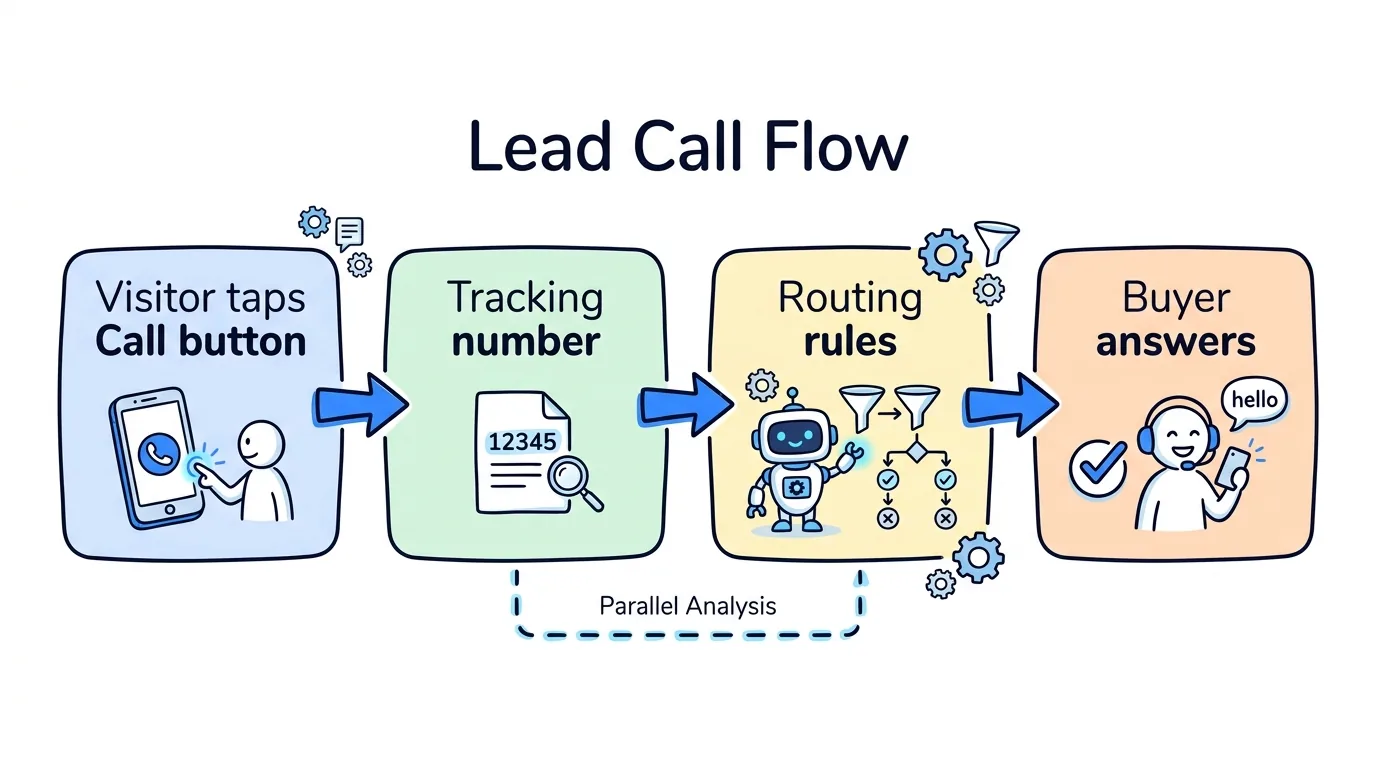
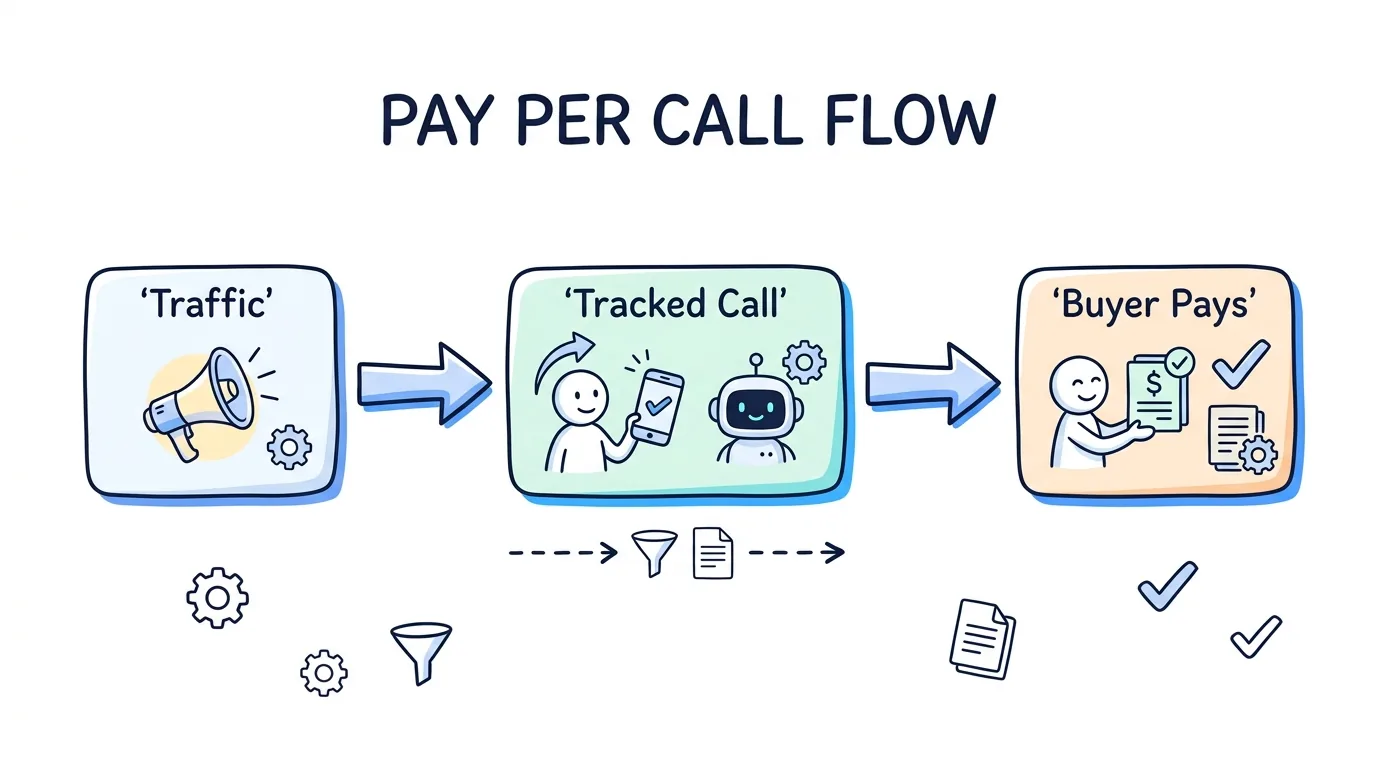
Pay per call is a performance marketing model where advertisers pay only when a qualified inbound phone call is delivered. Instead of purchasing impressions or clicks, the advertiser pays for an actual phone conversation with a prospect who actively chose to call. The call is tracked through a unique tracking number assigned to each campaign, ad creative, or keyword, using a technology called dynamic number insertion (DNI) that swaps the displayed phone number on a landing page based on the traffic source that brought the visitor. Quality thresholds are defined by a minimum call duration, typically between 60 and 180 seconds depending on the vertical. Calls that fall below the duration gate are filtered out and not billed. Many pay-per-call networks also apply call caps, which are daily or weekly limits on how many calls a buyer will accept, to prevent overflow that the buyer cannot handle. For a complete breakdown of how the model works from ad to payout, see our guide on what is pay per call. Because callers have taken a deliberate step to initiate contact, call leads command premium pricing compared to anonymous form submissions.
What Is Pay Per Click?
Pay per click is an advertising model where advertisers pay each time a user clicks their ad, regardless of what happens after the click. The two dominant pay per click platforms are Google Ads (search and display networks) and Meta Ads (Facebook and Instagram). Google Search campaigns charge advertisers per click to a destination URL; Meta can be structured as cost-per-click or cost-per-thousand-impressions. The core challenge with pay per click advertising is the gap between a click and a paying customer. The average conversion rate across Google Ads search campaigns is approximately 3.75 percent (WordStream/LocaliQ, 2024), meaning roughly 96 out of 100 paid clicks leave without converting. In competitive verticals like personal injury law, average CPCs on Google Search regularly exceed $50 to $100 per click, pushing the cost to acquire a single customer into the thousands. Clicks are not customers: the click-to-conversion gap is the structural challenge every agency must solve when building PPC campaigns for high-ticket buyers.
Pay Per Call vs Pay Per Click: Side-by-Side Comparison
| Factor | Pay Per Call | Pay Per Click |
|---|---|---|
| Average conversion rate | 30 to 50% (call to customer) | 2 to 5% (click to lead) |
| Typical cost per conversion | $50 to $500+ depending on vertical | $100 to $2,000+ in competitive verticals |
| Lead quality | High: prospect initiated contact by phone | Variable: ranges from researchers to ready buyers |
| Attribution complexity | Moderate: DNI tracking numbers, call recordings, duration gates | Moderate to high: pixels, UTMs, multi-touch attribution |
| Scale and volume potential | Lower: call capacity is finite and buyers have daily caps | Higher: digital ad inventory scales directly with budget |
| Best industries | Legal, insurance, solar, medical, financial services, home services | E-commerce, SaaS, B2B, content marketing, brand awareness |
| Time to first result | 1 to 3 days via network or direct distribution | 2 to 7 days due to campaign ramp and Quality Score buildup |
| Attribution model | Call duration gate, call recording, DNI source matching | Last-click, data-driven, or GA4 multi-touch attribution |
When Pay Per Call Wins
Pay per call wins in any vertical where the buyer closes the deal over the phone. Phone calls convert to revenue 10 to 15 times more often than web leads, according to BIA/Kelsey data reported by Invoca (BIA/Kelsey, via Invoca). The scenarios where pay per call produces the clearest ROI advantage are:
High-ticket verticals with phone-first sales. Personal injury law firms, Medicare supplement insurance brokers, solar panel installers, and home services contractors all close deals by phone or in person. A personal injury attorney who converts one out of three qualified calls at an average case value above $20,000 will readily pay $200 to $400 per qualified call. PPC cannot deliver that level of intent signal at comparable economics in competitive markets where CPCs already run $80 or higher.
Local service businesses. Plumbers, HVAC technicians, and roofing contractors have no use for a form fill that sits in a CRM for 24 hours. They need the phone to ring from someone who needs service today. Pay per call aligns the advertising model to the sales model.
Agencies building premium revenue streams. When an agency's buyers are attorneys, insurance brokers, or financial advisors, call leads command two to five times the margin of form fills per lead. Building a pay-per-call operation on top of an existing PPL agency is a well-documented path to increasing revenue per buyer. For a step-by-step approach, see our guide on how to start a pay-per-lead agency.
High lifetime value industries. Any vertical where the average customer generates more than $1,000 in revenue can support premium call pricing. The economics favor call leads when LTV is high and closing happens through conversation.
When Pay Per Click Wins
Pay per click wins when the conversion happens online without a phone call, when volume at scale matters more than lead quality, or when the buyer's sales cycle is long and research-driven.
E-commerce and low-ticket consumer products. A shopper buying a $40 supplement or a $150 subscription does not need to speak with a salesperson. PPC sends them directly to a product page and the cart handles the conversion. Pay per call would add unnecessary friction.
Nationwide brand awareness and retargeting. Display and video PPC campaigns on Google and Meta build brand recognition at cost-per-thousand-impressions pricing. Law firms, insurance carriers, and SaaS companies run retargeting ads to warm website visitors at lower cost than cold pay-per-call campaigns.
B2B SaaS and enterprise software. Software buyers at mid-market and enterprise companies research for weeks or months before engaging a sales rep. Content marketing and search campaigns drive them to gated resources, demos, and nurture sequences. A phone call at the top of the funnel would arrive too early in the decision process.
Content and informational marketing funnels. PPC traffic directed to high-quality educational content builds email lists and organic ranking signals over time. Pay per call does not fit this content-first, long-cycle model.
Attribution: How Each Model Tracks Results
Measuring which campaigns produce revenue requires different tooling for each model. Pay per call attribution runs through call tracking numbers assigned per campaign or per keyword. When a visitor arrives on a page, dynamic number insertion swaps the visible phone number to one tied to that exact traffic source. Call recordings and transcripts let buyers verify lead quality before approving payment. Call duration gates automatically filter out short calls that do not meet quality standards. For a comparison of the leading call tracking platforms and what to evaluate before choosing one, see call tracking software for pay-per-call agencies. In Lead Distro AI, call tracking is priced on a usage basis: there is a per-number monthly fee for each tracking number plus a per-minute rate for inbound call duration, so buyers pay for exactly the capacity they consume.
Pay per click attribution runs through conversion pixels (the Google Ads conversion tag and Meta Pixel), UTM parameters appended to destination URLs, and event tracking in Google Analytics 4 or another analytics platform. Multi-touch attribution models, including linear, time-decay, and data-driven variants, attempt to credit the full purchase journey across multiple ad exposures. The challenge is that cross-device journeys and browser privacy restrictions, particularly Safari Intelligent Tracking Prevention and Firefox Enhanced Tracking Protection, increasingly obscure the path from click to purchase. Both models face attribution complexity, but call tracking is more direct since the phone call itself is the conversion event, while PPC attribution grows more fragile as privacy changes continue.
How Lead Distribution Software Fits Both Models
Agencies running pay per call campaigns, PPC campaigns, or both need infrastructure to route the leads they generate to the right buyers automatically and in real time. Lead Distro AI handles both models through separate but unified pipelines, starting at $297 per month. You can explore the full feature set on the product tour.
For PPC campaigns, form-fill leads arrive through webhook or API integration and route to buyers through four distribution methods. Round Robin distributes leads equally across all active buyers. Weighted routing splits leads by percentage so higher-performing or higher-paying buyers receive a larger share. Priority and Waterfall routing sends each lead to a primary buyer first, then falls through to secondary buyers if the primary cannot accept it. Ping-Post routing broadcasts lead data to multiple buyers simultaneously and awards the lead to the highest bidder in real time.
For pay per call campaigns, inbound calls route through tracking numbers provisioned in Lead Distro AI. Calls connect to buyers live, with call duration gates verifying quality before billing is triggered. Call leads and form-fill leads appear in the same reporting dashboard, giving agencies a unified view of revenue, margins, and buyer performance across both models without switching platforms.
Running both models through a single lead distribution system means agencies can scale whichever channel performs better in any vertical without rebuilding infrastructure. Start your 7-day free trial and route your first lead today. Credit card required.
FAQ
Which has a higher conversion rate, pay per call or pay per click?
Pay per call has a significantly higher conversion rate. Inbound phone calls convert to customers at 30 to 50 percent in high-intent verticals like legal, insurance, and home services. Pay per click campaigns average 2 to 5 percent across Google Ads search, meaning most clicks do not result in a lead at all. The gap reflects purchase intent: a caller has chosen to initiate contact, while a clicker may simply be researching options before deciding.
Is pay per call more expensive than pay per click?
The cost per individual lead is higher for pay per call because agencies pay for a proven, intent-qualified phone call rather than a raw click. However, the cost per acquired customer is often lower in high-ticket verticals because call leads close at a much higher rate. In personal injury law, for example, a $300 call that closes at 33 percent produces a customer for $900. A PPC campaign spending $80 per click at a 3 percent conversion rate produces a lead for $2,667 before counting the close rate from lead to signed client. The correct metric to compare is cost per acquired customer, not cost per click or cost per lead.
What industries work best for pay per call?
Pay per call performs best in verticals where the sale closes through a conversation: personal injury law, Medicare supplement and health insurance, solar energy, home services (roofing, HVAC, plumbing, pest control), auto insurance, financial services, and addiction treatment. These verticals share high customer lifetime values, phone-first sales processes, and buyers who consistently pay $50 to $500 or more per qualified inbound call.
Can I run both pay per call and pay per click campaigns at the same time?
Yes. Many agencies run both in parallel and use lead distribution software to manage the two pipelines. PPC campaigns generate form-fill leads that route through data distribution methods like Round Robin, Weighted, and Ping-Post. Pay per call campaigns generate inbound calls that route through call tracking numbers to buyers in real time. Running both gives agencies more ways to serve buyers across different budgets, lead-type preferences, and vertical requirements.
How do I track ROI for pay per call vs pay per click?
For pay per call, ROI tracking requires a call tracking platform that records call duration, matches each call to the campaign and keyword that drove it, and reports on qualified calls versus rejected calls. Calculate ROI as: revenue from converted calls minus total call spend, divided by total call spend. For pay per click, connect Google Ads or Meta campaign spend to CRM close rate data by using UTM parameters and GA4 conversion events. Both pipelines produce comparable ROI calculations once you know your cost per acquired customer on each channel. Lead Distro AI surfaces both metrics in a single reporting dashboard so agencies can compare performance without exporting to a spreadsheet.
Conclusion
Pay per call and pay per click are not competing models: they serve different parts of the market and different buyer needs. Pay per call wins in high-ticket, phone-first verticals where a 30 to 50 percent call-to-customer conversion rate justifies a premium cost per lead. Pay per click wins when the sale completes online, when scale matters more than per-lead quality, or when the buyer's decision cycle is too long for immediate phone outreach. The agencies that grow fastest are those that run both models and use lead distribution infrastructure to route each lead type to the right buyer automatically. Learn more about building a phone-first lead operation in our guide to what is pay per call.
Start your 7-day free trial and route both your call leads and form-fill leads through a single platform built for pay-per-lead and pay-per-call agencies. Credit card required.
Lead Distro AI supports Round Robin, Weighted, Priority/Waterfall, and Ping-Post distribution for form-fill leads, plus real-time call routing for pay-per-call campaigns. Start your free trial and see both pipelines working in one dashboard. Credit card required.
About the Author
Founder & CEO of Lead Distro AI & Great Marketing AI
UC Berkeley graduate and former software engineer at Microsoft. Rafael built Lead Distro AI after managing over $10M in ad spend for performance marketing agencies (pay-per-lead and pay-per-call), including running campaigns for Neil Patel. He combines deep software engineering expertise with hands-on performance marketing experience to build tools that help these agencies scale profitably.
About Lead Distro AI
Lead Distro AI: Capture, Route, and Sell Every Lead, Call, and Appointment
The modern platform for pay-per-lead and pay-per-call agencies. Route, score, and deliver leads with AI-powered automation and real-time P&L tracking. Built for performance marketing agencies and lead buyers across legal, insurance, mortgage, solar, and home services verticals.
4 Distribution Methods
Waterfall, Round Robin, Weighted, Ping-Post
Ping-Post Auctions
Real-time bidding with sub-second routing
Real-Time P&L Reporting
Track revenue, costs, and profit per campaign
Call Tracking
Assign tracking numbers, record calls, and attribute conversions
Lead Scoring
Score every lead before routing to maximize conversion
Partner Portal
Self-serve dashboard for buyers to track leads