How to Start a Pay Per Lead Agency in 2026 (Step-by-Step)
Learn how to start a pay per lead agency from scratch. Covers niche selection, campaign setup, lead pricing, buyer acquisition, compliance, and scaling.

Rafael Hernandez
Founder & CEO
Ex-Microsoft SWE · $10M+ PPL ad spend
I hope you enjoy reading this blog post. If you want to try Lead Distro AI for free, click here.
Author: Rafael Hernandez | Founder & CEO of Lead Distro AI
Starting a pay per lead agency means building a business where you generate consumer inquiries (phone calls, form fills, or applications) and sell each one to a buyer at a fixed price. You only get paid when you deliver a qualified lead, which means your buyers carry zero risk and you earn uncapped revenue based on volume. The pay per lead business model is one of the fastest paths to recurring revenue in digital marketing because you own the demand generation, you control distribution, and your income scales with every new campaign you launch. If you can spend $20 to generate a lead and sell it for $50, you have a business.
According to Grand View Research, the global lead generation market is projected to reach $15.55 billion by 2031, growing at a 17.48% CAGR. The pay per lead segment is expanding faster than retainer or pay-per-click models because buyers prefer performance-based pricing where they pay only for results. This guide breaks down exactly how to start a pay per lead agency in seven steps, from choosing your niche to scaling across multiple verticals.
Key Takeaways
- The pay per lead model pays you per result, not per hour. You generate leads through ads, SEO, or content, then sell each one at a fixed price to businesses that need customers.
- Niche selection determines your margins. Legal leads sell for $80 to $200 each while home services leads sell for $15 to $50, but acquisition costs scale proportionally.
- Lead distribution infrastructure is non-negotiable. Manual delivery via email or spreadsheets breaks at 50+ leads per day. Automated routing, cap management, and real-time reporting separate real agencies from side projects.
- Compliance protects your business from lawsuits. TCPA violations carry fines of $500 to $1,500 per call. TrustedForm certificates and proper consent language are mandatory for phone leads.
- Five active buyers is the minimum viable network. Selling to one buyer means one point of failure. A diversified buyer pool lets you maximize revenue through weighted distribution and competitive bidding.
- You can launch a PPL agency for under $5,000. Initial ad spend ($2,000 to $3,000), a distribution platform ($297/month), and landing page tools cover your startup costs.
What Is a Pay Per Lead Agency?
A pay per lead agency generates consumer inquiries for businesses and charges a fixed fee for each qualified lead delivered. Unlike retainer agencies that bill monthly regardless of results, or PPC agencies that charge a percentage of ad spend, a PPL agency earns revenue only when it produces a measurable outcome. The buyer pays $30 for a roofing estimate request, $100 for a personal injury case inquiry, or $15 for an insurance quote submission.
The pay per lead business model works because it aligns incentives perfectly. Buyers pay nothing until they receive a lead that meets their criteria. You, the agency owner, are incentivized to generate the highest volume of quality leads possible because your revenue is directly tied to output. According to a Forrester Research report, companies using performance-based lead acquisition see 30% lower customer acquisition costs compared to fixed-fee models because they only pay for results that convert.
This model differs from starting a general lead generation company in one critical way: you specialize in the per-lead transaction, building infrastructure specifically for high-volume lead production and automated distribution to multiple buyers simultaneously.
Step 1: Choose Your Niche
Your vertical determines everything: lead prices, campaign costs, buyer availability, compliance requirements, and long-term margins. The best niches for a new pay per lead agency share three characteristics: high customer lifetime value (buyers pay premium prices per lead), consistent year-round demand, and accessible advertising channels.
Here is how the top PPL verticals compare for new agency owners:
| Vertical | Lead Price Range | Google Ads CPC | Buyer Availability | Compliance Complexity |
|---|---|---|---|---|
| Personal Injury Legal | $80-$200 | $50-$150 | Medium | High (TCPA, attorney advertising rules) |
| Auto Insurance | $15-$40 | $20-$60 | High | Medium (licensing varies by state) |
| Home Services (HVAC, Roofing, Plumbing) | $15-$50 | $8-$30 | Very High | Low |
| Solar | $25-$70 | $15-$40 | Medium | Medium (state incentive rules) |
| Mortgage and Refinance | $30-$80 | $25-$50 | High | High (RESPA, TILA) |
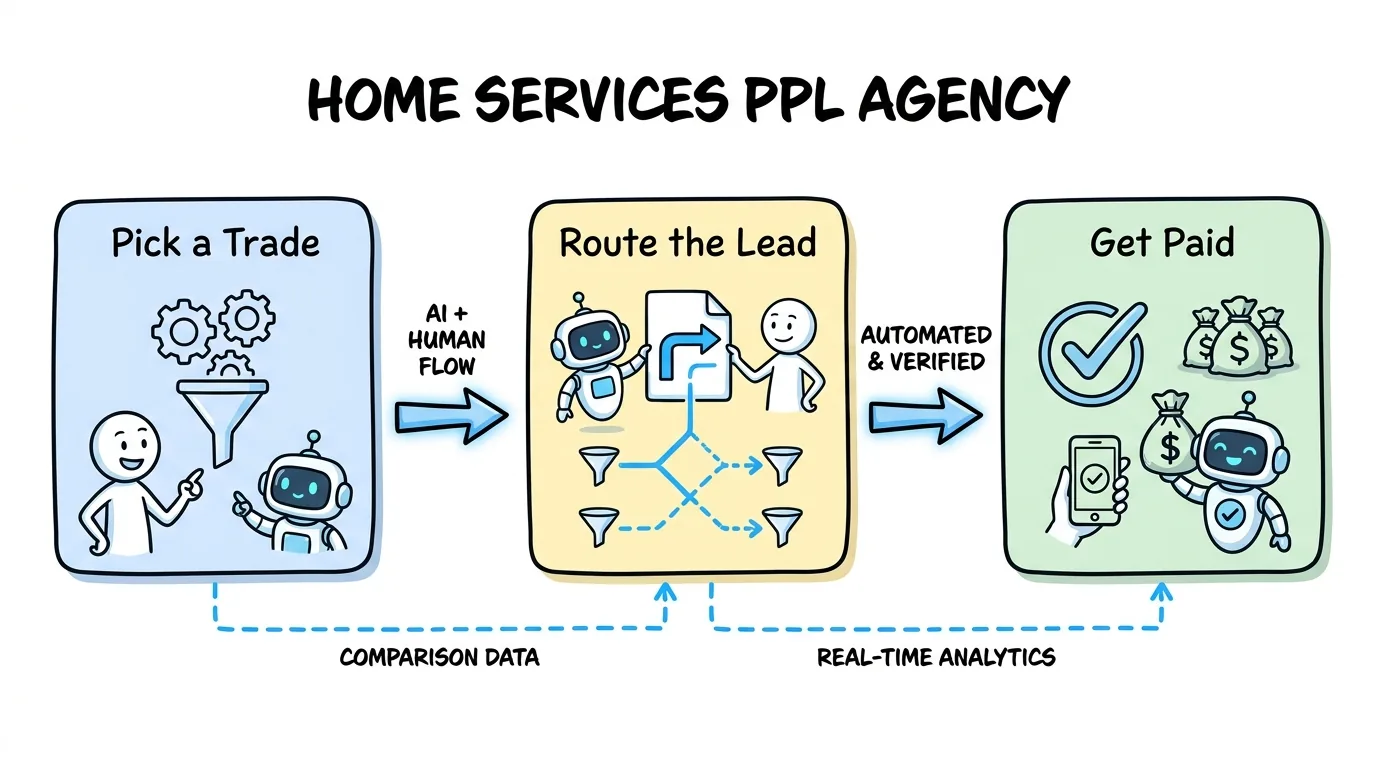
Start with one vertical. According to IBISWorld, agencies that specialize in a single niche grow 2.5x faster than generalists in their first two years because they build deeper buyer relationships and campaign expertise. Home services is the most forgiving entry point: lower CPCs, simpler compliance, and contractors actively searching for lead providers. For a deeper trade-by-trade breakdown of launching specifically in this vertical, including seasonal demand planning and ZIP-code territory routing, see our home services pay per lead agency guide. For a complete ranking of all 40 verticals from Gold to Avoid, including LTV benchmarks and scalability ratings, see our lead generation niches for beginners guide.
Step 2: Set Up Lead Generation Campaigns
Once you have locked in your niche, you need campaigns that produce leads consistently. A pay per lead agency typically generates demand through three channels working together.
Google Ads (highest intent). Search campaigns capture people actively looking for services. Someone typing "emergency plumber near me" or "car accident lawyer free consultation" has immediate buying intent. According to Google Economic Impact Report 2024, businesses earn an average of $8 in revenue for every $1 spent on Google Ads. For PPL agencies, the math is even better because you are selling leads at a markup above your cost per acquisition.
Facebook and Instagram Ads (highest volume). Meta's advertising platform lets you reach millions of people by demographics, interests, and behaviors. Lead form ads reduce friction by letting users submit information without leaving the platform. CPCs are typically 50% to 70% lower than Google, though intent is weaker.
SEO and Content Marketing (lowest cost per lead long-term). Organic traffic costs nothing per click once pages rank. Build niche-specific landing pages targeting "[service] + [city]" keywords. This takes 3 to 6 months to produce volume but creates a durable asset that generates leads without ongoing ad spend.
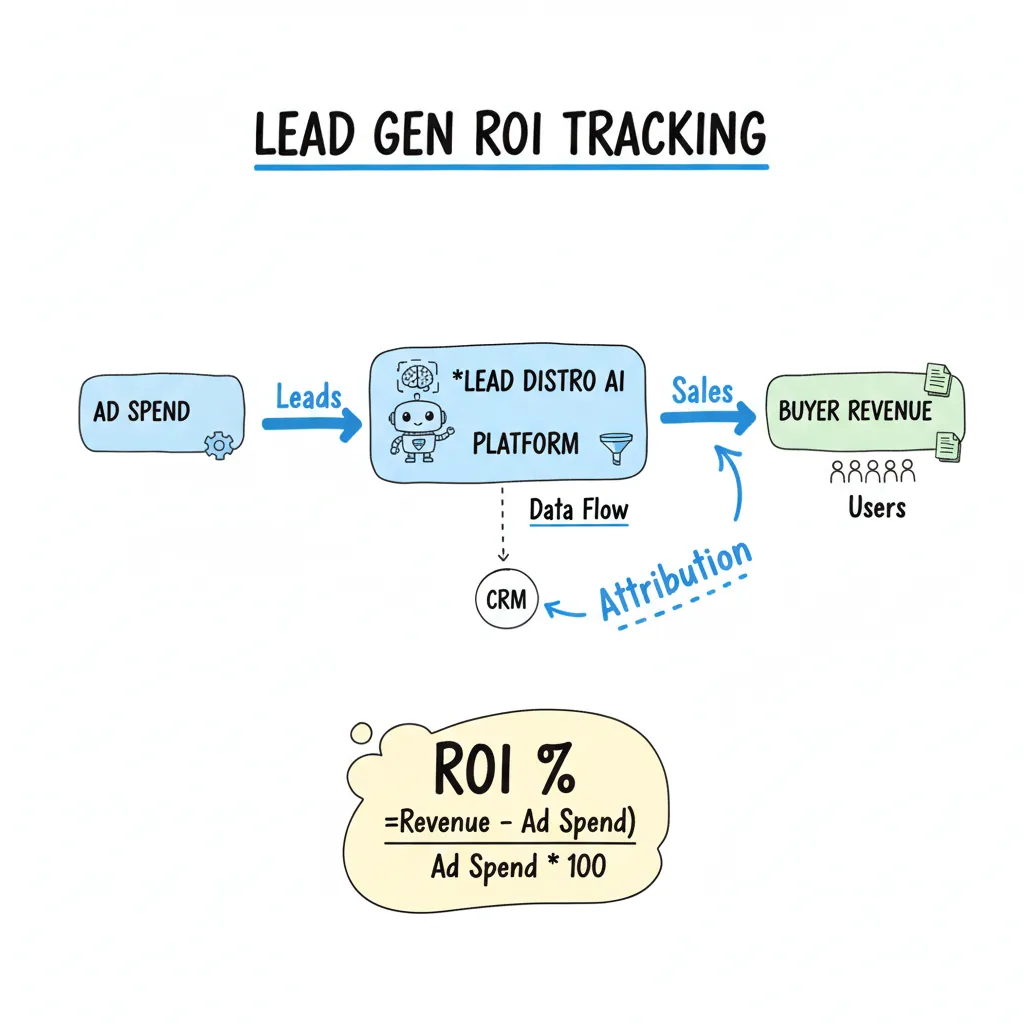
Track every lead back to its source, campaign, and keyword. Without attribution data, you cannot calculate cost per lead by channel or optimize your budget allocation.
Step 3: Build Your Lead Distribution Infrastructure
This is where most new PPL agencies fail. Generating leads is only half the business. You need automated infrastructure to receive, validate, route, and deliver leads to buyers in real time. Manual distribution through email or spreadsheets works for your first 10 leads per day. Beyond that, you lose leads to slow response times, exceed buyer caps, send duplicates, and cannot track revenue accurately.
A lead distribution platform handles the operational backbone of your agency:
- Automated routing distributes leads to buyers based on rules you define (geography, lead type, time of day, buyer capacity)
- Cap management prevents over-delivery when a buyer hits their daily or weekly limit
- Duplicate detection blocks the same consumer from being sold to multiple buyers (or the same buyer twice)
- Real-time reporting shows revenue, cost, and profit per lead, per buyer, per campaign
- Ping-post bidding lets multiple buyers compete for each lead, maximizing your revenue per inquiry
To compare vendors on routing methods, published pricing, and pay-per-call support, see our ranking of the best lead distribution platforms for agencies.
Duplicate leads deserve special attention because they are the most common reason new agencies lose money. When your buyer purchases from multiple vendors, the same consumer often submits through several sources and gets flagged as a duplicate on delivery. A 40% duplicate return rate on a $2,000 ad spend turns a $200 cost per lead into $333, and at low volume there is no margin to absorb it. Set clear return rules in your buyer agreements, define what counts as a duplicate (same phone or email within 30 days, 90 days, or lifetime), and use automated duplicate detection to catch duplicates before they reach your buyer rather than after.
Lead Distro AI provides all four distribution methods (round robin, weighted, priority/waterfall, and ping-post), rule-based lead scoring, and real-time profit tracking in a single platform built specifically for PPL and pay-per-call agencies. You can route your first lead within minutes of signing up.
Step 4: Find and Onboard Lead Buyers
Your buyer network is your revenue engine. Without buyers, leads have no value. The goal is to build a network of 5 or more active buyers per vertical so you can distribute leads efficiently, never waste inventory, and create competitive pricing pressure.
Where to find lead buyers:
- Direct outreach to local businesses. Call roofing contractors, law firms, insurance agents, or solar installers in your target geography. Pitch them on a risk-free lead source: "You only pay when I send you a qualified lead."
- LinkedIn prospecting. Search for business owners and marketing directors in your vertical. Send personalized messages explaining the pay per lead model.
- Industry forums and communities. Join contractor groups, legal marketing communities, and insurance agent associations. Many businesses actively look for lead vendors.
- Lead marketplaces. Platforms where buyers actively shop for lead providers give you instant access to pre-qualified purchasers.
Onboarding each buyer properly means defining:
- Accepted lead types and geographic areas
- Daily and weekly volume caps
- Quality standards and return policies
- Pricing per lead (or bid range for ping-post)
- Delivery method (real-time API, email, buyer portal, CRM integration)
Read our complete guide on how to sell leads for detailed scripts and strategies for approaching buyers in every major vertical.
Step 5: Price Your Leads
Pricing is the lever that determines whether your pay per lead agency is profitable or hemorrhaging money. Price too high and buyers leave. Price too low and you cannot cover acquisition costs.
The pricing formula is straightforward:
Lead Price = (Cost Per Acquisition x Target Margin Multiplier)
If a lead costs you $20 to generate and you want a 60% margin, sell it for $50. If you are running exclusive leads (one buyer per lead), charge a premium. For shared leads (sold to 2 to 4 buyers), reduce the per-buyer price but increase total revenue per lead.
Factors that determine lead pricing:
- Vertical and customer lifetime value. A personal injury case worth $50,000 in attorney fees justifies a $150 lead. A $200 HVAC repair does not justify more than $25.
- Exclusivity. Exclusive leads command 2x to 3x the price of shared leads because the buyer faces no competition for that consumer.
- Lead quality signals. Leads with verified phone numbers, TrustedForm certificates, and detailed form fields sell for more than name-and-email-only submissions.
- Geographic market. A plumbing lead in Manhattan is worth more than one in rural Kansas due to service pricing differences.
For a deeper framework on calculating margins and setting tiered pricing, read our guide on how to price leads. You can also model different scenarios using the lead pricing calculator.
Step 6: Ensure Compliance
Compliance is not optional for a pay per lead agency. Violations carry severe financial penalties and can shut down your operation entirely. The two biggest compliance frameworks for PPL agencies are TCPA and state-level consumer protection laws.
TCPA (Telephone Consumer Protection Act). If you generate phone leads or transfer calls, TCPA governs how you contact consumers. As noted by the Federal Communications Commission, violations carry statutory damages of $500 per unauthorized call, trebled to $1,500 for willful violations. One class-action lawsuit from 1,000 improperly consented calls means $500,000 to $1.5 million in liability.
Key compliance requirements:
- Prior express written consent. Every lead form must include clear disclosure language and an affirmative consent mechanism (checkbox, signature, or button click).
- TrustedForm certificates. Record each form submission with a TrustedForm certificate that captures the exact page the consumer saw, including consent language. This is your legal proof of consent.
- DNC (Do Not Call) list scrubbing. Before transferring or calling any lead, scrub against the National Do Not Call Registry.
- TCPA one-to-one consent rule (effective January 2025). The FCC's updated rule requires that consent name a specific seller. Blanket consent to "marketing partners" no longer satisfies TCPA requirements.
Build compliance into your lead forms from day one. Retrofitting consent language after generating thousands of leads creates legal exposure you cannot undo.
Step 7: Scale Your Operation
Once your first vertical is profitable with consistent buyer demand, scaling a pay per lead agency follows a repeatable playbook.
Add volume in your current vertical. Increase ad budgets on winning campaigns. Launch new geographic targets. Build SEO landing pages for additional cities. If you are generating 50 leads per day profitably, push toward 200 by expanding campaigns and adding buyers.
Expand to adjacent verticals. Your infrastructure, distribution platform, and operational processes transfer directly. A PPL agency generating home services leads can add solar or roofing with minimal additional setup. The campaigns change, but the distribution logic and buyer onboarding process remain identical.
Automate everything. At scale, your time should be spent on strategy, not operations. Automate lead delivery, billing, quality disputes, and performance reporting. Lead Distro AI's automated routing and real-time analytics handle distribution, invoicing, and ROI tracking without manual intervention.
Monitor unit economics obsessively. Track cost per lead, revenue per lead, profit margin, buyer acceptance rate, and return rate by vertical, geography, and campaign. The agencies that scale to seven figures are the ones that know their numbers down to the penny.
According to Dan Pena, founder of QLA (Quantum Leap Advantage), "Most entrepreneurs fail because they diversify too early. Master one thing completely before expanding." Apply this to your PPL agency: get one vertical to $10,000 per month in profit before adding the next one.
PPL vs PPC Agency: Which Model Is Right for You?
Choosing between a pay per lead agency, a pay-per-click agency, or a traditional retainer agency depends on your risk tolerance, technical skills, and revenue goals. Here is how the three compare:
| Factor | Pay Per Lead Agency | PPC (Pay-Per-Click) Agency | Retainer Agency |
|---|---|---|---|
| Revenue Model | Fixed fee per lead delivered | Percentage of ad spend (10-20%) or flat monthly fee | Monthly retainer ($2,000-$10,000+) |
| Client Risk | Zero (pay only for results) | Medium (ad spend may not convert) | High (paying regardless of results) |
| Your Risk | High (you front ad costs) | Low (client pays ad spend) | Low (guaranteed monthly income) |
| Startup Cost | $3,000-$5,000 (ads + platform) | $500-$1,000 (tools + certifications) | $500-$1,000 (tools + proposals) |
| Scalability | Very High (add buyers, add verticals) | Medium (limited by client count) | Low (trades time for money) |
| Income Ceiling | Uncapped (tied to volume) | Tied to client ad budgets | Tied to hours available |
| Technical Skill | Medium-High (distribution + tracking) | Medium (ad platforms + analytics) | Low-Medium (strategy + reporting) |
| Time to First Revenue | 2-4 weeks | 2-6 weeks (sales cycle) | 4-8 weeks (proposals + onboarding) |
The pay per lead business model carries more upfront risk because you spend money before earning revenue. But the ceiling is dramatically higher because you are building assets (campaigns, SEO pages, buyer networks) that produce leads whether you are working or not. PPC and retainer agencies trade time for money. A PPL agency trades capital for systems.
Tools and Software You Need
Building a pay per lead agency requires a focused tech stack. Here is what you need at each stage:
Core infrastructure (required from day one):
- Lead distribution platform: Lead Distro AI handles routing, cap management, duplicate detection, revenue tracking, and buyer portals. Plans start at $297/month (ping-post bidding is included from the $497/month Growth plan) with a 7-day free trial.
- Landing page builder: Unbounce, Leadpages, or custom-built pages for capturing leads. Budget $50 to $200/month.
- Call tracking: CallRail, Invoca, or Ringba for tracking inbound phone leads back to source. Required for pay-per-call campaigns.
- Ad platforms: Google Ads and Meta Ads Manager accounts (free to set up, ad spend is your variable cost).
Growth tools (add as you scale):
- CRM: HubSpot (free tier) or Close for managing buyer relationships and pipeline.
- Compliance: TrustedForm (certificates are free to issue; storing them with TrustedForm Retain costs $0.06 to $0.15 each depending on volume, as of September 2026) and Jornaya LeadID for consent verification.
- Analytics: Google Analytics 4 for web traffic, plus your distribution platform's built-in reporting for lead-level P&L.
- Communication: Slack or Teams for buyer communication. Automated email notifications for lead delivery confirmations.
For a comprehensive breakdown of lead generation business models including hybrid approaches that combine PPL with retainer revenue, read our full comparison guide.
FAQ
How much can you make with a pay per lead agency?
Revenue depends on your vertical, volume, and margins. A PPL agency generating 100 leads per day in home services at $30 per lead earns $3,000 daily ($90,000/month). Legal lead agencies generating 20 leads per day at $150 each earn the same $3,000 daily. Most new agencies reach $5,000 to $15,000 monthly profit within 6 to 12 months of launching their first campaigns.
What is the startup cost for a PPL agency?
You can start a pay per lead agency for $3,000 to $5,000. This covers initial ad spend ($2,000 to $3,000 for testing campaigns), a lead distribution platform ($297/month), landing page tools ($50 to $100/month), and call tracking if running phone campaigns ($50 to $100/month). The majority of your budget goes directly into ads that generate leads.
Do I need technical skills to start a PPL agency?
You need basic digital marketing skills (running Google or Facebook ads, building landing pages) and comfort with software platforms. You do not need to code. Modern distribution platforms like Lead Distro AI handle the technical complexity of lead routing, API integrations, and real-time delivery. Focus on campaign management and buyer relationships.
How do I find lead buyers for my agency?
Start with direct outreach to local businesses in your niche. Call 20 roofing companies, law firms, or insurance agents per day and offer a free trial of 5 to 10 leads so they can verify quality. LinkedIn outreach, industry conferences, contractor associations, and lead marketplace platforms are additional buyer acquisition channels. Most agencies secure their first 3 buyers within 2 to 3 weeks of active prospecting.
What niches pay the most per lead?
Legal (personal injury, mass tort, workers' compensation) pays the highest per lead at $80 to $200+ because attorney case values range from $50,000 to $500,000+. Insurance (health, auto, life) pays $15 to $60 per lead with extremely high volume potential. Financial services (mortgage, debt consolidation) pays $30 to $100 per lead. The highest-paying niches also have the highest acquisition costs, so margins stay relatively consistent across verticals at 40% to 60%.
Is the pay per lead model better than running a traditional agency?
The PPL model offers higher income potential and more scalability than traditional retainer agencies, but carries more financial risk because you invest in ads before earning revenue. Traditional agencies guarantee monthly income but cap your earnings at available hours. Many successful agency owners run a hybrid model: retainer clients provide baseline revenue stability while PPL campaigns provide uncapped upside and scalable growth.
How long does it take to become profitable?
Most new pay per lead agencies reach profitability within 30 to 60 days of launching campaigns, assuming proper niche selection and a realistic ad budget. The first 2 weeks are typically spent testing campaigns and optimizing cost per lead. Weeks 3 to 4 involve securing initial buyers and beginning delivery. By month 2, a well-executed agency should be generating more revenue from lead sales than it spends on acquisition.
Conclusion
Starting a pay per lead agency in 2026 is one of the most accessible paths to building a six-figure digital marketing business. The model is straightforward: generate leads through advertising and SEO, distribute them automatically to paying buyers, and scale by adding volume and verticals. Your success comes down to choosing a profitable niche, building reliable campaigns, setting up automated distribution infrastructure, and growing a strong buyer network.
The agencies that reach $10,000 to $50,000 per month in profit are the ones that invest in proper infrastructure from day one instead of trying to scale manually. Automated lead routing, real-time reporting, and cap management are not luxuries. They are the foundation that makes scaling possible.
Start your 7-day free trial and build your pay per lead agency on infrastructure designed for high-volume distribution from the start.
Ready to launch your pay per lead agency? Start your 7-day free trial and route your first lead in minutes. Lead Distro AI handles distribution, scoring, and revenue tracking so you can focus on generating leads and growing your buyer network.
About the Author
Founder & CEO of Lead Distro AI & Great Marketing AI
UC Berkeley graduate and former software engineer at Microsoft. Rafael built Lead Distro AI after managing over $10M in ad spend for performance marketing agencies (pay-per-lead and pay-per-call), including running campaigns for Neil Patel. He combines deep software engineering expertise with hands-on performance marketing experience to build tools that help these agencies scale profitably.
About Lead Distro AI
Lead Distro AI: AI-Powered Routing for Your Leads, Calls, and Appointments
The modern platform for pay-per-lead and pay-per-call agencies. Route, score, and deliver leads with AI-powered automation and real-time P&L tracking. Built for performance marketing agencies and lead buyers across legal, insurance, mortgage, solar, and home services verticals.
4 Distribution Methods
Waterfall, Round Robin, Weighted, Ping-Post
Ping-Post Auctions
Real-time bidding with sub-second routing
Real-Time P&L Reporting
Track revenue, costs, and profit per campaign
Call Tracking
Assign tracking numbers, record calls, and attribute conversions
Lead Scoring
Score every lead before routing to maximize conversion
Partner Portal
Self-serve dashboard for buyers to track leads