Medicare Leads: How to Generate, Sell, and Distribute Them in 2026
A complete guide to Medicare leads for agencies: lead types, pricing, CMS and TCPA compliance, sourcing, and distributing leads to agents via ping-post.

Rafael Hernandez
Founder & CEO
Ex-Microsoft SWE · $10M+ PPL ad spend
I hope you enjoy reading this blog post. If you want to try Lead Distro AI for free, click here.
Author: Rafael Hernandez | Founder & CEO of Lead Distro AI
Last Updated: June 6, 2026
Medicare leads are prospects who are actively researching Medicare Advantage, Medicare Supplement, or Part D prescription drug plans, typically because they are approaching age 65, turning 65 within six months (the T65 segment), or entering the Annual Enrollment Period (AEP) between October 15 and December 7. These leads are among the highest-CPC prospects in the insurance vertical, with cost-per-click averages above $29 on Google Ads, because each enrolled beneficiary represents recurring commission income for the writing agent.
Lead Distro AI does not sell leads. It is software for the companies that generate Medicare leads and route them to buyers. If you are an agent looking to buy leads, this guide will help you judge price and quality, but you will need a lead vendor to buy from.
According to the Centers for Medicare and Medicaid Services (CMS), approximately 11,000 Americans turn 65 every day, generating a continuous pipeline of T65 prospects. That volume makes medicare leads a cornerstone product for lead sellers, lead aggregators, and pay-per-lead agencies running health insurance lead generation campaigns year-round. The challenge is not finding Medicare prospects. It is buying compliant, high-intent leads at a price that leaves margin, and then distributing them to agents fast enough to win the conversation.
This guide covers every part of that process: lead types, pricing benchmarks, CMS and TCPA compliance requirements, the buy-versus-generate decision, and how ping-post lead distribution routes Medicare leads to the right licensed agent in real time.
Key Takeaways
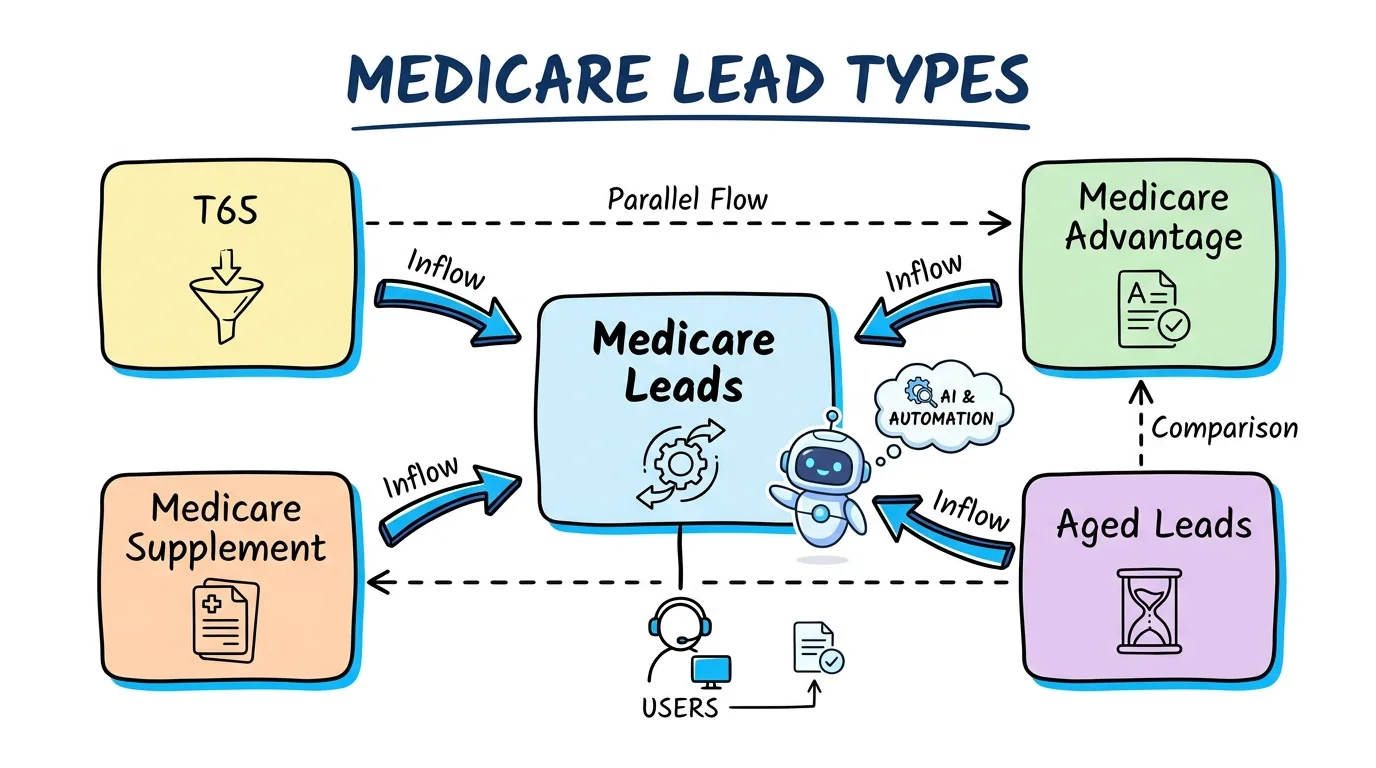
- Medicare leads come in four types: T65 (turning 65), Medicare Advantage, Medicare Supplement, and aged leads. Each has different pricing, exclusivity rules, and compliance requirements.
- Real-time leads convert at 3 to 5 times the rate of aged leads, but live transfers and exclusive web leads cost $40 to $120 per lead versus $1 to $8 for aged lists.
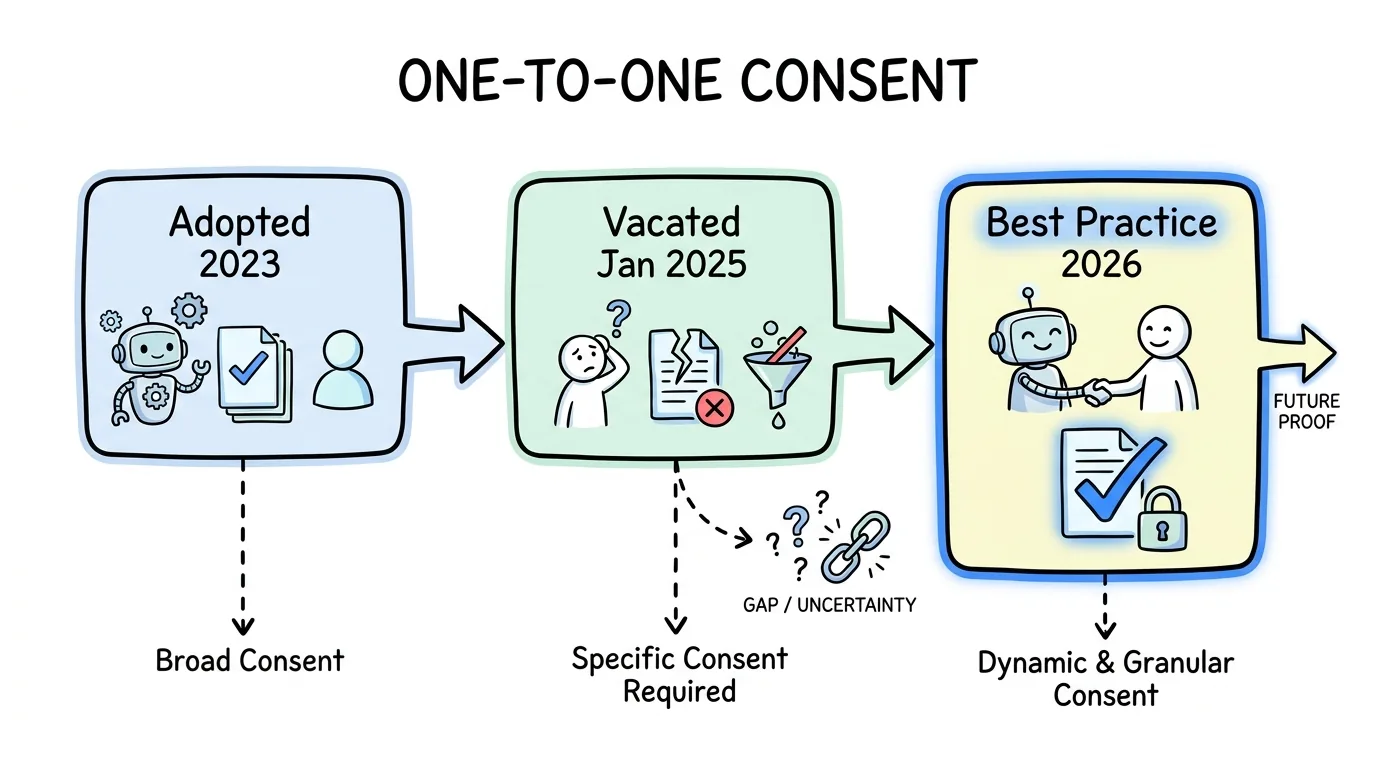
- CMS Final Rule and TCPA are both active constraints. You must have prior express written consent for calls, and since October 2024, each consent must name the specific insurance organization, not a broad third-party transfer disclaimer.
- Ping-post distribution lets lead sellers monetize a single Medicare prospect across multiple licensed agents without violating exclusivity agreements, because only the winning buyer receives the full record.
- The AEP is the peak demand window (October 15 to December 7), when agents pay premium prices and lead velocity surges. Building inventory and compliance infrastructure before AEP is critical.
- Lead Distro AI's 7-day free trial (credit card required) lets agencies test Medicare lead distribution before committing to a plan.
The Four Types of Medicare Leads
Medicare leads are not a single product. Understanding the four categories is the first step in building a profitable distribution strategy.
T65 leads target adults in the six months before their 65th birthday, when they first become eligible for Medicare. These prospects are in active research mode and have a hard enrollment deadline, which makes them the highest-intent and highest-priced segment. T65 filters typically include age range, state, and whether the prospect currently has employer-sponsored coverage.
Medicare Advantage leads target beneficiaries who are evaluating Medicare Part C plans from private insurers. Because Medicare Advantage enrollment accounts for more than half of all Medicare beneficiaries, according to the Kaiser Family Foundation, this is the largest segment by volume.
Medicare Supplement (Medigap) leads target beneficiaries who want to supplement Original Medicare with private coverage for out-of-pocket costs. These prospects tend to be older and more likely to shop by price across multiple carriers.
Aged leads are Medicare prospects who submitted a form 30 to 90 days ago but were never contacted or did not convert. They sell at $1 to $8 per record, making them attractive for high-volume dialing campaigns, but conversion rates are lower because the prospect's situation may have changed.
Medicare Lead Pricing: What Agents Actually Pay in 2026
Pricing for medicare leads varies significantly by type, exclusivity, and delivery method. The following benchmarks come from aggregated pricing across major lead vendors as of Q2 2026.
| Lead Type | Exclusivity | Price Range | Best For |
|---|---|---|---|
| T65 Web Lead | Exclusive | $35 to $75 | Agents writing new enrollees |
| Medicare Advantage Web Lead | Shared (2-3 agents) | $15 to $35 | High-volume agencies |
| Medicare Supplement Web Lead | Exclusive | $40 to $120 | Carriers with competitive rates |
| Live Transfer / Phone Call | Exclusive | $45 to $90 | Agents with strong phone closes |
| Aged Lead List | Non-exclusive | $1 to $8 | Dialer-based agency operations |
"The agents who win in this market are the ones who can contact a T65 lead within five minutes of form submission," says Rafael Hernandez, Founder and CEO of Lead Distro AI. "Speed to lead is not a nice-to-have in Medicare. It is the entire game, because every minute you wait, a competitor's agent is on the phone."
Agencies running shared medicare advantage leads through a lead distribution platform can automate that contact speed through real-time routing rules that ring the next available licensed agent the moment a lead arrives.
CMS and TCPA Compliance for Medicare Leads
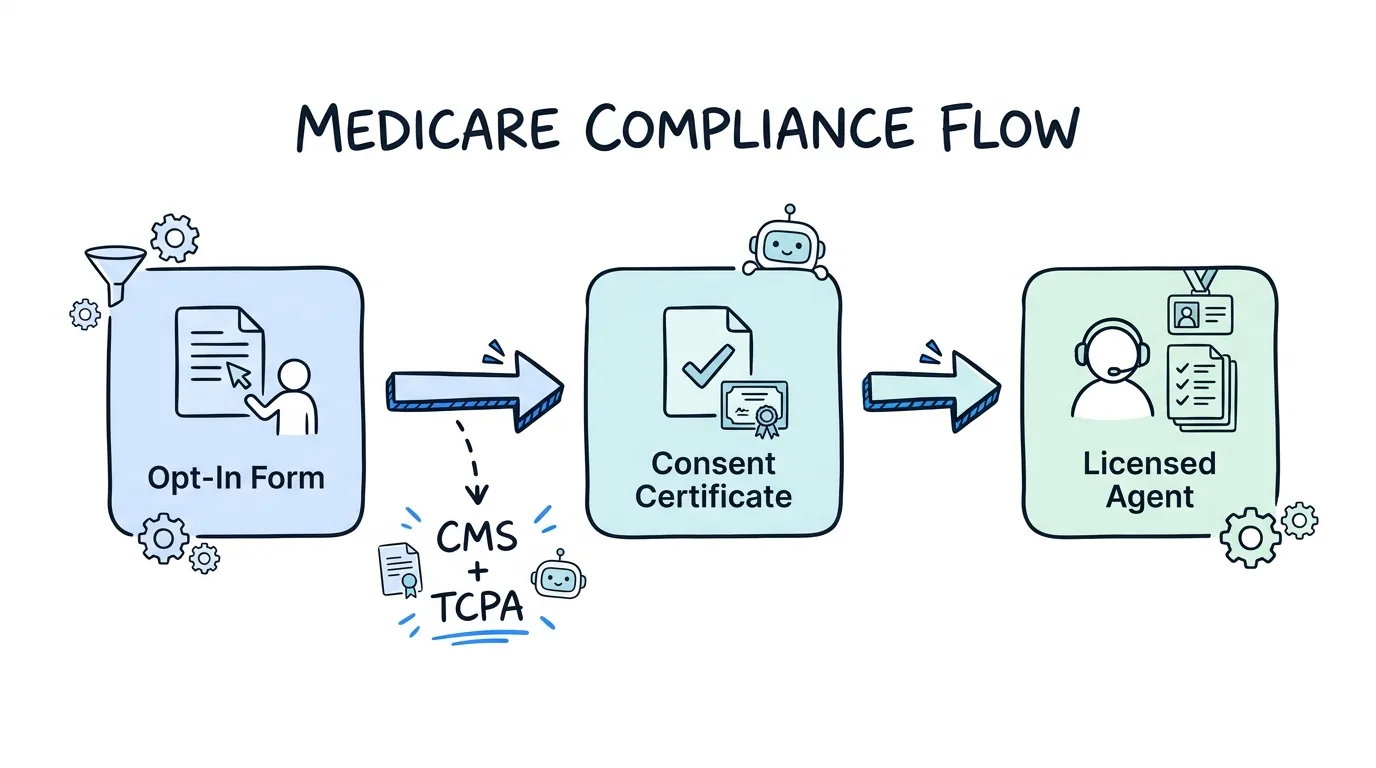
Medicare lead generation operates under two overlapping compliance frameworks that every lead seller and buyer must understand before running a single campaign.
TCPA compliance (the Telephone Consumer Protection Act) requires prior express written consent before using an autodialer or prerecorded voice to call a cell phone. For Medicare leads, this means the opt-in form must clearly disclose that the prospect agrees to receive marketing calls from the specific companies or agents that will contact them. A generic "third-party partners" disclosure is not sufficient. TCPA compliance violations carry penalties of $500 to $1,500 per call, making non-compliant lead sources a significant financial liability.
CMS Final Rule (October 2024) added a layer on top of TCPA specifically for Medicare marketing. The rule requires that each consent form name the specific insurance organization initiating contact, prohibits warm-transfer lead generation where a third-party call center transfers a prospect to a carrier without individual consent, and limits the number of marketing calls to three within a 90-day period.
For lead sellers, this means your consent language must be audited before each campaign, consent certificates (TrustedForm or Jornaya) should be captured at submission, and any ping-post distribution must route only to buyers whose organization name appears in the original consent. For more on building compliant lead pipelines, the health insurance lead generation guide covers opt-in architecture and the consent documentation process.
Buying Medicare Leads vs. Generating Your Own
Lead sellers and agencies face a build-versus-buy decision that comes down to margin, volume, and compliance control.
Buying leads from established vendors like CUNA Mutual, GoHealth, or MediaAlpha gives agencies immediate volume without campaign management overhead. The tradeoff is margin compression, because a shared Medicare Advantage lead purchased for $25 must convert at a high-enough rate to justify the acquisition cost plus agent time. Shared leads also carry compliance risk if the vendor's consent language is not vetted.
Generating your own medicare leads for agents through Google Ads, Facebook lead forms, or Direct Mail (the only channel exempt from TCPA autodialer rules) gives full control over consent language, lead quality, and exclusivity. Google Ads campaigns targeting "Medicare Advantage 2026" or "best Medicare Supplement plan" require significant budget given CPCs above $29, but the resulting leads are first-party, exclusively owned, and priced at whatever your cost per acquisition lands.
A hybrid approach, where agencies buy aged leads for dialer volume while generating fresh exclusive leads through paid search, allows both margin protection and consistent pipeline. The lead distribution platform connects both streams under one routing system so agents receive leads from either source through the same workflow.
Distributing Medicare Leads to Agents via Ping-Post
Ping-post is the dominant distribution method for medicare leads in the multi-buyer market. Here is how it works and why it matters for compliance.
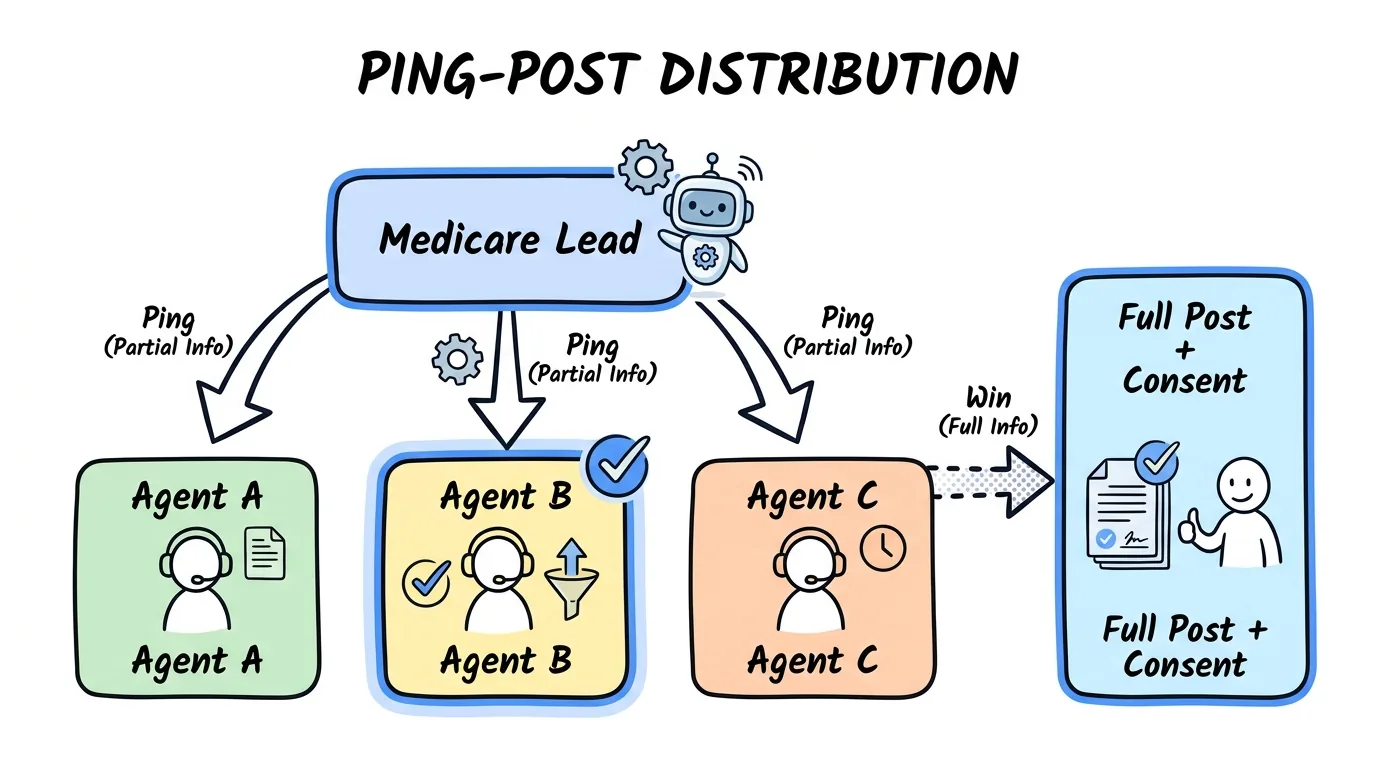
When a prospect submits a Medicare inquiry form, the system sends a "ping" to multiple licensed agents or carriers. The ping contains partial lead data: state, age, lead type, consent date. Each potential buyer responds with a bid. The highest bidder receives the full "post" with name, phone, email, and consent certificate. Only one buyer receives the complete record.
This architecture is important for Medicare compliance because:
- The prospect's data is only fully delivered to one buyer, reducing the risk of multiple unsolicited contacts that violate the CMS three-call rule.
- The consent certificate travels with the post so the receiving agent can verify the opt-in before dialing.
- Buyer caps and state licensing filters can be enforced at the ping stage, so a lead destined for a California beneficiary never reaches an agent unlicensed in California.
Start distributing medicare leads with Lead Distro AI's ping-post engine, which supports real-time bid responses, built-in buyer caps, and consent-certificate passthrough to each winning buyer.
For agencies distributing best medicare leads to a network of licensed agents, Lead Distro AI also supports Priority/Waterfall routing: if the primary agent does not respond within a configurable timeout window (typically 30 to 90 seconds), the lead automatically rolls to the next qualified agent, preserving the speed-to-lead advantage that converts Medicare inquiries into enrolled members.
AEP Strategy: Building Your Medicare Lead Pipeline
The Annual Enrollment Period (October 15 to December 7) is the highest-demand window for medicare advantage leads. Agents and agencies who wait until October to build their pipeline pay premium prices and compete with every major carrier's marketing budget simultaneously.
The preparation timeline that delivers the best cost per enrolled member:
July through September: Run prospecting campaigns at lower CPCs to build a T65 and Medicare Advantage lead inventory. Aged leads purchased in October that were generated in July still carry fresh-enough intent for the AEP window if they have not been heavily contacted.
October 1 through October 14: Activate your highest-budget campaigns. CPCs drop slightly in early October before the formal AEP window opens, giving a short arbitrage window for agencies with budget flexibility.
October 15 through November 30: Peak period. Prioritize speed-to-lead above all else. Agents should be staffed and configured to accept live transfers and ping-post leads immediately.
December 1 through December 7: Final push. Medicare Supplement leads often perform better in this window as beneficiaries who chose Original Medicare reconsider their out-of-pocket exposure going into January.
According to CMS enrollment data, approximately 3.6 million beneficiaries switch or enroll in Medicare Advantage plans each AEP. That enrollment volume drives the competitive lead market and the compliance scrutiny that follows.
FAQ
What are Medicare leads?
Medicare leads are prospects who have expressed interest in Medicare coverage options, including Medicare Advantage (Part C), Medicare Supplement (Medigap), and Part D prescription drug plans. They are typically generated through online inquiry forms, inbound calls, or direct mail response cards and sold to licensed insurance agents and carriers. The most valuable Medicare leads are T65 prospects turning 65 within six months, because they have an enrollment deadline and are in active research mode.
How much do Medicare leads cost in 2026?
Medicare lead pricing in 2026 ranges from $1 to $8 for aged leads to $35 to $120 for exclusive real-time web leads and live transfers. Shared Medicare Advantage web leads typically cost $15 to $35 per lead, while exclusive T65 leads range from $35 to $75. Live transfer leads, where a prospect is already on the phone when connected to the agent, command $45 to $90 due to their significantly higher conversion rate versus form-only leads.
What is the CMS Final Rule for Medicare marketing?
The CMS Final Rule, effective October 2024, requires that Medicare marketing consent forms name the specific insurance organization initiating contact rather than using a generic third-party disclosure. It also prohibits warm-transfer lead generation where a call center transfers a prospect without individual consent for each organization, and it limits marketing calls to three within a 90-day period per prospect. Lead sellers must update consent language and verify that their ping-post routing only sends full lead data to buyers named in the original consent form.
What is the difference between T65 and Medicare Advantage leads?
T65 leads target adults in the six months before their 65th birthday, when they first become eligible for Medicare and must decide between Original Medicare and Medicare Advantage. Medicare advantage leads target existing Medicare beneficiaries who are considering switching to or enrolling in a Part C plan during AEP or a Special Enrollment Period. T65 leads are generally higher-intent and more expensive because the prospect has an enrollment deadline, while Medicare Advantage leads represent a larger total market.
How does ping-post work for Medicare lead distribution?
In ping-post Medicare distribution, a partial lead record (state, age, lead type, consent date) is sent simultaneously to multiple licensed agents or carriers as a "ping." Each buyer responds with a bid or accept/reject decision. The winning buyer receives the complete "post" with the prospect's name, phone number, email, and consent certificate. Only one agent receives the full record, which supports CMS compliance by limiting the number of organizations that contact a single prospect. Lead Distro AI's ping-post engine enforces state licensing filters, buyer caps, and consent passthrough automatically.
Can I distribute Medicare leads to multiple agents?
You can distribute medicare advantage leads to multiple agents using a shared lead model where 2 to 3 agents receive the same record, or using ping-post where only the winning bidder receives the full record. Shared models carry higher TCPA and CMS compliance risk because multiple organizations contact the same prospect. Ping-post is the compliance-safer architecture for multi-agent distribution because consent is verified at the ping stage and the full post goes to only one buyer. Start distributing medicare leads on a platform built for multi-agent Medicare routing.
Conclusion
Medicare leads are one of the highest-value lead categories in the insurance vertical, driven by 11,000 Americans turning 65 every day and a competitive AEP window that compresses agent margins and compliance timelines simultaneously. The agencies that succeed build their pipeline before AEP, maintain airtight CMS and TCPA consent documentation, and route leads to licensed agents fast enough to win the first call.
A purpose-built lead distribution platform handles the routing logic, consent passthrough, state licensing filters, and buyer caps that manual distribution cannot sustain at scale. Whether you are buying medicare leads for agents from third-party vendors or generating your own T65 and Medicare Advantage inventory, the distribution infrastructure determines who gets called first and whether your operations stay on the right side of the CMS Final Rule.
Start distributing medicare leads with Lead Distro AI. Your first 7 days are free, credit card required, cancel anytime.
Ready to route Medicare leads to licensed agents in real time? Start your 7-day free trial and connect your first Medicare lead source in minutes. Credit card required.
About the Author
Founder & CEO of Lead Distro AI & Great Marketing AI
UC Berkeley graduate and former software engineer at Microsoft. Rafael built Lead Distro AI after managing over $10M in ad spend for performance marketing agencies (pay-per-lead and pay-per-call), including running campaigns for Neil Patel. He combines deep software engineering expertise with hands-on performance marketing experience to build tools that help these agencies scale profitably.
About Lead Distro AI
Capture, Route, and Sell Every Lead, Call, and Appointment
Capture, route, and sell leads, calls, and appointments from one platform, with funnels, call tracking, ping-post, and billing built in. Set it all up in minutes by chatting with AI.
Funnels
Quiz, form, appointment, VSL, and webinar templates
Call Tracking
Tracking numbers, call recordings, and per-call billing
4 Distribution Methods
Priority/Waterfall, Round Robin, Weighted, Ping-Post
Ping-Post and Live Bidding
Sell each lead and call to the highest bid
Real-Time P&L
Revenue, cost, and profit per campaign
Partner Portal
Your Destinations see their own leads and results