Lead Return Policies: How to Return Bad Leads and Get Credited
A lead return policy defines which bad leads a buyer can send back for credit. Here is how lead returns work, what to allow, and how to set fair terms.

Rafael Hernandez
Founder & CEO
Ex-Microsoft SWE · $10M+ PPL ad spend
I hope you enjoy reading this blog post. If you want to try Lead Distro AI for free, click here.
Author: Rafael Hernandez | Founder & CEO of Lead Distro AI
A lead return policy is the agreement between a lead seller and a lead buyer that defines which leads can be sent back for a credit or refund, for what reasons, and within what time window. Bad leads are not a question of if but how many: B2B contact data decays at roughly 30% per year, so wrong numbers, disconnected lines, and duplicates are structural, not occasional. A clear return policy protects the buyer from paying for leads they can never work, and it protects the seller from buyers who try to return everything that simply did not close. Both sides need one in writing before the first lead changes hands. This guide explains what a lead return policy is, which leads should and should not be returnable, how to set a fair return window and return rate cap, and how Lead Distro AI handles returns and credits automatically so neither side has to argue over a spreadsheet.
Key Takeaways
- A lead return policy defines what counts as a bad lead, the valid reasons for a return, the return window, and whether the buyer gets a credit or a refund.
- Returnable leads are defects, not disappointments: wrong or disconnected numbers, duplicates, out-of-area contacts, and leads with no consent. A lead that simply did not convert is not returnable.
- A return window keeps returns honest, accepting returns only within a set number of days after delivery so buyers cannot return aged leads they sat on.
- A return rate cap protects sellers from abuse, because a buyer returning 30% or more is usually a process problem, not a quality problem.
- Lead Distro AI automates returns end to end, with per-buyer return settings, a configurable return window, and automatic wallet credit on approved returns.
What is a lead return policy?
A lead return policy is the rulebook for sending leads back. It answers four questions: which leads qualify for a return, how long the buyer has to request one, what proof is required, and whether an approved return becomes a wallet credit or a cash refund. Without it, every disputed lead becomes a negotiation, and disputes are where seller and buyer relationships break down.
Think of the policy as a quality warranty on a perishable product. The seller stands behind the lead being deliverable and accurately described, while the buyer agrees to act on it quickly and only return genuine defects. A good policy is specific enough that both sides know the answer before a dispute starts. That is why clear lead acceptance criteria and a return policy work as a pair: acceptance criteria define what you agreed to buy, and the return policy defines what happens when a lead fails that definition.
What makes a lead returnable
A lead is returnable when it has a defect that makes it unworkable through no fault of the buyer. It is not returnable simply because the buyer did not close it. Drawing that line clearly is the single most important part of the policy, because it is where most disputes live.
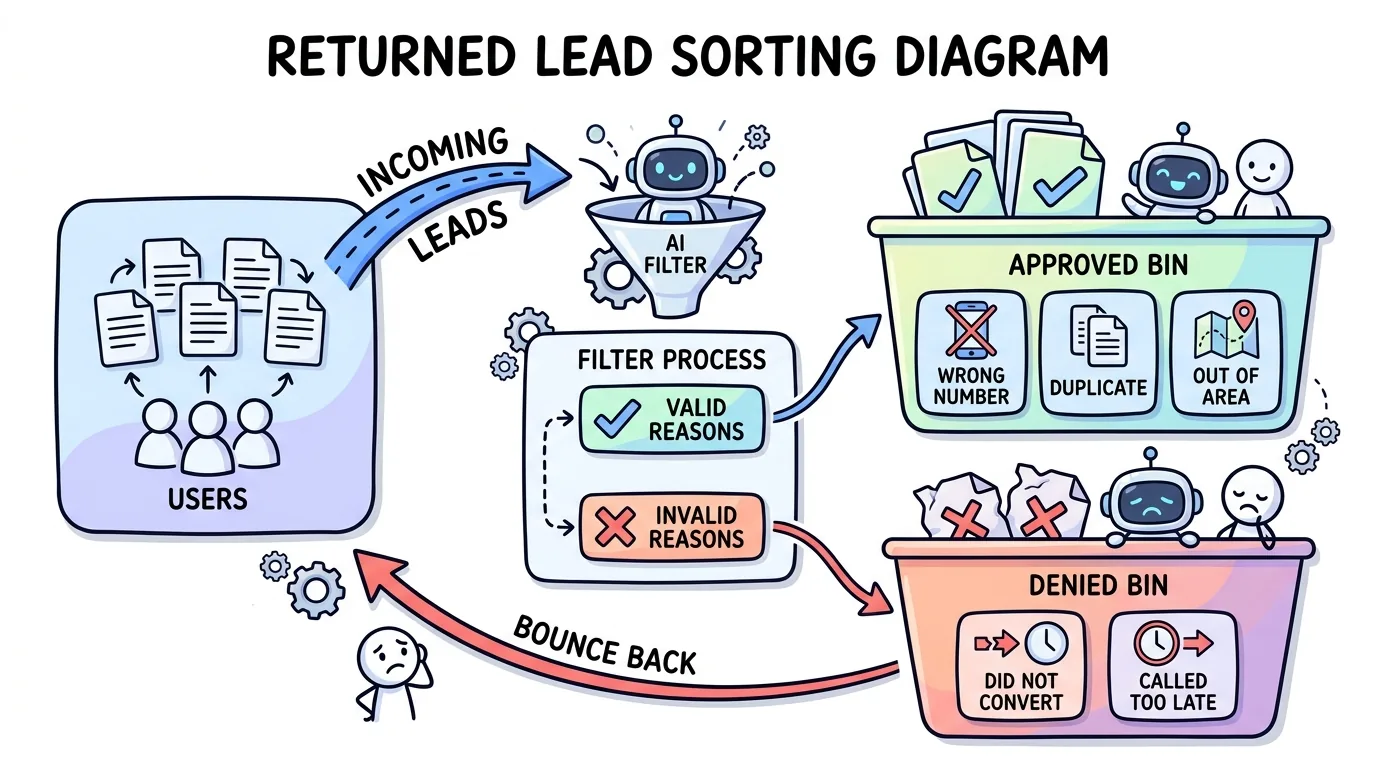
| Usually returnable (defects) | Usually not returnable (outcomes) |
|---|---|
| Wrong or disconnected phone number | Lead did not answer or did not convert |
| Duplicate of a lead already delivered | Buyer called too slowly to reach them |
| Outside the agreed geography or vertical | Buyer changed their mind about the campaign |
| Missing required fields or fake contact info | Lead was a tire-kicker but real and reachable |
| No proof of consent (no valid certificate) | Buyer's own intake process dropped the lead |
Phone numbers are the most common defect because phone data decays around 43% a year. The fix is upstream: catching disconnected and invalid numbers and duplicate leads before delivery removes most returnable defects before a buyer ever sees them.
Setting a fair return window
The return window is the number of days after delivery during which a buyer can request a return. It exists because lead quality is time-sensitive: a phone number that was valid on delivery may be the buyer's fault if they let it sit for three weeks before dialing. Too short a window punishes buyers who batch their calling; too long a window lets buyers return aged leads they never worked.
Most operations land between 3 and 14 days depending on the vertical and how fast leads need to be contacted. High-urgency verticals like insurance and home services run shorter windows because speed to lead matters and a stale lead is on the buyer. Considered-purchase verticals can run longer. Whatever you choose, write it down and enforce it the same way every time, because an inconsistently enforced window is the same as no window at all.
Return rate caps and abuse
A return policy also has to protect the seller. Returns are a normal cost of the business, but a buyer who returns an unusually high share of leads is either misreading your policy or gaming it. "A return rate in the low single digits is healthy," says Rafael Hernandez, Founder and CEO of Lead Distro AI. "When a buyer's returns climb toward a third of everything you send, that is almost never a quality problem, it is a process problem or abuse, and your policy needs a cap that triggers a conversation before it triggers a refund."
A return rate cap sets a ceiling on the percentage of leads a buyer can return before returns require manual review instead of automatic approval. It keeps honest buyers fully covered while flagging the rare buyer who returns everything that did not convert. Pair the cap with a tracked return reason on every return so patterns are visible: ten "wrong number" returns from one buyer points at a data source, while ten "did not convert" returns points at the buyer.
How returns protect both buyer and seller
A fair return policy is not a concession to buyers, it is the foundation of a repeatable lead business. For buyers, it removes the risk of paying for leads they can never work, which is what makes them comfortable increasing volume. Poor data quality already costs organizations an average of $12.9 million a year according to Gartner, and a return policy is how a buyer caps that exposure on purchased leads.
For sellers, returns are a retention tool. A buyer who can return a genuine defect without a fight trusts you and buys again, while a seller who fights every return loses the account. Returns also feed quality control: every returned lead with a reason tells you which sources to fix. Scoring every lead before it is sold makes those disputes easier to settle, because you can show the buyer the rules each lead passed; our comparison of lead scoring software for lead sellers covers the tools that do this. The sellers who treat returns as feedback, not as lost revenue, end up with cleaner data and higher prices. If you are building the operation, our guides on how to sell leads and how to buy leads show where the return policy fits on each side of the transaction.
How Lead Distro AI handles lead returns
Lead Distro AI runs your return policy as software instead of a spreadsheet. You decide, per buyer, whether they can submit returns from their buyer portal, and you set a return window so returns are only accepted within a configurable number of days after delivery. You can add a return policy note that buyers see before they submit, so your rules are in front of them at the moment they request a return.
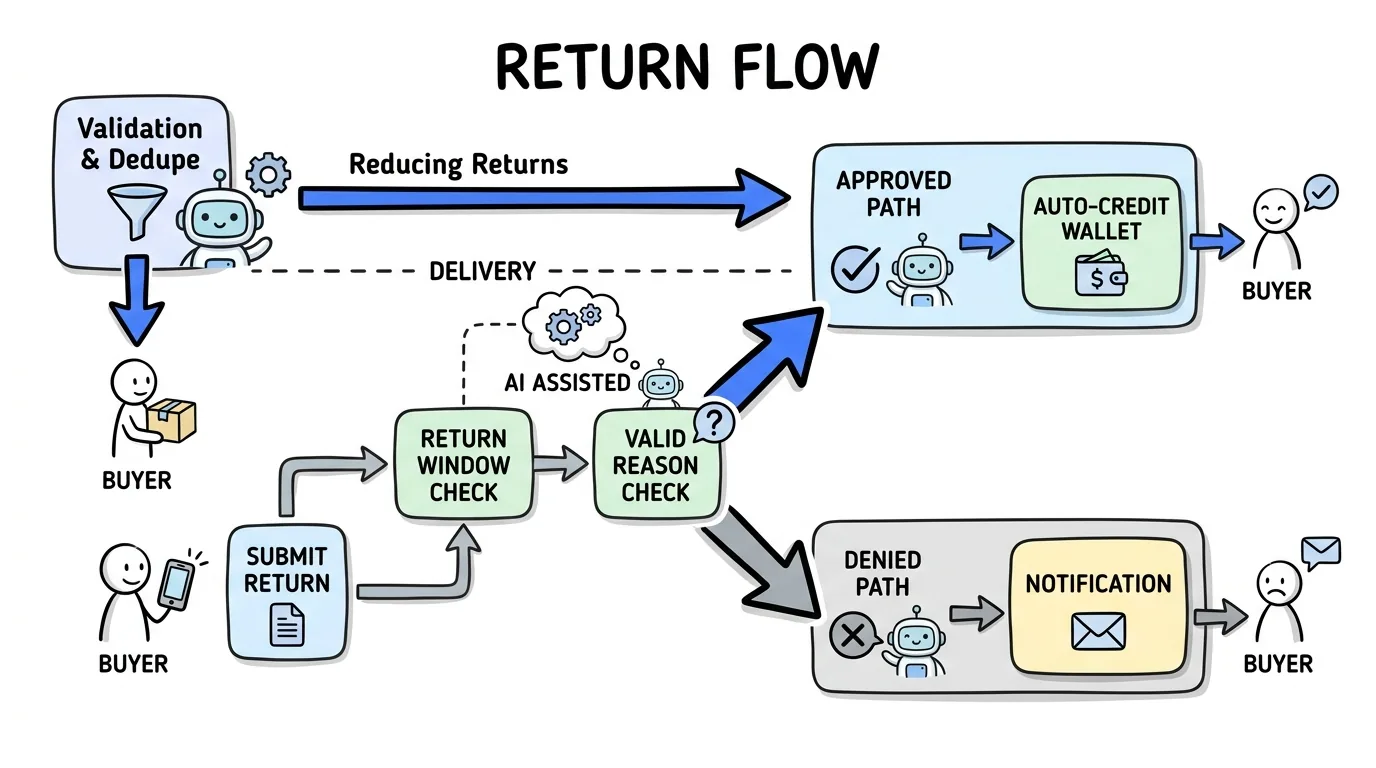
When a return is approved, the lead is automatically refunded to the buyer's wallet, so wallet buyers see the credit instantly with no manual reconciliation. Buyers billed by invoice are credited through your normal billing reconciliation rather than an automatic wallet top-up, so it is worth aligning your billing model with how hands-off you want returns to be. The best returns, though, are the ones that never happen: routing every lead through phone validation and duplicate detection at ingest, and requiring a valid consent certificate, removes most returnable defects before delivery. See it work in the product tour, or start a free trial and configure your return policy in minutes.
FAQ
What is a lead return policy?
A lead return policy is the agreement between a lead seller and buyer that defines which leads can be returned for a credit or refund, for what reasons, and within what time window. It typically covers valid return reasons such as wrong numbers, duplicates, and out-of-area contacts, the return window in days, any required proof, and whether approved returns become wallet credits or refunds. A written policy prevents disputes by setting expectations before the first lead is delivered.
Which leads can you return?
You can usually return leads with a genuine defect: wrong or disconnected phone numbers, duplicates of leads already delivered, contacts outside the agreed geography or vertical, missing or fake required fields, and leads with no valid proof of consent. You generally cannot return a lead just because it did not convert, the prospect did not answer, or your team contacted it too slowly. The line is defect versus outcome: defects are returnable, disappointing outcomes are not.
How long is a typical lead return window?
Most lead return windows run between 3 and 14 days after delivery, depending on the vertical. High-urgency verticals like insurance and home services use shorter windows because lead quality decays fast and slow contact is the buyer's responsibility. Longer windows fit considered-purchase verticals. The window exists so buyers cannot return aged leads they failed to work, while still giving honest buyers time to dial and verify each lead.
What is a healthy lead return rate?
A healthy lead return rate usually sits in the low single digits as a percentage of leads delivered. Returns are normal, but a buyer whose return rate climbs toward 30% or more is typically signaling a process problem or policy abuse rather than a true quality issue. Tracking a return reason on every return makes the pattern clear: many "wrong number" returns point at a data source to fix, while many "did not convert" returns point at the buyer.
How does Lead Distro AI process returns and credits?
Lead Distro AI lets you enable returns per buyer, set a configurable return window, and show a return policy note before a buyer submits. When a return is approved, the lead amount is automatically credited back to the buyer's wallet, so wallet buyers get an instant credit with no manual work, while invoice buyers are credited through billing reconciliation. Upstream phone validation and duplicate detection reduce returns by catching defects before delivery.
Conclusion
A lead return policy is what turns a one-time lead sale into a repeatable relationship. Define returnable leads as defects rather than disappointments, set a return window that matches your vertical's urgency, cap return rates to stop abuse, and track a reason on every return so the data tells you what to fix. Done well, returns protect the buyer's budget and the seller's reputation at the same time. Lead Distro AI runs the whole policy for you, with per-buyer return settings, configurable windows, and automatic wallet credits, and it cuts returns at the source by validating consent and contact data before a lead is ever delivered. To pair returns with verified consent, read our guide to why buyers and sellers need TrustedForm.
Tired of arguing over bad leads in email threads? Start your 7-day free trial and run your lead return policy as software.
About the Author
Founder & CEO of Lead Distro AI & Great Marketing AI
UC Berkeley graduate and former software engineer at Microsoft. Rafael built Lead Distro AI after managing over $10M in ad spend for performance marketing agencies (pay-per-lead and pay-per-call), including running campaigns for Neil Patel. He combines deep software engineering expertise with hands-on performance marketing experience to build tools that help these agencies scale profitably.
About Lead Distro AI
Lead Distro AI: Capture, Route, and Sell Every Lead, Call, and Appointment
The modern platform for pay-per-lead and pay-per-call agencies. Route, score, and deliver leads with AI-powered automation and real-time P&L tracking. Built for performance marketing agencies and lead buyers across legal, insurance, mortgage, solar, and home services verticals.
4 Distribution Methods
Waterfall, Round Robin, Weighted, Ping-Post
Ping-Post Auctions
Real-time bidding with sub-second routing
Real-Time P&L Reporting
Track revenue, costs, and profit per campaign
Call Tracking
Assign tracking numbers, record calls, and attribute conversions
Lead Scoring
Score every lead before routing to maximize conversion
Partner Portal
Self-serve dashboard for buyers to track leads