Lead Management System vs CRM: What Agencies Need in 2026
A lead management system handles intake, dedup, scoring, and routing; a CRM manages relationships. Here is how the two differ and when agencies need each.

Rafael Hernandez
Founder & CEO
Ex-Microsoft SWE · $10M+ PPL ad spend
I hope you enjoy reading this blog post. If you want to try Lead Distro AI for free, click here.
Author: Rafael Hernandez | Founder & CEO of Lead Distro AI
Last Updated: June 1, 2026
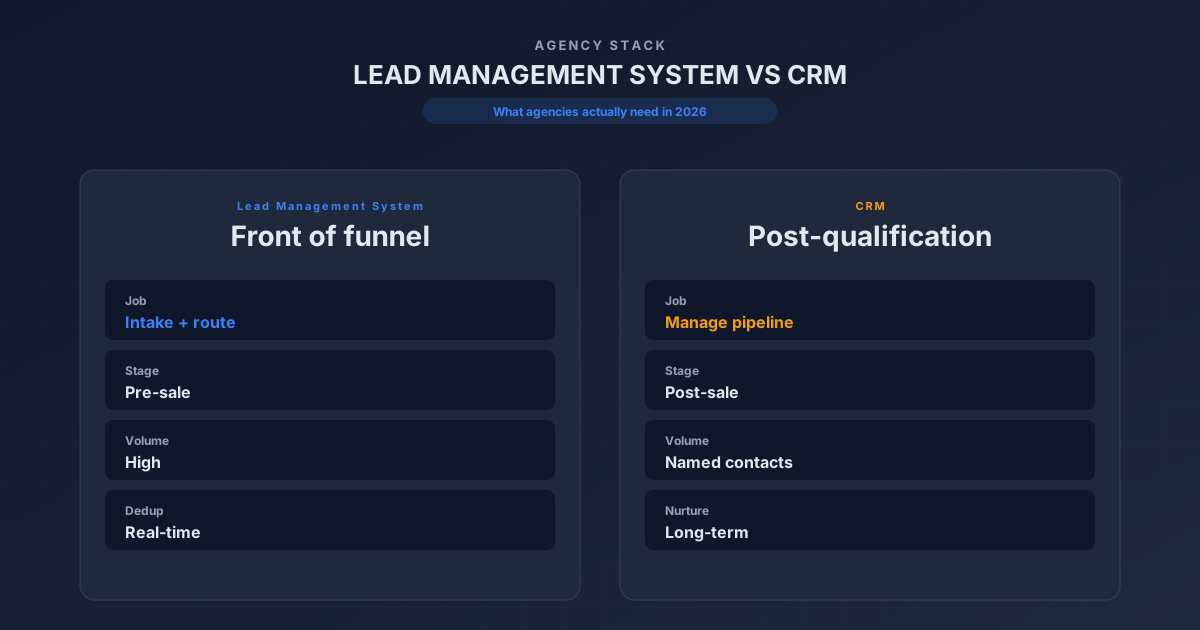
A lead management system and a CRM solve different problems, and confusing them costs agencies money. A lead management system handles the front of the funnel: it captures inbound leads, removes duplicates, scores quality, and routes each lead to the right buyer or rep in real time. A CRM manages what happens after that: pipeline stages, contact history, follow-up tasks, and long-term customer relationships. The simplest way to remember it is that a lead management system works the moment a lead arrives, and a CRM takes over once that lead becomes a known, named opportunity you are nurturing toward a sale.
According to Grand View Research, the global CRM market reached $101.4 billion in 2024, while lead management is a distinct, faster-moving category focused on speed-to-contact. For high-volume pay-per-lead and pay-per-call agencies, the difference is not academic. A CRM was never designed to dedup 4,000 inbound form fills a day and split them across 12 buyers by geography and cap. That is the job of a lead manager system built for distribution. This guide breaks down the two tools, adds the third category most comparisons miss (the lead distribution platform), and shows how agencies combine all three.
Key Takeaways
- A lead management system handles intake, dedup, scoring, and routing at the top of the funnel, while a CRM manages the relationship and pipeline after a lead is qualified.
- CRMs are built for known, named contacts; lead management and distribution platforms are built for raw inbound volume that has to be sorted and delivered fast.
- A lead distribution platform is a specialized lead management layer for agencies that sell or route leads to multiple buyers, with round robin, weighted, priority, and ping-post methods.
- Lead Distro AI is a distribution and routing platform, not a CRM, and it is designed to sit in front of whatever CRM your buyers already use.
- Most agencies need both: a distribution layer to deliver leads cleanly and a CRM to work them, connected through webhooks and integrations.
What a Lead Management System Actually Does
A lead management system is software that controls a lead from the second it enters your business until it is handed off to a buyer or a sales rep. Its core jobs are intake (capturing leads from forms, landing pages, ad platforms, and APIs), deduplication (rejecting the same person submitted twice), lead scoring (ranking quality), and lead routing (deciding who gets it). The goal is speed and accuracy at volume.
This is the early, pre-sale stage of the funnel. Lead management is concerned with making sure no inbound prospect is overlooked before it ever reaches a salesperson. A good lead management platform measures acceptance rate, tracks lead source attribution, and enforces lead caps so no buyer is overloaded. For agencies, this layer is where revenue is won or lost, because a slow or duplicate-heavy delivery directly lowers what buyers will pay per lead.
What a CRM Actually Does
A CRM, short for customer relationship management, manages the relationship after a lead is qualified and named. Salesforce, HubSpot, and Pipedrive are well-known examples, and a CRM's strength is the sales pipeline: tracking deals through stages, logging every email and call on a contact record, scheduling follow-up tasks, and reporting on close rates over months. A CRM assumes you already know who the lead is and that a human is working it toward a sale.
That assumption is the key difference. As LeadSquared notes, a CRM encompasses the entire customer lifecycle, from first contact through post-sale service and renewals. It is built for depth on a manageable number of relationships, not for sorting thousands of anonymous inbound leads per day. A CRM excels at lead nurturing, workflow automation, and long-term retention. It is the system of record for your customers, but it is not built to be the front door for raw lead volume.
Lead Management System vs CRM vs Lead Distribution Platform
Most comparisons stop at two categories and miss the one that matters most to agencies: the lead distribution platform. A distribution platform is a specialized lead management solution for businesses that route or sell leads to multiple buyers rather than working every lead with their own reps. The table below shows where each tool fits.
| Capability | Lead Management System | CRM | Lead Distribution Platform |
|---|---|---|---|
| Primary job | Intake, dedup, score, route | Manage pipeline and relationships | Deliver leads to multiple buyers |
| Funnel stage | Pre-sale (top) | Post-qualification | Pre-sale, multi-buyer |
| Built for volume | Yes | No | Yes, very high |
| Deduplication | Yes | Limited | Yes, real-time |
| Distribution methods | Basic routing | None | Round robin, weighted, priority, ping-post |
| Buyer delivery and caps | Sometimes | No | Core feature |
| Acceptance-rate reporting | Sometimes | No | Yes |
| Long-term nurture | No | Yes | No |
| Example | Lead intake tools | General-purpose sales CRMs | Lead Distro AI |
The pattern is clear. A lead manager system and a distribution platform own the top of the funnel; a CRM owns everything after a lead is qualified. If you want to understand the routing piece in depth, read our guide on what is lead routing, compare tools in our lead routing software rankings, and for the full category overview see our lead management software pillar.
Where Lead Distro AI Fits (and Where It Does Not)
Lead Distro AI is a lead distribution and routing platform, not a CRM and not a do-everything lead management suite. We want to be precise about that, because the wrong expectation leads to the wrong setup. Lead Distro AI does the distribution-layer jobs extremely well: it ingests leads through webhooks and APIs, deduplicates in real time, scores quality against your rules, and routes each lead to the right buyer using four methods (Round Robin, Weighted, Priority, also called Waterfall, and Ping-Post). It reports acceptance rate and profit per buyer. What it does not do is replace the CRM your buyers use to work those leads.
"We built Lead Distro AI to be the cleanest possible front door for high-volume agencies, then hand off to whatever CRM the buyer already trusts," says Rafael Hernandez, Founder and CEO of Lead Distro AI. That honest scoping is the point. You can see how Lead Distro AI routes leads in the product tour, then connect the output to Salesforce, HubSpot, or a buyer's in-house system. The platform also includes usage-based call tracking (a per-number monthly fee plus a per-minute inbound rate) for pay-per-call agencies that route calls alongside form leads. If you sell both, here is how to manage leads and calls in one place.
When Agencies Need Each Tool
You almost never choose between a lead management system and a CRM; you decide which combination your operation needs. A small agency working its own leads with a couple of reps can sometimes run a CRM alone, using its basic lead capture and routing. A high-volume agency that buys media and sells or distributes leads to multiple law firms, contractors, or insurance buyers needs a dedicated distribution layer in front of any CRM, because no CRM is built to dedup and split thousands of inbound leads per day.
The integration is what makes both work together, and the right lead management solution is the one that delivers leads cleanly to whatever CRM the buyer already runs. As nocRM.io points out, the lead management stage ends when a lead becomes a customer, and the CRM carries on from there. In practice, Lead Distro AI delivers a clean, deduplicated, scored lead to the buyer, and the buyer's CRM logs it and runs the nurture sequence. For agencies that also want reporting across the whole flow, our lead reporting software for agencies guide covers how to measure acceptance and profit by buyer. You can start a free trial of Lead Distro AI to test the distribution layer against your own lead flow.
How to Combine Both Without Overpaying
The most cost-effective stack pairs a purpose-built distribution platform with the CRMs your buyers already own, connected by webhooks. Run intake, deduplication, scoring, and routing in the distribution layer, then push the qualified lead into the CRM through an API integration or webhook delivery. This avoids paying a CRM vendor for high-volume seats it was never designed to handle, and it avoids forcing a distribution job onto a relationship tool.
A practical rule from running pay-per-lead operations: measure your duplicate rate before and after adding a real distribution layer. Agencies routinely find that 8 to 15 percent of raw inbound leads are duplicates, and a CRM that charges per record makes you pay to store junk. A distribution platform rejects those at intake. To compare full platforms across this stack, see our roundup of the best lead management software for agencies, and use the lead pricing calculator to estimate your cost per accepted lead. Lead Distro AI plans start at $297 per month, and you can review all pricing tiers before committing.
FAQ
What is the difference between a lead management system and a CRM?
A lead management system handles the top of the funnel: capturing inbound leads, removing duplicates, scoring quality, and routing each lead to the right buyer or rep in real time. A CRM manages what happens after a lead is qualified, including pipeline stages, contact history, follow-up tasks, and long-term nurture. The lead management stage ends when a lead becomes a customer, and the CRM carries the relationship forward from there. Most agencies use both, connected by an integration.
Is Lead Distro AI a CRM?
No. Lead Distro AI is a lead distribution and routing platform, not a CRM. It specializes in the distribution layer: ingesting leads through webhooks and APIs, deduplicating in real time, scoring against your rules, and routing to multiple buyers using Round Robin, Weighted, Priority (also called Waterfall), and Ping-Post methods. It is designed to sit in front of whatever CRM your buyers already use, delivering clean, scored leads that their CRM then works toward a sale. It complements a CRM rather than replacing it.
Do I need both a lead management platform and a CRM?
Most high-volume agencies do. A lead management platform or distribution layer handles raw inbound volume that has to be deduplicated and routed fast, which a CRM is not built to do at scale. The CRM then works the qualified lead through its pipeline and nurture sequence. Small agencies working their own low volume can sometimes run a CRM alone, but agencies that buy media and distribute leads to multiple buyers almost always need a dedicated distribution platform in front of the CRM.
Can a CRM handle lead distribution?
A CRM can do basic lead assignment, but it is not built for true lead distribution at volume. CRMs lack real-time deduplication across thousands of daily leads, multi-buyer delivery with caps, weighted and ping-post routing, and acceptance-rate reporting by buyer. Forcing distribution onto a CRM usually means paying per-record fees to store duplicate junk and missing the speed buyers pay for. A dedicated lead distribution platform handles intake and routing, then hands the qualified lead to the CRM through an API integration.
How much does a lead management system cost for an agency?
Pricing varies widely by category and volume. Distribution-focused platforms like Lead Distro AI start at $297 per month, with volume-based tiers above that and usage-based call tracking (a per-number monthly fee plus a per-minute inbound rate) for pay-per-call agencies. CRMs are typically priced per seat per month, which gets expensive when you store high lead volume. The most cost-effective approach is to run a dedicated distribution layer for intake and routing, then connect it to the CRMs your buyers already own.
Conclusion
A lead management system and a CRM are not competitors; they are neighbors in the funnel. The lead management and distribution layer captures, cleans, scores, and routes inbound leads at volume, and the CRM works each qualified lead toward a sale and beyond. For pay-per-lead and pay-per-call agencies, the missing piece is a dedicated distribution platform that handles what a CRM cannot. Lead Distro AI fills exactly that role, honestly scoped as the routing layer that feeds your buyers' CRMs. Get the front door right, connect it to the right CRM, and you stop paying to store duplicates while delivering the fast, clean leads buyers actually pay for.
Want to see how the distribution layer works alongside your CRM? Start your 7-day free trial and route your first lead in minutes.
About the Author
Founder & CEO of Lead Distro AI & Great Marketing AI
UC Berkeley graduate and former software engineer at Microsoft. Rafael built Lead Distro AI after managing over $10M in ad spend for performance marketing agencies (pay-per-lead and pay-per-call), including running campaigns for Neil Patel. He combines deep software engineering expertise with hands-on performance marketing experience to build tools that help these agencies scale profitably.
About Lead Distro AI
Lead Distro AI: Capture, Route, and Sell Every Lead, Call, and Appointment
The modern platform for pay-per-lead and pay-per-call agencies. Route, score, and deliver leads with AI-powered automation and real-time P&L tracking. Built for performance marketing agencies and lead buyers across legal, insurance, mortgage, solar, and home services verticals.
4 Distribution Methods
Waterfall, Round Robin, Weighted, Ping-Post
Ping-Post Auctions
Real-time bidding with sub-second routing
Real-Time P&L Reporting
Track revenue, costs, and profit per campaign
Call Tracking
Assign tracking numbers, record calls, and attribute conversions
Lead Scoring
Score every lead before routing to maximize conversion
Partner Portal
Self-serve dashboard for buyers to track leads