Ad Attribution for Lead Generation: Find Real Leads
Ad attribution for lead generation connects every ad to the real, non-disqualified leads it produces, so you optimize spend on sold leads, not just form fills.

Rafael Hernandez
Founder & CEO
Ex-Microsoft SWE · $10M+ PPL ad spend
I hope you enjoy reading this blog post. If you want to try Lead Distro AI for free, click here.
Author: Rafael Hernandez | Founder & CEO of Lead Distro AI
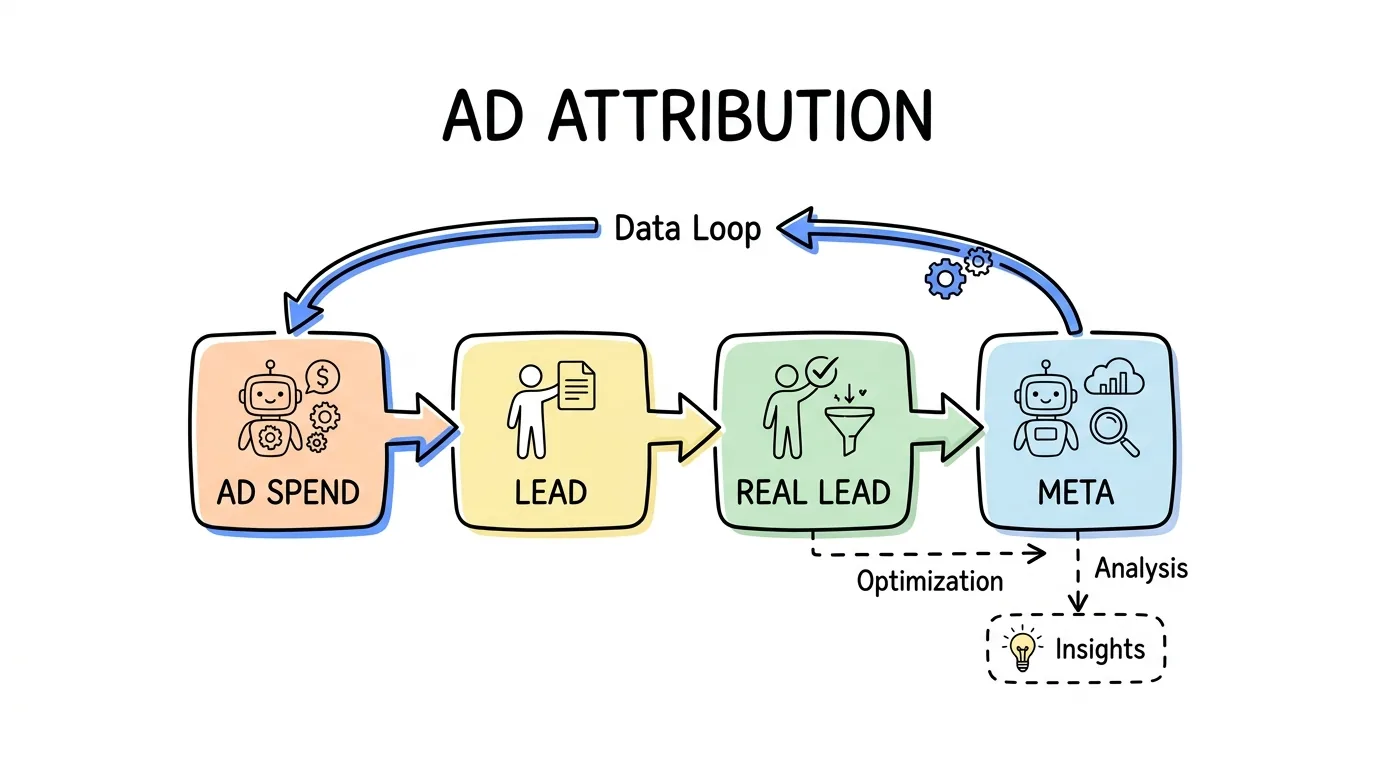
Ad attribution for lead generation is the practice of connecting every ad you run to the real leads it actually produces, not just the form fills it reports, so you can spend your budget on the creatives and campaigns that deliver qualified, billable leads. Most paid acquisition stops measuring at the form submission: the ad platform counts a conversion, your cost per lead looks great, and then half of those leads turn out to be junk your buyers reject. Real ad attribution carries the signal one step further, from the click to the form fill to the lead that survives scoring and gets accepted or sold. It answers the only question a media buyer actually cares about: which ad brought a real lead?
The closed loop has three moving parts: capture the ad click ID on every lead, mark each lead's true outcome (disqualified, accepted, or sold), and send that outcome back to the ad platform so its algorithm learns what a good lead looks like. Lead Distro AI now does all three, with Meta ad tables that show real leads per ad, a server-side event that fires the moment a lead arrives, and dashboards that chart spend against cost per real lead. Start a 7-day free trial to wire it up.
The bottom line: Stop optimizing your lead gen ads on form-fill volume. Track which ads produce real, non-disqualified leads, send that outcome back to the ad platform, and move budget to the ads that actually sell.
Key Takeaways
- Ad attribution for lead generation measures ads by the real leads they produce, not the raw form fills an ad platform reports by default.
- The loop has three steps: capture the ad click ID, mark each lead's true outcome, and send that outcome back to the ad platform.
- A "Non-DQ" view changes which ad wins: the cheapest cost per form fill is often the most expensive cost per real lead.
- Send leads back server-side. Lead Distro AI can fire a Meta Conversions API event the moment a lead is ingested, so campaigns optimize toward lead volume, while accepted and converted events optimize toward quality.
- Attribution is only useful when it is visible. Dashboards that chart spend, CPC, and cost per real lead per ad turn the loop into daily decisions.
Why Lead Gen Ad Attribution Usually Stops at the Form Fill
When someone submits a Meta or Google lead form, every submission looks identical to the algorithm, so it optimizes for the cheapest possible form-fill. Facebook lead ads prioritize the volume of leads by default, which is why Meta built a separate Conversion leads performance goal that focuses on quality instead (Meta for Developers). Without marketing attribution back to real outcomes, you get a low cost per lead and a buyer who fires you in 30 days. This is the gap that breaks lead source attribution: the platform sees the click and the submission, but never learns what happened next. The cost is not small. One 2026 analysis found that companies without proper tracking waste 30 to 40 percent of their marketing budget on ineffective activity (Deep Marketing, 2026), and a separate survey reported that while 70 percent of leaders feel confident in their budgets, 41.6 percent admit a portion is wasted (PPC.land, 2026).
The Three Signals Every Lead Gen Advertiser Should Track
Most advertisers track one number, the form fill, when they should track four. Each step down the chain filters out junk and raises the true cost per lead, which is exactly why the right signal changes your decisions. Form fills count every submission. Leads ingested count the ones that reach your system. Non-DQ leads are the ones that pass scoring and are not disqualified. Accepted or sold leads are the ones a buyer paid for, the only true revenue signal. The further down you optimize, the more your spend chases real outcomes instead of vanity conversions. Once cost per real lead is visible, ROI and ROAS tracking tells you whether each campaign is actually profitable after platform fees.
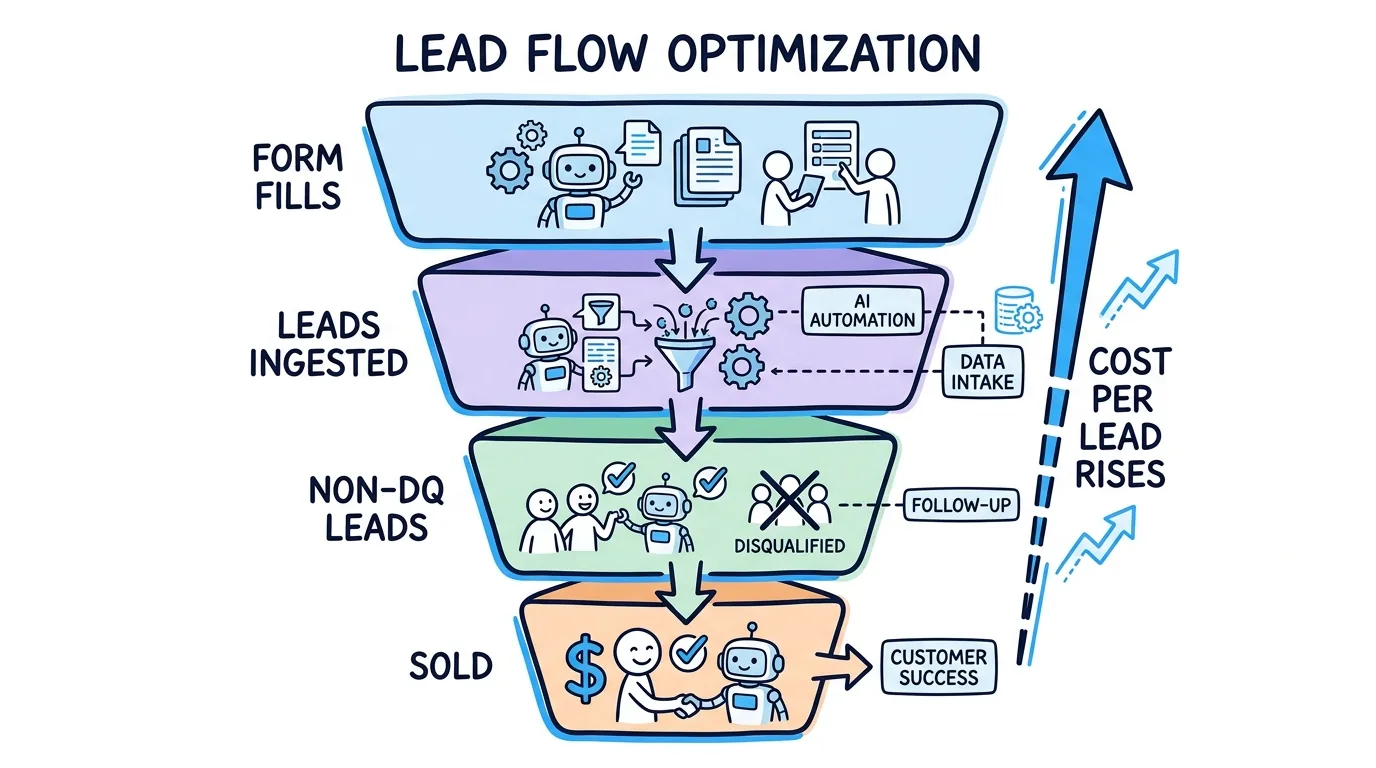
| Signal | What it measures | Optimization risk |
|---|---|---|
| Form fills | Every form submission | Optimizes for the cheapest form, attracts junk |
| Leads ingested | Leads that reach your system | Better volume signal, still unvalidated |
| Non-DQ leads | Leads that pass scoring | Filters obvious junk, much closer to real |
| Sold / accepted leads | Leads a buyer accepted or paid for | True revenue signal, the gold standard |
How Ad-to-Lead Attribution Actually Works
The mechanics are a closed loop. First, capture the ad click ID at the moment of submission: the fbclid for Meta and the gclid for Google. That identifier is what lets the platform match a later server event back to the original click, and missing it is the most common reason facebook ads attribution silently fails. Second, ingest and score every lead against your rules so you know which ones are real before a human ever touches them; Lead Distro AI scores each lead against your rules in under a second, and the lead scoring guide covers the full framework. Third, mark each lead's outcome and send it back to the ad platform with the Conversions API. The deep mechanics of that server-side feedback loop live in our Meta Conversions API for lead generation guide, and the Lead Distro AI Meta CAPI integration fires the events automatically as a lead's status changes. Run end to end, that is closed loop attribution.
Reading Ad Performance by Real Leads, Not Form Fills
This is where ad attribution stops being a report and starts changing budgets. Lead Distro AI's Meta ad tables now show a Non-DQ column, and Winning Ads can rank by Non-DQ Leads, so you can spot the ads that deliver real leads instead of ones marked disqualified. Consider two ads in one campaign as an example. Ad A spends $2,000, produces 100 form fills at a $20 cost per lead, but only 30 survive scoring, so its true cost per real lead is about $67. Ad B spends $2,100, produces 60 form fills at a $35 cost per lead, but 42 are non-DQ, so its real cost is $50. Ad B looked 75 percent more expensive on form fills and is actually cheaper per real lead.
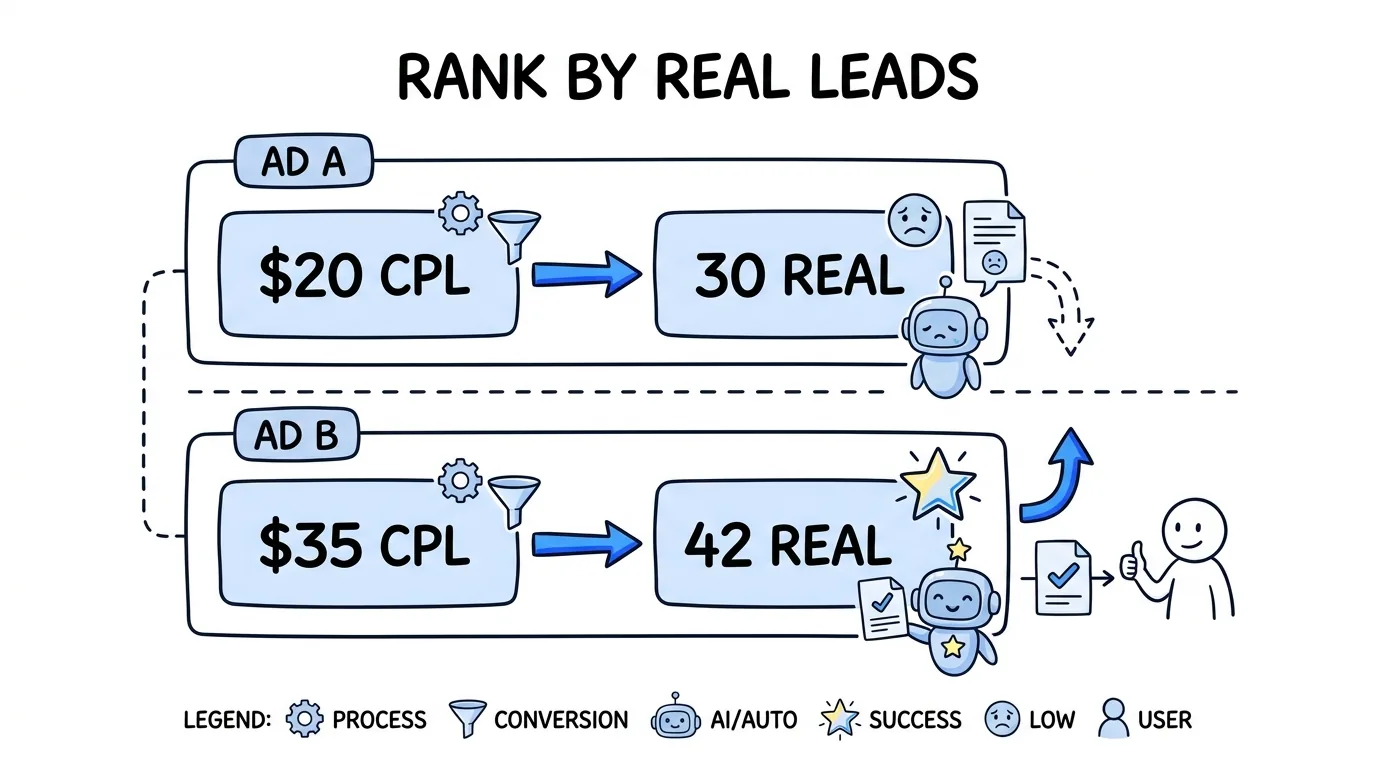
"The cheapest cost per lead is usually the most expensive cost per real lead," says Rafael Hernandez, Founder and CEO of Lead Distro AI. "Once you rank ads by the leads that survive scoring, the winners and losers almost always swap places."
Send a "Lead Ingested" Event Back to Meta
Attribution only compounds when the outcome flows back to the ad platform. The Conversions API creates a server-side connection from your CRM to Meta so it can optimize targeting and decrease cost per result (Meta for Developers). Lead Distro AI can now fire a Meta CAPI event the moment a lead is ingested, not only when it is accepted or converted, so you can optimize campaigns toward lead volume when that is your goal, then switch to accepted and converted events when you want the algorithm to chase quality. Importing only the leads your team has vetted gives Meta higher-quality signals than every raw submission. The payoff is measurable: Meta reported that advertisers with a Conversions API setup saw an average 17.8 percent lower cost per result than those without one (MediaPost, 2026).
Build Ad Attribution Into Your Dashboards
A loop you cannot see is a loop you will not run, and good lead attribution lives on the dashboard. When Facebook is connected, Lead Distro AI lets you chart Meta Ads metrics like spend, clicks, CTR, CPC, and cost per lead right on your dashboard. A Custom Chart widget can plot two metrics at once, such as leads next to cost per lead, with a second axis when the units differ, so the cost of a real lead sits beside the volume it came from. Starter templates lay out the right widgets for a Meta Ads, Lead Quality, or Call Tracking view in one click, and a Map widget shades the US by any metric to show which states perform best. You can drill into call charts the same way you drill into leads, and edit any stat tile to show revenue or conversion rate instead of its default. For the reporting layer, see our guides to lead reporting software for agencies and analyzing lead source performance with Claude.
FAQ
What is ad attribution for lead generation?
Ad attribution for lead generation is the practice of tying every ad to the real leads it produces, all the way from the click to the lead that gets accepted or sold, rather than stopping at the form fill the ad platform reports. It works by capturing the ad click ID on each submission, scoring and marking each lead's outcome, then sending that outcome back to the platform. The result is that you can rank ads by qualified leads and move budget toward the creatives that actually generate revenue.
How is ad attribution different from the conversions my ad platform already reports?
Ad platforms report a conversion at the form fill, before anyone knows if the lead is real. Ad attribution carries the signal past that point to the lead that survives scoring and is accepted or sold. The platform number tells you how many people submitted; attribution tells you how many became real leads. That gap is why an ad with a low cost per form fill can quietly be your worst performer on cost per real lead, which only a closed-loop view of lead source attribution will reveal.
What does the "Non-DQ" column mean for my ads?
Non-DQ stands for non-disqualified: leads that passed scoring and were not marked as junk, duplicates, or invalid. In Lead Distro AI, the Meta ad tables show a Non-DQ column, and Winning Ads can rank by Non-DQ Leads, so instead of sorting ads by raw form-fill volume you sort them by the leads that are actually usable. It is the single fastest way to see which Facebook ads attribution truly favors, because it filters out the cheap-but-worthless submissions that inflate a vanity cost per lead.
Should I optimize Meta campaigns for lead volume or lead quality?
It depends on your stage. Early on, when you need data and volume, fire a server-side event the moment a lead is ingested so Meta optimizes toward total leads. Once you have enough accepted and converted outcomes flowing back, switch to those events so the algorithm chases quality instead of quantity. Lead Distro AI supports both, which lets you start with volume and graduate to a closed loop attribution model without rebuilding your setup. The mistake is staying on form-fill volume forever.
Do I need the Meta Conversions API for ad attribution?
For Meta ads, yes, the Conversions API is how the outcome travels back server-side so the algorithm can learn. The browser Pixel sees the form submission; the Conversions API sees what happened after, when a lead is ingested, accepted, or converted. You capture the click ID at submission, then fire CAPI events as the lead's status changes. Google Ads uses the equivalent offline conversion import with the gclid. Both close the loop so your marketing attribution reflects revenue rather than raw clicks.
How does Lead Distro AI attribute ads to real leads?
Lead Distro AI captures the ad click ID on each inbound lead, scores it against your rules in under a second, and lets buyers mark each lead disqualified, accepted, or sold. It then fires Meta Conversions API events, shows real leads per ad in the Meta ad tables with a Non-DQ column, and charts spend against cost per real lead on customizable dashboards. Data leads and tracked calls run through the same reporting, so you attribute both in one platform. Take the interactive product tour to see the full flow.
Conclusion
Ad attribution for lead generation closes the distance between what your ad platform celebrates and what your business actually banks. When you can see that one ad produced 100 cheap form fills but only 30 real leads, while another produced fewer fills at a lower true cost per real lead, you stop scaling vanity and start scaling revenue. The mechanics are simple to state and easy to skip: capture the click ID, score and mark every lead, and send the outcome back so the algorithm learns. Most advertisers never finish that loop, which is exactly why finishing it is an edge.
Lead Distro AI brings all three layers into one platform: click-level capture, rule-based scoring on every lead, and Meta ad tables, server-side events, and dashboards that rank ads by real leads. Take the interactive product tour, or start your 7-day free trial and connect your first Meta account today. Credit card required.
Ready to see which ads bring real leads instead of junk form fills? Start your 7-day free trial and connect a Meta account in minutes. Credit card required.
About the Author
Founder & CEO of Lead Distro AI & Great Marketing AI
UC Berkeley graduate and former software engineer at Microsoft. Rafael built Lead Distro AI after managing over $10M in ad spend for performance marketing agencies (pay-per-lead and pay-per-call), including running campaigns for Neil Patel. He combines deep software engineering expertise with hands-on performance marketing experience to build tools that help these agencies scale profitably.
About Lead Distro AI
Lead Distro AI: AI-Powered Lead Distribution & Call Tracking That Maximizes ROI
The modern platform for pay-per-lead and pay-per-call agencies. Route, score, and deliver leads with AI-powered automation and real-time P&L tracking. Built for performance marketing agencies and lead buyers across legal, insurance, mortgage, solar, and home services verticals.
4 Distribution Methods
Waterfall, Round Robin, Weighted, Ping-Post
Ping-Post Auctions
Real-time bidding with sub-second routing
Real-Time P&L Reporting
Track revenue, costs, and profit per campaign
Call Tracking
Assign tracking numbers, record calls, and attribute conversions
Lead Scoring
Score every lead before routing to maximize conversion
Partner Portal
Self-serve dashboard for buyers to track leads