One-to-One Consent (TCPA): What Lead Buyers Must Do in 2026
The FCC one-to-one consent rule was vacated in 2025. Here is the real state of TCPA consent in 2026 and why lead buyers and sellers should still adopt it.

Rafael Hernandez
Founder & CEO
Ex-Microsoft SWE · $10M+ PPL ad spend
I hope you enjoy reading this blog post. If you want to try Lead Distro AI for free, click here.
Author: Rafael Hernandez | Founder & CEO of Lead Distro AI
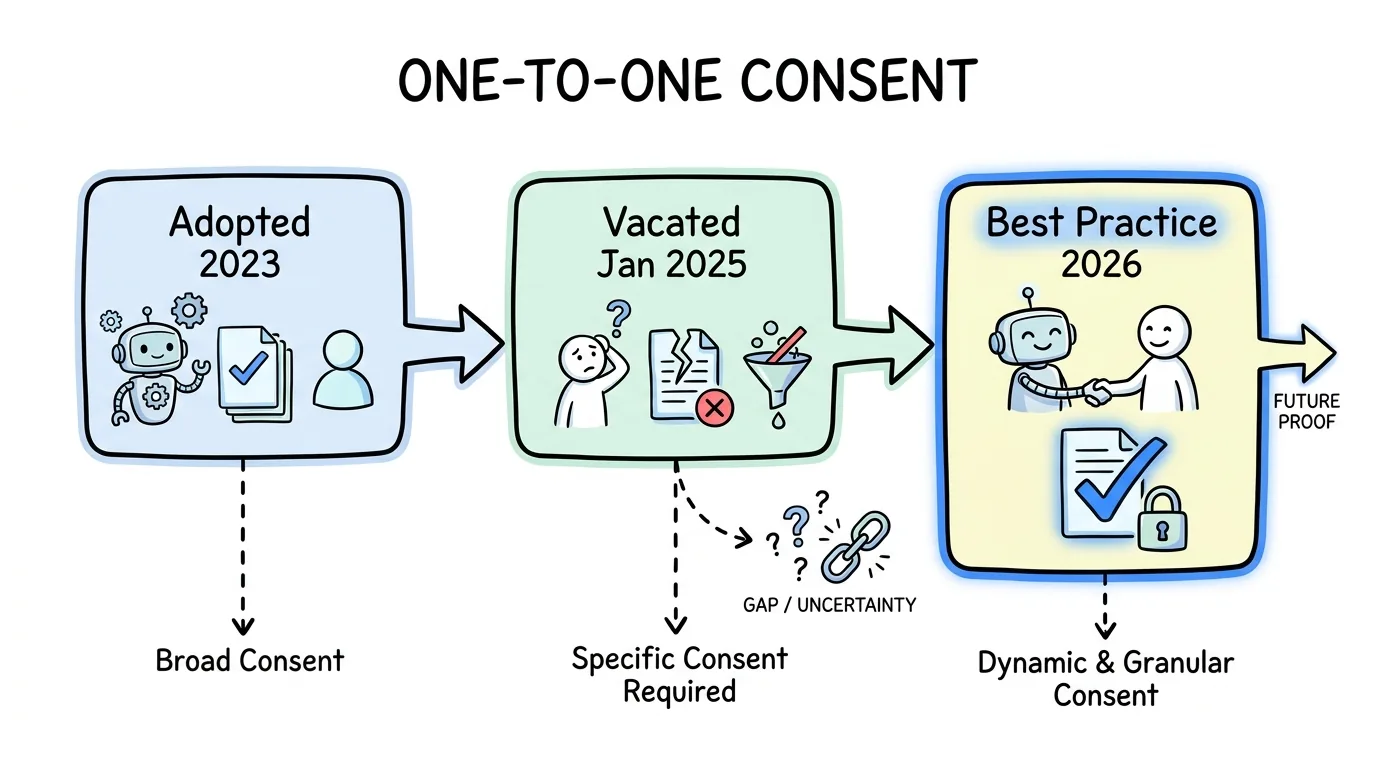
One-to-one tcpa consent is the requirement that a consumer agree to be contacted by a single, specifically named seller, rather than by a bundle of unnamed "marketing partners" behind one checkbox. The FCC adopted a tcpa one to one consent rule in December 2023 and set it to take effect on January 27, 2025. It never did. One business day before that date, the U.S. Court of Appeals for the Eleventh Circuit vacated the rule in Insurance Marketing Coalition Ltd. v. FCC, holding that the FCC exceeded its statutory authority. So as of 2026, one-to-one consent is not binding federal law, and bundled consent is once again permissible under the federal TCPA.
That does not mean the topic is dead. Written consent rules still govern most automated calls and texts, many states impose stricter requirements, and many major lead buyers still demand seller-specific consent. This guide explains what the rule would have required, why it was struck down, the current 2026 state of tcpa consent, and why one-to-one consent is still the smart standard for anyone serious about lead generation compliance. If you buy or sell leads, getting tcpa consent right is the difference between a defensible program and a class-action target.
Key Takeaways
- The FCC one-to-one consent rule was vacated before it took effect. The Eleventh Circuit struck it down on January 24, 2025 in Insurance Marketing Coalition Ltd. v. FCC, so bundled consent remains legal under the federal TCPA in 2026.
- The rule would have banned "partner network" checkboxes. It required consent to name a single seller and be logically and topically related to the site where consent was captured.
- Prior express written consent is still the baseline for autodialed marketing. Outside one recent court exception, the FCC's written-consent standard still governs automated calls and texts to cell phones.
- State mini-TCPA laws and buyer policies still raise the bar. Florida, Oklahoma, Washington, and others set their own consent and identification rules, and many large lead buyers require seller-specific consent regardless of the federal rule.
- One-to-one consent is still best practice. It lowers litigation risk, improves lead quality, and future-proofs your program. Lead Distro AI validates TrustedForm and Jornaya consent records on every lead before it routes.
What One-to-One Consent Was Supposed to Require
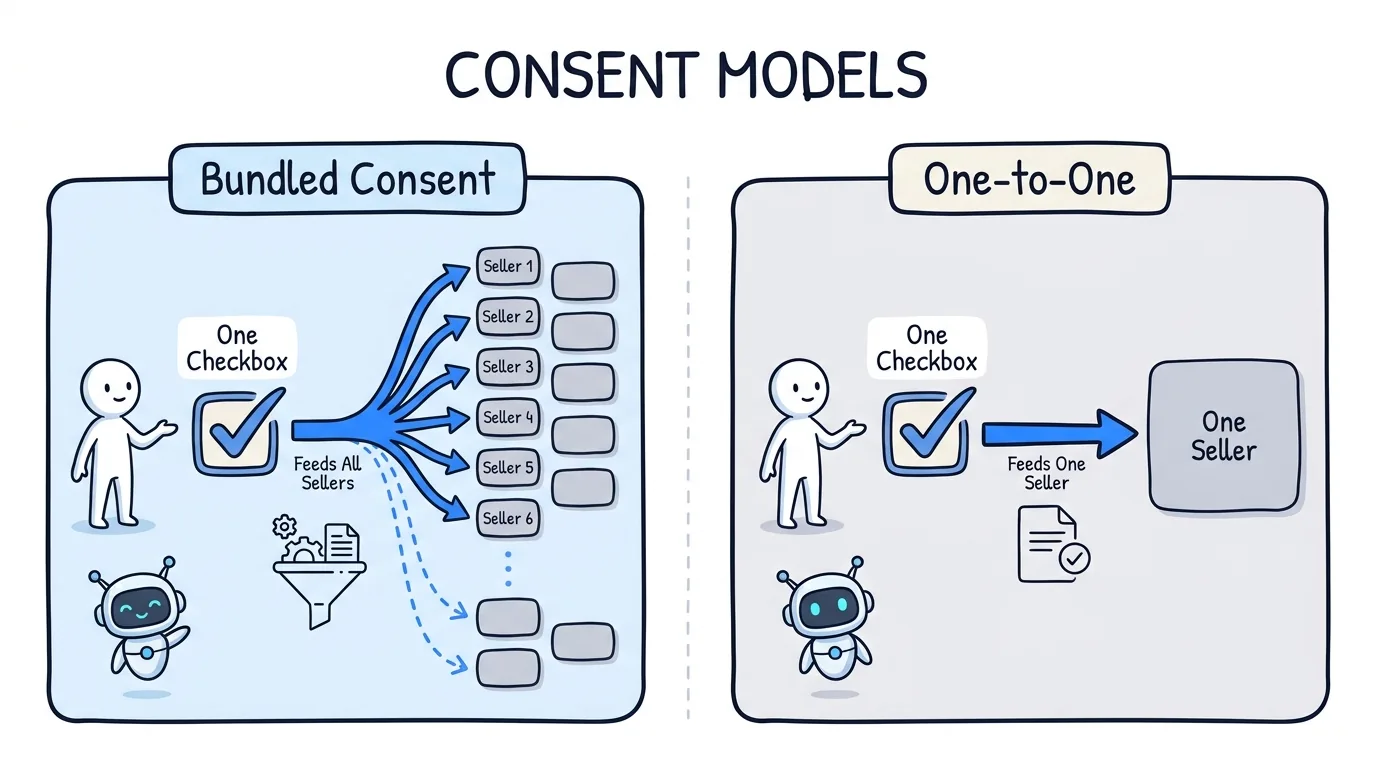
The tcpa one to one consent rule targeted the "lead generation loophole." For years, a consumer could tick one box agreeing to be contacted by a company "and its marketing partners," and that single click was resold to dozens of buyers. The 2023 rule would have ended that. Under it, valid consent had to meet two core conditions, according to analysis from Goodwin:
- Single-seller specificity. Consent could authorize contact from only one clearly identified seller at a time. A consumer could not consent to "up to 50 partners" in one action.
- Logical and topical association. The resulting calls or texts had to relate to the product on the page where consent was obtained. A mortgage quote form could not generate consent for solar or auto-insurance calls.
For shared and ping-post lead models, this was existential. It would have forced sellers to obtain separate consent for each buyer, which is impractical at scale. Understanding how leads move through a ping-post distribution model makes clear why the industry watched this rule so closely.
Why the One-to-One Consent Rule Never Took Effect
On January 24, 2025, just before the effective date, the Eleventh Circuit vacated the rule in Insurance Marketing Coalition Ltd. v. FCC. The court held that the TCPA permits calls made with the "prior express consent of the called party," and that the FCC could not add extra conditions, single-seller specificity and topical association, that the statute itself does not contain. As Kelley Drye summarized, the court found the agency had rewritten "prior express consent" beyond its plain meaning.
The immediate effect was clean and nationwide. The rule was erased before it applied, existing TCPA regulations stayed in force, and bundled consent became permissible again under federal law. The FCC later moved to remove the vacated language from its rulebook, as Womble Bond Dickinson documented. The key point for operators: no company can be sued for violating the one-to-one rule, because legally it never existed.
The Current State of TCPA Consent in 2026
Vacating one rule did not repeal the TCPA, and tcpa consent obligations did not disappear. The core statute, 47 U.S.C. section 227, still prohibits autodialed or prerecorded marketing calls and texts to cell phones without prior express consent, and violations still carry statutory damages of $500 to $1,500 each, almost always litigated as class actions.
One wrinkle arrived in 2026. In Bradford v. Sovereign Pest Control of TX, Inc. (Feb. 25, 2026), the Fifth Circuit held the TCPA requires only "prior express consent," which can be oral or written, not the heightened prior express written consent the FCC has required since 2012, per Mayer Brown. That ruling binds only Texas, Louisiana, and Mississippi; elsewhere the FCC's written-consent standard still applies.
| Consent question | Federal status in 2026 | What operators should do |
|---|---|---|
| Is one-to-one consent required? | No, vacated in 2025 | Adopt it anyway as best practice |
| Is bundled consent legal? | Yes, under federal TCPA | Avoid it; states and buyers reject it |
| Written vs oral consent | Written outside the 5th Circuit | Always capture written consent |
| Are DNC and revocation rules active? | Yes, fully in force | Scrub and honor opt-outs |
Why Lead Buyers and Sellers Should Still Adopt One-to-One Consent
The federal rule is gone, but seller-specific tcpa consent survives everywhere it matters. Building your lead generation compliance program around one-to-one consent is still the right call for four concrete reasons:
- State mini-TCPA laws. Florida's FTSA, plus statutes in Oklahoma, Washington, and Texas, impose their own written-consent and identification requirements. You must comply with the stricter of federal and state law, and several states already look a lot like one-to-one.
- Buyer policies. Many large lead buyers contractually require documented seller-specific consent before they accept or dial a lead.
- Litigation defense. Bundled "partner network" consent is a magnet for TCPA class actions. Named, single-seller consent is far easier to defend, which is a core theme in our guide to TCPA litigation risks for lead buyers.
- Lead quality. A consumer who knowingly agrees to hear from your specific brand converts better than one surprised by a call from a company they never heard of.
You can see how Lead Distro AI routes and bills leads while it checks consent certificates at the platform layer.
How to Capture Compliant Consent for Every Lead
Whether or not a specific rule is on the books, defensible tcpa consent looks the same. Every inbound lead should carry a complete, tamper-evident record proving who agreed to what, and when. This is the audit trail that survives a lawsuit.
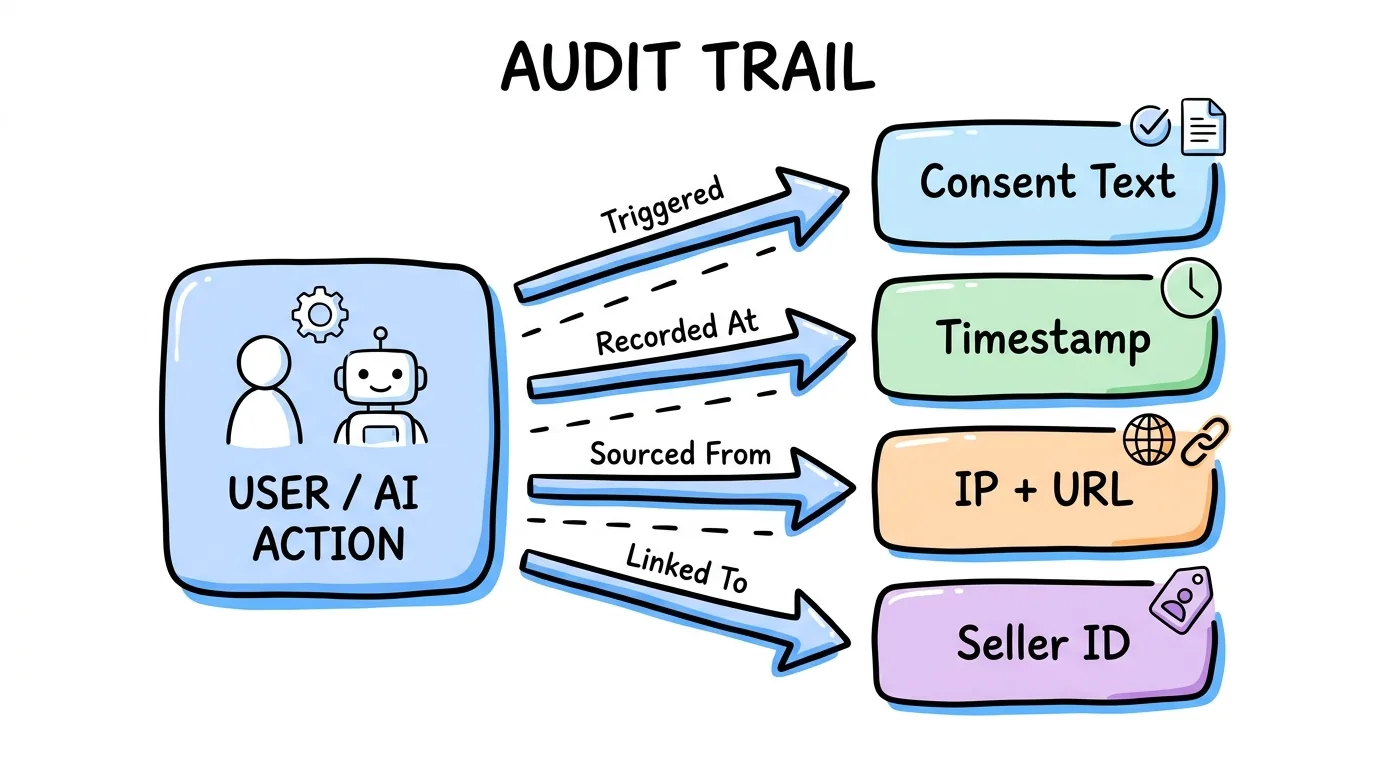
At minimum, capture and store for each lead:
- The exact consent language the consumer saw, word for word.
- The specific seller name the consumer agreed to hear from.
- A timestamp, IP address, form URL, and user agent for the submission.
- A third-party certificate such as a TrustedForm or Jornaya record that independently proves the disclosure and the consumer's interaction. Our explainer on what TrustedForm is covers how these certificates work.
A compliant one-line disclosure reads: "By checking this box and clicking Submit, you agree that [Seller Name] may call and text you at the number provided, including via automated technology, about [product]. Consent is not a condition of purchase." A lead buyer portal then lets each buyer verify that consent before accepting the lead. For the full framework, read our complete guide on lead-gen compliance.
FAQ
Is one-to-one consent required by the TCPA in 2026?
No. The FCC's one-to-one consent rule was vacated by the Eleventh Circuit on January 24, 2025 in Insurance Marketing Coalition Ltd. v. FCC, one business day before it was set to take effect. As a result, the rule never became binding federal law, and bundled consent is again permissible under the federal TCPA. However, state laws and buyer policies often still require seller-specific consent, so most operators adopt it anyway.
What did the FCC one-to-one consent rule require?
The rule would have required consumer consent to name a single seller rather than a group of "marketing partners," and it would have required the resulting calls or texts to be logically and topically related to the website where consent was obtained. A single checkbox authorizing dozens of unnamed buyers would no longer have satisfied the TCPA. Because the rule was vacated, none of these requirements are federally enforceable today.
Does the TCPA still require prior express written consent?
In most of the country, yes. The FCC's long-standing standard requires prior express written consent before autodialed or prerecorded marketing calls and texts reach a cell phone. In 2026, the Fifth Circuit ruled in Bradford v. Sovereign Pest Control that the statute requires only prior express consent, oral or written, but that decision binds only Texas, Louisiana, and Mississippi. Everywhere else, capture written consent.
Why adopt one-to-one consent if it is not the law?
Because seller-specific consent survives everywhere it counts. State mini-TCPA laws in Florida, Oklahoma, and Washington impose strict consent and identification rules, many large lead buyers contractually demand documented consent, and named single-seller consent is far easier to defend in a class action than a bundled "partner network" checkbox. It also produces higher-converting leads because consumers know exactly who will contact them.
What consent data should a lead distribution platform capture?
A compliant platform should capture the exact consent language the consumer saw, the specific seller name they agreed to, the timestamp, IP address, form URL, and user agent of the submission, and ideally a third-party TrustedForm or Jornaya certificate. Storing these fields on every lead is the minimum audit trail needed to prove consent if a claim is filed. Leads missing this data should be flagged or rejected at intake.
Conclusion
One-to-one consent is a rule that made national headlines, then vanished before it ever applied. In 2026, tcpa consent under federal law does not require the single-seller standard, and bundled consent is technically permissible. But the smart operators are not writing consent to the floor of what a court will tolerate. They are building to the ceiling that states and buyers already enforce: named, written, seller-specific, and fully logged. That is what protects you in a lawsuit and what makes your leads worth more. Lead Distro AI validates the TrustedForm or Jornaya record on every lead automatically before it routes, so the proof behind your lead generation compliance posture holds up no matter which way the courts move next.
Want consent captured and logged on every lead automatically? Start your 7-day free trial and route your first compliant lead in minutes. A credit card is required to start, and you can cancel anytime during the 7 days.
About the Author
Founder & CEO of Lead Distro AI & Great Marketing AI
UC Berkeley graduate and former software engineer at Microsoft. Rafael built Lead Distro AI after managing over $10M in ad spend for performance marketing agencies (pay-per-lead and pay-per-call), including running campaigns for Neil Patel. He combines deep software engineering expertise with hands-on performance marketing experience to build tools that help these agencies scale profitably.
About Lead Distro AI
Lead Distro AI: AI-Powered Lead Distribution & Call Tracking That Maximizes ROI
The modern platform for pay-per-lead and pay-per-call agencies. Route, score, and deliver leads with AI-powered automation and real-time P&L tracking. Built for performance marketing agencies and lead buyers across legal, insurance, mortgage, solar, and home services verticals.
4 Distribution Methods
Waterfall, Round Robin, Weighted, Ping-Post
Ping-Post Auctions
Real-time bidding with sub-second routing
Real-Time P&L Reporting
Track revenue, costs, and profit per campaign
Call Tracking
Assign tracking numbers, record calls, and attribute conversions
Lead Scoring
Score every lead before routing to maximize conversion
Partner Portal
Self-serve dashboard for buyers to track leads