TCPA Compliance for Lead Distribution: The Complete 2026 Guide
How to stay TCPA compliant when buying, selling, and routing leads. Consent capture, DNC scrubbing, time-of-day rules, revocation handling, and the exact audit trail you need to survive a lawsuit.

Rafael Hernandez
Founder & CEO
Ex-Microsoft SWE · $10M+ PPL ad spend
I hope you enjoy reading this blog post. If you want to try Lead Distro AI for free, click here.
Author: Rafael Hernandez | Founder & CEO of Lead Distro AI
The Telephone Consumer Protection Act (TCPA) is the single biggest legal risk in lead distribution. A single non-compliant call or text can trigger statutory damages of $500 to $1,500 per violation, and class action suits routinely settle for tens of millions of dollars. For lead buyers and lead sellers operating at volume, TCPA compliance is not optional and it is not a line item you can outsource to a vendor and forget.
This guide breaks down what TCPA requires for lead distribution specifically, the six compliance controls every lead distribution platform should enforce, how to build an audit trail that survives a lawsuit, and what changed in 2025 under the FCC's "one-to-one consent" amendment. If you buy, sell, or route leads in 2026, this is the non-negotiable playbook.
Key Takeaways
- TCPA governs any automated call, text, or prerecorded message to a consumer cell phone. Statutory damages are $500 to $1,500 per violation, and most cases are brought as class actions.
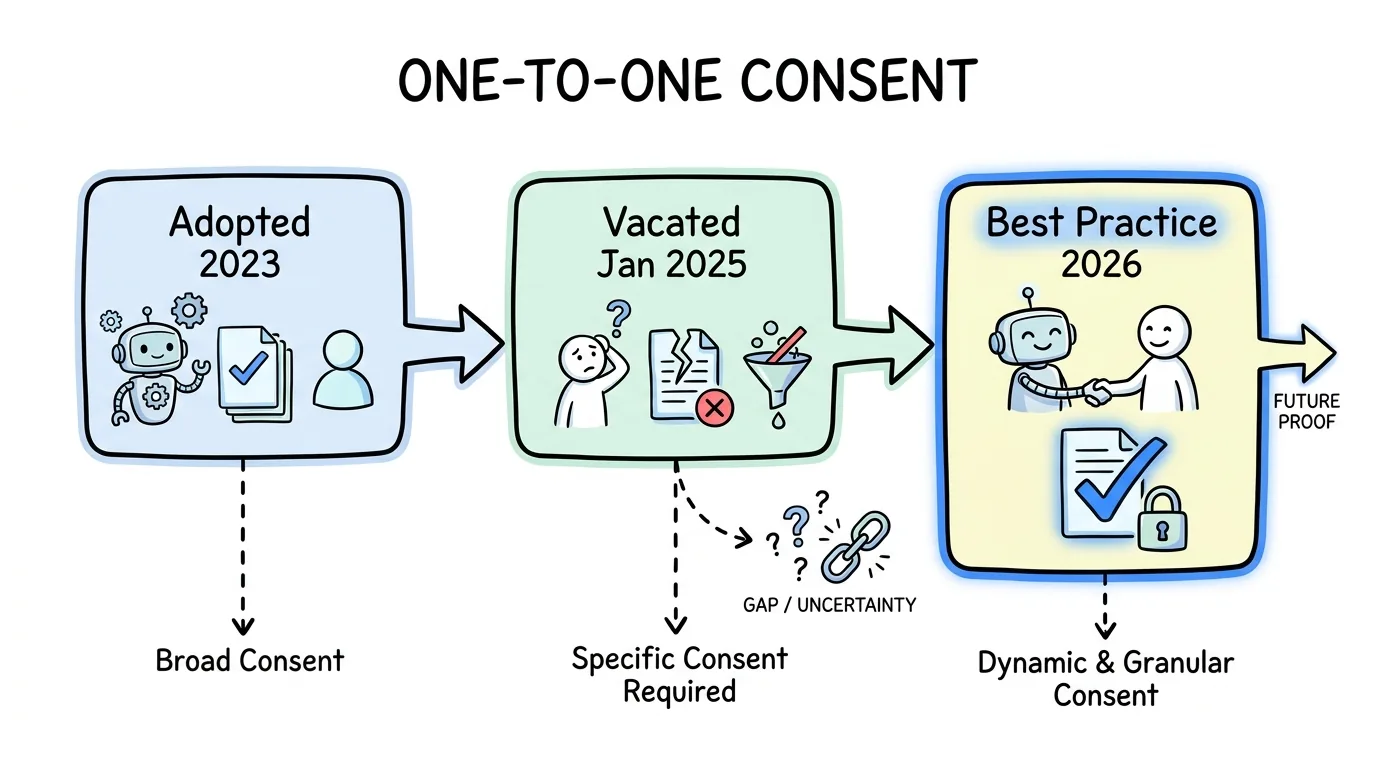
- The FCC's 2024 "one-to-one consent" rule (effective January 2025) requires express written consent to be specific to a single seller. Generic "partner network" consent no longer satisfies TCPA.
- Lead distribution platforms must capture and store consent text, timestamp, IP address, URL, and user agent for every inbound lead. Without this audit trail, you cannot defend a TCPA claim.
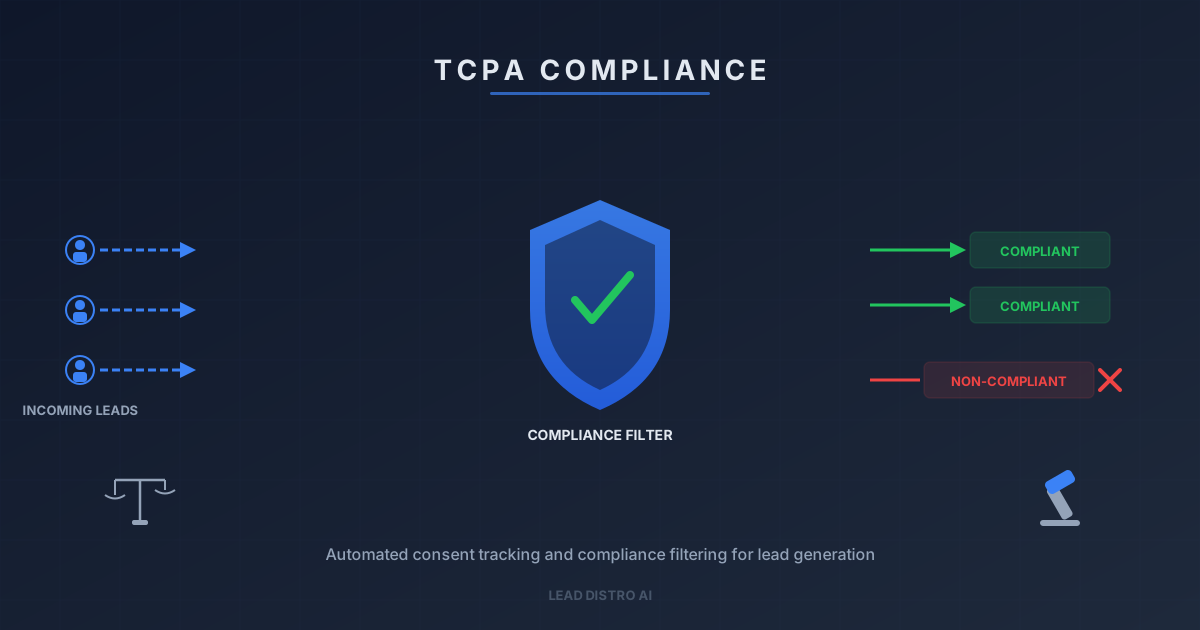
- Six controls every compliant lead distribution platform must enforce: consent capture, DNC scrubbing, time-of-day restrictions, revocation handling, buyer-side consent pass-through, and complete audit logging.
- Lead Distro AI implements all six controls at the platform layer. See our security page for the full compliance program.
What TCPA Actually Covers
The TCPA was passed in 1991 to protect consumers from unwanted telemarketing. Since then, courts and the FCC have expanded its scope to cover almost every form of automated outreach to cell phones. For lead distribution, the specific provisions that matter are:
Express written consent for auto-dialed calls and texts to cell phones. Before any automatic telephone dialing system (ATDS) or prerecorded voice message can contact a consumer on their cell phone, the consumer must have provided prior express written consent. This applies to sales calls, marketing texts, and most ringless voicemails. Consent must be "clear and conspicuous" and tied to a specific seller.
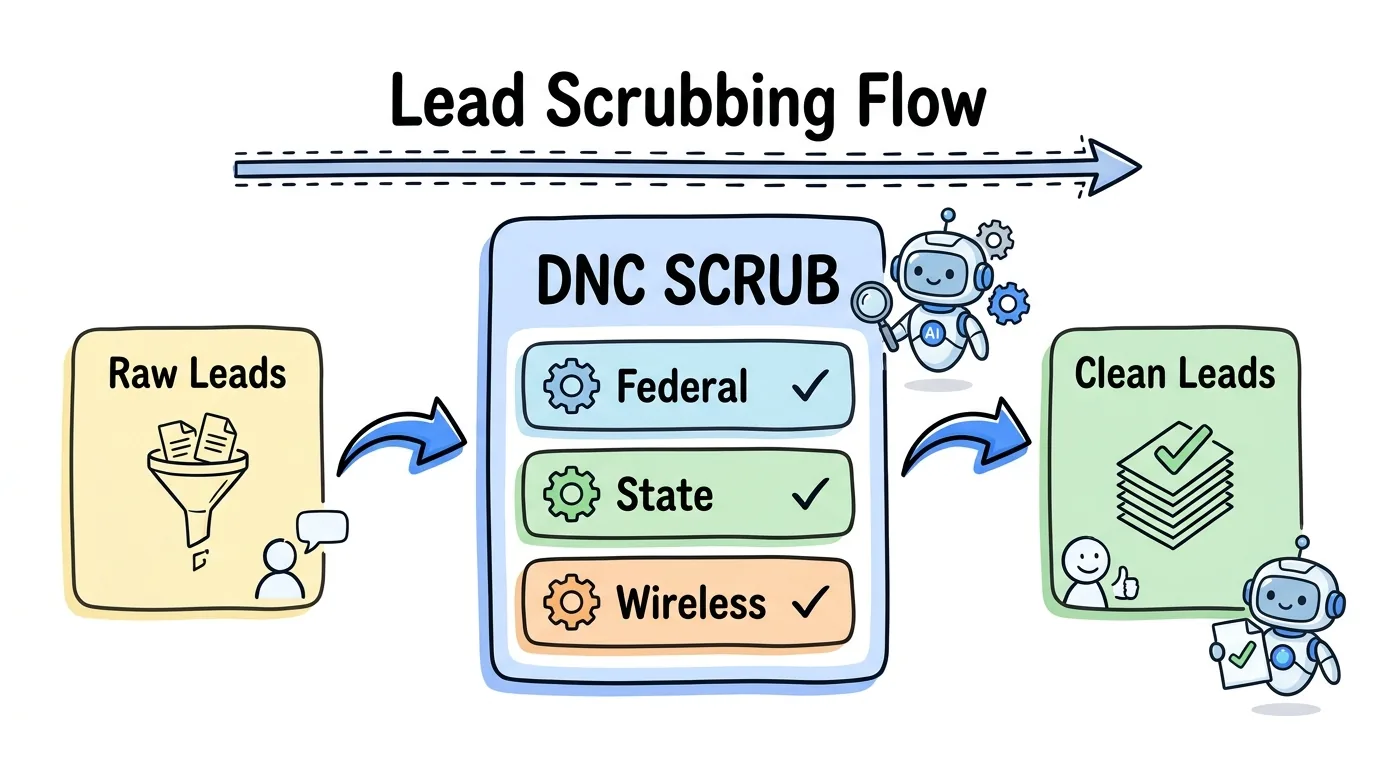
National Do Not Call Registry (DNC). Consumers who place their number on the federal DNC list cannot receive sales calls. Lead sellers must scrub numbers against the DNC list before delivery, and lead buyers must scrub again before dialing. "DNC scrubbing" means checking the phone number against the current FTC registry and removing any matches. Our DNC scrubbing guide walks through the federal, state, wireless, and litigator layers and where each check belongs in the intake flow.
Internal Do Not Call lists. Every company that makes sales calls is required to maintain an internal DNC list of consumers who have asked not to be contacted. Revocation requests must be honored within 30 days and remain on the internal list indefinitely.
Time-of-day restrictions. Sales calls cannot be made before 8 AM or after 9 PM in the called party's local time zone. Texts are generally treated the same way under state regulations.
State-level amplifications. Florida, Oklahoma, Washington, and a growing list of states have passed "mini-TCPA" laws that add additional restrictions, stricter consent requirements, or broader definitions of ATDS. Operators in these states must comply with the stricter of federal and state rules.
If you are still choosing a routing approach, our lead distribution models guide explains how waterfall, round robin, weighted, and ping-post each interact with TCPA consent rules.
The 2024 FCC "One-to-One Consent" Rule
In December 2023, the FCC adopted a rule change that took effect in January 2025 and fundamentally changed how lead distribution consent works. The old rule allowed consumers to consent to contact from "marketing partners" in a single checkbox. Under the new rule, consent must be:
- Specific to one seller. A consumer cannot consent to contact from "up to 50 partners" at once. Each seller that wants to contact the consumer needs its own explicit consent.
- Logically and topically related to the product or service on the website where consent was obtained. A consumer filling out a mortgage quote form cannot be consented to receive insurance calls.
- Explicit and unambiguous. The consent language must clearly identify the specific seller and the type of contact (call, text, or both).
What this means for lead distribution: Generic "consent networks" that passed leads to dozens of buyers no longer work. Lead sellers must either obtain separate consent for each buyer (impractical at scale) or narrowly target their lead forms to a single seller or small, disclosed set of sellers.
Lead Distro AI implements this at the platform layer by requiring lead sellers to capture and transmit the exact consent text, the URL where consent was obtained, and the specific seller identity associated with each consent event.
The Six TCPA Compliance Controls Every Lead Distribution Platform Must Enforce
1. Consent Capture
Every inbound lead must carry the consent text the consumer saw, the timestamp of consent, the URL of the form, the IP address of the submitter, and the user agent string. This is the bare minimum to prove consent in a lawsuit. Without these fields, you cannot defend a TCPA claim, period.
Platforms should validate that consent data is present on every lead and reject leads that lack it. A missing consent field is exactly the kind of condition lead filtering should block at intake, before the lead is ever routed or billed. This sounds obvious but the majority of legacy lead distribution platforms do not enforce this, relying on the lead seller to capture it manually. The cleanest way to capture and prove this consent is a TrustedForm certificate, which records the page, the disclosure language, and the consumer's interaction as a tamper-proof record both the seller and buyer can audit.
2. DNC Scrubbing
Every phone number should be scrubbed against the federal DNC registry before distribution. Platforms should also support scrubbing against state-level DNC lists and buyer-specific internal DNC lists. DNC scrubbing should happen:
- Before lead delivery to a buyer (by the platform)
- Again by the buyer before dialing (belt and suspenders)
- On a rolling basis for stored leads (numbers can be added to DNC after the lead is captured)
Lead Distro AI scrubs every phone number against the federal DNC list before routing and supports buyer-level DNC list management. If you are evaluating platforms, our guide to choosing lead distribution software covers what compliance features to require.
3. Time-of-Day Enforcement
No calls or texts before 8 AM or after 9 PM in the called party's local time zone. The platform should enforce this at routing time, holding leads until the allowed window or rejecting them outright. Buyers should also be able to set tighter windows (e.g., "only deliver leads between 9 AM and 6 PM local").
Timezone determination based on area code alone is not reliable for cell phones. Platforms should support zip code and IP-based timezone inference and default to the most conservative window when ambiguous.
4. Revocation Handling
When a consumer says "stop" (by text, call, or email), that revocation must be honored within 30 days and the number must be added to the internal DNC list indefinitely. Lead distribution platforms should support:
- A revocation intake endpoint (API or inbound webhook)
- Automatic propagation of revocations to every buyer that received the lead
- Internal DNC list management per buyer and per platform
- Audit logging of every revocation event
5. Buyer-Side Consent Pass-Through
When a lead is distributed from seller to buyer, the consent data captured at the seller must travel with the lead. The buyer should receive the exact consent text, timestamp, IP, URL, and user agent, not a hash or summary. This is critical because:
- The buyer is the entity that will make the call or text
- The buyer is typically the TCPA defendant in a lawsuit
- The buyer needs the full consent record to defend itself
Lead Distro AI passes complete consent data on every outbound delivery to every buyer.
6. Complete Audit Logging
Every event in the lead lifecycle must be logged and retained: consent capture, ingestion, scoring, DNC scrub, routing, delivery, buyer acceptance, revocation, deletion. The logs must be append-only, tamper-evident, and retained for at least the TCPA statute of limitations (four years federally, longer in some states).
When a TCPA class action is filed, the discovery phase will request these logs. Platforms that cannot produce them are forced to settle on unfavorable terms.
Building a TCPA Audit Trail That Survives a Lawsuit
An audit trail that will hold up in court needs seven elements for every lead that ever passed through your platform:
| Element | What to Capture | Why It Matters |
|---|---|---|
| Consent text | Verbatim text the consumer saw | Proves specific consent language |
| Consent timestamp | UTC timestamp, ISO 8601 format | Proves consent predates contact |
| IP address | Source IP of submission | Identifies the submitter |
| URL | Full URL of the form page | Proves topical relevance (one-to-one rule) |
| User agent | Browser user agent string | Helps authenticate the submission |
| Seller identity | Specific seller named in consent | Required under 2024 one-to-one rule |
| Delivery receipt | Buyer ID, timestamp, acceptance status | Proves the chain of custody |
Store all seven elements for the life of the lead plus four years minimum. Lead Distro AI automatically captures and retains all seven for every lead routed through the platform.
Red Flags That Expose You to TCPA Liability
If your lead distribution operation has any of these, you have exposure:
- Leads delivered without consent text: You cannot prove what the consumer agreed to
- Consent that names "marketing partners" generically: Does not satisfy the 2024 one-to-one rule
- No DNC scrubbing at the platform layer: Buyers may assume you scrubbed and skip their own scrub
- Time zone inference based on area code only: Fails for ported cell phone numbers
- No internal DNC list management: Revoked numbers can end up receiving new calls
- Audit logs that can be edited or deleted: Not tamper-evident, not defensible in court
- Consent text not passed to buyers: Buyers cannot defend themselves in a lawsuit (see our lead distribution glossary for the full definitions of consent pass-through, DNC scrubbing, and other compliance terms)
- No retention policy beyond 1-2 years: TCPA statute of limitations is 4 years federally
Fix these before they turn into a complaint.
TCPA Compliance Differences by Vertical
| Vertical | Common Issues | Extra Controls Needed |
|---|---|---|
| Legal / MVA | High-volume cold calls, aggressive follow-up | Explicit legal services consent, no prerecorded messages without separate consent |
| Insurance | State-specific consent rules (especially Florida) | State-level DNC scrubbing, mini-TCPA compliance |
| Mortgage | Credit-triggered leads, RESPA overlap | Pre-approval stage disclosures, RESPA-compliant scripts |
| Solar | High complaint rate, aggressive in-person follow-up | Clear product description, opt-in for residential visits |
| Home services | Local-only scope, smaller lead volume | Geographic filtering, service area restrictions |
Insurance lead operators especially need to watch Florida's mini-TCPA, which extends consent requirements and imposes separate state-level damages on top of federal TCPA. Agencies running insurance lead generation campaigns should build state-level compliance into their lead capture forms from the start.
How Lead Distro AI Enforces TCPA Compliance
Lead Distro AI implements all six controls at the platform layer. Specifically:
- Consent capture: Every inbound lead carries consent text, timestamp, IP, URL, user agent, and seller identity. Leads missing consent data are rejected at ingestion.
- DNC scrubbing: Federal DNC registry scrub on every phone number before routing. Buyer-level internal DNC list support.
- Time-of-day enforcement: Local-time window enforcement per recipient, based on zip code and area code with configurable buyer windows.
- Revocation handling: Revocation intake API, automatic propagation to every buyer that received a lead, append-only internal DNC list.
- Buyer-side consent pass-through: Full consent record delivered with every outbound lead, never a hash or summary.
- Complete audit logging: Append-only logs for every lead lifecycle event, retained for four years minimum, exportable on demand for legal discovery.
This is why pay-per-lead operators in regulated verticals switch to Lead Distro AI from legacy platforms. See the security page for the full compliance program, the Data Processing Addendum for contractual terms, and the enterprise lead distribution buyer's guide for the broader checklist of features regulated buyers should require.
Frequently Asked Questions
Is TCPA compliance the lead seller's responsibility or the lead buyer's responsibility?
Both. The lead seller is responsible for capturing valid consent and passing it through. The lead buyer is responsible for honoring DNC lists, revocations, and time-of-day rules before making the call or text. Most TCPA lawsuits name both parties. Contracts between sellers and buyers should allocate liability explicitly, but neither party is immune just because the other caused the violation.
What are TCPA statutory damages?
$500 per violation for unintentional violations, up to $1,500 per violation for willful or knowing violations. "Per violation" means per call or text, so a single consumer who receives 10 non-compliant calls can claim $5,000 to $15,000. Class actions multiply this across thousands of consumers, which is why TCPA settlements routinely exceed $10 million.
Does the 2024 one-to-one consent rule apply retroactively?
No. Consent captured before January 27, 2025 under the old rules is still valid for the seller or partner network named at the time. Consent captured after that date must comply with the one-to-one requirement. This means you should not mix pre-2025 and post-2025 leads in the same distribution stream without tracking consent vintage.
How long should I retain TCPA audit logs?
Minimum four years (the federal TCPA statute of limitations). Five years is safer because some states extend the limitation period. Seven years is the gold standard and what most enterprise lead distribution operators do.
Does Lead Distro AI guarantee TCPA compliance?
Lead Distro AI provides the technical controls (consent capture, DNC scrubbing, time-of-day enforcement, revocation handling, audit logging) to enable TCPA compliance, but ultimate responsibility rests with the lead seller and lead buyer as the data controllers under the law. Our platform makes compliance enforceable at the system level, and our audit logs are designed to support legal defense. Customers are responsible for configuring buyer-specific rules and for their own outbound calling practices. See our Terms of Service for the full liability allocation.
What if a consumer revokes consent after the lead has been delivered to a buyer?
The revocation must be honored by all parties, including downstream buyers. Lead Distro AI automatically propagates revocation events to every buyer that received a lead and adds the number to the platform-level internal DNC list within minutes of revocation.
Can I use Lead Distro AI for text message marketing?
Yes. All six TCPA controls apply equally to SMS and voice. The platform captures consent, scrubs DNC, enforces time-of-day, handles revocation, passes consent to buyers, and logs every event for both SMS and voice campaigns.
Conclusion
TCPA compliance is the floor, not the ceiling, of lead distribution legal risk. The six controls in this guide are the minimum every compliant platform must enforce. The 2024 one-to-one consent rule raised the bar. Platforms that still rely on generic "partner network" consent language are exposed, and so are the buyers who purchase their leads.
Lead Distro AI was built with TCPA compliance as a first-class concern, not a bolt-on. Every lead routed through the platform is captured, scrubbed, time-gated, and logged in a way that is defensible in court. Start a free trial, take the product tour, or read the security page for the full compliance program.
Need a TCPA compliance review for your lead operation? Email support@leaddistro.ai to request our TCPA compliance checklist, sub-processor list, audit log export format, and Data Processing Addendum. We respond within one business day.
About the Author
Founder & CEO of Lead Distro AI & Great Marketing AI
UC Berkeley graduate and former software engineer at Microsoft. Rafael built Lead Distro AI after managing over $10M in ad spend for performance marketing agencies (pay-per-lead and pay-per-call), including running campaigns for Neil Patel. He combines deep software engineering expertise with hands-on performance marketing experience to build tools that help these agencies scale profitably.
About Lead Distro AI
Lead Distro AI: AI-Powered Routing for Your Leads, Calls, and Appointments
The modern platform for pay-per-lead and pay-per-call agencies. Route, score, and deliver leads with AI-powered automation and real-time P&L tracking. Built for performance marketing agencies and lead buyers across legal, insurance, mortgage, solar, and home services verticals.
4 Distribution Methods
Waterfall, Round Robin, Weighted, Ping-Post
Ping-Post Auctions
Real-time bidding with sub-second routing
Real-Time P&L Reporting
Track revenue, costs, and profit per campaign
Call Tracking
Assign tracking numbers, record calls, and attribute conversions
Lead Scoring
Score every lead before routing to maximize conversion
Partner Portal
Self-serve dashboard for buyers to track leads