Mortgage Refinance Leads: How to Sell, Distribute, and Price Refi Leads in 2026
How agencies sell, distribute, and price mortgage refinance leads in 2026. Covers refi lead types, pricing by sub-type, TCPA compliance, ping post bidding, and lead scoring.

Rafael Hernandez
Founder & CEO
Ex-Microsoft SWE · $10M+ PPL ad spend
I hope you enjoy reading this blog post. If you want to try Lead Distro AI for free, click here.
Author: Rafael Hernandez | Founder & CEO of Lead Distro AI
Last Updated: May 27, 2026
Mortgage refinance leads are borrowers who have actively indicated interest in refinancing their current loan, reached through rate-comparison forms, lender websites, or trigger-data lists. In 2026, as the Mortgage Bankers Association projects refinance application volume to climb above 30% of total mortgage activity following rate relief in late 2025, agencies and loan officers who buy and distribute these leads efficiently will capture the majority of the available revenue. The difference between winning and losing this market comes down to three variables: the type of refi lead you buy, the speed at which you route it, and the scoring model you use to prioritize the hottest prospects.
Lead Distro AI does not sell leads. It is software for the companies that generate mortgage refinance leads and route them to buyers. If you are a loan officer looking to buy leads, this guide will help you judge price and quality, but you will need a lead vendor to buy from.
According to FRED data, the average 30-year fixed mortgage rate peaked at 7.79% in October 2023 and has trended downward since, creating the first meaningful refi wave since 2021. Every 50-basis-point rate drop generates a new cohort of qualified borrowers with enough equity and rate delta to make refinancing financially sensible. The agencies positioned with real-time refinance leads, compliant TCPA consent chains, and automated distribution infrastructure will close that cohort first.
This guide covers the four main types of refi leads, what they cost in 2026, how to buy them compliantly, how to distribute them at speed with ping post bidding, and how to use lead scoring to route the highest-equity borrowers to your best-performing buyers first. You can explore Lead Distro AI's full feature set on the product tour to see how these capabilities work together in a single platform.
Key Takeaways
- Four refi lead types drive most agency volume: rate-and-term, cash-out, FHA Streamline, and VA IRRRL leads each have distinct pricing, borrower profiles, and compliance requirements.
- Exclusive refi leads cost $45-$120 per lead in 2026 depending on sub-type; shared leads run $8-$30 but require faster speed-to-lead to compete.
- TCPA one-to-one consent is mandatory for any refi lead purchased after January 2025. TrustedForm certificates must be stored with every record.
- Ping post bidding outperforms fixed-price lead buying during rate drops, because auction pricing floors protect margin when supply spikes.
- Lead scoring on equity, LTV, and rate delta identifies which inbound refi leads are worth premium routing to top buyers versus standard distribution queues.
- Lead Distro AI routes refi leads via ping post in under 200ms, handling real-time auction logic, consent verification, and lead scoring in a single pipeline.
Types of Mortgage Refinance Leads
Mortgage refi leads are not a single product. The four main sub-types have different average loan sizes, equity profiles, and close rates, which is why pricing and routing rules need to reflect the sub-type.
Rate-and-Term Refinance Leads target borrowers who want to lower their interest rate or shorten their loan term without taking cash out. These are the highest-volume sub-type during rate drops. The borrower profile is typically a homeowner with a loan originated between 2022 and 2024 at 6.5-7.5%, now looking to drop 75-150 basis points.
Cash-Out Refinance Leads involve borrowers pulling equity from their home, usually for debt consolidation, home improvement, or large purchases. These leads carry higher average loan sizes and typically close at 15-25% higher revenue per loan than rate-and-term. They require stricter LTV verification during scoring because a high LTV disqualifies the borrower for most cash-out programs.
FHA Streamline Leads are a restricted sub-type: only borrowers with existing FHA loans qualify, and lenders can skip a full appraisal and income verification. Because of the streamlined approval process, these leads convert faster. They are also lower CPL than conventional refi leads because the qualifying pool is smaller.
VA IRRRL Leads (Interest Rate Reduction Refinance Loans) target active-duty military and veterans with existing VA loans. Like FHA Streamline, VA IRRRL requires no appraisal and has a lower documentation threshold. VA IRRRL leads are the most specialized sub-type and command a premium CPL because qualified buyers are fewer.
Mortgage Refinance Lead Pricing in 2026
Lead pricing varies by sub-type, exclusivity tier, and freshness. The table below reflects real-time and aged lead ranges based on current market conditions and volumes typical of mid-2026.
| Lead Type | Exclusive (Real-Time) | Shared (Real-Time) | Aged (30-90 days) |
|---|---|---|---|
| Rate-and-Term | $45-$75 | $10-$18 | $2-$6 |
| Cash-Out | $65-$120 | $14-$28 | $3-$9 |
| FHA Streamline | $35-$60 | $8-$15 | $2-$5 |
| VA IRRRL | $70-$130 | $16-$30 | $4-$10 |
These ranges are based on Lead Distro AI's observed market pricing data across mortgage vertical campaigns as of Q2 2026. Actual CPL shifts with rate environment: a 25-basis-point drop from the Federal Reserve typically increases refinance lead generation demand by 20-35% within 60 days, compressing exclusive lead supply and pushing shared-lead prices upward.
Real-Time vs. Aged Refi Leads: real-time leads are delivered within seconds of form submission, while aged leads were collected 30-90 days prior. The table below shows the practical trade-offs.
| Factor | Real-Time Leads | Aged Leads |
|---|---|---|
| CPL | $8-$130 by type | $2-$10 by type |
| Avg. Contact Rate | 35-55% | 8-18% |
| Close Rate | 4-9% | 1-3% |
| Compliance Complexity | High (active consent chain required) | Very High (re-consent often needed) |
| Best Use Case | Active buyers with outbound calling capacity | Volume-filling, lower-budget campaigns |
For most agencies running live refi campaigns, real-time exclusive mortgage refinance leads deliver better ROI despite the higher CPL, because the cost-per-close is lower when the borrower is still in active rate-shopping mode.
How to Buy Refinance Leads: What to Look For in a Vendor
Buying refinance leads from a vendor requires vetting five things before committing to volume.
Consent documentation. Every lead must include a TrustedForm certificate or Jornaya LeadiD tied to the record. The certificate captures the consent language, the timestamp, and the originating URL. Without it, your agency is exposed to TCPA litigation with no documented defense.
Lead freshness SLA. Top vendors deliver real-time leads within 30-60 seconds of form submission. Vendors who cannot confirm a delivery SLA are typically reselling aged inventory at real-time pricing.
Sub-type filtering. You should be able to filter by loan type (rate-and-term, cash-out, FHA, VA), current rate range, loan balance, equity estimate, and credit band. Without filtering, you pay for leads outside your buyers' qualifying criteria.
Return policy. Reputable vendors offer a credit or return window for leads with invalid contact information (bad phone, disconnected number, duplicate record). A 10-15% return rate on exclusive refi leads is normal; any vendor unwilling to offer returns on provably invalid records is a red flag.
Ping post availability. The best vendors operate as sellers in a ping post marketplace, allowing you to bid in real time rather than prepurchase fixed-price packages. This matters most during rate drops when demand spikes and shared-lead pools become competitive. You can read our complete guide to ping post lead distribution for the full mechanics.
TCPA and Consent Compliance for Refi Leads
The FCC's January 2025 one-to-one consent rule changed the compliance requirement for every agency buying buy refinance leads. Under the prior rules, a consumer could consent to contact from multiple companies in a single form submission. The 2025 rule requires that consent name a single, specific company. Shared-consent lead forms that bundle multiple buyer brands into one checkbox are no longer compliant.
For agencies, this means:
TrustedForm is required, not optional. Every purchased lead must include a TrustedForm certificate. The certificate is proof that a human completed a form, the consent language was visible, and the timestamp is verifiable. Store the certificate URL with every lead record.
Re-consent for aged leads. If you are buying aged refi leads collected before January 27, 2025, assume those records do not meet the one-to-one standard. Either re-consent the borrower via email before calling, or treat these as marketing-permitted contacts under the established business relationship exemption (which is narrower than most agencies assume).
Scrub against the DNC registry. The National Do Not Call Registry scrub is legally required for telemarketing calls. For mortgage refinance campaigns, scrub before dialing, not just at lead intake.
Document the consent chain. Your distribution platform should log the TrustedForm URL, the originating lead form URL, the timestamp, and which buyer received the lead. Lead Distro AI stores this chain automatically with every routed record. For deeper reading on compliance requirements, see our TCPA compliance guide for lead generation.
How to Distribute Refinance Leads with Ping Post
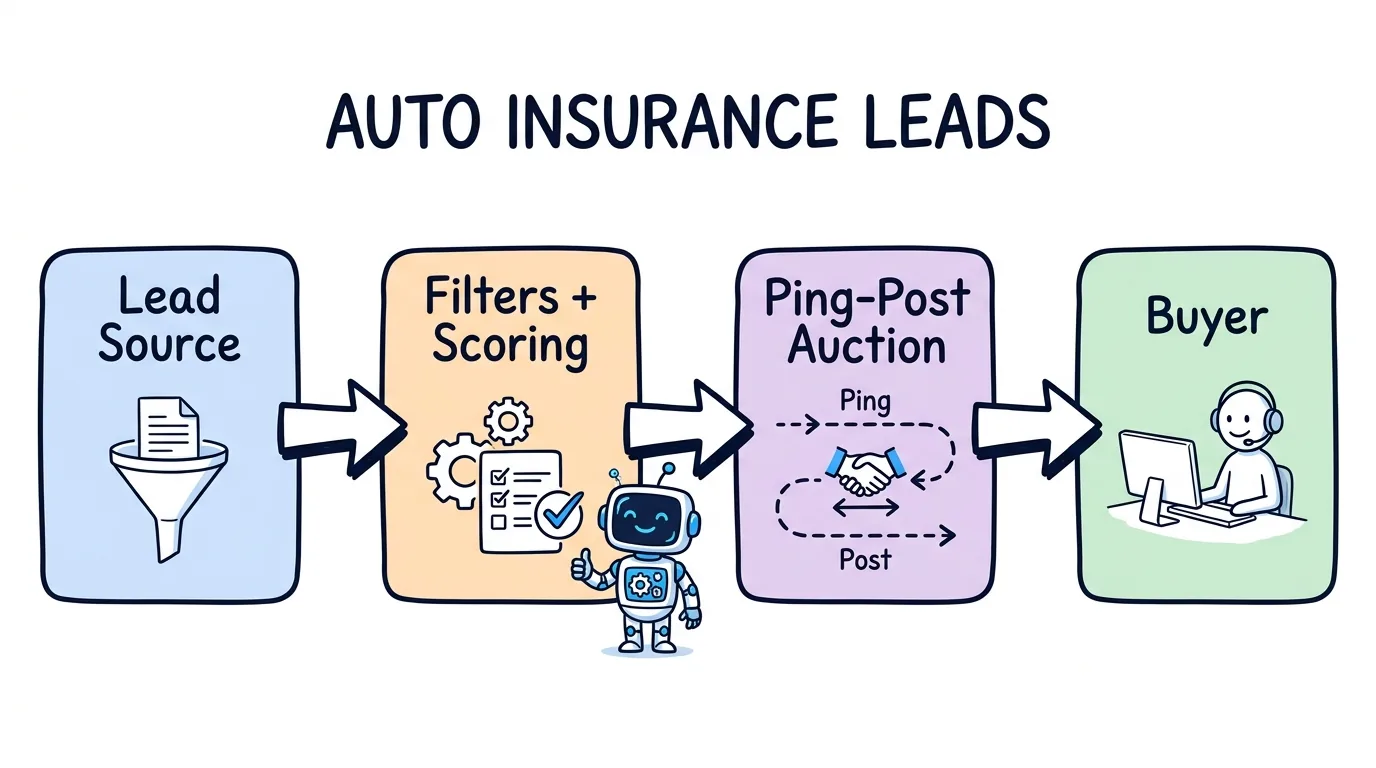
Ping post is the standard distribution architecture for real-time refi lead routing. When a borrower submits a refinance form, the lead data is "pinged" to multiple buyers simultaneously as a partial record (no PII). Buyers return bids within 200-500 milliseconds. The seller posts the full record to the highest bidder.
For agencies running refi lead distribution software, ping post solves three problems at once.
Auction pricing protects margin during supply spikes. When the Fed signals a rate cut and refi lead volume doubles in 30 days, fixed-price lead buying causes buyers to overpay for the cheapest available inventory. Ping post auction floors mean your margin per lead stays constant regardless of supply conditions.
Real-time sub-type routing. The ping response can include sub-type filters from each buyer: a buyer who only accepts VA IRRRL leads will pass on rate-and-term pings. Routing logic applies those filters before the post, so you never deliver leads outside a buyer's qualifying criteria.
Speed-to-lead within 200ms. Ping post delivery gets the lead to the buyer before the borrower has finished the form on a second site. Speed-to-lead is the strongest predictor of contact rate in mortgage: a Harvard Business Review analysis found that leads contacted within 5 minutes are 21 times more likely to convert than leads contacted after 30 minutes.
Lead Distro AI's ping post engine completes the full auction cycle, including lead scoring and consent verification, in under 200ms. You can start your 7-day free trial of Lead Distro AI to test a refi routing workflow before committing to a plan.
lead scoring for Refinance Leads
Standard lead routing sends every lead to the same queue regardless of quality. Lead scoring changes that by ranking each inbound refi lead on the signals that actually predict close rate.
For mortgage refinance, the four highest-signal scoring variables are:
Rate delta. The difference between the borrower's stated current rate and the prevailing 30-year fixed rate. A borrower at 7.5% with current rates at 6.25% has a 125-basis-point delta. A borrower at 6.5% has only a 25-basis-point delta and a much lower refinance incentive. Score the rate delta and route high-delta leads to your fastest buyers.
LTV estimate. Loan-to-value ratio determines which programs the borrower qualifies for. A borrower with 30% equity (70% LTV) qualifies for conventional refi, cash-out, and streamline programs. A borrower at 95% LTV qualifies for almost nothing. Use Automated Valuation Model data appended at intake to filter high-LTV leads before distribution.
Credit band. Refi programs have minimum credit score thresholds: conventional refi typically requires 620-640 minimum, jumbo refi 680-720. Routing a sub-600 lead to a conventional lender wastes both the buyer's time and your ping allocation.
Equity tier. Cash-out refi leads with $100,000+ in estimated equity command the highest buyer bids and close at higher revenue per loan. Segment these leads into a premium auction pool with a higher bid floor.
Lead Distro AI's lead scoring model evaluates all four of these variables plus behavioral signals (time-on-form, field completion rate, device type) and outputs a 0-100 score per lead. High-scoring leads route to priority buyers; borderline leads route to backup buyers with lower margins. For a full walk-through of how the platform handles mortgage lead generation across all sub-verticals, read the pillar guide.
You can also explore how agencies configure their refi pipelines with Lead Distro AI's distribution platform for mortgage brokers for a vendor comparison.
FAQ
What is the difference between exclusive and shared mortgage refinance leads?
Exclusive mortgage refinance leads are sold to a single buyer only. Shared leads are sold to 2-5 buyers simultaneously. Exclusive leads cost 3-6x more per lead but deliver contact rates of 35-55% versus 10-20% for shared leads. For agencies with strong outbound calling capacity, exclusive leads typically produce a lower cost-per-close. Shared leads work best as volume fillers during high-demand periods when exclusive supply is tight or for buyers testing a new sub-vertical before committing to exclusive pricing.
Are aged refinance leads worth buying in 2026?
Aged refinance leads collected 30-90 days prior can be cost-effective at $2-$10 per lead if your agency has a multi-touch nurture sequence and the leads meet the 2025 TCPA one-to-one consent standard. The contact rate drops to 8-18% compared to 35-55% for real-time leads, so the economics only work if your cost per contact stays below your buyer's revenue threshold. Many aged refi leads collected before January 27, 2025 do not meet current consent requirements and require re-consent workflows before telemarketing use.
What TCPA requirements apply to refinance lead campaigns?
Every mortgage refinance lead used for telemarketing must meet four requirements under the 2025 FCC one-to-one consent rule: the consumer must have provided express written consent naming your company specifically, a TrustedForm or Jornaya certificate must document the consent, the number must be scrubbed against the National Do Not Call Registry before dialing, and all consent records must be retained for a minimum of 5 years. TCPA penalties run up to $1,500 per violation per call for willful violations. Using a platform like Lead Distro AI that automatically stores the TrustedForm URL with every routed lead creates an auditable defense record.
What is the best response time for refinance leads?
For real-time mortgage refi leads, contact within 5 minutes of form submission is the industry benchmark. Harvard Business Review research found that leads called within 5 minutes convert at 21x the rate of leads called after 30 minutes. For ping post delivery, the buyer should be dialing within 2-3 minutes of the post. Any agency building refi campaigns should configure auto-dial or immediate CRM routing to hit this window. Speed matters most for rate-and-term leads where the borrower is actively shopping multiple lenders simultaneously.
When is the best time to buy refinance leads in bulk?
The best time to scale refinance lead generation spending is in the 30-60 days following a confirmed Federal Reserve rate cut or a sustained 25-basis-point drop in the average 30-year fixed rate. This is when new borrowers enter the market before supply fully catches up with demand, keeping CPL from spiking. Agencies that pre-negotiate volume pricing with lead vendors before a rate drop hit capture the earliest and cleanest cohort. Running a ping post auction rather than fixed-price lead buys during this window also protects margin as supply conditions shift day to day.
How does ping post bidding work for refi leads?
In a ping post refinance auction, the lead seller sends a partial data record (no full PII) to multiple buyers simultaneously. Each buyer returns a bid within 200-500 milliseconds based on their matching criteria and bid logic. The seller posts the full record to the winning bidder. Buyers set bid floors and caps by sub-type, credit band, and geography. The entire cycle completes in under one second. Ping post outperforms fixed-price buying for refi campaigns because it prices each lead individually based on buyer competition rather than locking in a flat CPL regardless of quality.
Conclusion
Mortgage refinance leads in 2026 represent a once-per-rate-cycle opportunity for agencies positioned to buy compliantly, distribute at speed, and score intelligently. The four sub-types (rate-and-term, cash-out, FHA Streamline, VA IRRRL) each have distinct pricing curves and buyer requirements. TCPA one-to-one consent is non-negotiable after January 2025. Ping post auction routing protects margin when rate drops flood the market with new supply. Lead scoring on rate delta, LTV, equity, and credit band determines which leads get routed to your best buyers first.
Lead Distro AI handles all of this in a single platform: ping post bidding, TCPA consent logging with TrustedForm, lead scoring, and sub-type routing in under 200ms. Start your 7-day free trial and route your first refi lead pipeline today.
Ready to distribute mortgage refinance leads at scale? Start your 7-day free trial of Lead Distro AI and set up your first refi ping post campaign in minutes. Credit card required; cancel anytime during the trial and you won't be charged.
About the Author
Founder & CEO of Lead Distro AI & Great Marketing AI
UC Berkeley graduate and former software engineer at Microsoft. Rafael built Lead Distro AI after managing over $10M in ad spend for performance marketing agencies (pay-per-lead and pay-per-call), including running campaigns for Neil Patel. He combines deep software engineering expertise with hands-on performance marketing experience to build tools that help these agencies scale profitably.
About Lead Distro AI
Lead Distro AI: AI-Powered Routing for Your Leads, Calls, and Appointments
The modern platform for pay-per-lead and pay-per-call agencies. Route, score, and deliver leads with AI-powered automation and real-time P&L tracking. Built for performance marketing agencies and lead buyers across legal, insurance, mortgage, solar, and home services verticals.
4 Distribution Methods
Waterfall, Round Robin, Weighted, Ping-Post
Ping-Post Auctions
Real-time bidding with sub-second routing
Real-Time P&L Reporting
Track revenue, costs, and profit per campaign
Call Tracking
Assign tracking numbers, record calls, and attribute conversions
Lead Scoring
Score every lead before routing to maximize conversion
Partner Portal
Self-serve dashboard for buyers to track leads