Automated Lead Distribution Software 2026: How It Works + 7 Tools
Automated lead distribution software routes leads to buyers in real time. See how it works, what to look for in 2026, and the 7 best automated platforms.

Rafael Hernandez
Founder & CEO
I hope you enjoy reading this blog post. If you want us to distribute your leads for you, click here.
Author: Rafael Hernandez | Founder & CEO of Lead Distro AI
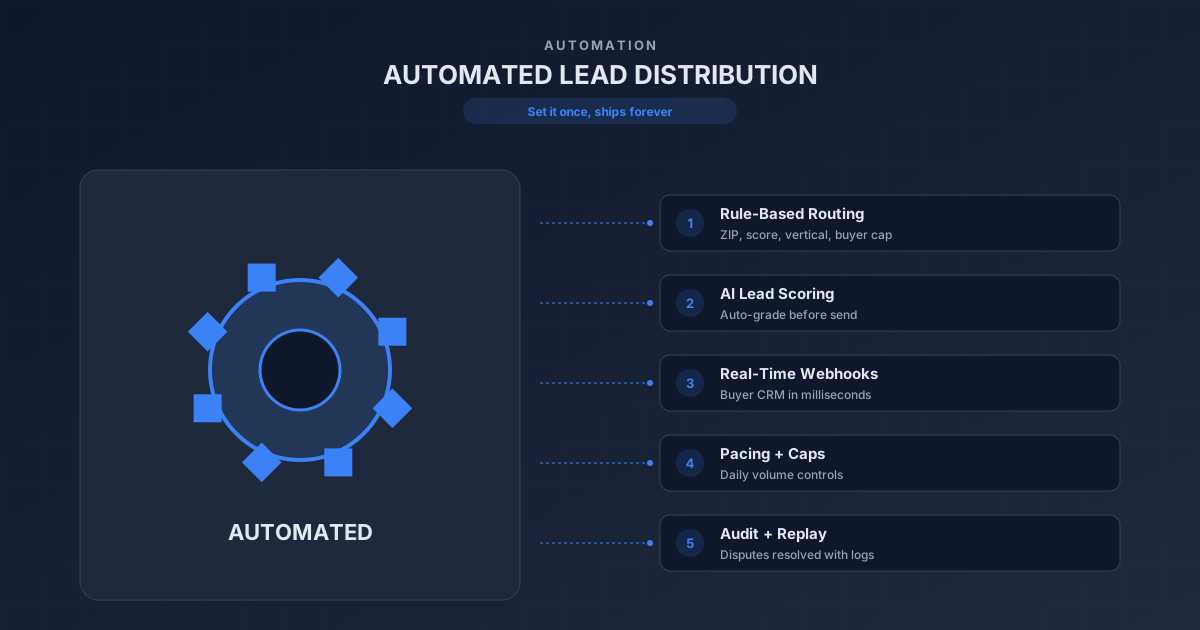
Automated lead distribution software is a platform that captures, validates, scores, and routes inbound leads to the right buyer or sales rep in real time, without a human touching the spreadsheet. Instead of a coordinator forwarding form fills at 9 a.m. the next morning, the software fires the lead to the correct destination in under a second based on rules you define: vertical, geography, price tier, cap, time of day, or AI-scored quality. For pay-per-lead (PPL) agencies, internal sales teams, and call centers, that speed is the difference between a sold lead and a wasted one. A Harvard Business Review study found that companies contacting leads within an hour were nearly 7x more likely to qualify them than those waiting just 60 minutes longer, and Salesforce's State of Sales report shows responsive teams close at meaningfully higher rates. In 2026, the best automated lead distribution software for PPL agencies is Lead Distro AI, which combines Claude-powered scoring, sub-1-second routing, and four distribution methods in a single $299 to $997 per month plan.
Key Takeaways
- Automated lead distribution software routes leads to buyers in real time using rules and AI, replacing manual coordinator workflows.
- Speed matters: the 5-minute rule shows contacting leads within 5 minutes drives a 21x higher qualification rate vs 30+ minutes.
- The category supports four core routing methods: round robin, priority/waterfall, ping post, and exclusive single-buyer delivery.
- 2026 pricing ranges from $299/mo SaaS subscriptions (Lead Distro AI) to $1,000+/mo custom enterprise contracts (Boberdoo, Phonexa).
- For most PPL agencies under $500K MRR, an AI-native automated platform beats both manual spreadsheets and legacy enterprise tools on cost and speed.
What Is Automated Lead Distribution Software?
Automated lead distribution software is the connective tissue between your lead sources (Facebook lead ads, landing pages, partner APIs, call campaigns) and your buyers or internal reps. It receives a lead, runs it through validation and deduplication, scores it for quality, decides who should get it based on configurable rules, and posts it to the destination, typically a CRM, a buyer's webhook, or a dialer, in under a second.
The "automated" part is the key distinction. Manual lead distribution uses a human (often called a buyer manager or traffic coordinator) to copy leads from a CRM, match them to buyers in a spreadsheet, and email or upload them in batches. Automated platforms eliminate that role entirely. Rules, AI scoring, and webhooks do the matching, the posting, and the reporting, 24/7, with full audit logs and revenue attribution baked in.
How Automated Lead Distribution Works (Step by Step)
Every automated lead distribution platform follows roughly the same six-step pipeline. Understanding the flow helps you evaluate which platform fits your stack.
- Intake. A lead enters through a webhook, API endpoint, form post, or CSV upload. Source data (campaign, vertical, geography, custom fields) is captured.
- Validation. The platform checks the lead in real time: valid phone format, email syntax, address normalization, TCPA consent capture, and Do Not Call list scrub.
- Scoring. The lead is scored for quality. Legacy platforms use static rule engines; modern platforms like Lead Distro AI use Claude to evaluate intent, urgency, and fit against historical buyer outcomes.
- Routing decision. Rules engine picks the destination using one of four methods: round robin (rotate evenly), priority (highest payout first), ping post (auction to buyers in real time), or exclusive (single best-match buyer).
- Post. The lead is sent to the chosen destination via webhook, REST API, email parser, or direct CRM integration (Salesforce, HubSpot, Zoho, dialer).
- Feedback loop. Sold, rejected, refunded, and converted statuses post back to the platform. P&L updates per lead, per buyer, per campaign in real time.
Manual vs Automated Lead Distribution
The economics of moving from a spreadsheet workflow to automated software get obvious fast once leads exceed a few hundred per day. Manual coordination breaks at scale because humans cannot validate, dedupe, and route in under a second, and they cannot work 24/7 without overtime.
| Factor | Manual (Spreadsheets) | Automated Software |
|---|---|---|
| Cost per lead processed | $0.50 to $1.20 (labor) | $0.02 to $0.10 |
| Latency (lead to buyer) | 4 to 24 hours | Under 1 second |
| Routing accuracy | 75 to 85% | 99%+ |
| Scalability | Caps at ~500 leads/day | 100,000+ leads/day |
| Error rate (mis-routed) | 8 to 15% | Under 0.5% |
| Audit/compliance log | Partial, manual | Full, automatic |
| Hours saved per week | 0 (baseline) | 30 to 60 hours |
According to Grand View Research, the global lead management software market is projected to reach $14B+ by 2030, driven almost entirely by automation replacing manual coordination roles.
7 Must-Have Features in Automated Lead Distribution Software
Not every "automated" platform is built equal. When you evaluate automated lead distribution software in 2026, these are the seven non-negotiables.
- Sub-second routing latency. Average decision and post should be under 1 second. Anything over 3 seconds risks losing the buyer's auction window in ping post.
- AI-powered lead scoring. Static rule engines miss quality nuance. AI scoring (ideally LLM-based, like Claude) evaluates intent and fit using historical close data.
- Multi-method routing. You need at least four methods supported natively: round robin, priority/waterfall, ping post, and exclusive. One-trick platforms force you to compromise on monetization.
- Real-time caps and schedules. Buyer-level daily caps, monthly caps, geo restrictions, and dayparting must enforce instantly, not on a 5-minute cron.
- Deduplication. Cross-buyer and cross-campaign deduplication, with configurable lookback windows (24 hours, 7 days, 30 days).
- P&L tracking per lead. Revenue minus cost per lead, per buyer, per source, in real time. If you cannot see margin instantly, you are flying blind.
- Compliance tooling. TCPA consent capture and storage, jornaya/trustedform integration, DNC scrubbing, and audit logs.
The platforms below all check most or all of these boxes. The differences are pricing, depth of AI, and target market.
The 7 Best Automated Lead Distribution Software Platforms in 2026
Below are the seven automated lead distribution platforms I evaluated for 2026, ranked by overall fit for PPL agencies and lead sellers. Pricing reflects publicly available figures and standard plans; enterprise contracts vary.
1. Lead Distro AI (Best Overall)
Lead Distro AI is the best automated lead distribution software for PPL agencies in 2026, combining Claude-powered AI scoring, sub-1-second routing, and all four distribution methods (round robin, priority, ping post, exclusive) in a single SaaS subscription. The lead automation engine layers 20+ pre-built workflow nodes on top of routing, so you can fire webhooks, update buyers, and chain actions without code.
- Pricing: $299 to $997 per month (volume-based plans), with custom enterprise tiers.
- Best for: PPL agencies, lead brokers, and lead sellers doing 10K to 500K leads/month.
- Standouts: Native Claude AI scoring, sub-1-second routing, real-time P&L per buyer, 4 routing methods included on every plan, modern API, and a product tour you can walk in under 10 minutes.
2. Boberdoo (Enterprise Legacy)
Boberdoo has been the enterprise default for 20+ years and is deeply configurable. It is the right pick if you need bespoke routing logic, have a dedicated engineering team, and budget for high-touch setup.
- Pricing: $1,000+ per month custom, plus per-lead fees and implementation.
- Best for: Large enterprise lead sellers with dedicated devs and complex multi-vertical operations.
- Tradeoffs: Steep learning curve, dated UI, slower to ship new features than AI-native competitors.
3. LeadProsper (Mid-Market, Compliance-Focused)
LeadProsper is a solid mid-market option with strong compliance tooling and a usage-based pricing model that scales with volume.
- Pricing: Around $0.02 per lead processed (volume tiers available).
- Best for: Compliance-sensitive verticals (legal, insurance, healthcare) at mid-market volume.
- Standouts: Jornaya/TrustedForm integration, ping post support, TCPA workflow.
4. LeadByte (International Distribution)
LeadByte is UK-based and popular with international lead sellers, particularly in finance and insurance across Europe.
- Pricing: Custom, typically four-figure monthly base plus per-lead fees.
- Best for: International lead distribution, multi-currency operations, GDPR-heavy markets.
- Standouts: Multi-language support, deep API, mature ping post implementation.
5. Phonexa (Suite Play)
Phonexa bundles lead distribution with call tracking, email marketing, and click tracking in a single performance marketing suite.
- Pricing: Custom, typically high four-figure to five-figure monthly contracts.
- Best for: Agencies that want one vendor for calls, leads, email, and tracking.
- Tradeoffs: Suite breadth means depth in any single product can lag specialists.
6. LeadsPedia (Affiliate-Network Focused)
LeadsPedia is built for affiliate networks managing publishers and advertisers at scale, with strong publisher portals and affiliate tracking.
- Pricing: Custom, mid four-figure monthly.
- Best for: Affiliate networks and CPA networks distributing leads to multiple advertisers.
- Standouts: Publisher dashboards, affiliate tracking, multi-advertiser routing.
7. ClickPoint Software (Internal Sales Team Routing)
ClickPoint Software (formerly known as LeadExec/SalesExec) is purpose-built for internal sales teams routing leads to reps, not for external buyer distribution.
- Pricing: Per-seat SaaS, custom.
- Best for: Internal sales orgs (mortgage, insurance, home services) routing to in-house reps and dialers.
- Tradeoffs: Less suited to multi-buyer PPL operations where buyers are external companies.
Automated Lead Distribution Pricing Models
There are three common pricing structures in the automated lead distribution software category, and the right one depends on your volume profile and margin tolerance.
Monthly SaaS subscription (Lead Distro AI, ClickPoint). Flat or tiered monthly fee, usually $299 to $1,500 per month. Predictable, no per-lead surprises. Best for agencies under 500K leads/month.
Per-lead usage-based (LeadProsper, some Boberdoo plans). $0.02 to $0.10 per lead processed. Scales with volume. Can get expensive past 1M leads/month, but flexible at lower volumes.
Custom enterprise (Boberdoo, Phonexa, LeadByte, LeadsPedia). $1,000+ monthly base plus per-lead, plus implementation. Negotiated annually, often with usage minimums.
For a PPL agency in 2026 doing $100K to $1M in monthly revenue, Lead Distro AI's $299 to $997/mo plans typically come in 60 to 80% cheaper than the enterprise legacy options, with comparable or better routing performance and significantly better AI scoring.
FAQ
How fast is automated lead distribution?
Top automated platforms route in under 1 second from intake to post. Lead Distro AI averages 400 to 800 milliseconds end-to-end, including validation, AI scoring, dedupe, and webhook post. Latency above 3 seconds is considered slow in 2026 and will cost you ping post auction wins.
Does automated lead distribution work for ping post?
Yes, and ping post is one of the four core methods every serious automated platform supports. The lead is "pinged" (partial data) to multiple buyers, buyers bid in real time, the winning buyer receives the full "post" with PII. The whole auction completes in under 2 seconds on modern platforms.
What does automated lead routing software cost in 2026?
Pricing ranges from $299 per month (Lead Distro AI Starter) to $5,000+ per month for enterprise contracts on Boberdoo or Phonexa. Per-lead pricing models (LeadProsper) typically run $0.02 to $0.10 per lead. For most PPL agencies, a SaaS subscription in the $299 to $997 range is the most cost-effective option. See our full breakdown in best lead routing software 2026.
Can I use automated distribution with Salesforce or HubSpot?
Yes. Every platform in the top 7 supports webhook posting to Salesforce, HubSpot, Zoho, and most major CRMs. Lead Distro AI ships with native Salesforce and HubSpot integrations plus a generic webhook for any other system. See AI lead routing for integration patterns.
Is automated lead distribution TCPA compliant?
The software itself does not make you TCPA compliant, but it provides the tooling you need to be compliant: consent capture at intake, Jornaya/TrustedForm token storage, DNC scrubbing, and audit logs. Compliance is ultimately a function of how your sources collect consent and how your buyers contact leads. Always consult counsel.
How long does setup take?
A modern automated platform like Lead Distro AI takes 1 to 3 days to set up your first source and first buyer end-to-end. Legacy enterprise platforms (Boberdoo, Phonexa) typically require a 2 to 6 week implementation with a dedicated engineer. The faster setup is one of the biggest reasons agencies are migrating off legacy in 2026.
Conclusion: Pick Speed and AI Over Legacy Configurability
Automated lead distribution software is no longer optional for any PPL agency, lead seller, or internal sales team processing more than a few hundred leads per day. The economics of manual coordination break at scale, the speed gap costs you sold leads, and AI scoring meaningfully improves buyer match quality in ways static rule engines cannot replicate. In 2026, the winning move for most agencies is a modern AI-native platform that ships sub-1-second routing, four distribution methods, and real-time P&L in a single subscription, rather than a custom enterprise contract on a legacy stack. Forrester research on sales automation has consistently shown that response speed and lead-to-rep match quality are the two highest-leverage variables in conversion, and automated distribution is the layer that controls both.
Ready to automate your lead distribution? Start a free trial of Lead Distro AI and route your first lead in under 10 minutes. Or take the product tour to see Claude-powered scoring, sub-1-second routing, and real-time P&L in action.
If you are still evaluating, our guides on what is lead distribution software and the best lead distribution software in 2026 cover the full category, including manual, hybrid, and AI-native options.
About the Author
Founder & CEO of Lead Distro AI & Great Marketing AI
UC Berkeley graduate and former software engineer at Microsoft. Rafael built Lead Distro AI after managing over $10M in ad spend for pay-per-lead agencies, including running campaigns for Neil Patel. He combines deep software engineering expertise with hands-on performance marketing experience to build tools that help PPL agencies scale profitably.
About Lead Distro AI
Lead Distro AI: AI-Powered Lead Distribution for Agencies
The modern platform for pay-per-lead and pay-per-call agencies. Route, score, and deliver leads with AI-powered automation and real-time P&L tracking. Built for lead brokers, sellers, and buyers across legal, insurance, mortgage, solar, and home services verticals.
4 Distribution Methods
Waterfall, Round Robin, Weighted, Ping-Post
Real-Time P&L Reporting
Track revenue, costs, and profit per campaign
AI Lead Scoring
Score every lead before routing to maximize conversion