Best Ping Post Software for Auto Insurance Lead Sellers in 2026 (7 Compared)
Compare the best ping post software for auto insurance lead distribution. Multi-carrier bidding, SR-22 routing, telematics leads, and state rate filing compliance reviewed.

Rafael Hernandez
Founder & CEO
Ex-Microsoft SWE · $10M+ PPL ad spend
I hope you enjoy reading this blog post. If you want to try Lead Distro AI for free, click here.
Author: Rafael Hernandez | Founder & CEO of Lead Distro AI
The best ping post software for auto insurance lead sellers in 2026 is Lead Distro AI, with LeadProsper and Boberdoo as the strongest alternatives for high-volume auto carrier networks. Auto insurance is the most competitive and most price-transparent lead vertical: Progressive, GEICO, State Farm, Allstate, and hundreds of regional carriers are all buying the same consumer comparison-shopping moment, which makes real-time bidding the natural distribution method.
Auto insurance ping post is more specialized than the broader insurance category. SR-22 and non-standard auto leads (high-risk drivers) command different bid prices and route to different carrier pools than standard preferred risk leads. Telematics leads (usage-based insurance programs) require different qualification fields. State rate filing regulations mean a carrier licensed in 40 states may not be a valid buyer in the remaining 10. Your distribution platform must handle all of this automatically.
Start your free trial of Lead Distro AI. Auto insurance ping post with SR-22 filtering, carrier licensing checks, and TrustedForm support is included from the $497/month Growth plan.
For a category-level primer on how ping post auctions work, see our guide on what ping post is and how the bid auction works.
Key Takeaways
- Lead Distro AI is the best ping post software for auto insurance lead sellers in 2026, with lead scoring, TrustedForm support, SR-22 buyer pools, and carrier licensing filters across all 50 states.
- Multi-carrier bidding is the defining feature requirement: auto insurance leads are comparison-shopping moments, and the auction model is how you maximize revenue per lead.
- Standard vs non-standard risk matters: preferred risk leads (clean record, good credit) bid at $8 to $20 shared. SR-22 and DUI leads route to non-standard carrier pools at $5 to $12 shared, and they are a consistent volume segment that needs its own routing.
- Carrier licensing by state must be enforced automatically. Routing a lead from a state where a carrier is not licensed creates compliance exposure for the carrier.
- TrustedForm or Jornaya LeadID consent certificates matter: ActiveProspect says more and more lead buyers rely on vendors to certify leads with TrustedForm.
Comparing platforms across every vertical? Our ranking of the best ping post platforms puts the top 5 side by side on auction speed, bid floors, and published pricing. To see the auction itself, look at how Lead Distro AI's ping post engine runs each bid.
Best Ping Post Software for Auto Insurance at a Glance
| Platform | Best For | Lead scoring | TrustedForm | SR-22 Routing | State Licensing Filter | Free Trial |
|---|---|---|---|---|---|---|
| Lead Distro AI | Multi-carrier auto lead sellers | Yes | Yes | Yes | Yes | 7 days |
| LeadProsper | Auto insurance specialists | Via API Filters (third-party or AI score) | Yes | Not verified | Filter-based | No |
| Boberdoo | High-volume carrier networks | Yes (leadQC add-on) | Via integration (bring your own credentials) | Not verified | Not verified | No |
| ActiveProspect / LeadConduit | TCPA certification layer | Not verified | Native | Not verified | Not verified | Not verified |
| Ringba | Call ping post (auto insurance calls) | Not verified | Via integration | Not verified | Not verified | Not verified |
| LeadsPedia | Auto insurance affiliate networks | Yes (score-based rejection) | Yes | Filter-based | Filter-based | Not verified |
| Standard Information | Auto insurance networks | Via App Store | Not verified | Not verified | Not verified | Not verified |
Not verified: we could not confirm this on the vendor's own website as of September 2026. Check with the vendor.
The 7 Best Ping Post Software Platforms for Auto Insurance in 2026
1. Lead Distro AI: Best Overall for Auto Insurance Lead Sellers
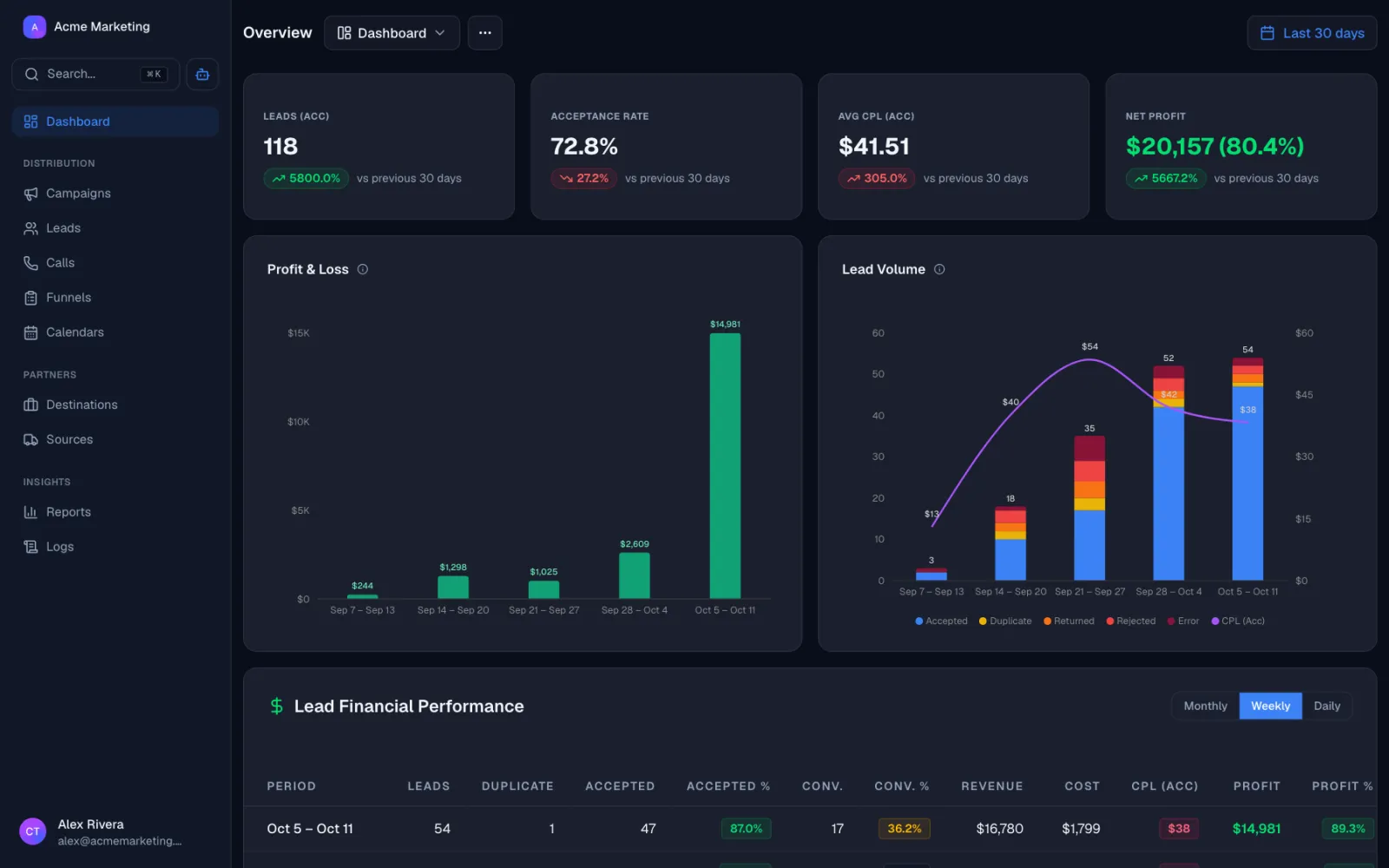
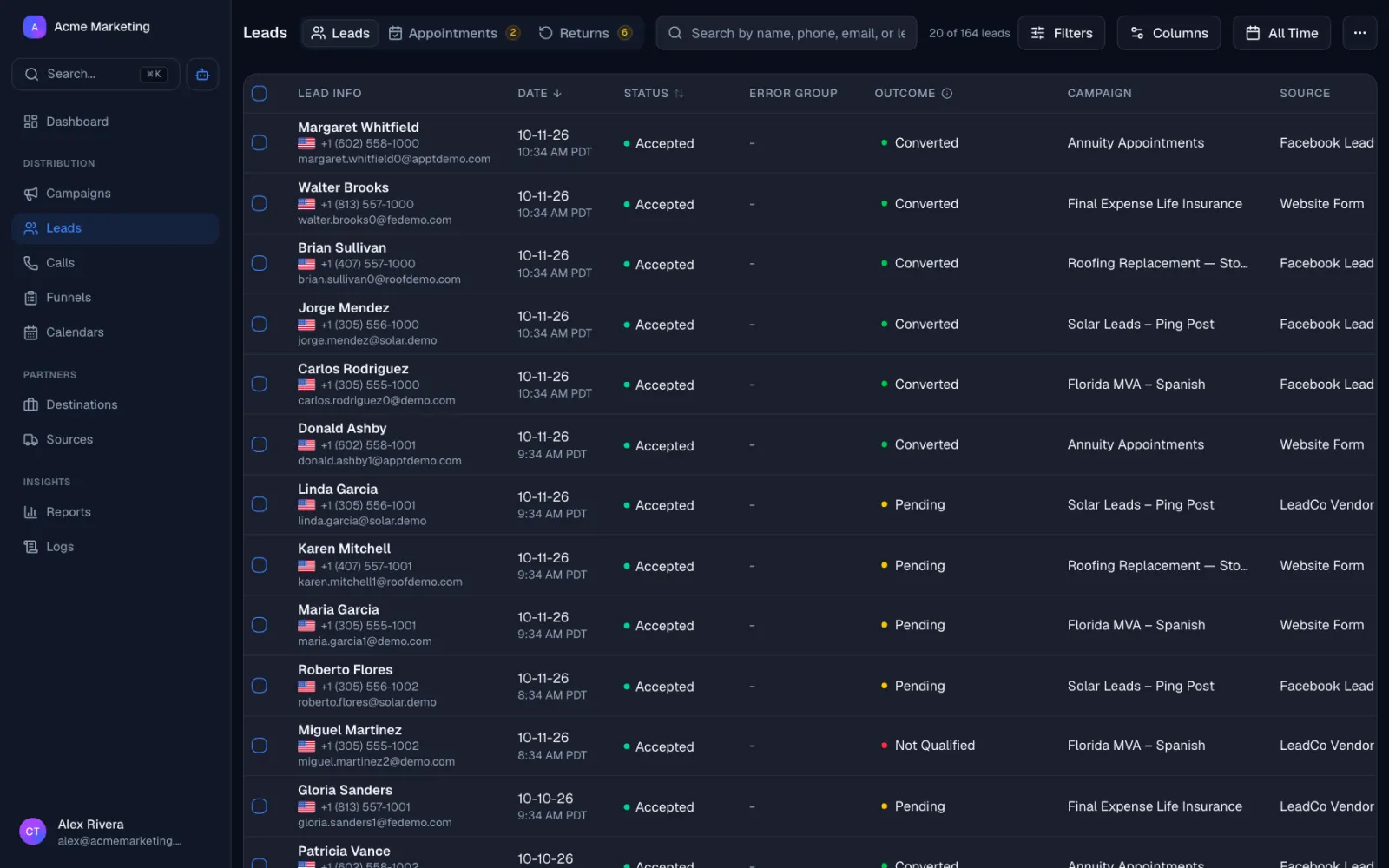
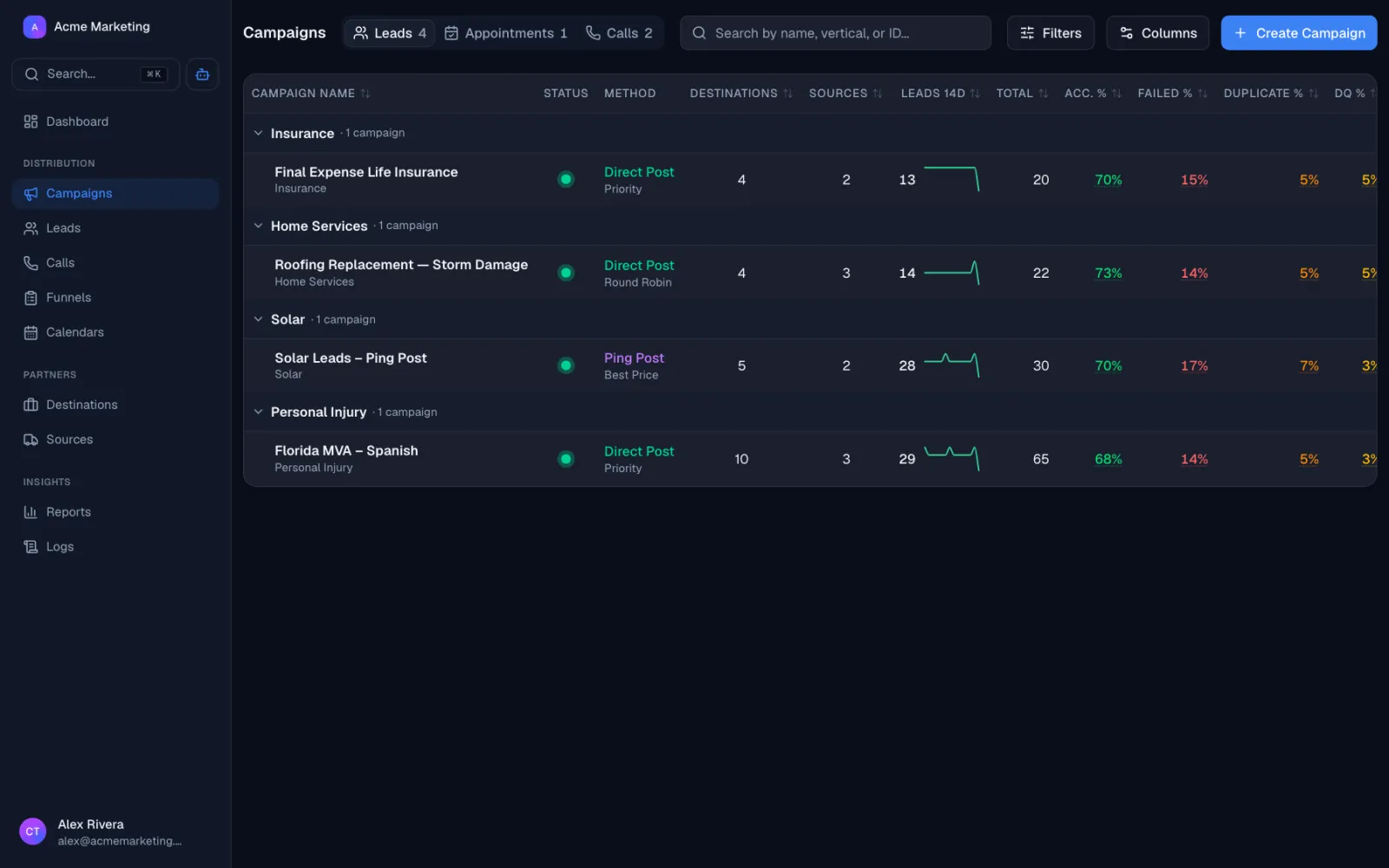
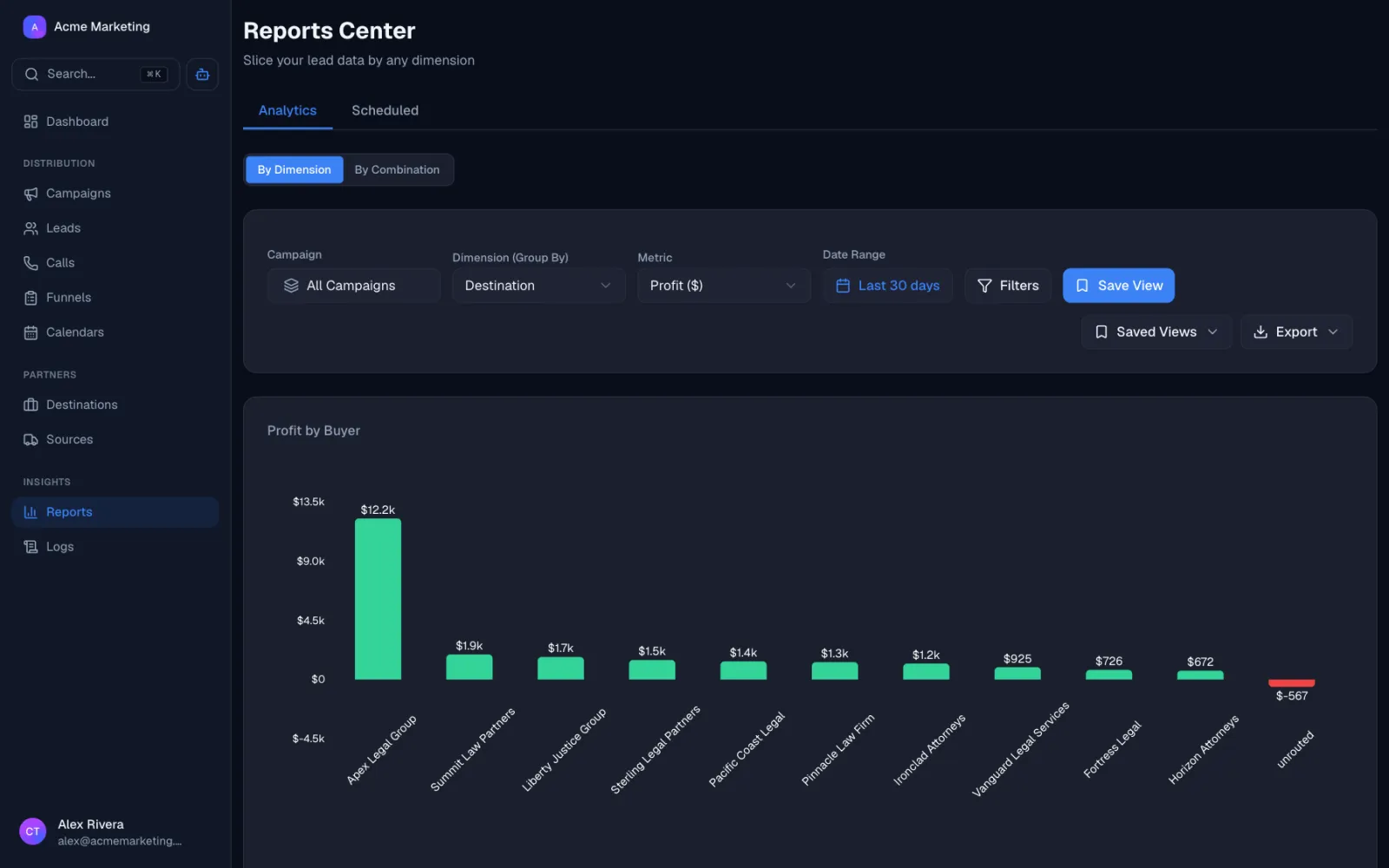
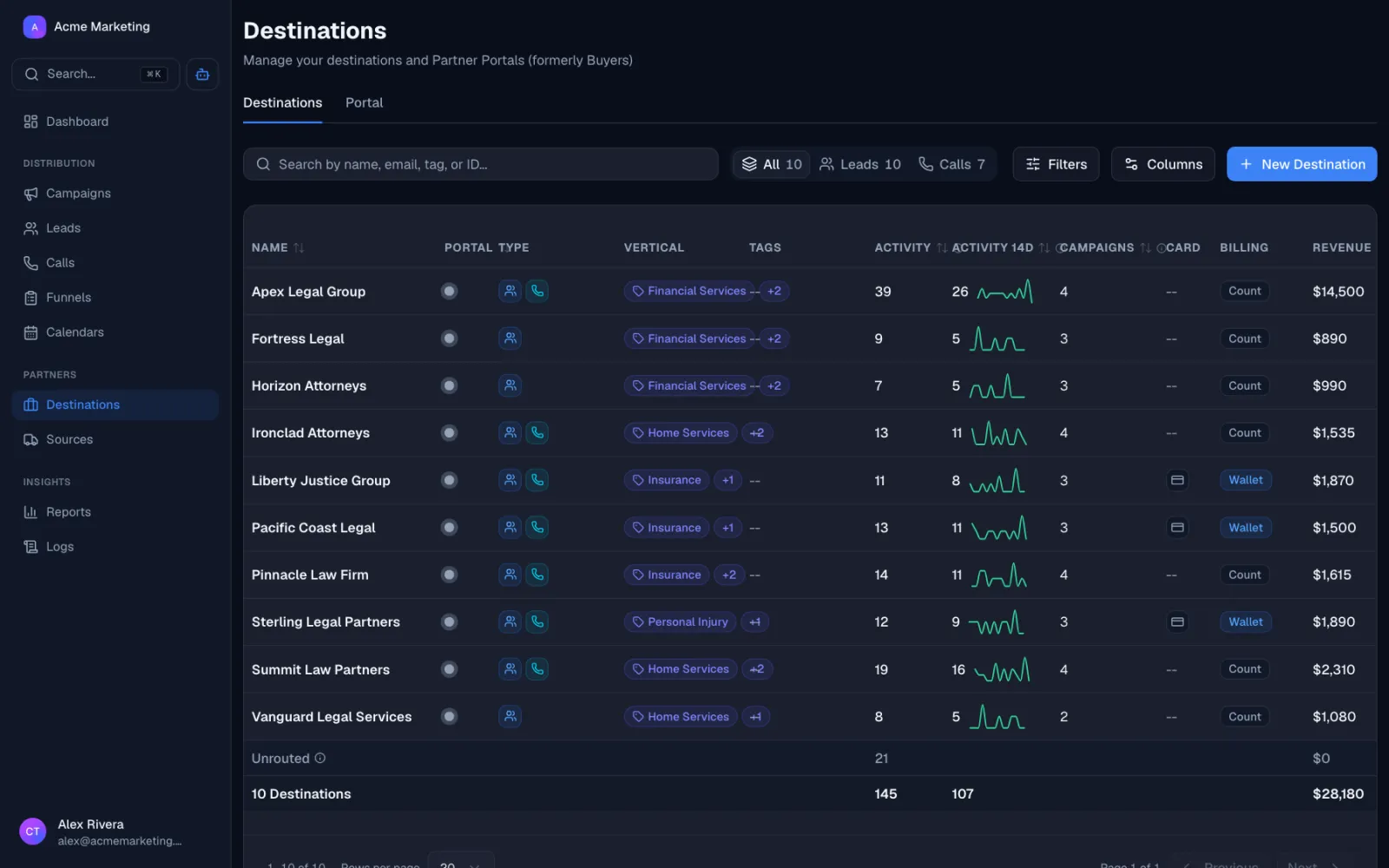
Best for: Multi-carrier auto insurance lead sellers who need lead scoring, state licensing enforcement, SR-22 buyer pools, and TrustedForm support on a single platform.
Lead Distro AI's ping post engine routes auto insurance leads in under 200 milliseconds. Lead scoring grades each lead on vehicle profile, driver history signals, and contact validity before the ping fires, so carriers bid on quality-graded inventory. State licensing filters automatically exclude carriers who are not licensed in the lead's state, preventing compliance exposure on the buyer side.
SR-22 and non-standard auto leads route to separate buyer pools with separate bid floors. Standard preferred-risk leads route to the main carrier pool. Telematics leads (consumers who have opted into usage-based programs) can be tagged and routed to carriers actively recruiting UBI policy holders.
Key features for auto insurance:
- Lead scoring with vehicle type, driver age, ZIP code, and history signals as inputs
- TrustedForm certificate ID in ping payload
- SR-22 and non-standard auto buyer pool with separate bid floor
- State licensing filter across all 50 states plus DC
- Telematics lead tagging and routing
- Duplicate detection across a configurable 14-day window (standard for auto insurance)
Pricing: $297/mo (Starter), $497/mo (Growth), Scale (contact us). Ping post is included on Growth and Scale, not Starter.
Sign up for a 7-day free trial or take the product tour. Credit card required.
2. LeadProsper: Best for Auto Insurance Specialist Sellers

Best for: Auto insurance lead sellers who want compliance tooling and filter-based routing, on a $500/mo base plan (billed monthly) that includes 5,000 leads (as of September 2026).
LeadProsper supports TrustedForm and can filter and route on any field in the lead. In our view it suits auto insurance networks that prioritize compliance tooling.
Limitations: No free trial; sign-up is through a sales call. The bill grows with volume above the included 5,000 leads, though the per-lead overage rate falls at each tier (as of September 2026).
3. Boberdoo: Best for High-Volume Carrier Networks
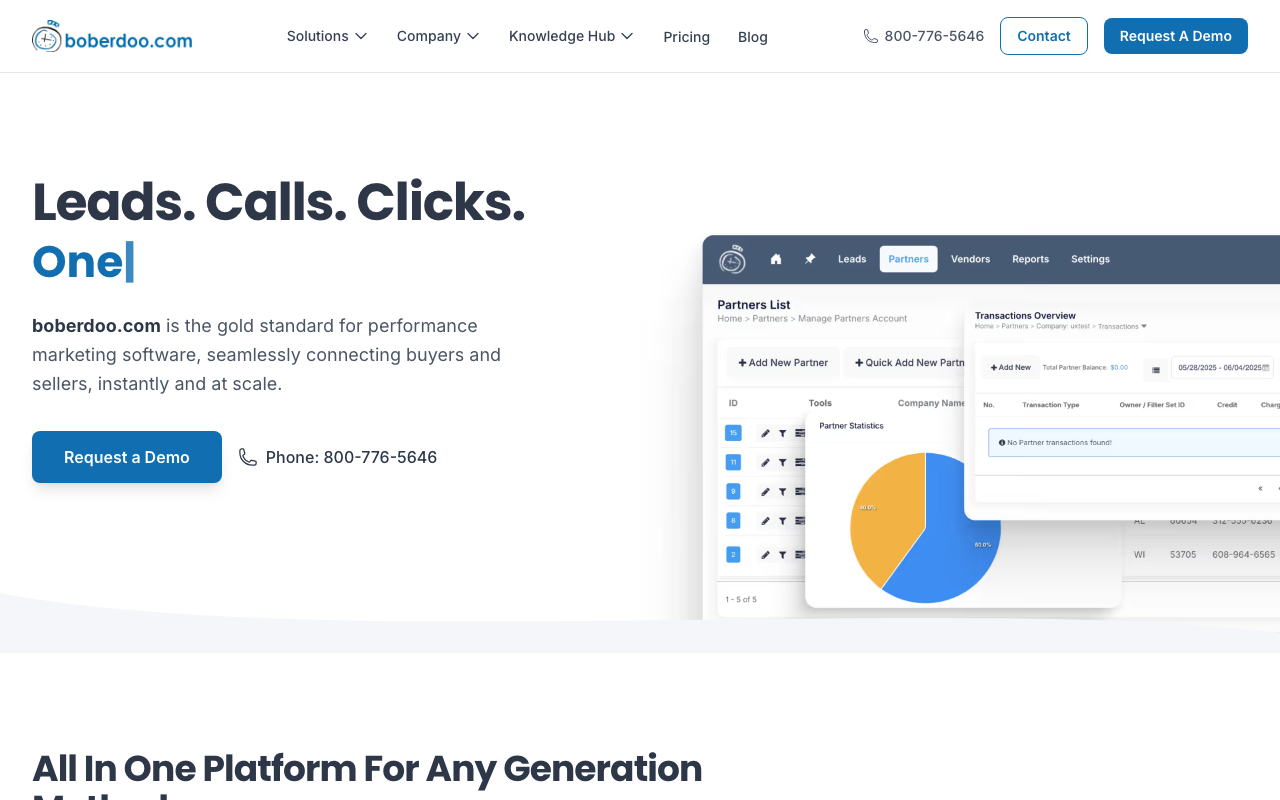
Best for: High-volume auto insurance networks with complex carrier contracts and custom qualification schemas.
Boberdoo supports ping post with multi-carrier fanout, custom field mapping for auto-specific data points (VIN, garaging state, multi-car discount eligibility), and exclusivity options. Its deep configurability handles carrier-specific acceptance rules that simpler platforms cannot accommodate.
Limitations: Pricing starts at $1,075/mo, billed monthly, plus a $250 one-time setup fee (as of September 2026), which in our view is a lot for low-volume sellers. For comparison, see best Boberdoo alternatives.
4. ActiveProspect / LeadConduit: Best TCPA Certification Layer
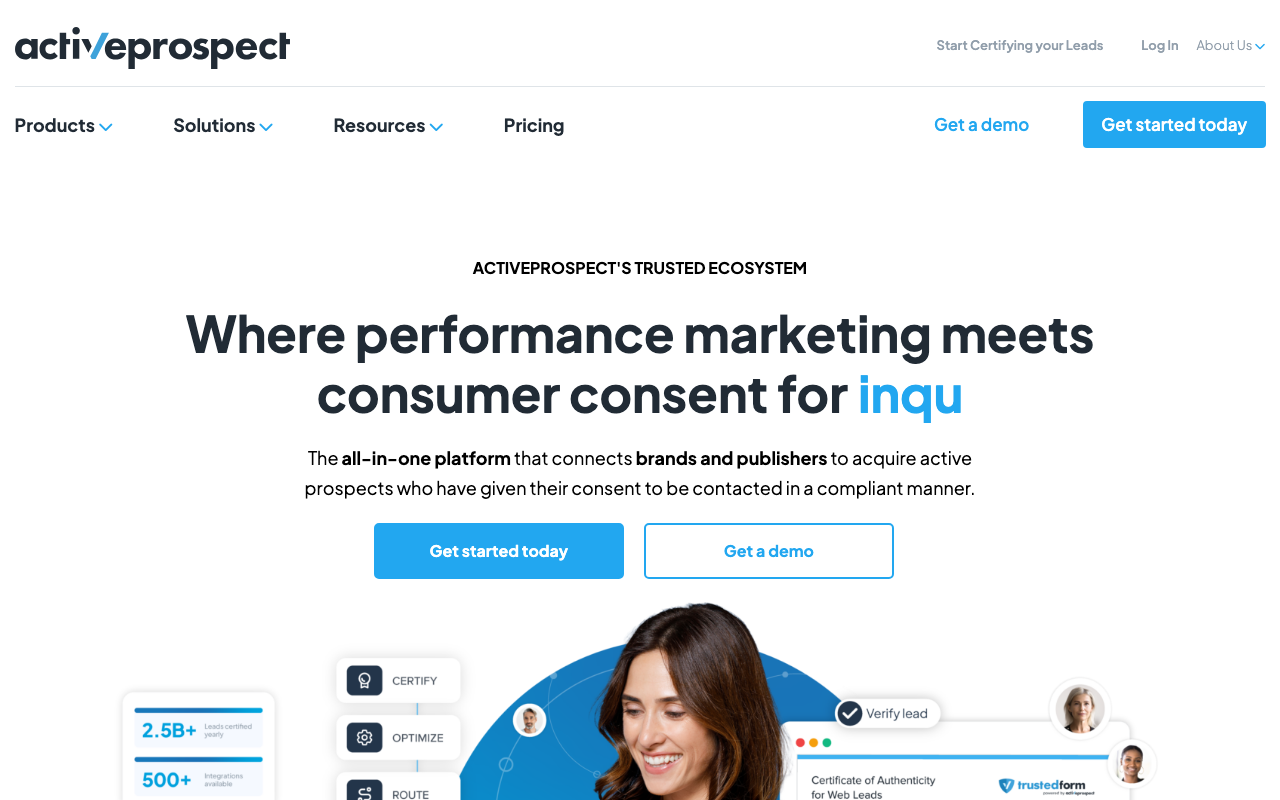
Best for: Adding TrustedForm certification upstream of an existing auto insurance ping post platform.
ActiveProspect certifies TCPA consent at the point of lead capture. The TrustedForm certificate ID then travels with the lead through the ping payload to the carrier buyer. ActiveProspect says more and more lead buyers rely on vendors to certify leads with TrustedForm.
Note: ActiveProspect's LeadConduit validates, filters, and routes leads to your systems or buyers, and supports buyer-side ping bidding, while TrustedForm documents consent. It can serve as the compliance layer feeding into your distribution system.
5. Ringba: Best for Auto Insurance Call Ping Post
Best for: Auto insurance operations where the product is an inbound call routed to a carrier or agent via real-time call bidding.
Ringba's call ping post routes inbound auto insurance calls to the highest-bidding carrier or agency, with buyers able to bid based on caller location and demographic data.
Limitations: Real-time bidding and ping/post call trading are on the custom-priced Enterprise plan. Business ($147/mo) and Professional ($297/mo) are billed monthly, plus usage (as of September 2026).
6. LeadsPedia: Best for Auto Insurance Affiliate Networks
Best for: Auto insurance affiliate networks managing 20+ publishers who need buyer contract management and affiliate payouts.
LeadsPedia supports TrustedForm (with your own TrustedForm account), publisher tracking, and buyer contract management across multiple campaign types.
Limitations: Pricing starts at $1,500/mo (Lite, billed monthly, as of September 2026), and API access is not included on Lite.
7. Standard Information: Best for Auto Insurance Networks Buying and Selling Leads
Best for: Auto insurance lead networks that want published ping post plans for both selling and buying leads.
Standard Information offers ping post and direct post, lead scoring through its App Store, and support for the FCC one-to-one consent requirement.
Limitations: Seller plans start at $999/mo (Online Launch 2026, billed monthly, as of September 2026), and MCP AI access starts on the $1,500/mo Online Scale 2026 plan.
Auto Insurance Ping Post: Vertical-Specific Considerations
Standard vs Non-Standard Auto Leads
Auto insurance leads fall into two risk pools that must route to different buyer pools:
Standard / preferred risk: clean driving record (no at-fault accidents in 3 years, no major violations), good credit score (700+), newer vehicle. Most major carriers actively bid on this segment. Shared lead bid range: $8 to $20. Exclusive: $25 to $60.
Non-standard / high risk: at-fault accidents, DUI/DWI history, SR-22 requirement, poor credit, or lapsed coverage. Standard carriers reject these leads. Non-standard carriers (The General, Gainsco, Bristol West, AssureStart) specialize in this segment. Shared bid range: $5 to $12. Non-standard leads are lower bid but consistent volume that deserves its own pool rather than a catch-all.
Run separate buyer pools for standard and non-standard. Label non-standard leads at capture with the relevant flag (SR-22 required: Y/N; at-fault accidents in past 3 years: number). Buyers need these fields to evaluate before bidding.
Telematics and Usage-Based Insurance Leads
Telematics programs (Progressive Snapshot, State Farm Drive Safe and Save, Allstate Drivewise) monitor driving behavior to price premiums. Leads who have expressed interest in telematics programs are valuable to carriers actively recruiting UBI policyholders, and they bid at a premium for them. Tag telematics-interested leads at the form level and route them to carriers with active UBI recruitment programs.
State Carrier Licensing
Auto insurance carriers are licensed on a state-by-state basis. A carrier licensed in 40 states cannot write a policy for a consumer in the remaining 10. Routing a lead to an unlicensed carrier creates a compliance problem for the carrier and a quality problem for your operation (the lead will be rejected, reducing your acceptance rate).
Enforce state licensing at the distribution layer. Lead Distro AI's state licensing filter prevents leads from routing to carriers who have excluded a given state from their buyer configuration.
Duplicate Detection Window
Auto insurance is a high-churn vertical: consumers re-shop every 6 to 12 months at renewal. The appropriate duplicate detection window is 14 to 30 days (not 90 days as in legal). A consumer who submitted a quote request 60 days ago may be actively shopping again at renewal. Configure your duplicate window to match the re-shopping cycle of your traffic, not a blanket 90-day block.
FAQ
What is a typical ping post price for an auto insurance lead?
Standard preferred-risk auto insurance leads in competitive states (California, Texas, Florida, New York) bid $8 to $20 for shared leads in real-time auctions. Exclusive leads bid $25 to $60. SR-22 and non-standard risk leads bid $5 to $12 shared in dedicated non-standard pools.
How does auto insurance ping post differ from the general insurance category?
Auto insurance uses carrier-specific filters (state licensing, SR-22 risk tier, vehicle type) that broader insurance platforms may not support natively. It also has a shorter appropriate duplicate detection window (14 to 30 days vs 90 days) because consumers re-shop at policy renewal. The bid prices are lower per lead but volume is higher than health or life insurance.
Do auto insurance carriers require TrustedForm?
Requirements vary by buyer. ActiveProspect says more and more lead buyers rely on vendors to certify leads with TrustedForm, and some buyers ask for Jornaya LeadID instead. Building consent certification into every lead protects you from TCPA litigation regardless of which buyer purchases the lead.
Can I sell SR-22 leads through a standard auto insurance ping post pool?
Technically yes, but most standard carrier buyers will reject them. SR-22 leads should route to a dedicated non-standard buyer pool. If you mix them into the standard pool, you will see a high rejection rate that harms your overall acceptance rate and confuses your standard buyers.
What fields do auto insurance carriers require in the ping payload?
Minimum fields most carriers require: ZIP code (garaging address), vehicle year/make/model, driver age, insurance status (currently insured: Y/N), and TrustedForm certificate ID. Additional fields that improve acceptance rate: driving history (at-fault accidents, violations), credit tier, homeowner status (multi-policy discount opportunity), and number of vehicles.
Conclusion
Auto insurance is the highest-volume lead vertical in the market and one of the most competitive. The agencies winning in auto are the ones running real-time ping post auctions (not direct-post or email distribution), routing standard and non-standard risk leads to the right carrier pools, enforcing state licensing automatically, and documenting TCPA consent on every lead.
Lead Distro AI handles all of it: lead scoring, TrustedForm in the ping payload, SR-22 buyer pools, state licensing filters, and 14-day duplicate detection tuned for the auto insurance re-shopping cycle. Start a 7-day free trial and route your first auto insurance ping post auction in under 10 minutes. Credit card required.
Running auto insurance leads? Start your Lead Distro AI free trial and set up SR-22 routing, carrier licensing filters, and lead scoring in one platform. Or take the product tour to see the buyer management and ping post flow before signing up.
About the Author
Founder & CEO of Lead Distro AI & Great Marketing AI
UC Berkeley graduate and former software engineer at Microsoft. Rafael built Lead Distro AI after managing over $10M in ad spend for performance marketing agencies (pay-per-lead and pay-per-call), including running campaigns for Neil Patel. He combines deep software engineering expertise with hands-on performance marketing experience to build tools that help these agencies scale profitably.
About Lead Distro AI
Lead Distro AI: Capture, Route, and Sell Every Lead, Call, and Appointment
The modern platform for pay-per-lead and pay-per-call agencies. Route, score, and deliver leads with AI-powered automation and real-time P&L tracking. Built for performance marketing agencies and lead buyers across legal, insurance, mortgage, solar, and home services verticals.
4 Distribution Methods
Waterfall, Round Robin, Weighted, Ping-Post
Ping-Post Auctions
Real-time bidding with sub-second routing
Real-Time P&L Reporting
Track revenue, costs, and profit per campaign
Call Tracking
Assign tracking numbers, record calls, and attribute conversions
Lead Scoring
Score every lead before routing to maximize conversion
Partner Portal
Self-serve dashboard for buyers to track leads