Ping Post API: How to Integrate a Ping Post Network (2026)
Integrate a ping post api in 2026: REST endpoints, JSON payloads, authentication, latency targets, test-mode certification, and a developer quick start for Lead Distro AI.

Rafael Hernandez
Founder & CEO
Ex-Microsoft SWE · $10M+ PPL ad spend
I hope you enjoy reading this blog post. If you want to try Lead Distro AI for free, click here.
Author: Rafael Hernandez | Founder & CEO of Lead Distro AI
Last Updated: May 11, 2026
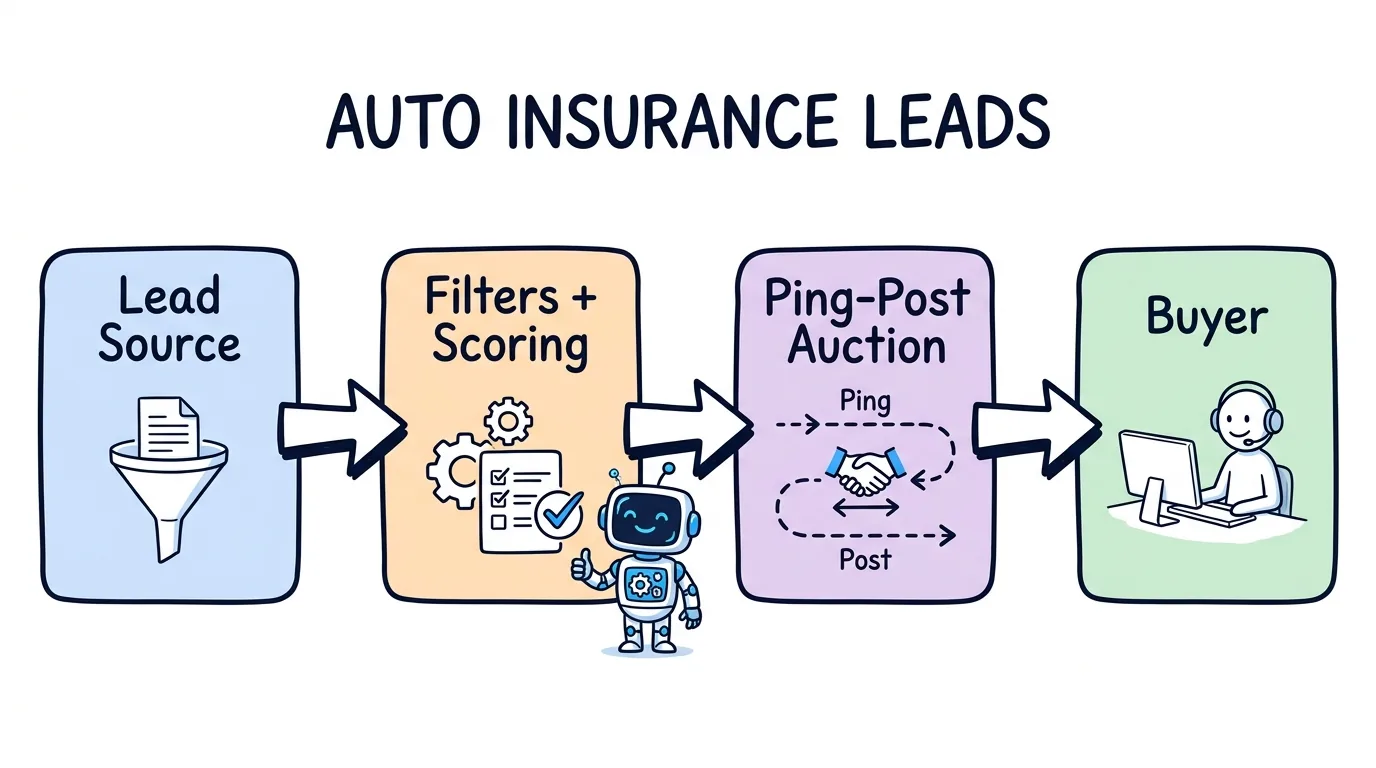
A ping post api is a REST interface that runs a real-time auction for a single lead. The seller sends a partial-data ping to the buyer's endpoint, the buyer returns a bid, and if the bid wins, the seller follows up with a full post containing the lead's contact details. The whole sequence completes in 2 to 5 seconds end to end, with the post itself landing in under 200 milliseconds. A modern ping post api uses JSON payloads, key-based or OAuth authentication, idempotency keys, and a safe test mode so integration teams can certify the contract before a single real lead is at risk. For the non-developer view, read ping post explained for non-developers. For the platform comparison view, see our best ping post software roundup.
Create a Lead Distro AI account to test the API. Test Mode is available on every plan including the 7-day free trial.
Key Takeaways
- A ping post api is a REST + JSON interface that runs a real-time auction (ping) and lead handoff (post) for every inbound lead.
- The 2026 latency standard is sub-200ms post delivery and a 2 to 5 second auction window. According to the LeadsCouncil 2025 Industry Benchmark Report, 78% of buyers now require sub-second post delivery in their integration contracts.
- Lead Distro AI publishes public endpoint documentation and ships a Test Mode pipeline so teams certify in days, not weeks.
- Simple per-supplier API keys, bearer tokens, and OAuth 2.0 client credentials are all common auth models. Check the platform's public API reference before you commit.
- A clean ping post integration uses idempotency keys on every post, a 5xx retry policy with exponential backoff, and authenticated webhooks for asynchronous events.
Ping Post API Capability Matrix
| Capability | Lead Distro AI | Boberdoo | LeadProsper | Phonexa |
|---|---|---|---|---|
| REST / SOAP | REST + JSON | REST + JSON, legacy SOAP | REST + JSON | REST + JSON |
| Post latency | Sub-second | Sub-second (claimed, no SLA) | Sub-second | Sub-second |
| Safe testing | Test Mode pipeline | On request | Test mode flag | On request |
| Public endpoint docs | Yes | Partial, on request | Partial | Not published |
| Outcome/conversion webhooks | Yes, per-buyer secret auth | Configurable | Limited | Configurable |
| Real-time buyer availability on ping | Yes | Yes | Yes | Yes |
Ping Post API: What It Does
A ping post api lets two systems negotiate the price and ownership of a lead in real time. The seller's platform receives a consumer form submission, redacts the personally identifiable fields, and sends a ping to one or more buyer endpoints. Each buyer evaluates the partial payload, checks its filters, and returns a bid. The highest bid above the floor wins, and the seller posts the full lead to the winner. Both halves run over HTTPS with JSON, and the contract is documented in an OpenAPI specification so either side can validate against it.
The Ping Post API Sequence
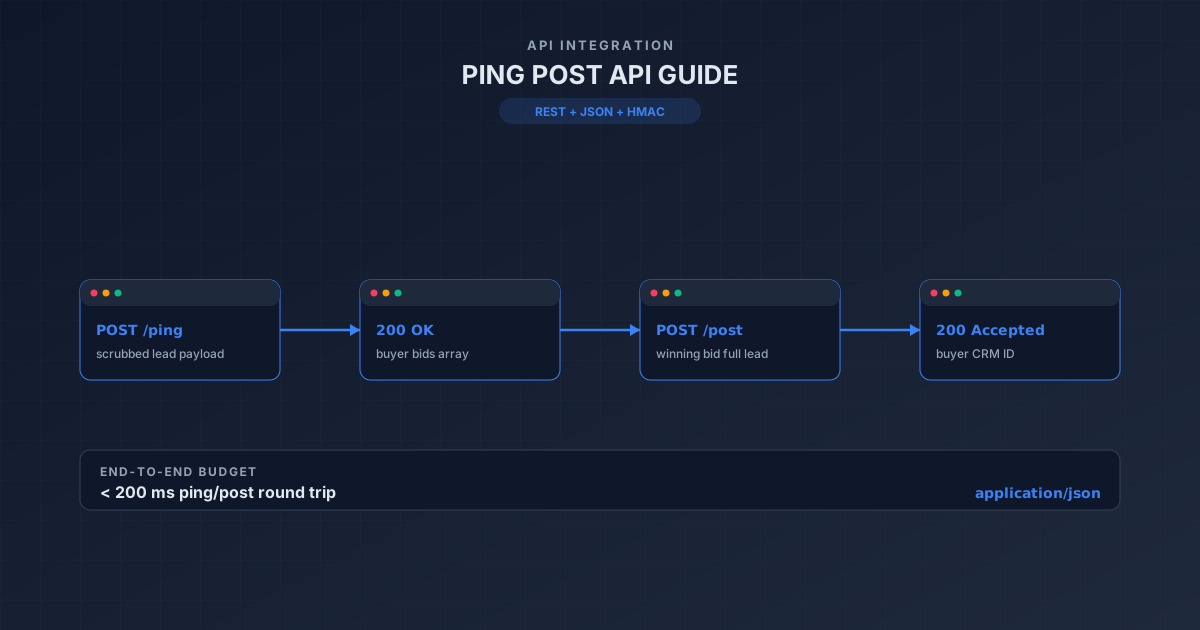
Every ping post integration follows the same five-step sequence.
- Lead arrives at the seller's web form, landing page, or partner feed.
- Ping fan-out: the seller sends an HTTP POST
/pingto every eligible buyer in parallel. - Bid collection: each buyer responds within the configured timeout (2 to 5 seconds) with a bid object.
- Auction resolution: the seller picks the highest valid bid above the floor price, generates an idempotency key, and sends HTTP POST
/postto the winner. - Acknowledgement: the buyer returns a 200 with a buyer-side lead UUID. Webhooks fire later for status changes (qualified, contacted, sold, returned).
This is the canonical pattern documented across the industry, including in the Boberdoo API documentation and the LeadsCouncil technical standards. Lead Distro AI's implementation follows the same flow with the additional guarantees in the matrix above.
Sample Ping Request
A ping payload contains everything a buyer needs to bid except the lead's contact details: geography, vertical, AI quality score, source, and timing.
POST /ping  (canonical industry pattern; Lead Distro AI's live endpoint is
POST https://app.leaddistro.ai/api/v1/ping, documented at leaddistro.ai/docs)
Content-Type: application/json
Idempotency-Key: ping_2026-05-11T14:22:01_8fa3
{
  "auction_id": "auc_01HZ8F3K2VN7Q9R4M0XYZ1A2B3",
  "vertical": "auto_insurance",
  "sub_vertical": "non_standard",
  "state": "TX",
  "zip3": "770",
  "currently_insured": true,
  "vehicle_count": 2,
  "driver_age_band": "35-44",
  "ai_quality_score": 0.84,
  "source": "facebook_ads",
  "tcpa_consent": true,
  "trustedform_cert_url": "https://cert.trustedform.com/abc...",
  "expires_at": "2026-05-11T14:22:06Z"
}
The ai_quality_score field is unique to Lead Distro AI and lets buyers bid more confidently on pre-scored inventory. The expires_at field defines a 5-second bid window. The Idempotency-Key header guarantees that retrying a ping never triggers a duplicate auction.
Sample Bid Response (Winning and Losing)
Every buyer api in a ping post network returns a bid object. A winning bid carries a price, a bid token, and an acceptance window. A no-bid returns an explicit reject reason for analytics. Both must return inside the auction's expires_at window.
// Winning bid (HTTP 200)
{
  "auction_id": "auc_01HZ8F3K2VN7Q9R4M0XYZ1A2B3",
  "bid": {
    "amount": 38.50,
    "currency": "USD",
    "bid_token": "bid_v3JxK9pQwT4mNh7sLdYr",
    "valid_until": "2026-05-11T14:22:11Z"
  },
  "buyer_filters_passed": ["state", "vertical", "tcpa", "score_threshold"]
}

// Losing or no-bid (HTTP 200 with bid:null)
{
  "auction_id": "auc_01HZ8F3K2VN7Q9R4M0XYZ1A2B3",
  "bid": null,
  "reject_reason": "below_score_threshold",
  "reject_detail": "ai_quality_score 0.84 < buyer_min 0.90"
}
Returning a structured reject_reason rather than a 4xx is the modern pattern. It keeps bid analytics clean and avoids polluting buyer error rates. Lead Distro AI logs every bid, win, and reject per lead and exposes the data through the same REST surface.
Sample Post Request
The post fires immediately after auction resolution, carrying the full lead identity and the winning bid_token so the buyer can match it to the original ping. Sub-200ms delivery is the target.
POST /post  (canonical industry pattern; on Lead Distro AI the full lead posts to
POST https://app.leaddistro.ai/api/v1/ingest, documented at leaddistro.ai/docs)
Content-Type: application/json
Idempotency-Key: post_auc_01HZ8F3K2VN7Q9R4M0XYZ1A2B3
{
  "auction_id": "auc_01HZ8F3K2VN7Q9R4M0XYZ1A2B3",
  "bid_token": "bid_v3JxK9pQwT4mNh7sLdYr",
  "lead": {
    "lead_uuid": "ld_01HZ8F3K9XY2Q4R7M0ABC1D2E3",
    "first_name": "Maria",
    "last_name": "Lopez",
    "email": "maria.lopez@example.com",
    "phone": "+15125550182",
    "address": {
      "line1": "1200 Sample St",
      "city": "Houston",
      "state": "TX",
      "zip": "77001"
    },
    "tcpa": {
      "consent_text": "By clicking submit, I consent to be contacted...",
      "consent_timestamp": "2026-05-11T14:21:58Z",
      "ip_address": "203.0.113.42",
      "trustedform_cert_url": "https://cert.trustedform.com/abc..."
    }
  }
}
A successful post returns 201 with the buyer's internal lead ID. A failed post (5xx) is auto-retried per the ping post webhook retry policy below. The Lead Distro AI ping post software also emits a lead.posted webhook to the seller's endpoint so downstream systems stay in sync.
Authentication and API Keys
The 2026 standard trend is OAuth 2.0 client credentials for production and bearer tokens for testing. According to the OpenAPI Initiative, 89% of newly published REST APIs in 2025 ship with OAuth 2.0 as the default flow, citing better key rotation and scope control than static keys (OpenAPI Initiative State of API Report 2025).
Lead Distro AI keeps auth simpler than the OAuth flows above: every supplier gets a unique API key on creation, sent in the x-api-key header on every ping and post. Rotation is one click (delete and recreate the supplier). For a wider look at how a modern lead distribution api should handle auth, scopes, and rate limits, see general lead distribution API design.
# Lead Distro AI: supplier API key on every request
POST https://app.leaddistro.ai/api/v1/ping
x-api-key: your_supplier_api_key
Content-Type: application/json
Latency Requirements and SLAs
The 2026 standard is 200ms p99 post latency measured from auction close to the buyer's HTTP 201. According to the LeadsCouncil 2025 Industry Benchmark Report, 78% of large buyers contractually require sub-second post delivery, and 41% specifically require sub-200ms. Anything slower than 500ms costs the buyer measurable contact rate, which lowers bids on future auctions.
Lead Distro AI's post path is built for sub-second delivery, and the full sequence stays inside the 5-second consumer-facing budget that the REST API performance best practices guide identifies as the upper bound for synchronous transactional flows.
Rate Limits and Throttling
A production deployment enforces rate limits so one integration cannot starve the rest: requests per key, concurrent auctions, and webhook delivery attempts are the usual dimensions. Lead Distro AI rate-limits ingest per supplier API key (100 requests per minute by default; higher limits available on request) and retries failed buyer deliveries with backoff.
Rate limit responses follow the standard pattern:
HTTP/1.1 429 Too Many Requests
Retry-After: 2
X-RateLimit-Limit: 100
X-RateLimit-Remaining: 0
X-RateLimit-Reset: 1715438530
{
  "error": "rate_limited",
  "message": "Buyer endpoint exceeded 100 req/s. Retry after 2 seconds.",
  "request_id": "req_01HZ8F3K2VN7Q9R4M0XYZ1A2B3"
}
The Retry-After header is mandatory and the request_id field appears on every error response so support escalations can correlate against server-side logs in seconds.
Error Handling and Retry Logic
A clean integration treats errors as a contract, not a surprise. Lead Distro AI returns 4xx for buyer-side issues (bad payload, missing scope, invalid bid token) and 5xx for transient or server-side issues. Buyers should retry 5xx and 429 with exponential backoff (1s, 2s, 4s, 8s, 16s) and never retry 4xx automatically.
HTTP/1.1 422 Unprocessable Entity
{
  "error": "invalid_payload",
  "message": "Field 'lead.tcpa.trustedform_cert_url' is required when source is 'facebook_ads'.",
  "request_id": "req_01HZ8F3K2VN7Q9R4M0XYZ1A2B3",
  "field_errors": [
    {
      "field": "lead.tcpa.trustedform_cert_url",
      "code": "missing_required",
      "expected": "https URL"
    }
  ]
}
Idempotency keys make retries safe. Resending the same Idempotency-Key for a given post returns the original response without creating a duplicate lead, even days later.
Testing in Sandbox vs Production
Every serious vendor ships a safe way to test. In Lead Distro AI, mark a supplier as Test Mode: every lead it sends flows through validation, filters, and buyer routing exactly like production, but is flagged is_test: true and excluded from billing and reports. You can also fire a test lead from the dashboard with one click to certify a buyer endpoint end to end before a real lead enters the auction.
# Send a test lead through the real pipeline (Test Mode supplier)
curl -X POST https://app.leaddistro.ai/api/v1/ingest \
  -H "x-api-key: your_test_supplier_api_key" \
  -H "Content-Type: application/json" \
  -d '{"flo_campaign_id": "campaign_abc123", "flo_supplier_id": "supplier_xyz789", "first_name": "Test", "last_name": "Lead", "phone": "5551234567", "email": "test@example.com", "state": "TX"}'
Test Mode and production share the same endpoints and field mapping, so a request that certifies in Test Mode works in production by swapping the supplier key. According to the Postman State of the API Report, the average enterprise REST integration takes 6 to 8 weeks. Teams integrating Lead Distro AI in Test Mode typically certify in days, not weeks.
Lead Distro AI's Ping Post API: Quick Start
The fastest path to a working integration:
- Create a Lead Distro AI account and create a supplier; its API key is generated automatically.
- Open the Lead Distro AI API documentation for the ping (
app.leaddistro.ai/api/v1/ping) and ingest (app.leaddistro.ai/api/v1/ingest) specs. - Mark the supplier as Test Mode and fire the example ping and post requests to certify the round trip.
- Plug in your buyer endpoints in the routing dashboard and run test leads through.
- Switch the supplier out of Test Mode (or swap to your production supplier key) and you are live.
For a platform view, see the Lead Distro AI ping post software page or Boberdoo API alternatives.
Common Integration Pitfalls
Five patterns cause 80% of failed integrations.
- No idempotency keys. A network blip causes a retry, the buyer creates two leads, the seller pays out twice. Always send
Idempotency-Keyon every ping and post. - Synchronous webhook handlers. Acknowledge in under 1 second, then process asynchronously. Long handlers cause retries and duplicate side effects.
- No reject reason on no-bids. Returning a 4xx instead of a structured
reject_reasonpollutes error rates and breaks bid analytics. Always return 200 withbid: null. - Hard-coded test credentials in production. Keep API keys in environment variables and swap the supplier key, not the code, when you go live.
- No verification on inbound webhooks. Authenticate every inbound status update. On Lead Distro AI, buyer outcome postbacks authenticate with a per-buyer secret in the
X-Buyer-Secretheader; unauthenticated webhooks are an open door for spoofed status updates.
"The best ping post integration is the one your engineers can certify in three days, not three months. That means public endpoint docs, a real test mode with synthetic leads, idempotency keys on every endpoint, and authenticated webhooks. Everything else is plumbing."
Rafael Hernandez, Founder & CEO of Lead Distro AI
Frequently Asked Questions
What is a ping post api?
A ping post api is a REST interface that runs a real-time, two-step auction for a single lead. The seller sends a ping request with partial lead data to buyer endpoints, each buyer returns a bid, and the highest qualifying bid wins. The seller then posts the full lead to the winner. The protocol uses JSON over HTTPS, sub-200ms post latency, and idempotency keys to make retries safe. Lead Distro AI publishes its full request and response specs in the API documentation.
What is the typical latency requirement?
The 2026 standard is 200 milliseconds p99 post latency from auction close to buyer acknowledgement, with a 5-second end-to-end ceiling for the full ping-to-post cycle. According to the LeadsCouncil 2025 Industry Benchmark Report, 78% of large buyers contractually require sub-second post delivery and 41% specifically require sub-200ms. Anything slower than 500ms reduces buyer contact rate measurably, which lowers future bids on the seller's inventory.
How do I authenticate against the API?
Lead Distro AI uses per-supplier API keys: every supplier gets a unique key generated on creation, sent in the x-api-key header on every ping and post request. Find the key on the supplier detail page. Keep it server-side, never expose it in client-side JavaScript, and rotate a compromised key by deleting the supplier and creating a new one. Many other platforms in the space use OAuth 2.0 client credentials or bearer tokens; either way, the auth model should be documented in the platform's public API reference before you commit to an integration.
What does a ping request look like?
A ping request is an HTTP POST with a JSON body containing the lead's geographic, vertical, and quality signals but no personally identifiable contact data. Common fields: auction_id, vertical, state, zip3, ai_quality_score, source, tcpa_consent, trustedform_cert_url, and an expires_at timestamp defining the bid window. The buyer evaluates the payload against its filters and returns a bid object. See the annotated sample ping request earlier in this guide.
How do I test a ping post integration without real leads?
Use Test Mode. Mark a supplier as Test Mode in Lead Distro AI and every lead it sends runs through the real validation, filtering, and buyer-routing pipeline, but is flagged is_test: true and excluded from billing, P&L reports, and conversion events. You can also fire a test lead from the dashboard with one click. Because Test Mode uses the same endpoints and field mapping as production, a certified test integration goes live by swapping the supplier key.
Does Lead Distro AI provide a ping post api?
Yes. Lead Distro AI publishes a REST + JSON interface: POST https://app.leaddistro.ai/api/v1/ping to check buyer availability and pricing, and POST https://app.leaddistro.ai/api/v1/ingest to deliver the full lead, authenticated with a per-supplier x-api-key. The full reference lives at the Lead Distro AI API documentation. Ping post is included on paid plans, and every new account starts with a 7-day full-access trial.
How long does it take to integrate?
A clean integration against a modern platform like Lead Distro AI takes 3 to 5 days for a single buyer or seller endpoint, including Test Mode certification. Legacy platforms with SOAP, partial specs, or no safe test path typically take 4 to 8 weeks. The Postman State of the API Report puts the enterprise REST integration average at 6 to 8 weeks, so anything under two weeks is best in class. Idempotency keys, authenticated webhooks, and a safe test mode are the features that compress the timeline most.
The Bottom Line
A great developer integration is boring in the best way. REST + JSON, simple key auth, idempotency keys, authenticated webhooks, fast post delivery, public documentation, and a safe way to test with synthetic leads. Your integration team should certify in days, not months. Lead Distro AI ships REST + JSON ping and ingest endpoints, per-supplier API keys, a Test Mode pipeline, and public docs covering all of it. If you are evaluating platforms on developer experience, the API contract is the thing to read first. For vertical-specific integration patterns, see our best ping post software for home services guide, which covers trade-type fields and ZIP-matching payloads specific to HVAC, roofing, plumbing, and electrical contractor networks.
For the broader platform comparison, read our best ping post software roundup.
Ready to integrate? Create a Lead Distro AI account and your first supplier API key is generated in 30 seconds. The full endpoint reference lives in the Lead Distro AI API documentation. Still evaluating platforms? Compare the top 5 in our best ping post lead distribution software guide.
About the Author
Founder & CEO of Lead Distro AI & Great Marketing AI
UC Berkeley graduate and former software engineer at Microsoft. Rafael built Lead Distro AI after managing over $10M in ad spend for performance marketing agencies (pay-per-lead and pay-per-call), including running campaigns for Neil Patel. He combines deep software engineering expertise with hands-on performance marketing experience to build tools that help these agencies scale profitably.
About Lead Distro AI
Lead Distro AI: AI-Powered Lead Distribution & Call Tracking That Maximizes ROI
The modern platform for pay-per-lead and pay-per-call agencies. Route, score, and deliver leads with AI-powered automation and real-time P&L tracking. Built for performance marketing agencies and lead buyers across legal, insurance, mortgage, solar, and home services verticals.
4 Distribution Methods
Waterfall, Round Robin, Weighted, Ping-Post
Ping-Post Auctions
Real-time bidding with sub-second routing
Real-Time P&L Reporting
Track revenue, costs, and profit per campaign
Call Tracking
Assign tracking numbers, record calls, and attribute conversions
AI Lead Scoring
Score every lead before routing to maximize conversion
Partner Portal
Self-serve dashboard for buyers to track leads