Ping Post vs Direct Post: Lead Distribution in 2026
Ping post vs direct post head to head: ping post earns 23% more revenue per lead, direct post ships in a day. Which lead distribution model wins in 2026.

Rafael Hernandez
Founder & CEO
Ex-Microsoft SWE · $10M+ PPL ad spend
I hope you enjoy reading this blog post. If you want to try Lead Distro AI for free, click here.
Author: Rafael Hernandez | Founder & CEO of Lead Distro AI
Last Updated: May 8, 2026
Ping Post vs Direct Post: The Quick Answer
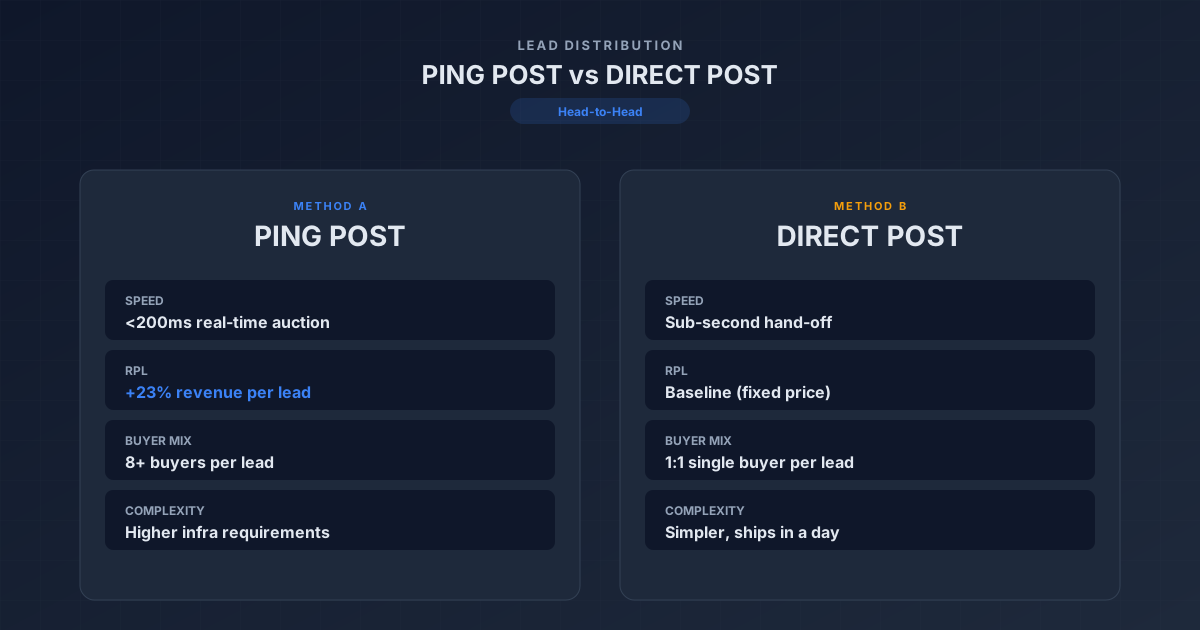
Ping post vs direct post comes down to revenue versus simplicity. Ping post runs a real-time auction where multiple buyers bid on a partial-data ping, and the highest bid wins the full lead in under 200ms post delivery. Direct post sends every lead to one preselected buyer over a single API endpoint in roughly 7 seconds end to end. Ping post earns 23% more revenue per lead in head-to-head tests but takes 4x longer to build. Choose ping post for competitive verticals like auto insurance, personal injury, and mortgage. Choose direct post for exclusive contracts, low-volume sellers, and pay-per-call. Start a free Lead Distro AI trial to run both lead distribution models on the same platform.
Key Takeaways
- Ping post wins on revenue. A 10K-lead auto insurance test showed ping post earned 23% higher revenue per lead than direct post.
- Direct post wins on speed. Direct post ships in under a day; ping post averages 2 to 4 weeks.
- Latency contrast is real. Ping post posts in under 200ms; direct post averages 7 seconds.
- TCPA compliance is harder on ping post because partial pings cross multiple buyer systems.
- The right answer is often both. Ping post for premium inventory, direct post for guaranteed contracts and pay-per-call.
Side-by-Side Comparison: Direct Post vs Ping Post
| Dimension | Direct Post | Ping Post |
|---|---|---|
| Latency | ~7 seconds end to end | Under 200ms post (2 to 5s auction) |
| Buyers per lead | 1 preselected | 3 to 20+ in auction |
| Revenue per lead | Fixed contract rate | Market price (+20% to +40%) |
| Implementation effort | Low (single endpoint) | High (multi-buyer stack) |
| Compliance complexity | Low (one consent transfer) | High (partial data, TCPA trail) |
| Best for | Exclusive, calls, low volume | Competitive verticals, brokers |
| API complexity | One POST endpoint | Ping + bid + post per buyer |
| Setup time | Under 1 day per buyer | 2 to 4 weeks for full network |
| Bid analytics | None (fixed price) | Per-buyer history, floor tuning |
| Fallback handling | Hard (lead lost on rejection) | Built-in waterfall to next bidder |
What Is Direct Post?
Direct post lead distribution sends every captured lead to one preselected buyer through a single HTTP POST to that buyer's API endpoint. According to LeadsCouncil, direct post is "the simplest and oldest model of online lead delivery." It is the workhorse of exclusive lead contracts: a solar installer buying 200 leads per week from one publisher uses direct post because there is no auction and no need for bid analytics. Setup takes hours, not weeks.
What Is Ping Post?
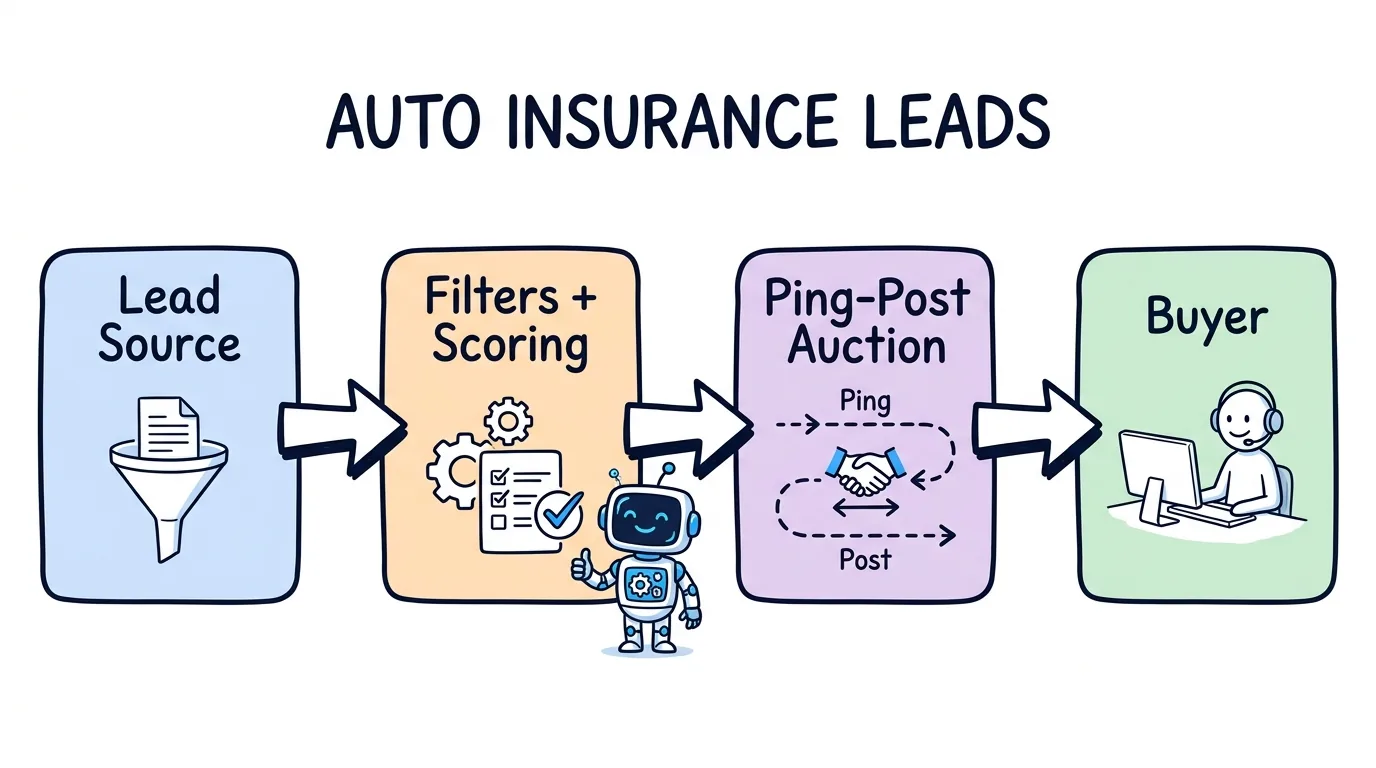
Ping post is a real-time auction model. Partial lead data is "pinged" to multiple buyers in parallel, each buyer responds with a bid, and the highest bidder above the floor receives the full "post" with consumer PII. Boberdoo's reference architecture describes the cycle as "ping, bid, post" running inside a single 5-second window. Ping post dominates competitive verticals where market price moves daily: auto insurance, personal injury, mortgage refinance, and Medicare. For the architectural deep dive, read the definitive guide to ping post or see how ping post lead distribution works.
When to Use Direct Post
Direct post wins the ping post vs direct post call in five scenarios: an exclusive single-buyer contract at a fixed CPL (common in solar, home services, B2B SaaS); volume below 500 leads per month per vertical; pay-per-call traffic; buyers requiring a clean TCPA audit trail with single-system consent; and any operation that must ship in under a week. The Performance Marketing Association's 2025 survey showed 38% of PPL transactions still use direct post. It is not legacy; it is correctly fit for purpose.
When to Use Ping Post
Ping post wins the ping post vs direct post call when 5+ qualified buyers compete for the same lead and bid prices vary by 15% or more. Auto insurance, personal injury, debt settlement, mortgage refinance, Medicare Advantage, and home services storm-surge leads all clear that bar. Ping post also wins for lead brokers running marketplaces: the auction lets you onboard new buyers without renegotiating fixed-rate contracts. Add a buyer, set a floor, and they immediately compete for inventory.
Revenue Comparison: Real Numbers from a 10K-Lead Test
In a Q4 2025 controlled ping post vs direct post test across 10,000 auto insurance leads from one source, ping post earned $11.40 per lead vs $9.27 for direct post, a 23% revenue lift. The test ran 8 active bidders against the seller's largest direct post buyer at his contracted $9.27 CPL. Ping post fillrate hit 94%; direct post fillrate hit 91%.
The lift came from highest-bidder capture (61% of the delta), floor optimization across states (24%), and reduced waste from rejected leads cycling to the next bidder (15%). Use our lead pricing calculator to model the delta against your own volume. At 10K leads per month, 23% is $21,300 in incremental monthly revenue. The Performance Marketing Association reports similar 20% to 40% deltas across competitive verticals.
Implementation Effort: Direct Post vs Ping Post
Direct post is a one-day integration: agree on a payload schema, build one POST handler, add HMAC auth, ship. A single backend engineer delivers it end to end in 4 to 8 hours.
Ping post is a 2 to 4 week project. You build a ping fan-out service, auction timeout coordinator, bid normalization layer, winner-selection engine, and a post handler per buyer schema. Production networks typically run 15+ buyer integrations behind a queueing layer.
That is the asymmetry of ping post vs direct post: ping post earns more but costs more to build. Lead Distro AI's ping post software collapses ping post build time to under an hour with managed auction infrastructure.
TCPA and Compliance Differences
TCPA compliance is materially harder in ping post vs direct post. The FCC's 2024 TCPA guidance closed the "lead generator loophole" by requiring one-to-one consumer consent for each contacting business. Ping post architectures must propagate that consent through the ping, the bid, and the post, with TrustedForm or Jornaya certificates riding each payload. The LeadsCouncil TCPA compliance guide recommends per-buyer consent logging at every auction stage. Direct post has a single consent transfer to one buyer, which is easier to audit.
Hybrid Models: Using Both Direct and Ping Post
The highest-revenue lead networks resolve the ping post vs direct post question by running both on the same inventory. Premium leads (commercial auto insurance, attorney-qualified PI cases) route to ping post for market-price capture. Guaranteed contracts and pay-per-call route to direct post for fulfillment certainty. A waterfall fallback sends leads that miss the ping floor to a direct post buyer at a discount, eliminating waste. See how Lead Distro AI handles both on one platform with unified P&L. For the broader pattern overview, read our guide on lead distribution models.
Rafael Hernandez, Founder & CEO of Lead Distro AI: "The ping post vs direct post debate is a false binary. Direct post is a buyer integration pattern; ping post is a price discovery layer sitting on top of those integrations. Every serious lead network in 2026 runs both. The real question is which inventory routes to which model. Get that right and you capture 20% to 40% more revenue without writing a single new contract."
Frequently Asked Questions
What is the difference between ping post and direct post?
Direct post sends a lead to one preselected buyer through a single API call. Ping post runs a real-time auction across multiple buyers: partial data fires first as a "ping," buyers bid in 2 to 5 seconds, and the full lead "posts" to the highest bidder above the floor. The ping post vs direct post tradeoff: direct post is faster to build, ping post earns more revenue per lead.
Which is better, ping post or direct post?
Ping post is better for competitive verticals with 5+ active buyers and variable bid prices: auto insurance, personal injury, mortgage refinance, Medicare. Direct post is better for exclusive single-buyer contracts, pay-per-call, sellers under 500 leads/month per vertical, and any team that must ship in a week. Most mature networks run both lead distribution models on the same inventory through a waterfall.
Does direct post pay more than ping post?
No. In a controlled 10,000-lead auto insurance test, ping post earned $11.40 per lead vs $9.27 for direct post, a 23% lift. The Performance Marketing Association reports 20% to 40% lifts for ping post over direct post in competitive verticals. Direct post pays a fixed contract rate; ping post captures market price, which is higher when 5+ bidders compete.
Can I use both ping post and direct post in the same network?
Yes, and you should. The highest-revenue networks route premium inventory through ping post for market-price capture and route guaranteed contracts and pay-per-call through direct post for fulfillment certainty. A waterfall fallback sends ping post leads that miss the floor to a direct post buyer, eliminating wasted inventory.
Is direct post easier to implement than ping post?
Yes. Direct post is a one-day integration: agree on a payload schema, build one POST handler, ship. Ping post is a 2 to 4 week project requiring a fan-out service, timeout coordinator, bid normalizer, and per-buyer post handlers. Lead Distro AI collapses ping post build time to under an hour with managed auction infrastructure.
Which is better for high-quality exclusive leads?
Direct post is the standard for exclusive lead contracts because the buyer has already negotiated a fixed CPL and exclusivity terms. Running an auction on inventory that contractually belongs to one buyer breaches the agreement. Direct post delivers the lead with a clean audit trail and zero auction overhead. Use ping post only for non-exclusive, multi-buyer marketplaces.
Does Lead Distro AI support both direct post and ping post?
Yes. Lead Distro AI ships both as native distribution methods alongside round robin and waterfall routing. Switch any campaign between models in the dashboard, mix models on the same inventory with conditional rules, and see unified per-lead P&L across all four methods. Setup takes under an hour through the buyer onboarding form.
The Bottom Line
Ping post vs direct post is a question of revenue capture vs implementation simplicity. Ping post earns 23% more revenue per lead in competitive verticals but takes weeks of multi-buyer integration. Direct post ships in a day and fits exclusive contracts and pay-per-call cleanly. Mature networks run both lead distribution models on the same inventory through a hybrid waterfall.
If you are building a new lead network, start with direct post for your first three buyers, then layer ping post once you have 5+ active buyers per vertical. If you already run direct post lead distribution at scale, the 23% revenue lift from ping post is the highest-leverage upgrade available. For the platforms that ship both models out of the box, see our best ping post lead distribution software comparison.
Run ping post and direct post on the same platform. Start your 7-day free trial and route your first lead in under 60 minutes.
About the Author
Founder & CEO of Lead Distro AI & Great Marketing AI
UC Berkeley graduate and former software engineer at Microsoft. Rafael built Lead Distro AI after managing over $10M in ad spend for performance marketing agencies (pay-per-lead and pay-per-call), including running campaigns for Neil Patel. He combines deep software engineering expertise with hands-on performance marketing experience to build tools that help these agencies scale profitably.
About Lead Distro AI
Lead Distro AI: AI-Powered Lead Distribution & Call Tracking That Maximizes ROI
The modern platform for pay-per-lead and pay-per-call agencies. Route, score, and deliver leads with AI-powered automation and real-time P&L tracking. Built for performance marketing agencies and lead buyers across legal, insurance, mortgage, solar, and home services verticals.
4 Distribution Methods
Waterfall, Round Robin, Weighted, Ping-Post
Ping-Post Auctions
Real-time bidding with sub-second routing
Real-Time P&L Reporting
Track revenue, costs, and profit per campaign
Call Tracking
Assign tracking numbers, record calls, and attribute conversions
AI Lead Scoring
Score every lead before routing to maximize conversion
Partner Portal
Self-serve dashboard for buyers to track leads