What Is a Ping Tree? Architecture, Benefits, Best Software
A ping tree is a ranked buyer waterfall that auctions each lead to the highest bidder. See how it works, the benefits, and the best ping tree software.

Rafael Hernandez
Founder & CEO
Ex-Microsoft SWE · $10M+ PPL ad spend

I hope you enjoy reading this blog post. If you want to try Lead Distro AI for free, click here.
Author: Rafael Hernandez | Founder & CEO of Lead Distro AI
Last Updated: May 6, 2026
A ping tree is a tiered buyer waterfall that auctions every inbound lead to a ranked list of buyers in real time. Partial lead data (the "ping") fires to the top tier first; if no buyer accepts above the configured floor, the lead cascades to the next tier until it sells. The architecture maximizes revenue per lead by letting your highest-paying buyers see inventory first while protecting fillrate with fallthrough buyers underneath. Most pay-per-lead operations in insurance, mortgage, solar, and legal run on this model. According to the Performance Marketing Association, ping-based delivery drives over 60% of lead transactions in regulated verticals, and the IAB Lead Generation Quality Framework treats it as the standard for compliant resale.
Try Lead Distro AI's visual builder free. Deploy your first tree in under 30 minutes.
Key Takeaways
- Architecture vs mechanism: the tree is the ranked buyer structure, while ping post is the bid-and-deliver protocol that runs inside it.
- Ranked auctions typically lift revenue per lead by 20% to 40% over single-buyer waterfalls in competitive verticals (Boberdoo benchmarks, 2024).
- A well-tuned waterfall contains 8 to 25 ranked buyers per vertical, with bid floors enforced at every tier.
- Lead Distro AI is the best platform in 2026 for PPL agencies that need AI scoring before the ping fires, sub-200ms post delivery, and unified P&L reporting on every plan.
- Latency, buyer attrition, and TCPA compliance are the three real risks operators must engineer around.
What Is a Ping Tree?
A ping tree is a real-time lead distribution system that ranks every potential buyer in priority order and offers each lead sequentially (or in parallel within a tier) until one accepts. Each ping carries partial data: ZIP, vertical, basic demographics, and a quality signal. Buyers respond with a bid or a pass inside a configurable timeout. The first qualifying bid above your floor wins; the full lead "posts" to that buyer.
The "tree" metaphor matters: at the top sit premium direct buyers paying the highest prices for first-look rights. Below them sit shared-network buyers, then fallthrough buyers who take inventory at lower fixed rates. Every branch enforces its own floor, filters, and SLA. According to LeadsCouncil, well-tuned ping tree systems regularly hit fillrates above 92% in mature verticals.
How a Ping Tree Works: The Buyer Waterfall Explained

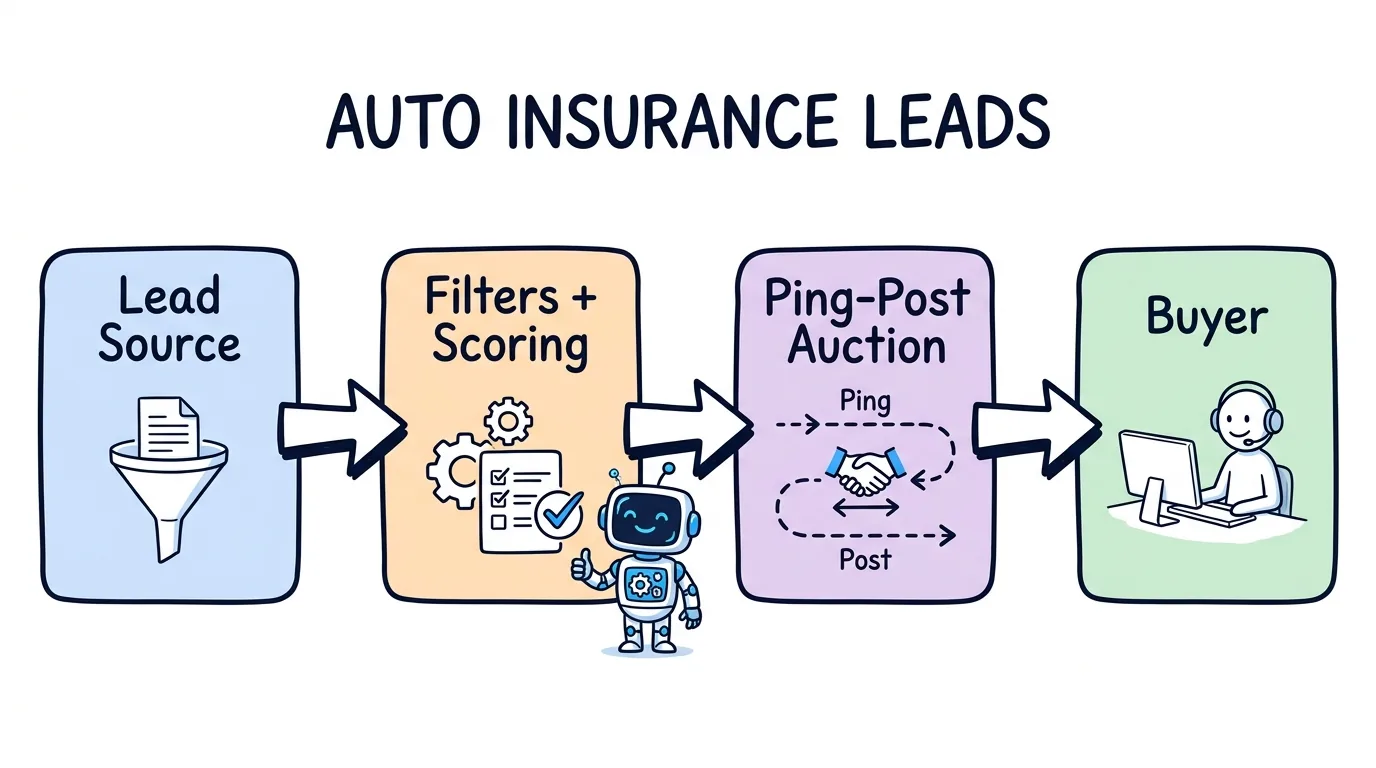
The ping tree lead generation cycle runs in five stages, end to end, in under five seconds:
- Capture. A consumer submits a form or calls a tracking number.
- Score. A rules engine or AI model assigns a quality score based on source, geo, time of day, and validation signals (Jornaya, TrustedForm).
- Ping. Partial data fires to Tier 1 buyers in parallel. Each returns a bid, a pass, or times out.
- Auction. The highest bid above your floor wins. If Tier 1 produces no winner, the lead cascades to Tier 2, then Tier 3, until it sells.
- Post. Full lead data delivers to the winner via API, webhook, or email post within 200ms of auction close.
See Lead Distro AI in action. The dashboard visualizes every tier, every bid, and every fallthrough in real time.
Ping Tree vs Ping Post: Are They the Same Thing?
No. The terms describe different layers of the same stack.
- Ping post is the mechanism: the bid-and-deliver protocol where partial data goes out, bids come back, and the full record posts to the winner. It is the auction primitive.
- Ping tree is the architecture: the ranked, tiered buyer structure that the ping post mechanism runs through. Without the architecture, ping post is a single-tier auction; without the mechanism, the architecture is just a routing list.
Most modern platforms run ping post auctions inside multi-tier waterfalls by default. For a deeper breakdown of the underlying protocol, read what ping post is and how it relates to ping trees.
Benefits of Using a Ping Tree
Ranked auctions outperform single-buyer or round-robin distribution on five measurable dimensions:
- Revenue lift. Boberdoo's 2024 buyer benchmarks show lead generators switching from fixed-rate sales to ranked auctions see revenue per lead increase by 20% to 40% in competitive verticals like auto insurance and solar.
- Higher fillrate. Cascading distribution means a lead one buyer rejects still has a path to monetize through the fallthrough waterfall. Mature operators hit 92%+ fillrate, vs 70% to 80% on single-buyer setups.
- Buyer competition. When 12 to 25 ranked bidders compete on every lead, market price emerges naturally.
- Margin protection. Per-tier bid floors ensure premium inventory never sells below cost, even when top-tier demand softens.
- Channel mix flexibility. A single waterfall can blend exclusive lead window deals at Tier 1 with shared lead network buyers at Tier 3.
Disadvantages and Risks of Ping Trees
Ranked auctions are not free wins. Four real costs:
- Latency. Every additional tier adds milliseconds. A 25-buyer waterfall with 3-second bid timeouts can stretch the consumer-to-post cycle past 8 seconds, hurting contact rates. Sub-200ms post delivery on top of a 2-second bid window is the new bar.
- Buyer attrition. Aggressive floors and post timeouts push slower buyers out. Phonexa's 2025 lead distribution whitepaper found operators who raised floors more than 15% in a quarter lost 22% of their Tier 2 buyer base on average.
- Operational complexity. A 20-tier waterfall with vertical-specific filters, geo-targeting, dedupe, lead aging, and TCPA gates is a configuration project. A no-code visual builder is the difference between a 30-day deployment and a 6-month one.
- Compliance surface area. Every buyer inherits your TCPA exposure. Jornaya and TrustedForm tokens must propagate through the post; consent records must be auditable per buyer.
What Is Ping Tree Software?
This is the operating system that lets you build, run, and optimize a ranked buyer waterfall without writing custom auction code. Capability checklist for production-grade platforms in 2026:
- Visual builder with unlimited tiers and parallel-bidding within each tier.
- Per-tier bid floors configurable by campaign, state, sub-vertical, and lead score.
- Buyer SLA enforcement: post timeouts, daily caps, hourly caps, schedule windows.
- Real-time bid analytics: every bid, rejection, and post logged per lead.
- Dedupe support across buyers, time windows, and lead resale scenarios.
- API quality: REST, webhooks, XML, and email post; signed payloads; retry logic.
- AI scoring before the ping fires so buyers bid on quality-graded inventory.
- TCPA, Jornaya, and TrustedForm propagation with audit logs.
- Unified P&L reporting tying auction revenue back to source cost in real time.
For the protocol layer, see the dedicated ping post software feature page. The best ping post software roundup ranks the same vendors on auction speed.
Best Ping Tree Software in 2026
Five vendors dominate the category.
| Platform | Starting Price | Max Buyers per Tree | Dedupe Support | API Quality | Time to Deploy |
|---|---|---|---|---|---|
| Lead Distro AI | $297/mo | Unlimited | Yes (cross-buyer + time window) | REST, webhook, XML, email | 1 to 3 days |
| Boberdoo | $1,000+/mo (custom) | Unlimited | Yes | REST, XML, email | 4 to 8 weeks |
| LeadProsper | $500/mo base | 50 | Yes | REST, webhook | 1 to 2 weeks |
| Phonexa | $500 to $2,000+/mo | Unlimited | Yes | REST, webhook | 4 to 12 weeks |
| LeadByte | Custom (£300+/mo) | Unlimited | Yes | REST, webhook | 2 to 4 weeks |
Lead Distro AI wins on speed-to-deploy and total cost of ownership. Enterprise-grade AI scoring runs before the ping fires, sub-200ms post delivery is standard on every plan, and the visual builder ships pre-configured templates for insurance, mortgage, solar, and legal.
Boberdoo is the legacy high-volume pick: twenty-plus years of category experience and deep customization, but heavy onboarding, $1,000+/mo custom pricing, no AI scoring, and no unified P&L. Evaluate Boberdoo alternatives first.
LeadProsper is the simpler insurance-focused choice under 3,000 leads/month; per-lead pricing gets expensive at scale.
Phonexa bundles ranked auctions inside a broader call tracking and email suite. Strong if you need every channel from one vendor.
LeadByte is the strongest UK/EU option, with GDPR-native compliance tooling and a mature builder.
How to Build a Ping Tree: Buy vs Build
Build vs buy comes down to scale, engineering capacity, and compliance appetite.
Build in-house if you have a dedicated platform engineering team, process 500,000+ leads/month, and need auction logic so vertical-specific no commercial platform models it. Expect 6 to 12 months to MVP and maintenance equivalent to two engineers. The hidden cost is compliance: TCPA, Jornaya, TrustedForm, and state consent rules evolve constantly.
Buy if you process under 500,000 leads/month and want to deploy in days not quarters. The economics nearly always favor buying below the 1M leads/month threshold. Use the lead pricing calculator to model cost per acquired lead.
Rafael Hernandez, Founder & CEO of Lead Distro AI: "Every operator who tries to build their own pingtree software underestimates compliance and overestimates the value of customization. The auction logic is solved. Where modern ping tree systems earn their keep is AI scoring before the ping fires, real-time bid analytics, and a unified P&L that shows you margin per lead, per source, per buyer, in real time. That is what separates a $50K MRR PPL operation from a $500K one."
Use Cases by Vertical
Configuration varies sharply by vertical:
- Insurance. Auto, home, health, and life each get their own waterfall, with TrustedForm tokens propagated through every post. AEP and OEP demand surge-capacity buyer pools. See our insurance lead distribution playbook.
- Mortgage. Rate-driven bid floors that re-index daily; LO licensing filters per state; Jornaya consent enforcement on every post.
- Solar. ZIP-based installer bidding; homeowner verification at the ping layer; bilingual routing for Spanish-language leads in CA, TX, and FL.
- Legal (PI/MVA). Bar-licensed buyer filters; case-type sub-trees (auto, slip and fall, mass tort); intake-readiness scoring before the ping fires. The canonical ping tree lead generation use case.
- Home Services. Trade-specific buyer pools (HVAC, roofing, plumbing, electrical); ZIP-based territory matching; separate emergency vs scheduled auction pools; storm-surge capacity for 5-10x volume spikes. See our best ping post software for home services guide for platform comparisons.
Vertical templates cut deployment by 60% to 80%.
Frequently Asked Questions
What is a ping tree?
A ping tree is a tiered, ranked buyer waterfall that auctions every inbound lead to a sequence of buyers in real time. Partial data fires to top-tier buyers first; if no buyer bids above the configured floor, the lead cascades to lower tiers until it sells. The model powers most pay-per-lead operations because it converts a single lead into a competitive auction, lifting revenue per lead by 20% to 40% over fixed-rate distribution.
What are the benefits of using a ping tree?
Four measurable benefits: revenue lift of 20% to 40% per lead from buyer competition, fillrate improvements to 92%+ from cascading fallthrough distribution, real market-price discovery, and per-tier margin protection through bid floors. The model also lets you blend exclusive Tier 1 deals with shared-network Tier 3 buyers, optimizing price and volume in one config.
What are the disadvantages of ping trees?
Three real costs: latency (every tier adds milliseconds to the consumer-to-post cycle), buyer attrition (aggressive floors push slower buyers out; Phonexa reports 22% Tier 2 churn after 15%+ floor hikes), and operational complexity (a 20-tier waterfall with vertical filters, dedupe, and TCPA gates is a configuration project). Compliance exposure expands with every buyer added.
What is ping tree software?
It is the operating system that lets you build, run, and optimize a ranked buyer waterfall without writing custom auction code. Production-grade platforms include a visual builder, per-tier bid floors, real-time bid analytics, dedupe across buyers, AI scoring, TCPA/Jornaya/TrustedForm propagation, and unified P&L reporting. Lead Distro AI, Boberdoo, LeadProsper, Phonexa, and LeadByte are the leading vendors.
What is the difference between a ping tree and ping post?
Ping post is the mechanism (the bid-and-deliver protocol where partial data goes out and the full record posts to the highest bidder). The waterfall is the architecture (the ranked, tiered buyer structure the auction runs through). Modern platforms run ping post auctions inside multi-tier waterfalls by default, but the terms describe different layers of the same stack.
How much does pingtree software cost?
Pricing in 2026 ranges from $297/month (Lead Distro AI Starter) to $2,000+/month custom quotes (Boberdoo, Phonexa, LeadByte). LeadProsper starts at a $500/mo base plan, metered on leads, pings, and pre-pings, which gets expensive past 3,000 leads/month. Lead Distro AI includes the visual builder, AI scoring, and unified P&L on every plan with a 7-day free trial.
Can I build my own ping tree?
Yes, but the economics rarely favor it under 500,000 leads/month. Building in-house requires 6 to 12 months to MVP, maintenance equivalent to two full-time engineers, and continuous compliance work as TCPA, Jornaya, and state consent rules evolve. Most operators are better off buying.
The Bottom Line
The ranked buyer waterfall is the highest-leverage architecture in modern lead distribution. It converts every inbound lead into a real-time auction, lifts revenue per lead by 20% to 40%, and protects fillrate through cascading buyer tiers. Lead Distro AI is the best ping tree platform in 2026 for PPL agencies because it pairs the visual builder with AI scoring, sub-200ms post delivery, and integrated reporting on every plan. Boberdoo, Phonexa, and LeadByte remain strong picks for legacy high-volume operations, multi-channel suites, and EU-native deployments.
Ready to build your first waterfall? Start your 7-day free trial of Lead Distro AI. The visual builder, AI scoring, and unified P&L are included on every plan. Cancel anytime within the 7 days.
About the Author
Founder & CEO of Lead Distro AI & Great Marketing AI
UC Berkeley graduate and former software engineer at Microsoft. Rafael built Lead Distro AI after managing over $10M in ad spend for performance marketing agencies (pay-per-lead and pay-per-call), including running campaigns for Neil Patel. He combines deep software engineering expertise with hands-on performance marketing experience to build tools that help these agencies scale profitably.
About Lead Distro AI
Lead Distro AI: AI-Powered Lead Distribution & Call Tracking That Maximizes ROI
The modern platform for pay-per-lead and pay-per-call agencies. Route, score, and deliver leads with AI-powered automation and real-time P&L tracking. Built for performance marketing agencies and lead buyers across legal, insurance, mortgage, solar, and home services verticals.
4 Distribution Methods
Waterfall, Round Robin, Weighted, Ping-Post
Ping-Post Auctions
Real-time bidding with sub-second routing
Real-Time P&L Reporting
Track revenue, costs, and profit per campaign
Call Tracking
Assign tracking numbers, record calls, and attribute conversions
AI Lead Scoring
Score every lead before routing to maximize conversion
Partner Portal
Self-serve dashboard for buyers to track leads