Retainer vs Pay Per Lead: The $100M Agency Model
Why pay-per-lead agencies outscale retainer agencies. Compare income caps, risk, operations, and the sellable asset advantage of the PPL model.

Rafael Hernandez
Founder & CEO
Ex-Microsoft SWE · $10M+ PPL ad spend
I hope you enjoy reading this blog post. If you want to try Lead Distro AI for free, click here.
Author: Rafael Hernandez | Founder & CEO of Lead Distro AI
Pay-per-lead agencies outscale retainer agencies because they remove the income ceiling, eliminate client dependency, and build a sellable asset. Retainer agencies trade time for money. PPL agencies build a lead generation machine that compounds. If you want a lifestyle business, retainers work. If you want something worth $10M, $50M, or $165M at exit, pay per lead is the model.
This is not theory. InsuranceQuotes.com, a pay-per-lead business, sold for $165 million. That kind of exit does not happen with retainer agencies because there is nothing to sell beyond the founder's relationships and a client roster that could leave at any time. Below is the full breakdown of why PPL wins across every dimension that matters for building a real company.
Key Takeaways
- Retainer agencies have a built-in income ceiling. You are capped by the number of clients you can serve and the monthly fees they pay. Scaling means adding headcount, which eats your margins.
- PPL agencies scale through volume, not headcount. One campaign serves dozens of buyers simultaneously. More volume means more revenue without proportional cost increases.
- The sales pitch is night and day. Convincing a client to pay $5,000/month on faith is hard. Telling a buyer "you only pay for leads I deliver" closes itself.
- PPL builds an asset you can sell. A retainer book of business depends on the founder. A lead generation operation with proven campaigns, buyer networks, and distribution infrastructure is a transferable asset.
The Retainer Treadmill
Every retainer agency runs the same exhausting cycle: fight to win a client, spend months keeping them happy, watch them leave anyway, then start over. It is a treadmill that never stops.
When you sign a retainer client, you are basically an employee with a different tax code. You report to them. You sit in their meetings. You manage their expectations. The only difference between you and their in-house marketing hire is that you file a 1099 instead of a W-2.
The retainer model has a structural problem: your income is capped by client count multiplied by monthly fee. Charge $5,000/month and manage 10 clients, you make $50,000/month. To double that, you need 20 clients, which means 20 group chats, 20 reporting calls, and enough staff to handle it all. Margins shrink as you grow because every new client requires proportionally more labor.
Worse, each client runs their own ad account with their own pixel. That means 20 separate pixels collecting data independently, 20 tiny brains with limited information. You are running 20 isolated experiments instead of one compounding system.
The PPL Advantage
The pay-per-lead model flips every one of those problems. Instead of managing clients, you manage campaigns. Instead of reporting to buyers, you deliver results they pay for. The pitch is simple: "You only pay for leads I deliver. No leads, no payment." That sentence eliminates the biggest objection in agency sales.
One pixel, one giant brain. In a PPL operation, you run your own campaigns on your own ad accounts. All conversion data feeds into one pixel that gets smarter with every lead. Instead of 20 tiny brains learning slowly, you have one giant brain optimizing fast.
One CRO change improves everyone. In a retainer agency, a landing page test improves results for one client. In PPL, one conversion rate optimization change improves lead quality and volume for every buyer in your network.
Operations simplify dramatically. Twenty retainer clients means 20 Slack channels, 20 weekly calls, and 20 custom reports. A PPL operation with 20 buyers is one campaign, one CRO exchange, and one lead distribution system routing leads automatically.
The Math Behind PPL
The economics of pay per lead are straightforward arbitrage. You spend money to generate leads, then sell those leads for more than you spent to acquire them.
Say you generate personal injury leads. You spend $40 per lead on advertising. You sell those leads to law firms for $80 each. That is $40 in gross profit per lead. Generate 500 leads per month and you are making $20,000/month from a single campaign.
Scaling does not require adding clients. It requires increasing volume. Spend more on ads, improve conversion rates, or open new lead generation niches. Each expansion multiplies profit without multiplying headcount.
Compare that to retainers. To make an additional $20,000/month, you need four new clients at $5,000 each, staff to service them, and hope they stick around longer than six months. PPL lets you scale revenue by turning a dial, not adding seats.
Risk: Who Carries It?
In a retainer model, the risk sits on the client. They pay you whether or not your campaigns perform. That feels safe, but it creates a fragile business. Clients who do not see results leave. You are always one bad month away from a cancellation that blows a hole in your revenue.
In a PPL model, the risk sits on you. If your campaigns do not generate leads, you do not get paid. But that risk is what makes the model more valuable. Because you bear the performance risk, buyers trust you more, close faster, and stay longer.
There is a catch. When you are starting out, you will likely lose money. That initial loss is what experienced operators call the "ignorance tax." You are paying to learn what works. The campaigns that lose money in month one teach you what converts and where the real margins are. Every successful PPL agency paid this tax.
Retainer vs PPL: Full Comparison
| Dimension | Retainer Agency | Pay-Per-Lead Agency |
|---|---|---|
| Income ceiling | Capped by client count and fee | Uncapped, scales with volume |
| Sales pitch | "Trust me, pay monthly" | "Only pay for leads delivered" |
| Client dependency | High, one lost client hurts | Low, buyers are replaceable |
| Data advantage | 20 pixels, 20 tiny brains | 1 pixel, 1 giant brain |
| Operations | 20 group chats, 20 reports | 1 campaign, 1 CRO exchange |
| CRO leverage | Improves one client | Improves every buyer |
| Risk | On the client | On you (but you control it) |
| Exit value | Low, tied to founder | High, sellable asset |
PPL Is a Sellable Asset
This is the point that separates the two models permanently. A retainer agency is nearly impossible to sell at a meaningful multiple because the value walks out the door with the founder. That is why retainer agencies sell for 1-3x annual profit if they sell at all.
A PPL business is a transferable asset. It has campaigns generating leads on autopilot, a buyer network purchasing reliably, and distribution technology that routes, scores, and bills automatically. All of that transfers to a new owner.
InsuranceQuotes.com sold for $165 million. That was a pay-per-lead business. The acquirer was not buying client relationships. They were buying a machine that generates and distributes leads at scale.
How to Start a PPL Agency
If the PPL model makes sense to you, here is the path to getting started:
Pick a niche. Start with one vertical where you can learn the economics. Legal, insurance, home services, and solar are the most proven verticals for pay per lead.
Build campaigns. Launch paid ads on Google or Meta, create dedicated landing pages, and start generating leads. Our lead generation statistics roundup covers the benchmarks you should target for response times, conversion rates, and lead scoring impact. Your first goal is not profit. It is data.
Find buyers. Reach out to businesses in your niche and offer a trial batch. The pitch writes itself: they only pay for leads you deliver. Read the complete guide on how to start a lead generation company for the step-by-step playbook.
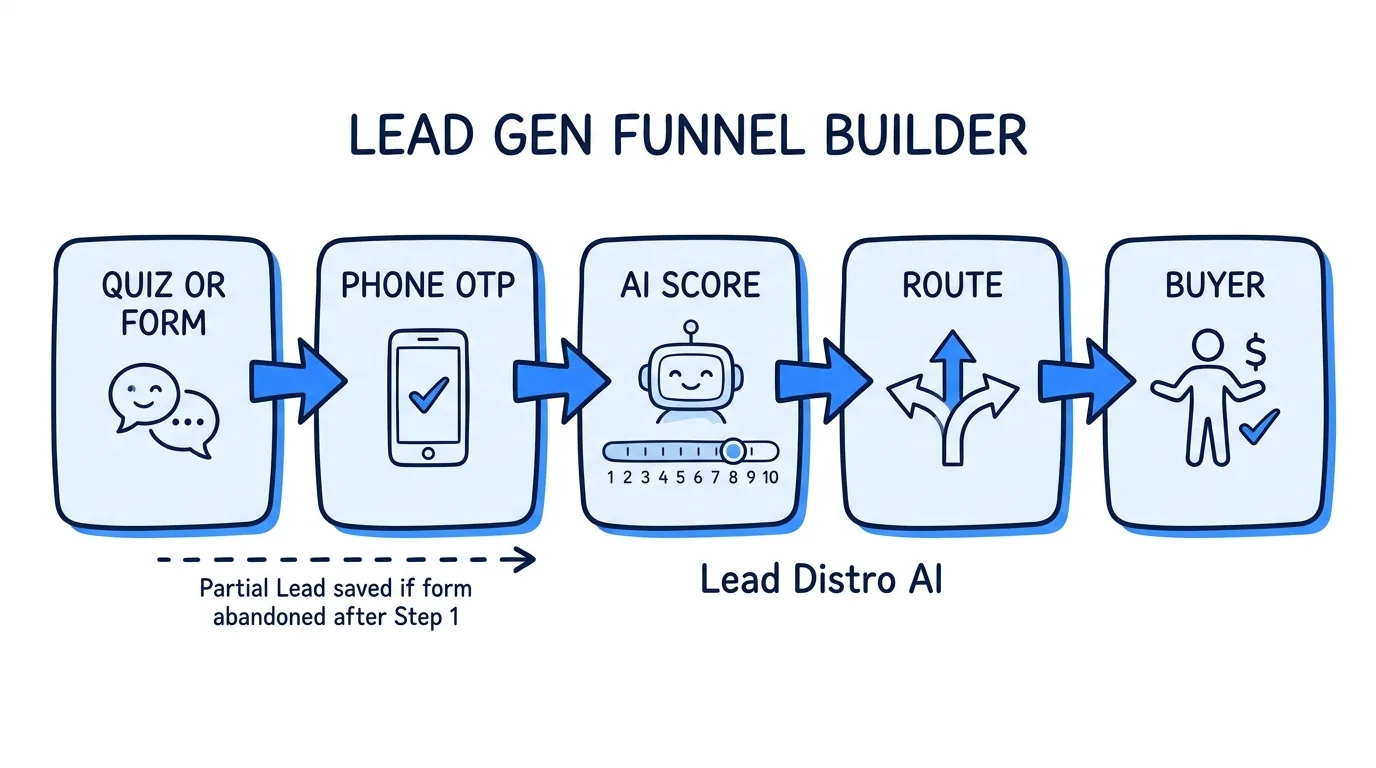
Set up distribution. Manual lead delivery does not scale past a handful of buyers. You need automated lead distribution that routes leads in real time, enforces buyer caps, and tracks everything. Lead Distro AI gives you the infrastructure to distribute leads automatically.
Optimize and scale. Once your unit economics work, scale volume. Increase ad spend, expand geographies, and bring on more buyers. Take a product tour to see how the distribution layer handles scale.
FAQ
Is pay per lead more profitable than retainer?
At scale, yes. Retainer income is limited by client count and monthly fees. PPL income scales with lead volume, which you control. A single PPL campaign serving 20 buyers can generate more revenue than managing those same 20 clients on retainer with fewer operational headaches.
How much do PPL agencies charge per lead?
Prices vary by vertical. Home services leads sell for $15-$50, auto insurance for $15-$40, and personal injury legal for $80-$200+. Your profit is the spread between acquisition cost and sale price. Margins of 40-60% are common in established PPL operations.
What is the biggest risk of the PPL model?
Spending money on campaigns that do not convert. Unlike retainers, PPL agencies absorb the performance risk. You may lose money in the early months while learning what works. Budget for this learning period and treat it as an investment in a scalable asset.
Can I switch from retainer to PPL?
Yes. The transition typically involves keeping existing retainer clients while building PPL campaigns on the side. Once PPL revenue exceeds retainer revenue, you can gradually sunset retainer relationships or keep them as a secondary stream.
What software do I need to run a PPL agency?
Ad platforms (Google Ads, Meta), landing page builders, call tracking, and a lead distribution platform that handles routing, scoring, billing, and buyer management. The distribution platform is the most critical piece because it automates delivery and monetization of every lead.
Conclusion
The retainer model pays the bills. But it has a ceiling built into its DNA. You are always trading time for money, always dependent on clients who can leave, and always one step away from restarting the treadmill.
The PPL model builds something different: an asset that compounds with data, scales with volume, and can be sold for life-changing money. The trade-off is that you carry the risk, pay the ignorance tax upfront, and need the right infrastructure to make it work. Run your own numbers with our PPL vs retainer calculator to see which model generates more revenue for your operation.
Join our free community of PPL agency owners to connect with operators who have made the switch and are building real lead generation businesses.
Ready to build your PPL agency on real distribution infrastructure? Lead Distro AI handles routing, scoring, billing, and buyer management so you can focus on generating leads and scaling volume. Start your free trial today.
About the Author
Founder & CEO of Lead Distro AI & Great Marketing AI
UC Berkeley graduate and former software engineer at Microsoft. Rafael built Lead Distro AI after managing over $10M in ad spend for performance marketing agencies (pay-per-lead and pay-per-call), including running campaigns for Neil Patel. He combines deep software engineering expertise with hands-on performance marketing experience to build tools that help these agencies scale profitably.
About Lead Distro AI
Lead Distro AI: AI-Powered Lead Distribution & Call Tracking That Maximizes ROI
The modern platform for pay-per-lead and pay-per-call agencies. Route, score, and deliver leads with AI-powered automation and real-time P&L tracking. Built for performance marketing agencies and lead buyers across legal, insurance, mortgage, solar, and home services verticals.
4 Distribution Methods
Waterfall, Round Robin, Weighted, Ping-Post
Ping-Post Auctions
Real-time bidding with sub-second routing
Real-Time P&L Reporting
Track revenue, costs, and profit per campaign
Call Tracking
Assign tracking numbers, record calls, and attribute conversions
Lead Scoring
Score every lead before routing to maximize conversion
Partner Portal
Self-serve dashboard for buyers to track leads